A Different Year, A Different Story: What Medicare Beneficiaries Should Review for 2027


The envelope arrives sometime in September. Most people know it on sight now, the way you know a jury summons before you open it. Annual Notice of Change. Same return address as last year. Same plan name on the cover.
A quick scan of the premium line brings a small measure of relief. It barely moved. Maybe it didn't move at all. The deductible looks familiar. The plan's name is the plan's name.
So the letter goes on the counter, then into a drawer, then, eventually, nowhere in particular.
The reasoning behind that isn't foolish. It sounds like this: I didn't change anything, so why would I need to do anything?
It's a fair question. It's also the wrong one.
A Medicare plan can change while a person changes nothing at all. The plan number stays the same. The premium barely moves. And underneath that quiet surface, something that mattered last year — a physician, a prescription, or a hospital relationship — may no longer work the way it did.
Which is why the better question is: will my plan still work for me next year?
The Notice tells part of the story, not all of it
The Annual Notice of Change exists for a reason, and it's worth reading closely rather than skimming. It's the plan's official statement of what's different for the coming year: premium, deductible, copays, coinsurance, the shape of covered benefits. If you're wondering what to look for, that's the honest starting point.
But the ANOC has a boundary, and it's a boundary that catches people off guard. It tells you what changed inside the plan. It does not necessarily tell you what changed around it. A physician's status in a network isn't always spelled out in that document. Neither does it show a shift in which hospital system actively participates in the plan's contracted network, as opposed to simply accepting Medicare in general.
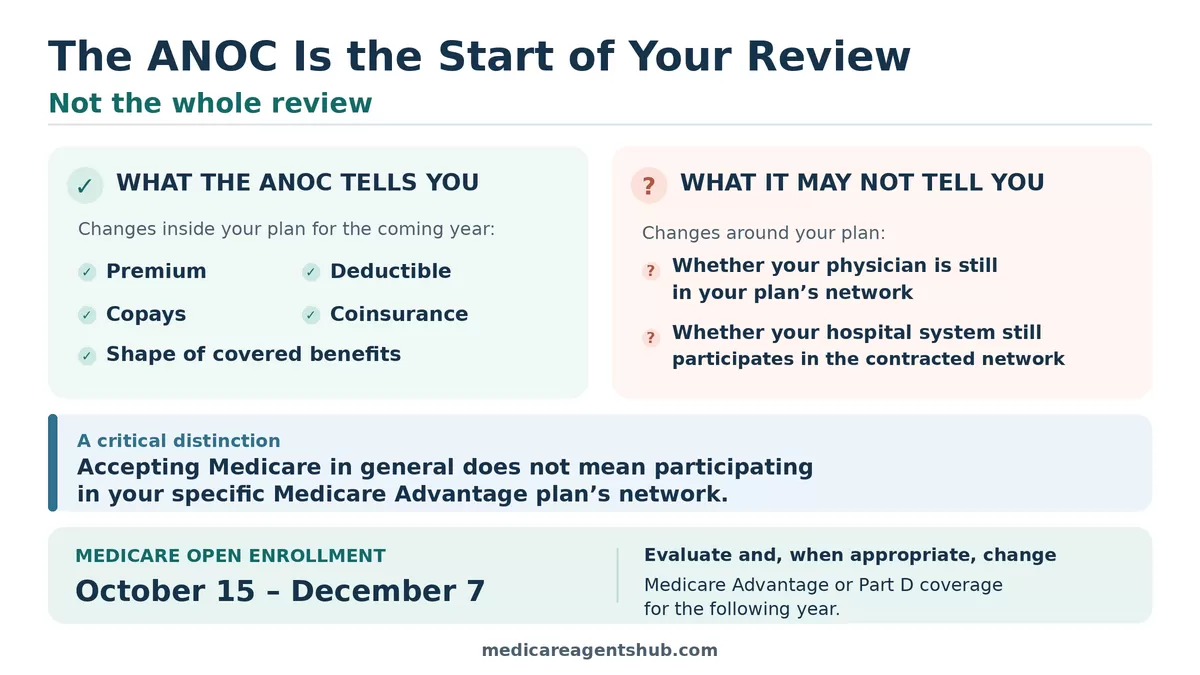
So the ANOC is the start of a review, not the whole review. It sets the table. It doesn't answer every question that matters.
That review matters because Medicare's annual Open Enrollment Period runs from October 15 through December 7, when beneficiaries can evaluate and, when appropriate, change Medicare Advantage or Part D coverage for the following year.
When will my provider send my Annual Notice of Change?
If you are enrolled in a Medicare Advantage or Part D plan, your plan sends you an Annual Notice of Change, commonly called the ANOC, each fall. Current members generally should receive it by September 30.The ANOC tells you what will change in your plan for the following January, including changes to coverage, costs, and benefits.
I would not treat it as routine mail.
Use it as the starting point for your annual Medicare review.
I recommend looking specifically at:
Premiums and deductibles.
Doctor and hospital costs.
Prescription coverage and cost sharing.
Maximum out-of-pocket exposure.
Changes to benefits you actually use.
Then go beyond the ANOC. Provider networks and prescription formularies deserve separate verification because those can be just as important as the benefit changes printed in the notice.
The question is not simply:
“Did my Medicare plan change?”
The more useful question is:
“Will my Medicare plan still work for me next year?”
My rule is simple: Don't assume. Review.
Medicare says the ANOC is sent each fall, in September, and CMS guidance requires most plan sponsors to ensure current members receive it by September 30.
Can a Medicare Advantage plan simply not come back?
Sometimes, yes. A carrier can discontinue a specific plan, adjust its service area, or exit a county altogether. That's not a sign that Medicare Advantage itself is disappearing. It's a normal, if disruptive, feature of a market where private companies design and price these plans year to year, and where CMS reviews and adjusts payment and program rules annually as part of the regular rulemaking cycle.
There's an important distinction buried in that sentence, and people often miss it under pressure: a plan ending is not the same as a plan changing its benefits, and it is not the same as a network adjusting who's in it. Each of those situations can carry different rights and different timelines for the person affected. Someone whose plan is genuinely terminating has a different set of options, and a different clock running, than someone whose plan continues but whose favorite specialist has moved on. Sorting out which situation actually applies is worth doing early, not in the last week of the enrollment period.
Why are seniors losing Medicare Advantage plans?
When people say seniors are "losing Medicare Advantage," several different situations can be getting lumped together.Sometimes an insurance company decides not to renew a particular Medicare Advantage plan or stops offering it in a county or service area. In other situations, the plan continues, but an important hospital, physician group, or doctor leaves the plan's provider network. A member can also lose eligibility for certain specialized plans, move outside a plan's service area, or experience another change that affects eligibility.
Those situations are not the same, and the options available to the beneficiary can be different.
If you receive a plan termination or nonrenewal notice, do not assume that you simply have to accept whatever replaces it. Medicare provides Special Enrollment Period rights in certain plan nonrenewal and contract-termination situations.
I recommend identifying exactly what changed before making a decision:
Is the Medicare Advantage plan itself ending?
Is the plan leaving your county?
Is your hospital leaving the network?
Is your doctor leaving the network?
Are your prescriptions or costs changing while the plan remains available?
That distinction matters. The goal should not be to change plans simply because something changed. The goal is to determine whether your coverage will still work for your doctors, hospitals, prescriptions, budget, and healthcare needs next year.
Two kinds of "in network"
Here's where the story usually gets underneath itself.
A plan can renew. The premium can stay flat. And the hospital where someone has received care for years can still, quietly, no longer participate in that plan's specific network.
That single sentence contains a distinction a lot of people never learn until it costs them something: a hospital participating in Medicare generally is not the same thing as participating in your specific Medicare Advantage plan's provider network. Medicare Advantage plans contract with particular hospitals, medical groups, and physicians, and those relationships can change. A facility that treated you under one plan or network last year should not automatically be assumed to have the same status next year.
For someone in reasonably good health, that distinction might never surface. For someone receiving ongoing treatment, seeing a specialist who knows their history, or relying on a particular surgical team, it can be the difference between continuity of care and starting over with someone new.
Verifying that a physician or hospital system is still active in the network, rather than assuming last year's information is still accurate, is a relatively small step now that can prevent a much larger problem after the new plan year begins.
I have an Aetna Medicare Advantage plan in Illinois. How can I check if my hospital will still be in network next year?
Start with the exact Aetna Medicare Advantage plan you will have next year, not simply the name "Aetna."Medicare Advantage networks can differ by plan, county, and plan year, so a hospital accepting one Aetna Medicare plan does not necessarily mean it participates in every Aetna Medicare Advantage network.
For Aetna, use the Aetna Medicare provider directory and search your exact hospital under the correct plan and ZIP code. Aetna says information for the next plan year is generally available in its provider search after October 1.
I recommend verifying the network in more than one place:
Check the hospital in Aetna's provider directory under your exact Medicare Advantage plan.
Call Aetna Member Services using the number on your member card and ask whether the specific hospital is in network for the upcoming plan year.
Contact the hospital and ask its insurance or contracting department to confirm participation with your exact Aetna Medicare Advantage plan.
Also check the physicians who matter to you. A hospital being in network does not automatically mean every surgeon, anesthesiology group, radiology group, specialist, or physician practicing there has the same network status.
Provider networks can change, so I recommend checking them during your annual Medicare review and confirming again before receiving significant non-emergency care.
The question is not simply, "Does this hospital take Aetna?" The better question is, "Is this hospital and the care team I need participating in my exact Aetna Medicare Advantage network for the plan year I am entering?"
Verification: Aetna says Medicare members can search its provider directory by plan and that next-year network information can be checked after October 1. Aetna and Medicare also caution that provider networks can change and recommend reconfirming participation.
The prescription is the same. The price might not be.
Somewhere in the middle of this story sits the pharmacy, which most people think of as the settled part of the equation. The medication hasn't changed. The dosage hasn't changed. Surely the cost hasn't either.
Except formularies move. A drug's tier placement can shift. Utilization management — things like prior authorization or step therapy — can be added where it wasn't required before. A preferred pharmacy relationship can change the price at the counter even when nothing about the prescription itself is different. So yes, a prescription can cost more next year, even the very same one, filled at the very same pharmacy that filled it last year, for a person who has done nothing wrong and changed nothing about their care.
Medicare Part D also has an important structural protection. Beginning in 2025, changes required by the Inflation Reduction Act created an annual limit on what beneficiaries pay out of pocket for covered Part D drugs. For 2027, that annual out-of-pocket threshold is $2,400. Once a beneficiary reaches the applicable threshold for covered Part D drugs, there is no additional beneficiary cost sharing in the catastrophic phase.
That's real protection, but it doesn't mean every prescription will cost the same or that every drug is covered by every plan. Formularies, tier placement, pharmacy arrangements, prior authorization, and step therapy can still make one plan very different from another. Knowing the ceiling exists is useful. Knowing whether a particular prescription is covered, what rules apply, and what it may cost under the plan turns that information into a practical decision.
The math nobody does until they need to
A monthly premium is the easiest number to compare, which is exactly why it gets too much weight in the decision.
Call it Bad Year Math: the practice of judging a plan not only by what it costs in an ordinary, healthy year, but by what it would cost, and require, during a genuinely difficult one. A Medicare Advantage plan with a low premium and a higher medical maximum out-of-pocket limit can look like the better deal in March and the harder deal in November, if that's the year surgery, a hospitalization, or a new specialist enters the picture. That medical maximum generally applies to covered Part A and Part B services; prescription drug costs operate under the separate Part D structure.
That medical maximum out-of-pocket figure deserves a look even from someone who rarely sees a doctor. Not because illness is likely. Because it isn't predictable. Understanding the ceiling on financial exposure is a different exercise than forecasting whether a person will need it, and it's the one exercise an annual review is actually meant to accomplish.
What is the biggest mistake seniors make when enrolling in Medicare?
The biggest mistake is choosing a Medicare plan based on one attractive feature instead of looking at how the entire plan works.A low or $0 premium, dental benefit, grocery allowance, Part B giveback, or recommendation from a friend may get your attention, but none of those tells you whether the plan fits your healthcare.
Before enrolling, I would look at five things:
Your doctors and hospitals.
Your prescriptions and pharmacies.
Your expected copays, deductibles, and coinsurance.
Your maximum financial exposure in a bad health year.
How the plan works when you travel or need specialized care.
I call that last piece the “Bad Year Math.” A plan should not only look affordable when you are healthy. You should understand what it could cost and how it could work if your health changes.
The best Medicare plan is not necessarily the plan with the most benefits or the lowest premium. It is the plan that fits your providers, prescriptions, budget, and the way you are likely to use healthcare.
That is why my approach is: Plan before pressure.
Medicare itself recommends comparing provider access, costs, coverage rules and benefits when choosing between Original Medicare and Medicare Advantage.
Staying is also a decision
None of this is an argument for switching plans every year. It's the opposite, in a way.
A real annual review can, and often should, end with a conclusion that sounds almost anticlimactic: the plan still works, the network still holds the right people, the formulary still covers what's needed, and the premium and cost-sharing still make sense against a realistic bad-year scenario. Staying put, after actually checking, is not the same as staying put because a drawer was easier to reach than a phone call.
That's really the difference between advising and selling. Selling wants a decision. Advising wants an accurate one, even when the accurate one is no change needed.
So, should a person change Medicare plans every year? No, not automatically, and not as a reflex. Should a person review the plan every year, whether or not last year's plan felt fine? Yes, because "felt fine" and "still fits" aren't always the same claim, and the only way to know which one applies is to look.
What the envelope was really asking
That envelope on the counter, the one with the plan name that looked the same and the premium that barely moved, didn't necessarily contain bad news.
It contained information. Nothing more, and nothing less.
The mistake wouldn't have been opening it. The mistake would have been assuming that because the beneficiary changed nothing, nothing else did either.
A different year does not automatically require a different plan. But it does deserve a fresh look.
The question is whether your plan will still work for you next year. The only honest way to answer that is to ask.
About the Author: Edward Givens is an independent licensed health insurance advisor, Medicare advisor, Registered Social Security Analyst (RSSA), and community educator based in Scottsdale, Arizona, serving Greater Phoenix and clients in multiple states. Through his Protection for Life approach, he helps individuals and families look beyond the insurance card to understand how healthcare coverage intersects with financial exposure, caregiving needs, and major life transitions. He also provides Medicare and healthcare education to community groups and professional referral partners.