Form CMS-L564: What It Is, Where to Get the PDF, and How to Fill It Out

-
June 21, 2026

Reviewed by Joel McClure
Medicare Agent Licensed in NJ, AL, AR & 42 other states
Most people who delay Medicare Part B because they're still working never hear about the CMS-L564 form until Social Security asks for it. By then, the clock on a late enrollment penalty may already be running.
Quick answer: CMS-L564 is the Medicare "Request for Employment Information" form used to prove that you delayed Part B because you had group health coverage based on current employment. It is usually submitted with CMS-40B when enrolling in Part B after age 65. COBRA and retiree coverage generally do not extend the Part B Special Enrollment Period, and missing the window can lead to a lifetime Part B penalty.
Need the form itself? Download the official CMS-L564 PDF from CMS.gov. One page. Print it, then fill out Section A.
What Form CMS-L564 (Request for Employment Information) Is
The CMS-L564, officially titled Request for Employment Information, is a one-page form that gives Social Security written proof that you (or your spouse) had health coverage through a current employer after you turned 65. That proof is what opens a Part B Special Enrollment Period (SEP) and waives the late enrollment penalty that normally kicks in for anyone who signs up after their Initial Enrollment Period ends.
You'll see it called a few different things: the SSA form L564, the Social Security L564, the Medicare employer form, or just "the form my employer has to fill out." Same one-page document. CMS publishes it, Social Security processes it.
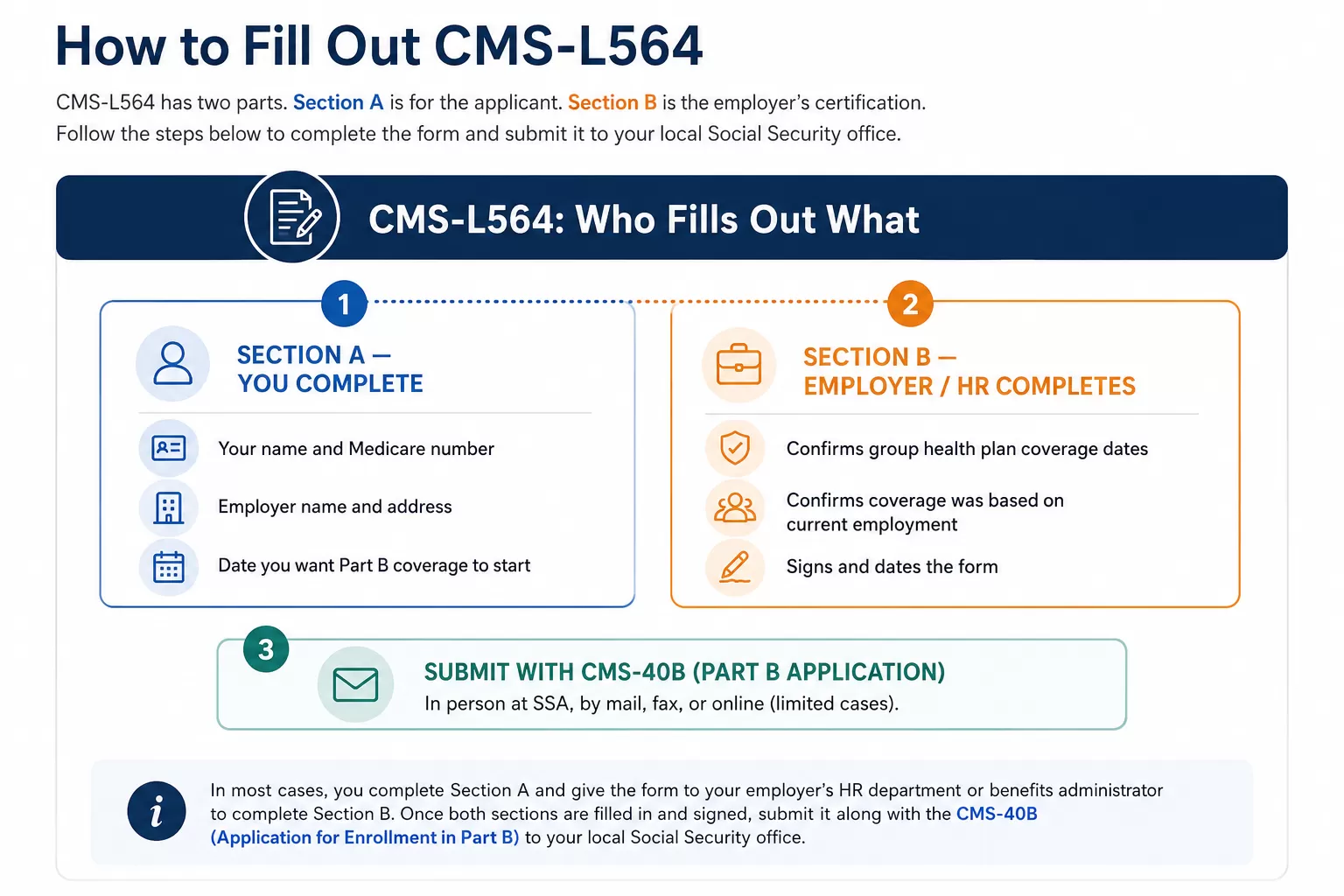
Two sections. You complete Section A: name, Medicare number, employer info. Your employer's HR or benefits administrator completes Section B, confirming the dates you were covered under their group health plan and that the coverage was based on current employment, not retirement or COBRA.
The form proves two things at once: you had coverage, and that coverage came from active employment. Agents say to keep two kinds of proof on file starting now. First, your annual Part D creditable drug coverage notice from the plan administrator. Second, separate proof that your medical coverage comes from active employment: a completed CMS-L564, an employer letter confirming group health plan dates, pay stubs, W-2s, insurance cards with effective dates, or EOBs. A Part D creditable coverage letter does not prove group health plan coverage for a Part B Special Enrollment Period. SSA is explicit about that distinction (SSA POMS HI 00805.295).

What is the CMS-L564 form and when do I need it for Medicare enrollment?
If you decide to work past the age of 65, you will need to fill out the L-564 form and submit it to Social Security when you apply for your Part B. The L-564 form is filled out by your employer and shows that you've had "creditable coverage" by your employer since you turned 65. This is a very important document to submit because it will keep you from having to pay a late penalty.How to Fill Out Form CMS-L564: Section A and Section B
Section A is for the applicant: your name, Medicare number (or Social Security number), and contact information. Section B is the employer's certification, where HR fills in the dates you were covered under the group health plan, the employer's name, and the employer's signature confirming the information.
The order of operations, start to finish:
- Fill out Section A yourself. Name, Medicare number or Social Security number, contact information.
- Hand the form to HR or your benefits administrator. They complete Section B with your coverage dates and sign it.
- Fill out the CMS-40B. That's the actual Part B application. The L564 on its own doesn't enroll you in anything.
- Mail or fax both to your local Social Security office. That's what the form's own instructions say. To find your office, use the locator at SSA.gov/locator or call 1-800-772-1213.
- Keep a copy of everything you send. Including the date you sent it and how.
If the employer can no longer fill out Section B (because the company closed, HR can't be reached, or records are unavailable), you can complete Section B as best as possible without signing the employer line and submit it with supporting proof: W-2s showing employer-paid premiums, insurance cards, pay stubs, or Explanations of Benefits. Medicare's enrollment guidance outlines the alternative documentation SSA will accept.

Am I eligible for a Special Enrollment Period if I lose employer coverage?
Yes- you have special enrollment and the most important part is to get your A and B.It's important to note that if you are over 65 you will need a form from your employer that confirms you had coverage from age 65.
An experienced agent can guide you through the process!!!
When You Need It (and When You Don't)
You need the L564 if all three of these are true:
- You're 65 or older and eligible for Medicare
- You delayed Part B enrollment because you were covered under a current employer's group health plan (yours or your spouse's)
- You're now ready to enroll in Part B, usually because the job is ending, the coverage is ending, or you're switching off the group plan
You do not need it if you're enrolling during your Initial Enrollment Period at 65, if you never had employer coverage past 65, or if your only coverage was COBRA or retiree health benefits. Neither COBRA nor retiree coverage counts as "current employment" coverage for SEP purposes, a detail that catches a surprising number of people.
The form also has rules around employer size. If the employer has fewer than 20 employees, Medicare typically becomes primary at 65, and delaying Part B may not have been the right move in the first place. The L564 alone won't fix that situation. How the handoff from employer coverage to Medicare actually works covers the 20-employee rule in depth.

I'm turning 65 in three months but still working with employer coverage. Do I need to sign up for Medicare right now or can I wait?
You can wait as long as you are maintaining employer coverage. Medicare part A will still get assigned to you but (as long as you are not receiving SS benefits) not part B. When you do choose to leave employer coverage make sure you visit SSA.gov and “apply for Medicare part B only”. Keep in mind this may take at least a few weeks and you may have to collect some signatures from your employers HR dept so start this process at least a month before you plan on quitting/ leaving employer coverage.The Part B Special Enrollment Period: Why This Form Matters
The SEP gives you up to 8 months after employer coverage ends (or after employment ends, whichever comes first) to enroll in Part B without a late penalty. The L564 is how Social Security verifies you qualify.
Miss that 8-month window and you lose the SEP entirely, get pushed into the General Enrollment Period (January 1 through March 31), and pick up a penalty that never goes away.
| Penalty Type | How It's Calculated | Duration | Impact Example (2-Year Delay) |
|---|---|---|---|
| Part B | +10% added to your monthly premium for every full 12 months you were eligible but didn't enroll, without creditable coverage | Permanent (lifetime) | Base premium jumps from $202.90 to about $243.50/mo |
In 2026, the standard Part B premium is $202.90. A two-year delay adds a 20% penalty, raising the monthly cost to about $243.50 for as long as you have Part B. Three years would mean 30%, pushing it past $264. That penalty shows up on every premium statement for the rest of your life. Real stories from seniors who ended up with lifelong penalties show that most of them came down to one form, one phone call, or one missed deadline.

Am I eligible for a Special Enrollment Period if I lose employer coverage?
Yes you are eligible for a Special Enrollment Period if you lose your employer coverage. The Special Enrollment Period for Parts A and/or B are for 8 months and starts the month after Employment stops or coverage stops, whichever comes first. You have 63 days from that time to enroll in either Part D or a Medicare Advantage plan with prescription drug coverage in order to avoid penalties.**Please note that COBRA does not count as creditable coverage, as it is not considered employer coverage. That said, there is not an SEP if you have COBRA and it ends.
Where to Get the CMS-L564 Form (PDF Download)
Three places to get the L564:
- Online: Download the CMS-L564 PDF straight from CMS.gov. Print it and write in Section A by hand. The official file isn't a fillable PDF, so don't waste time trying to type into it.
- Social Security: Pick one up at your local SSA office, or call SSA at 1-800-772-1213 (TTY 1-800-325-0778) and ask them to mail you one. Local offices are listed at SSA.gov/locator. If you'd rather have a person walk you through the whole thing than download a PDF, this is the number.
- Your HR department: Many benefits administrators keep copies on hand because the request comes up regularly for employees over 65
CMS-L564 vs. CMS-40B: Which Form Does What
These two get mixed up constantly. They do different jobs, and Social Security wants both in the same envelope.
| Form | What It Does | Who Fills It Out |
|---|---|---|
| CMS-L564 Request for Employment Information |
Proves you had group health coverage through current employment after 65, which is what qualifies you for the Special Enrollment Period | You (Section A) and your employer (Section B) |
| CMS-40B Application for Enrollment in Medicare Part B |
The actual Part B application. This is the form that signs you up. | You |
Send the L564 by itself and nothing happens. You've proven you qualify for something you never applied for. Send the 40B by itself and Social Security has no evidence you earned the penalty waiver. They travel together.

Am I eligible for a Special Enrollment Period if I lose employer coverage?
In most cases, losing your employer health coverage would qualify you for a Special Enrollment Period with Medicare. Example of when you would qualify: If you've been covered by an active employer group health plan (either yours or your spouse's) since turning 65, and it ended within the last 8 months, you can enroll in Part B without any penalty. You will need to have a few documents which include Employer verification of coverage and your application for part-B.Getting the Employer Form Back From HR
The biggest holdup with the L564 is getting Section B back from an HR department. Some employers handle it the same day. Others sit on it for weeks, especially if the company is small, if the benefits administrator is offsite, or if the former employee left on bad terms.
A few things that help:
- Ask early. Don't wait until your coverage ends. Start the conversation 60 to 90 days before you plan to enroll in Part B.
- Send the form pre-filled. Complete Section A yourself and email or hand-deliver the form so HR only has to fill in their part.
- If the employer refuses or can't be reached, Social Security will sometimes accept alternate proof: pay stubs showing health insurance deductions, a letter from the insurance carrier, or other documentation. Talk to SSA before assuming you're stuck.

What happens if I am unable to provide creditable coverage?
If you cannot show proof of creditable coverage for a period when you were eligible for Medicare but did not enroll, you face permanent premium penalties that never go away. The Part B penalty adds 10 percent to your premium for every 12 months you went without coverage, and the Part D penalty is calculated on how long you went without creditable drug coverage and gets tacked onto your monthly premium for life. Not all insurance qualifies, so never assume your retiree coverage or other plan meets the standard without verifying it first. If you have a gap or are unsure where you stand, talk to a Medicare agent or your local SHIP counselor before your enrollment deadlines, because fixing this before you enroll is always easier than dealing with penalties after the fact.What If the Employer Is Out of Business?
Companies close. Records get destroyed. People retire from places that no longer exist. Agents handle this scenario more often than you'd expect, and the playbook looks like this:
- Reach out to the plan administrator, not the employer. If the group plan was through a major carrier, that carrier still has enrollment records even when the employer is gone. Call the carrier's group benefits line and ask for a Certificate of Creditable Coverage covering the dates you were insured.
- Pull your old W-2s. If the employer offered group health, your W-2s from those years will show the employer-paid premium in Box 12, code DD. That's not a Notice of Creditable Coverage, but Social Security has accepted it as supporting evidence in cases where the L564 is impossible to obtain.
- Get a SHIP counselor involved. Every state has a free State Health Insurance Assistance Program that can submit an equitable relief request on your behalf. These requests are reviewed case by case, and a clean paper trail showing you tried in good faith is what usually wins them.
- Document everything in writing. Email beats phone calls here. If you have to argue an appeal later, you'll want timestamps and the names of every person you spoke to.
SSA accepts alternative evidence when the L564 can't be completed. Pay stubs, W-2s, insurance cards, and EOBs can all serve as supporting proof of group health plan coverage. The full list of acceptable documentation is outlined in SSA POMS HI 00805.295.
If You're Delaying Part A Too, Read This First
The L564 covers Part B enrollment. Part A is a different conversation. Most people qualify for premium-free Part A at 65 and just take it, even while still on employer coverage. There's usually no cost and no downside.
The exception: Health Savings Accounts. The moment you enroll in any part of Medicare, including premium-free Part A, you lose eligibility to contribute to an HSA. Worse, Part A can be backdated up to 6 months when you enroll later, which can retroactively disqualify HSA contributions you already made. The HSA six-month retroactive rule walks through the trap in detail.
If you're still contributing to an HSA past 65, talk to a tax advisor and a Medicare agent before signing up for Part A. Once it's done, it can't be undone without giving up Social Security entirely. What an HSA can and can't pay for once you're on Medicare covers the spending rules after enrollment.

Can I use a health savings account (HSA) to pay Medicare premiums after I retire?
It’s important to note that once you’re enrolled in in Medicare, you CANNOT make any new contributions to your HSA or you may incur IRS penalties. If you’re enrolling past age 65, your enrollment could be retroactive up to 6 months so one needs to plan carefully. You also CANNOT use HSA funds to pay a Medigap Premium (like plan G or plan F).You can use the EXISTING money to pay for Medicare premiums (A, B and D), deductibles, copays, and coinsurances and other qualified medical expenses like dental, vision or hearing. It requires some careful navigation but EXISTING HSA funds can be a big help in managing the cost of healthcare in retirement.
Common Mistakes That Cost People the Penalty Waiver
Counting COBRA as creditable employer coverage. It isn't, at least not for Part B SEP purposes. The day your active employment coverage ends, your SEP clock starts, even if COBRA picks up the same medical coverage.
Waiting past the 8-month SEP window. The window is shorter than people think. Once it closes, the next chance to enroll is the General Enrollment Period (January 1 through March 31), with coverage starting the month after you enroll and a permanent penalty attached.
Assuming a small employer counts. If the employer has fewer than 20 employees, the SEP rules don't protect you the same way. Medicare expects to be primary, and skipping Part B in that situation can mean both a coverage gap and a penalty. Understanding what actually qualifies as creditable coverage is worth reading before you make the decision to delay.
Filing without Section B completed. Social Security can't process a half-finished L564. If you can't get HR to fill it out, call SSA at 1-800-772-1213 before submitting, and loop in your state SHIP office if the employer is gone entirely. There are alternate paths, but you need to set them up in advance.

Am I eligible for a Special Enrollment Period if I lose employer coverage?
Yes, involuntary loss of employer sponsored coverage usually triggers a Special Enrollment period available for 2 months after the month of loss to join a Medicare advantage plan or a part D plan. In addition to that, if you delayed part B enrollment you have an 8 months widow to enroll into part B or parts A and B, if needed, without a penalty. Keep in mind COBRA doesn’t automatically extend the SEP, and part D penalty will still apply after the 63 day gap in creditable coverage. Always consult an insurance expert if you are unsure about your options.When to Loop In a Local Medicare Agent
The L564 itself is simple. The mistakes that surround it (small employer rules, HSA timing, COBRA confusion, SEP deadlines) are where things get expensive. A licensed Medicare agent in your area can walk through your specific employer situation, confirm you actually qualify for the SEP, and help with the paperwork at no cost to you.
The form is one page. The penalty for getting it wrong lasts forever. Worth the 20 minutes to get it right.
Don't guess on your creditable coverage status. If you're approaching 65 or helping a parent who is, find a licensed Medicare agent in your area who can review your employer plan details and flag any gaps before they become a permanent line item on your premium.