A Medicare Change You'll Want to Know About for 2026

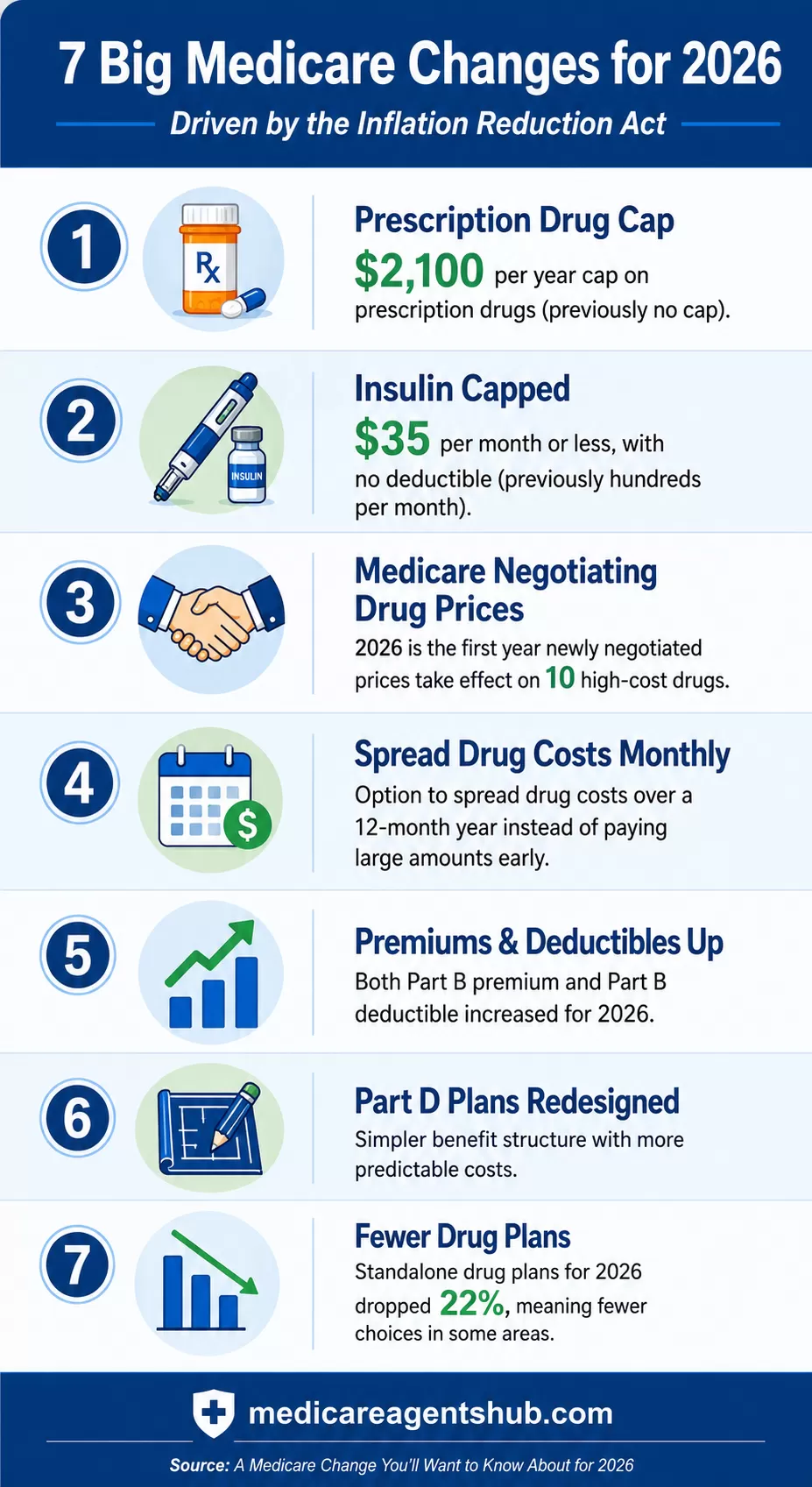
Medicare has gone through a significant number of changes over the last couple of years, driven by the Inflation Reduction Act. Some of the biggest changes include:
- 1) A cap on prescription drugs of $2,100 per year. Previously there was no cap, so you could spend thousands on your drug costs.
- 2) Insulin capped at $35 per month or less with no deductible. This is a massive savings to diabetics who would previously pay hundreds per month.
- 3) Medicare is negotiating drug prices. Previously Medicare could not negotiate drug prices, and 2026 is the first year that the newly negotiated prices take effect on 10 high-cost drugs.
- 4) Options to spread drug costs monthly. You can now spread your drug costs out over the course of a 12-month year, instead of paying large amounts early.
- 5) Premiums and deductibles increased. Both the Part B premium and the Part B deductible have increased for 2026.
- 6) Part D drug plans redesigned. A much simpler benefit structure makes it easier to understand with more predictable costs.
- 7) Fewer drug plans available. Standalone drug plans for 2026 dropped 22%. This means there are going to be fewer choices in some areas.
The 2026 Part D Change Almost Nobody Is Talking About
One of the most significant changes to Medicare is one that is almost never mentioned at all, and it's going to affect those people who may be deferring their Part B because they're covered by a work plan.
It used to be a no-brainer for us when meeting with clients that wanted to keep working beyond the age of 65. We would always tell them "Do Not Take Part B until you're ready to come off that work plan."
The reason for this is that when you initially take Part B of Medicare, you're in the most powerful position you'll ever be in as it pertains to Medicare. When you take Part B initially, the supplemental plans are not allowed to ask you health questions for 6 months as of the start date. The advantage plans are never allowed to ask, however the supplemental plans may. This obviously becomes a major issue if you have a serious health issue.
Why Taking Part B Too Early Can Backfire
Let's say you take Part B of Medicare at 65 because you were told that's what you need to do, but you keep on working. So you work until the age of 68. The free 6-month pass you got when you first took Part B at 65 will have expired by that point.
So this means that when you come off the work plan, you will now need to answer health questions as you won't be protected. Any health issues you have can create a problem and limit your options.
This is why we always told people "You never want to have both Part B and a work plan at the same time." It was the biggest mistake people would make with respect to their Medicare.
The New 2026 Creditable Coverage Rule
Now in 2026, the government has decided to change that rule. As of January of this year, if you're choosing to defer your Part B of Medicare, you now must prove to the government that the work plan you're covered by has a drug plan component that is considered to be "creditable" in the eyes of Medicare.
If that plan is not creditable, you will accrue a drug penalty for each month that you could've been covered by a creditable drug plan but weren't, since the time you first became eligible for a Medicare drug plan.
Once that drug penalty is assessed by the government, you will pay it every single month, for as long as you have Medicare. It doesn't go away.
What Counts as Creditable?
Your employer is supposed to provide you with documentation as to whether or not your drug plan is considered to be creditable. COBRA, for example, is not considered creditable by Medicare. So this means if you are eligible for Medicare and have COBRA, you are going to be assessed a penalty when you eventually come off COBRA and take Medicare.
This is definitely not something you're going to want to assume. I usually advise checking with the carrier, because they'll know for sure whether or not Medicare considers them creditable. The consequences of not knowing, or guessing incorrectly, could be very expensive if you guess wrong.
Don't Wait to Find Out
If you're currently working past 65 and deferring Part B, take the time now to confirm whether your employer's drug coverage is creditable. Ask your HR department or contact the carrier directly. This isn't something to leave to chance.
If you need assistance, reach out to a licensed agent or broker. We would be happy to help.
About the Author: JBA Insurance Brokers are based in Marlton, NJ where it's principal owner, John Billetdoux was born & raised. John has been helping people with Medicare since 2013 and has many clients from a variety of states.