Your Medicare Plan Worked This Year. Should You Still Review It for Next Year?


Every year as we get closer to Medicare's Annual Enrollment Period, I start having the same conversations with clients.
"My plan worked fine this year. Do I really need to look at it again?"
My answer is yes, but probably not for the reason you think.
Reviewing your Medicare coverage does not mean you need to change plans. In fact, I have plenty of annual reviews that end with me telling someone that their current coverage still makes sense and they should leave it alone.
That's a successful review.
The reason to look at your coverage each year is pretty simple. Medicare plans can change, and your needs can change. What worked well for you this year may still be the right choice next year, but it is worth taking the time to make sure.
Start With the Mail You Probably Don't Want to Read
If you have a Medicare Advantage or Medicare Part D prescription drug plan, your plan will send you an Annual Notice of Change, usually called an ANOC, in September (Medicare.gov).
I know. It's another insurance document arriving in the mail, and reading insurance documents isn't exactly how most people want to spend an afternoon.
But this one matters.
Your ANOC explains what is changing with your plan for the coming year. That can include premiums, deductibles, copays, prescription coverage, provider networks and other benefits.
You don't need to become an expert on every page. What you need to understand is whether any of those changes actually affect you.
A $10 change somewhere in the plan may mean absolutely nothing based on how you use your coverage. A change to the cost of a medication you take every day could be much more important.
That's why I don't believe Medicare reviews should be about finding the plan with the longest list of benefits. They should be about figuring out what matters to you.
Your Prescription Drug Coverage Is a Big Part of the Review
One area I pay particular attention to during an annual review is prescription drug coverage.
People sometimes assume that because their medications were covered well this year, they will work exactly the same way next year. That's not always the case.
Formularies can change. Drug tiers can change. Pharmacy arrangements can change. And, of course, the medications you're taking can change too.
This is also why comparing Medicare plans based solely on the monthly premium can be a mistake.
A plan with a lower premium isn't necessarily less expensive for you if your prescriptions cost considerably more. The opposite can also be true.
I would much rather look at the whole picture. What medications are you taking? What pharmacy do you use? What are your expected costs? Are there restrictions that matter for your prescriptions?
The lowest number in one column doesn't necessarily mean the lowest overall cost.
How do I compare Part D plans to minimize costs for a mix of generic and specialty drugs?
This can be done on the Medicare website but I absolutely recommend speaking with an agent who does this everyday. Getting your Part D plan correct could save so much money and a mistake could be really costly.Don't Assume Your Doctors Are Still in Network
If you're enrolled in a Medicare Advantage plan, your doctors and healthcare providers should be part of the review too.
If there are physicians, specialists, hospitals or healthcare systems that are important to you, make sure your coverage continues to work with them for the coming year.
This becomes even more important when your own healthcare situation changes.
Maybe you started seeing a new specialist this year. Maybe you moved. Maybe you spend several months each year in another state. Maybe a particular hospital or healthcare system has become more important to you.
Those are things I want to know when helping someone review their coverage.
A plan doesn't exist in a vacuum. It has to work with the way you actually receive healthcare.
Be Careful Chasing Extra Benefits During Your Review
This is one I see all the time.
During AEP, Medicare beneficiaries are flooded with advertising about additional benefits. Dental. Vision. Hearing. Over-the-counter allowances. Fitness benefits. Transportation. The list goes on.
Some of those benefits can be very valuable.
But they shouldn't distract you from the reason you have health insurance in the first place.
I've seen people get very focused on one attractive extra benefit while overlooking things that could have a much bigger impact on them, such as prescription costs, provider access or out-of-pocket expenses.
That doesn't mean ignore the extra benefits. If you're going to use them, they absolutely belong in the comparison.
Just keep them in perspective.
I would never recommend choosing Medicare coverage based on one flashy benefit without first looking at the parts of the coverage you're likely to depend on most.
Is Original Medicare or Medicare Advantage better? Why do you recommend one over the other?
Every person is different and depending on your individual needs one cannot necessarily be said to be better than the other. I have found Original Medicare with a Supplement and Part D plan makes people very confident with no network, referrals and usually no or low copays. On the other hand Medicare Advantage tends to be cheaper up front, has more added benefits outside of what Medicare covers and is usually more similar to what folks had when working. That said it is always worth having your situation evaluated by an Insurance Broker before making a decision.Remember That You May Have Changed Too
We spend a lot of time talking about what insurance companies change from one year to the next, but that's only half of the equation.
Your life can change too.
Maybe you take different medications than you did last year. Maybe you're seeing different doctors. Your health needs may have changed. You might be traveling more or spending part of the year somewhere else. Your budget or priorities may be different.
All of those things can change what you need from your Medicare coverage.
This is also why I'm skeptical whenever someone asks me, "What's the best Medicare plan?"
There isn't one answer to that question.
I can have two people living on the same street who need completely different things from their Medicare coverage.
The better question is which option fits your particular situation.
Sometimes the Best Advice Is to Do Nothing
This is probably the most important point I can make.
You do not get bonus points for changing Medicare plans.
If I sit down with someone, review their coverage, check their doctors and prescriptions, look at what's changing for next year and determine that their current plan still fits, I'm perfectly happy telling them to stay exactly where they are.
My job isn't to find a reason for someone to change plans. It's to help them understand whether they have a reason to change.
There is a big difference.
At the same time, I don't recommend simply assuming everything is fine because you haven't had a problem yet.
Take a little time each year and verify it.
What's one piece of advice you wish every senior knew before picking a Medicare plan?
Talk to an Insurance Broker to find out all of your options. Don't go directly to one company. Your needs are going to vary from others and you need a plan that fits those needs.What I Look At in an Annual Medicare Plan Review Before AEP
Medicare's Annual Enrollment Period runs from October 15 through December 7 each year (Medicare.gov). If you're planning to review your coverage, you can make the process much easier by gathering a few things ahead of time.
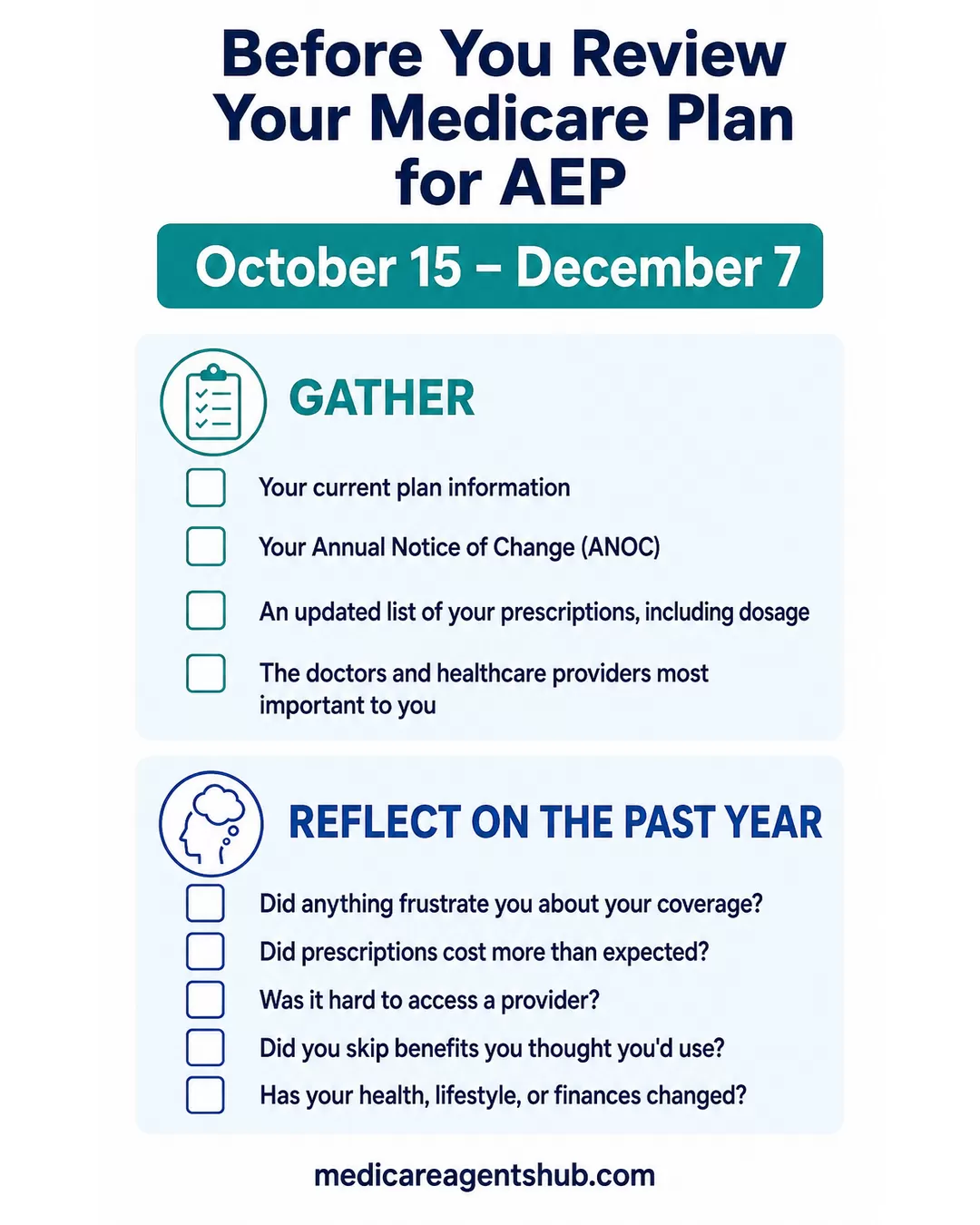
- Have your current plan information available.
- Keep your Annual Notice of Change.
- Make an updated list of your prescriptions, including dosage if possible.
- Know which doctors and healthcare providers are important to you.
Then think about the past year.
Did anything frustrate you about your coverage? Were there prescriptions that cost more than you expected? Did you have trouble accessing a provider? Were there benefits you thought you'd use but didn't? Has anything changed about your health, lifestyle or finances?
Those are much more useful starting points than simply asking which plan has the most benefits.
Make a Decision Instead of Letting the Calendar Make It for You
After nearly 20 years of helping people with Medicare, I've learned that most people aren't looking to become Medicare experts. They just want to know they're making a good decision.
That's completely reasonable.
An annual review doesn't need to turn into a month-long research project. It means taking the time to look at what's changing, consider what's changed in your own life, and determine whether your current coverage still does what you need it to do.
Maybe you'll discover another option that fits you better.
Maybe you'll discover that the plan you already have is still the right one.
Either result is fine.
What I wouldn't recommend is letting December 7 come and go simply because last year's decision was easier than making an informed decision this year.
Take the time to review it. Then, if staying exactly where you are still makes sense, you can do that with confidence.
About the Author: Gregory Gudis, CFP® is co-founder of BGA Insurance Group and has nearly 20 years of experience helping individuals with Medicare, insurance and retirement-related decisions. He works with Medicare beneficiaries across multiple states and focuses on helping clients understand their options and make informed decisions based on their individual needs.