Can You Cancel Medicare? How to Drop Part A, Part B, Part D, Medicare Advantage or Medigap

-
October 7, 2026

Reviewed by Michael Davis
Medicare Agent Licensed in MN, AL, AR & 42 other states
Quick answer: Yes, you can cancel most of Medicare, but every part has its own exit. Part B: sign Form CMS-1763 and mail or fax it to your local Social Security office. Part A: generally only if you pay a premium for it. Premium-free Part A can't simply be cancelled. Part D and Medicare Advantage: only during an enrollment period, through the plan or 1-800-MEDICARE. Medigap: call the insurance company, any day of the year. Getting back in is the hard part (penalties, waiting periods and health questions), so talk to a licensed Medicare agent before you cancel anything.
Every article about Medicare is about getting in. What about getting out?
Most Medicare content on the internet assumes you want coverage. And most people do. But agents on Medicare Agents Hub field a steady stream of questions from people trying to go the other direction: someone going back to an employer plan, someone moving abroad, someone who enrolled in Part A and now can't contribute to their HSA, or someone who just wants to stop paying a premium they feel they don't need.
The answers reveal something that surprises most people: Medicare isn't one door. It's four. And each one locks differently behind you.
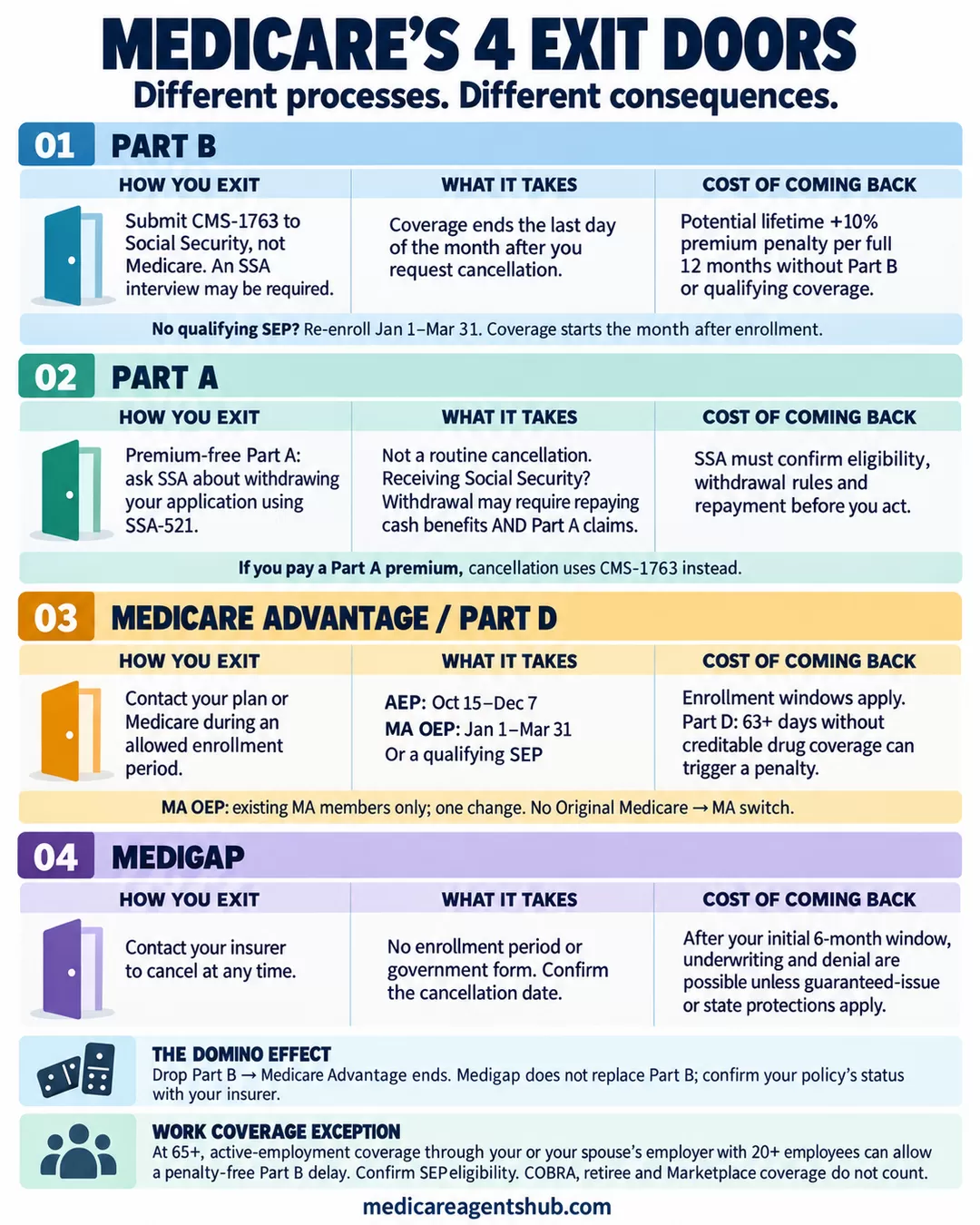
The four exit doors:
- Part B (the one most people mean when they say "cancel Medicare")
- Part A (the one agents can't agree on)
- Medicare Advantage and Part D (the ones that require an enrollment period)
- Medigap (the easiest to leave, the hardest to come back to)
Can you cancel Medicare? The answer for each part
Here's the short version, part by part. Agents get this question more ways than you'd think (how do I cancel my Medicare coverage is one of the most-viewed), and the honest answer always starts with "which part?"
| Coverage | Can you cancel it? | How | When it ends | Getting it back |
|---|---|---|---|---|
| Part B | Yes, any time | Signed Form CMS-1763, mailed or faxed to your local Social Security office | Last day of the month after you file | Wait for January 1 to March 31 (unless you qualify for a Special Enrollment Period), plus a 10% penalty for each 12 months without it |
| Part A (premium-free) | Generally no | The only route agents describe is asking Social Security to withdraw your Medicare application (Form SSA-521) | Only if Social Security approves it | Usually easy to get back, but a withdrawal can mean paying back what Medicare already paid |
| Part A (you pay a premium) | Yes | Same Form CMS-1763 as Part B | Last day of the month after you file | 10% penalty, charged for twice as many years as you went without |
| Part D drug plan | Only during an enrollment period | Call 1-800-MEDICARE, or send the plan a signed written request | January 1, if you drop it October 15 to December 7 | Wait for an enrollment period, plus 1% per month penalty after 63 days without creditable drug coverage |
| Medicare Advantage | Only during an enrollment period | Join another plan, or return to Original Medicare through the plan or 1-800-MEDICARE | January 1 (fall open enrollment) or the 1st of the next month (January 1 to March 31) | You keep Parts A and B. A Medigap policy may require health questions |
| Medigap | Yes, any time | Call the insurance company | The date you set with the insurer | Health questions and possible denial, unless you have a guaranteed issue right |
Exit door 1: dropping Part B
The process goes through Social Security, not Medicare
One of the most repeated lines in the agent answers: "You have to do it directly through Social Security, not Medicare." Multiple agents emphasized this point, and several noted that beneficiaries often call the wrong number first.
To drop Part B, you fill out Form CMS-1763. CMS retitled it in its January 2026 revision: it's now the "Request for Termination of Medicare Premium Part A, Part B, or Part B Immunosuppressive Drug Coverage." You sign it and mail or fax it to your local Social Security office. The current form doesn't call for an in-person interview, though some older agent answers still mention one. If your local office asks you to come in, go.
Your coverage ends on the last day of the month after the month you file. File on April 5 and Part B ends May 31. You keep paying premiums for every month you still have it. Changed your mind? Call Social Security before that end date.
Two things the form spells out that people miss:
- Just got your welcome packet? If you were enrolled automatically, you don't need the form. Follow the instructions in the packet and send the Medicare card back. Keep the card and you've agreed to keep Part B (and its premium).
- Paying a premium for Part A? Dropping Part B ends that Part A too.
Can you cancel Medicare online? Not Part B. Medicare.gov says the request has to be in writing with your signature, and the form goes to Social Security by mail or fax.
The penalty that follows you for life
This is the point agents hit hardest. If you drop Part B and later want it back, you'll face a lifetime late-enrollment penalty: 10% added to your Part B premium for every 12 months you were eligible but didn't have coverage. That penalty never goes away. Medicare.gov's own example: go 2 full years without Part B and your 2026 premium is $243.50 a month instead of the standard $202.90.
You also can't re-enroll whenever you want. Without a qualifying Special Enrollment Period, you have to wait for the General Enrollment Period (January 1 through March 31), and coverage won't start until the following month. That gap can leave you uninsured in the U.S. for weeks or months.
When dropping Part B is penalty-free
There is one well-known safe path. If you return to work and have health coverage through an employer with 20 or more employees, you can drop Part B and re-enroll penalty-free through a Special Enrollment Period when that employer coverage ends.
Agents are emphatic about the fine print here. COBRA, retiree coverage, and Marketplace plans do not count. As one agent put it: "Retiree coverage, COBRA, and marketplace plans do not count as employer coverage for this rule." The coverage has to come from current active employment (yours or your spouse's). When that job or that coverage ends, you get an 8-month Special Enrollment Period to sign back up for Part B, and choosing COBRA doesn't stretch it.
Employer size matters too. If the employer has fewer than 20 employees, Medicare usually pays first and the group plan pays second. Drop Part B there and you could end up paying the share Medicare would have covered. Ask the plan whether it pays first before you drop anything.

Can I drop Medicare Part B if I go back to work and get employer health coverage, then re-enroll later without a penalty?
Yes, you can drop Medicare Part B. The coverage from your employer must be acceptable to Medicare as your primary coverage. If you drop Part B, you can keep your Part D if your employer coverage will not be considered creditable prescription drug coverage. If you have a Medicare Advantage Plan, you will have to disenroll from it because you must have A & B to be enrolled in a Medicare Advantage plan.If you have a Medicare Supplement, you will have to disenroll from it. You will have to requalify for a Medicare Supplement plan and undergo underwriting if you should reapply for a Medicare Supplement if you decide to re-enroll.
Yes, you can re-enroll later without a penalty, if your employer coverage is acceptable to Medicare as primary coverage and your re-enrollment takes place in the window Medicare allows after your employer coverage ends.
A note on disagreement: While most agents agreed that returning to a 20+ employee group plan gives you a clean penalty-free SEP later, a few warned that the specifics matter and urged readers to confirm with Social Security before dropping anything. One agent cautioned that "Medicare frowns on jumping on and off coverage" and suggested staying on for at least 6 months. This is an area where the safe move is to confirm your SEP eligibility with SSA before you act.
The expat question
People who live part of the year abroad (or move permanently) face a tough calculation. Medicare generally doesn't cover care outside the U.S., so paying for Part B while overseas can feel like throwing money away. But agents overwhelmingly recommend keeping it.
As one agent wrote: "Dropping it carries serious financial risks. Medicare adds a 10% premium penalty for every 12-month period you were eligible for Part B but dropped it. Foreign health insurance or foreign national healthcare generally does not count as creditable coverage to waive this fee." For more detail, see our full guide to Medicare when you live abroad.

If I voluntarily drop Medicare Part B to live abroad or return to creditable employer coverage, will I get a new Medigap Open Enrollment Period? What happens if I reenroll in Part B years later?
Usually, no. Voluntarily dropping Medicare Part B does not give you a new Medigap Open Enrollment Period when you reenroll years later. This is especially important if you're considering living abroad for a while.Your initial Medigap Open Enrollment Period is generally a one-time, six-month period that begins when you're 65 or older and your Part B coverage starts. It generally cannot be restarted simply by dropping and later reinstating Part B
Exit door 2: dropping Part A (the one agents can't agree on)
This is where it gets complicated. And honest.
When people ask about dropping Part A (usually because it blocks HSA contributions), licensed agents on Medicare Agents Hub openly contradict each other. This disagreement is worth showing in full, because it reflects a genuinely confusing corner of Medicare policy.
Start with what Medicare itself says. Medicare.gov's page on dropping coverage puts it plainly: generally, you can only drop Part A if you pay a premium for it. CMS's form says the same thing, so Social Security will turn down a CMS-1763 request for free Part A. If you do pay for Part A, dropping it works like Part B, and the comeback penalty is 10% for twice as many years as you went without.
The fight is over everyone else.
Camp 1: you cannot disenroll from premium-free Part A
Several agents stated flatly that premium-free Part A cannot be dropped. One wrote: "You cannot cancel your Part A Medicare unless you paid premiums into it." Another said: "Unfortunately you cannot disenroll from Medicare Part A to continue contributing to an HSA if you are still working."
The logic: if Part A is free (meaning you or your spouse worked 10+ years and paid Medicare taxes), you're automatically enrolled when you turn 65 or claim Social Security. And several agents told readers there's no straightforward way to un-ring that bell.
Camp 2: you can, but only with Form SSA-521
Other agents pushed back directly. One wrote: "So whoever is saying that you cannot disenroll is incorrect." These agents explained that if you haven't claimed Social Security retirement benefits, you can ask Social Security to withdraw your Medicare application using Form SSA-521. This is a different form from CMS-1763 (which handles Part B).
But even the agents who say it's possible describe significant strings attached. One detailed the path this way: "Call Social Security, or go to the local office. Say: 'I applied for Medicare only. I am not receiving Social Security. I want to withdraw my Medicare application on Form SSA-521.' If the rep says free Part A can never be dropped, ask for a supervisor."

I’m 67, working full time, and previously had a 4-month job gap. I enrolled in Medicare A and B to avoid penalties, but SSA won’t let me disenroll from A. I haven’t claimed Social Security and don’t need Part A, which blocks my HSA. What can I do?
You can drop Part B. You cannot cancel free Part A the way you cancel Part B. Because you have not started Social Security, you can ask them to withdraw the Medicare application. That is a different request from the one they turned down. Even if they approve it, HSA deposits made after Part A started have to come out.At 67, Part A is free. Social Security will not cancel it on Form CMS-1763. That form drops Part B, or Part A only if you pay for it. You are not paying for it. The path left is Form SSA-521. You have not taken a Social Security check, so there is nothing to repay unless Medicare already paid a bill.
Stop HSA contributions now, including your payroll deduction and your employer’s deposit. Part A blocks new deposits for every month it is in effect. It can also reach back up to 6 months, but not before the month you turned 65.
Ask the HSA company to remove the excess deposits for those months, plus earnings. If the money stays in, the IRS charges 6% a year until it is removed. Do this even if the withdrawal is later approved. Those months do not become eligible again.
Call Social Security, or go to the local office. Say: “I applied for Medicare only. I am not receiving Social Security. I want to withdraw my Medicare application on Form SSA-521. I do not want CMS-1763.” If the rep says free Part A can never be dropped, ask for a supervisor. You generally have 12 months from the approval, and you can do this once. If Part A paid a claim, that claim has to be repaid.
Drop Part B on Form CMS-1763 once you are back on the employer plan. A 4-month gap is not long enough, by itself, to cause the Part B penalty. Have the employer confirm the plan is creditable first.
Keep the money already in the HSA. You can spend it on medical bills. After 65 you can also use it for Part B premiums. You cannot use it for a Medigap premium.
Do not drop the employer plan until Social Security confirms the withdrawal in writing.
What's actually going on here
Both camps are partly right, and the confusion stems from different situations. If you're already receiving Social Security checks, dropping Part A likely means withdrawing your Social Security application entirely and repaying every benefit you've received. If you haven't started Social Security yet, there may be a narrower path through SSA-521, but it's not guaranteed and typically can only be done once.
This article is not going to pick a winner. The agents disagree because the rules are genuinely complicated and depend on individual circumstances. If you're trying to drop Part A (particularly to restore HSA eligibility), the only source with a binding answer is Social Security itself. Go to your local office and ask specifically about your situation.
One thing every agent agreed on: stop HSA contributions immediately if you have Part A. The IRS charges 6% per year on excess contributions, and Part A can reach back up to 6 months, making months you thought were eligible suddenly ineligible.
Exit door 3: leaving Medicare Advantage or Part D
Dropping a Medicare Advantage plan or a standalone Part D prescription drug plan works differently from dropping Part A or B. You can't just call and cancel whenever you want. You need an enrollment period.
When you can leave
| Enrollment period | When it runs | What you can do |
|---|---|---|
| Annual Enrollment Period (AEP) | October 15 through December 7 | Switch MA plans, drop MA for Original Medicare, change Part D plans |
| Medicare Advantage OEP | January 1 through March 31 | Switch to a different MA plan or return to Original Medicare (one change only) |
| Special Enrollment Period (SEP) | Varies | Triggered by qualifying events: moving, losing plan coverage, plan leaving your area |
One agent emphasized what the OEP is not: "You cannot switch from Original Medicare to a Medicare Advantage plan during OEP. It's only for people already enrolled in a Medicare Advantage plan."

How do I cancel my Medicare coverage?
It depends on which Medicare coverage you’re trying to cancel. Medicare isn’t a single policy, so the process is different depending on what you have.If you’re talking about Original Medicare Part A or Part B, you generally need to contact Social Security. Be especially careful about dropping Part B because you could face a late-enrollment penalty and may have to wait for an enrollment period to get it back later.
If you’re talking about a Medicare Advantage plan, you generally can’t just cancel it whenever you want. You need to be in an applicable Medicare enrollment period or qualify for a Special Enrollment Period. Depending on what you’re trying to accomplish, you may disenroll and return to Original Medicare or enroll in another Medicare Advantage plan.
For a Part D prescription drug plan, similar enrollment-period rules apply. Also, going without creditable prescription drug coverage for too long can result in a Part D late-enrollment penalty later.
If you’re talking about a Medicare Supplement (Medigap) policy, that’s different. You can generally contact the insurance company and request cancellation, but I would never cancel an existing Medigap policy until you’re certain the replacement coverage is approved and effective. Depending on the circumstances, you may not be able to get the old coverage back.
So before canceling anything, first identify exactly what you’re trying to cancel: Part A, Part B, Medicare Advantage, Part D, or a Medicare Supplement… and make sure you understand what coverage will replace it and when that new coverage becomes effective.
How to cancel a Medicare Advantage plan
You leave Medicare Advantage one of two ways, during one of the windows above:
- Join a different plan. Your old plan ends on its own when the new one starts. You don't have to call the old plan.
- Go back to Original Medicare. Contact your plan or call 1-800-MEDICARE. If you leave between January 1 and March 31, you can also join a separate Part D drug plan at the same time.
Either way, you keep Part A and Part B. Leaving Medicare Advantage doesn't touch them. The part that trips people up is the Medigap policy they want next (more on that below). Our guide to switching from Medicare Advantage back to Original Medicare walks through the timing.
How to cancel a Part D drug plan
Same rule: you can't drop a standalone Part D plan just any month. Medicare.gov lists 3 chances: fall open enrollment (October 15 to December 7, effective January 1), the January 1 to March 31 window if you're in a Medicare Advantage plan with drug coverage, or a Special Enrollment Period.
To disenroll during fall open enrollment, you can:
- Call 1-800-MEDICARE (1-800-633-4227)
- Mail or fax the plan a signed letter saying you want to disenroll
- Submit the request on the plan's website, if it offers that
- Ask the plan to send you a disenrollment form, then sign it and send it back
Switching drug plans is different. Join the new one and the old one ends automatically.
The real cost shows up later. Go 63 days or more in a row without Part D or other creditable drug coverage and you'll owe a late penalty when you come back: 1% of the national base premium ($38.99 in 2026) for every month you went without, for as long as you have Part D. Medicare.gov's example: 14 months uncovered adds $5.50 a month in 2026. That sounds small. It's forever, though, and it's on top of waiting for an enrollment period while you're paying full price at the pharmacy. Agents fielded exactly this question from someone wondering if they could cancel a Part D plan they weren't using.

Can I cancel my Medicare Part D plan if I'm not using it, and will I get a penalty if I need it later?
Yes, you can disenroll from Medicare Part D during an applicable enrollment period. However, going without prescription drug coverage can become expensive later.* 63-day rule: If you go 63 or more consecutive days without Part D or other creditable prescription drug coverage, you may face a late enrollment penalty.
* Penalty: Generally, 1% of the national base beneficiary premium for each full uncovered month.
* Duration: The penalty generally continues for as long as you have Medicare Part D.
* Exception: If you maintain other creditable prescription drug coverage, such as qualifying employer coverage, you generally avoid the penalty.
The key takeaway
Even if someone takes no prescriptions today, keeping drug coverage may protect them from future penalties and unexpected medication costs.
What happens when your plan drops you
Sometimes the exit isn't voluntary. Carriers pull plans from markets when they can't operate profitably. Agents described this as increasingly common, driven by rising healthcare costs, reduced Medicare reimbursements, and changes from the Inflation Reduction Act. When your plan disappears, you get a Special Enrollment Period to choose a new one.
As one agent framed it: "Think of your Medicare Advantage plan like a physical and get it checked once a year." The plan that worked last year may not work next year, and the Annual Notice of Change (ANOC) mailed each fall is worth reading carefully.
Exit door 4: canceling Medigap (easy out, hard back in)
Of all four doors, Medigap is the simplest to walk through and the most dangerous to walk back through.
You can cancel a Medicare Supplement policy at any time by calling the insurance company. No enrollment period required. No government form to sign.
It also won't cancel itself. Medicare.gov warns that most Medigap policies don't automatically end when you join a Medicare Advantage plan, so if that's your move, you have to call the insurer. Time it so the Medigap ends when the new plan starts, so you're not paying for both.
But agents are nearly unanimous in warning against it. As one agent wrote: "Cancelling your Medicare Supplement does not create an enrollment period" to move to Medicare Advantage. And if you later want a new Medigap policy, you'll face medical underwriting. In most states, outside of your initial 6-month open enrollment window, insurers can ask health questions and deny you based on pre-existing conditions.
One agent laid out the stakes: "If you drop the plan because you want to change to a Medicare Advantage and you are on the Medicare Advantage for more than 12 months, you will be asked health questions to go back to a Medicare Supplemental plan and some people cannot qualify." That's a one-way door for anyone with health conditions that developed after their initial enrollment.
There's one federal safety net. If you dropped a Medigap policy to join Medicare Advantage for the first time, and you go back to Original Medicare within that first year, you can buy back the Medigap policy you had, as long as the same company still sells it. You have to apply no later than 63 days after your Medicare Advantage coverage ends. After that first year, the safety net is gone in most states.

Can I switch from a Medicare Advantage plan to a Supplemental/Medigap plan during the Annual Enrollment Period without answering health questions?
You can always switch from a Medicare Advantage plan back to Original Medicare during the Annual Enrollment Period, but the tricky part is picking up a Medigap (Supplement) plan. In most cases, unless you qualify for a special situation or you’re in your initial enrollment window, the insurance company can ask health questions and decide whether to accept you. The Annual Enrollment Period doesn’t guarantee you can get Medigap without going through underwriting.The domino effect agents keep warning about
Several of these exit doors are connected in ways people don't expect. Agents described what happens when one cancellation triggers a chain reaction:
- Drop Part B and your Medicare Advantage plan dies with it. You must have both Part A and Part B to stay on an MA plan. One agent stated plainly: "You must have A and B to be enrolled in a Medicare Advantage plan."
- Drop Part B and your Medigap policy can't do its main job. Medigap pays after Original Medicare pays. With no Part B, your doctor and outpatient bills have no Medicare payment for it to follow, which is why people dropping Part B usually cancel Medigap too.
- Re-entering Medigap after leaving requires medical underwriting. Even if the original exit was voluntary and made sense at the time.
- Part D gaps create their own penalty. Go without creditable prescription drug coverage for 63 days or more and you'll pay a permanent surcharge when you re-enroll.

If I voluntarily drop Medicare Part B to live abroad or return to creditable employer coverage, will I get a new Medigap Open Enrollment Period? What happens if I reenroll in Part B years later?
No, voluntarily dropping Medicare Part B does not grant you a new federal Medigap Open Enrollment Period. Because the one-time Medigap Open Enrollment window is permanently tied to your very first Part B effective date, dropping and later reenrolling in Part B means you will lose your old Medigap policy and likely face full medical underwriting to buy a new one. Furthermore, if you reenroll in Part B later without qualifying active employer coverage, you will be hit with a permanent 10% late-enrollment penalty for every full 12-month gap you went without coverage.One agent summed up the whole picture: "I would not recommend cancelling your Medicare coverage." That's the default position of most agents in this dataset. The exceptions are specific and situational: you're going back to a large employer plan, you're moving abroad permanently, or you have a documented need to restore HSA eligibility. Outside those scenarios, the math almost always favors staying enrolled.
Can Medicare cancel you?
A lot of people searching "can Medicare be cancelled" mean the other direction: can Medicare drop me? Original Medicare can't drop you for getting sick or using a lot of care. Unpaid premiums are what end it. If you're billed directly and get a Medicare premium bill that says "Delinquent Bill" at the top, you have to pay the full amount or you lose your coverage.
Private plans have a few more triggers:
- Medicare Advantage and Part D plans can disenroll you for unpaid premiums or if you move out of the plan's service area. And the company can pull the plan from your county altogether, which gets you a Special Enrollment Period.
- Medigap renews automatically every year, even if your health changes. Medicare.gov lists only 3 ways the insurer can drop you: you stop paying, you weren't truthful on the application, or the company goes bankrupt or out of business.
We go deeper on this in can Medicare drop you.

Can Medicare drop your coverage or cancel your plan?
Medicare generally cannot 'drop' you from Original Medicare Part A and Part B as long as you keep paying any required premiums.However, certain plans connected to Medicare, like Medicare Advantage (Part C) or Part D drug plans, can end your coverage if you stop paying your plan premium, move out of the service area, lose eligibility (for example, Medicaid), or the insurance company stops offering that plan in your area.
You will always be given notices and options to choose new coverage if a plan is ending.
When getting out actually makes sense
Despite all the warnings, there are real situations where dropping some or all of Medicare is the right call. Agents consistently pointed to three:
Returning to employer coverage (20+ employees). If you go back to work and get group health insurance from an employer with 20 or more employees, you can safely drop Part B and re-enroll later through the 8-month Special Enrollment Period without penalty. Confirm with your HR department that the plan counts as creditable coverage before you act.
Moving abroad permanently. If you're leaving the U.S. with no plans to return, paying Part B premiums for coverage that doesn't work overseas is hard to justify. But "permanently" is doing a lot of work in that sentence. If there's any chance you'll come back, most agents say keep paying.
Restoring HSA eligibility. This is the most contentious scenario. If you enrolled in Part A and now want to contribute to an HSA, you may need to withdraw your Medicare application. Whether that's possible (and worth it) depends on your Social Security status, whether Medicare has paid any claims, and how much HSA tax savings you'd gain. Talk to both Social Security and a tax professional before going down this path.
What agents want you to remember
Across hundreds of answers about canceling Medicare, a few themes came through again and again:
- Medicare can never drop you for health reasons. Getting sick won't cost you your coverage. Only non-payment of premiums or specific eligibility changes can end it.
- Part A and Part B exits go through Social Security, not Medicare or your insurance company. Form CMS-1763 for Part B. Possibly Form SSA-521 for Part A. Part D and Medicare Advantage go through the plan or 1-800-MEDICARE. Medigap goes through the insurance company.
- Most exits carry lifetime consequences. Penalties, underwriting barriers, and enrollment windows mean that getting back in is almost always harder than getting out.
- Talk to someone before you act. A licensed agent in your area can map out the specific consequences for your situation at no cost.