Can You Keep Your Marketplace Plan When You Enroll in Medicare? The Subsidy Cliff and the 3 Real Exceptions

-
October 15, 2026

Reviewed by Jamie Fowler
Medicare Agent Licensed in IL, AL, AR & 43 other states
Yes, you can technically hold both at once. The problem is what happens to the price.
The day Medicare Part A starts, you stop qualifying for premium tax credits on a Marketplace plan. Nothing cancels automatically. The subsidy just stops, and the bill arrives at full retail for coverage that now duplicates most of what Medicare already pays.
Licensed agents are close to unanimous that keeping both is a waste of money. Where they split is on the legal question, and that split matters if you are shopping right now during a Marketplace open enrollment that overlaps Medicare AEP.
Quick answer: You can keep a Marketplace plan you already have after Medicare begins, but you lose every dollar of premium tax credit and your insurer may decline to renew it. It is against the law for an agent or insurer to knowingly sell you a new Marketplace plan once you have Medicare. The people who genuinely should stay on Marketplace coverage are narrow: those who would have to buy Part A instead of getting it premium-free, green card holders still inside the 5-year residency wait, and younger spouses or children who remain on the family policy after you step off it.
The legal line agents keep drawing
Two different rules get mashed together in most conversations, and separating them clears up almost all the confusion.
Rule one: an agent or insurer cannot knowingly sell you a new Marketplace plan when they know you have Medicare. Agents describe that as flat-out illegal, and several said they will not touch the enrollment. Rule two: a plan you already own does not become illegal for you to hold. You can keep paying for it. You will just be paying the unsubsidized premium.
That is why you will hear one agent say "it's illegal" and the next one say "you can, it just makes no sense." Both are describing a real rule. They are answering different halves of the question.

Can I have Marketplace and Medicare coverage at the same time?
No. Once you are enrolled in Medicare Part A or Part B, you are not eligible for premium tax credits (subsidies) on a Marketplace plan. It is against the law for an agent or insurer to knowingly sell you a new Marketplace plan if you have Medicare. You can technically keep an existing Marketplace plan after enrolling in Medicare, but:*You will pay the full premium (no subsidies).
*The insurer may not renew the plan at the end of the year.
*It is almost always a waste of money because Medicare duplicates much of the coverage.
Rare Exceptions:
*If you pay premiums for Part A (not premium-free) and choose not to enroll in Medicare, you may keep subsidized Marketplace coverage.
*ESRD (End-Stage Renal Disease): Limited flexibility to keep or enroll in Marketplace with subsidies in some cases.
The practical version: nobody is going to come after a 65-year-old who kept a silver plan running for two months during a messy transition. But you will not find a licensed agent willing to write you a fresh one, and you should be suspicious of anyone who offers.
The subsidy cliff: it happens the day Part A starts
This is the part that costs people real money.
Premium tax credits are tied to not having access to other qualifying coverage. The moment you are enrolled in Medicare Part A, those credits stop. For most people that means a plan that cost $140 a month suddenly costs $700 or $900, because the subsidy was doing most of the lifting.
Worse, the Marketplace does not always catch it in real time. If the credits keep flowing after your Medicare start date, the IRS reconciles it at tax time and you pay it back. Agents raise this one constantly, and it is the single most expensive mistake in this whole category.
The other thing agents flag: your insurer may simply decline to renew the plan at the end of the year once Medicare shows up in the file. So even if the math somehow worked for you in March, it can fall apart in January.
Why agents call it a waste even when it's allowed
Marketplace plans and Medicare do not coordinate benefits. That is the core of it.
When you have employer coverage alongside Medicare, there is a primary payer and a secondary payer, and the two plans talk to each other about who pays what. A Marketplace plan has no such arrangement with Medicare. It will not pick up your Part A deductible. It will not cover your Part B coinsurance. You are paying two full premiums for two plans that both think they are your main coverage and neither of which fills the other's gaps.
Agents pointed the same people toward the same fix every time: pair Medicare with either a Medicare Supplement and a Part D plan, or a Medicare Advantage plan. Those products are built to sit on top of Medicare. A Marketplace plan is built to replace it.

Can I have Marketplace and Medicare coverage at the same time?
No, you cannot have both. If you are eligible for Medicare, you must take Medicare. Also, both the Marketplace plans and Medicare are government subsidized. Do not forget to cancel your Marketplace plan through the Marketplace, not the insurance company; otherwise, any subsidy you are getting will have to be repaid.Note the detail in there about how you cancel. The exchange has to process it. Cancelling through the carrier alone leaves the subsidy record open on the Marketplace side, and that is how people end up repaying credits they thought they had already stopped.
Delaying Medicare to keep the subsidy doesn't work either
Some people try to run it the other way: skip Medicare at 65, keep the subsidized Marketplace plan, sign up later. Agents shut this down fast.
Marketplace coverage is not creditable coverage. The rule that lets people delay Part B without a penalty is built specifically around active employer group coverage, generally at an employer with 20 or more employees. An individual plan you bought yourself does not qualify, no matter how good it is.
So if you skip Part B at 65 while sitting on a Marketplace plan, the Part B late enrollment penalty starts accruing at 10% for every 12 months you go without it. That penalty is permanent. It rides your premium for as long as you have Medicare.

I'm self-employed and turning 65 — how do I transition to Medicare without employer coverage?
What's different: no employer group plan means no delay option. Special Enrollment Periods that let people postpone Medicare exist specifically for those covered by an employer group health plan (generally one with 20 or more employees). Without that, you don't qualify to delay — which means your Initial Enrollment Period (IEP) is your real window: the 3 months before your 65th birthday month, your birthday month, and the 3 months after.
If you have an individual or ACA Marketplace plan: Marketplace coverage does not count as creditable employer coverage. Having a Marketplace plan doesn't allow you to delay Medicare — you still need to enroll during your IEP to avoid a late enrollment penalty, even though you technically have other coverage in place.
A few things to plan for specifically:
An HSA paired with a high-deductible health plan: stop contributing at least 6 months before you apply for Medicare. Medicare Part A can apply retroactively up to 6 months, and contributing to an HSA during that retroactive period can trigger a tax penalty.
Decide between Medicare Advantage and Medicare Supplement in advance — since without an employer plan as a fallback, you're making this decision solely on your own terms, which is an advantage if you plan ahead, but a real gap if you don't.
Plan your Marketplace plan's end date carefully. Once Medicare coverage begins, you'll generally want to end your Marketplace plan around the same time — running both isn't necessary and isn't an efficient use of your premium dollars.
A Medicare Supplement is worth a close look for self-employed clients as without an employer plan providing any kind of financial cushion, predictable monthly costs matter more. A Medicare Supplement plan, paired with Part D, gives you that predictability — broad provider access with fewer cost surprises.
Self-employed people get hit hardest here, because there is no HR department sending them a notice and no group plan forcing the question. Their Initial Enrollment Period is the whole window: 3 months before the birthday month, the birthday month, and 3 months after.
When you actually can delay Medicare
Signing up at 65 is not legally mandatory. Agents were clear about that, and equally clear about how narrow the safe exceptions are.

Is it mandatory to sign up for Medicare at age 65?
It's not mandatory to sign up for Medicare at 65, but a person will need to plan carefully in order to not miss any deadlines to register. If you happen to miss registration, you run a risk of lifelong late penalties and gaps in health coverage unless you qualify for an exception, such as having active health insurance through a job.You can delay signing up for Medicare Part B without facing penalties in the following situations: You are still working, the employer has 20 or more employees, you are covered by group health insurance through your employer or through your spouse's employer. If your employer has under 20 workers, you do not want to delay your enrollment in Medicare. Medicare will become your primary coverage.
Penalties will apply in the following scenarios: The Part B premium will go up by 10% for every 12-month period of delayed enrollment without other qualifying coverage. Part D (Prescription Drug Coverage) will go up by 1% of the national base beneficiary premium for every month you go without Medicare or other creditable drug coverage. (Creditable is defined as coverage as good as a standard Medicare coverage). Part B and Part D penalties are permanent penalties.
There is also a penalty for Part A if you have to pay a premium. Your Part A premium will go up by 10%, and you pay the penalty for twice the number of years your Part A enrollment is delayed. Keep in mind that according to Medicare.gov, a Part A penalty applies to 1% of Medicare beneficiaries. As a reminder, there are people who did not have enough working hours between them or a spouse to qualify for a free premium on Part A.
The short version of what qualifies: active coverage through your own or a spouse's current employment, at an employer with 20 or more employees. Under 20 employees and Medicare becomes primary, which means delaying Part B leaves you with almost no real coverage. COBRA and retiree plans do not count as current employment coverage. Neither does the Marketplace.
If you are leaving a job, the handoff from employer coverage to Medicare has its own 8-month Special Enrollment Period and its own set of traps.
The exceptions where Marketplace coverage still makes sense
Three situations come up again and again in the agent answers. In each one, keeping or buying Marketplace coverage is the right call rather than a mistake.
1. You'd have to buy Part A instead of getting it free
Premium-free Part A comes from 40 quarters of U.S. work history, roughly 10 years, either your own or a spouse's. Without those credits you can still get Part A, but you buy it.
Agents quoted the 2025 cost at around $285 a month with 30 to 39 quarters of credit, and just over $500 a month with fewer than 30. Add the Part B premium on top of that and the total can clear $700 before you have bought a drug plan or any supplemental coverage.

Can I enroll in Medicare if I've never paid into Social Security due to working overseas?
If you are a US citizen or a lawful permanent resident and have lived in the United States for at least five continuous years, you are generally eligible to enroll in Medicare at age 65.However, eligibility for premium-free Medicare Part A (hospital insurance) depends on your work history. In most cases, you (or your spouse) must have earned at least 40 Social Security credits (about 10 years of work). If you do not meet this requirement, you can still enroll in Medicare, but you will likely need to pay a monthly premium for Part A.
If you worked overseas for the U.S. government or the U.S.-based employer, your wages were generally subject to Social Security and Medicare (FICA) taxes under U.S. law. As a result, you likely earned credits toward Medicare eligibility just as if you had worked in the United States.
To determine your exact eligibility, especially if you qualify for premium‑free Part A, your best course of action is to contact the Social Security Administration. They can review your work record and confirm your eligibility for Medicare Parts A, B, and D, as well as any premiums that may apply.
Here is where the rule flips in your favor. If you are not entitled to premium-free Part A and you choose not to enroll, you can keep subsidized Marketplace coverage. The subsidy cliff is triggered by Part A entitlement, and someone who has to buy Part A is not automatically entitled to it. For a lot of people in that spot, a subsidized Marketplace plan beats paying $500-plus a month for hospital coverage. Run both numbers before you decide, and be aware that this choice interacts with future Part B penalties, so it is a conversation to have with an agent rather than a decision to make alone.
2. You're a green card holder inside the 5-year wait
Lawful permanent residents generally need 5 continuous years of U.S. residency before they can enroll in Medicare at all. Until that anniversary, Medicare is not an option, and the Marketplace is often the only place to get covered.

Is there a penalty for Medicare Part A or B for a 65-year-old green card holder who hasn’t met the five-year U.S. residency requirement and has no other insurance?
A 65-year-old green card holder who hasn’t met the five-year U.S. residency requirement cannot enroll in Medicare Part A or Part B yet, so no late-enrollment penalties apply. The penalty only starts once someone is eligible for Medicare and chooses not to enroll while lacking other creditable coverage. Until they meet the five-year residency rule, they are simply not eligible, so no penalties can accrue.The good news agents repeat here: no penalty clock runs during the wait, because you cannot be penalized for skipping something you are not allowed to buy. The clock starts at the 5-year mark, and that is when your Initial Enrollment Period opens. Put that date on a calendar the day you get your card.
3. A younger spouse or kids are on the family plan
Medicare is individual coverage. There is no family version of it, and enrolling does nothing for anyone else on your policy.
If your household is on a Marketplace plan and you are the one turning 65, the rest of the family generally stays put. You remove yourself from the policy and move to Medicare. They keep the plan, and their subsidy is recalculated based on the smaller household coverage need.

My spouse is younger than 65 — does my Medicare cover them, and what happens to their health insurance when I enroll?
Your Medicare does not cover a spouse or any other family members. Medicare is individual coverage and would just apply to you. When you go on Medicare, what happens with your spouse's coverage will depend upon what your current health insurance situation is. If you are on a group plan and retiring, your spouse may need to look at individual options such as ACA coverage from the Marketplace or other options that may exist in your area. If you are already on individual plans, when you cancel your coverage because you are moving to Medicare, your spouse should be able to stay on the individual plan.The version that goes wrong is the household on an employer plan where the 65-year-old is the employee. Most employers will not keep covering a spouse once the employee drops off the group plan. Losing that coverage does open a Special Enrollment Period on the Marketplace for the spouse, so there is a path, but it needs to be lined up before the employee's coverage ends rather than after.
How to run the transition month without paying twice
The sequencing is the whole game. Agents gave the same ordered steps over and over.
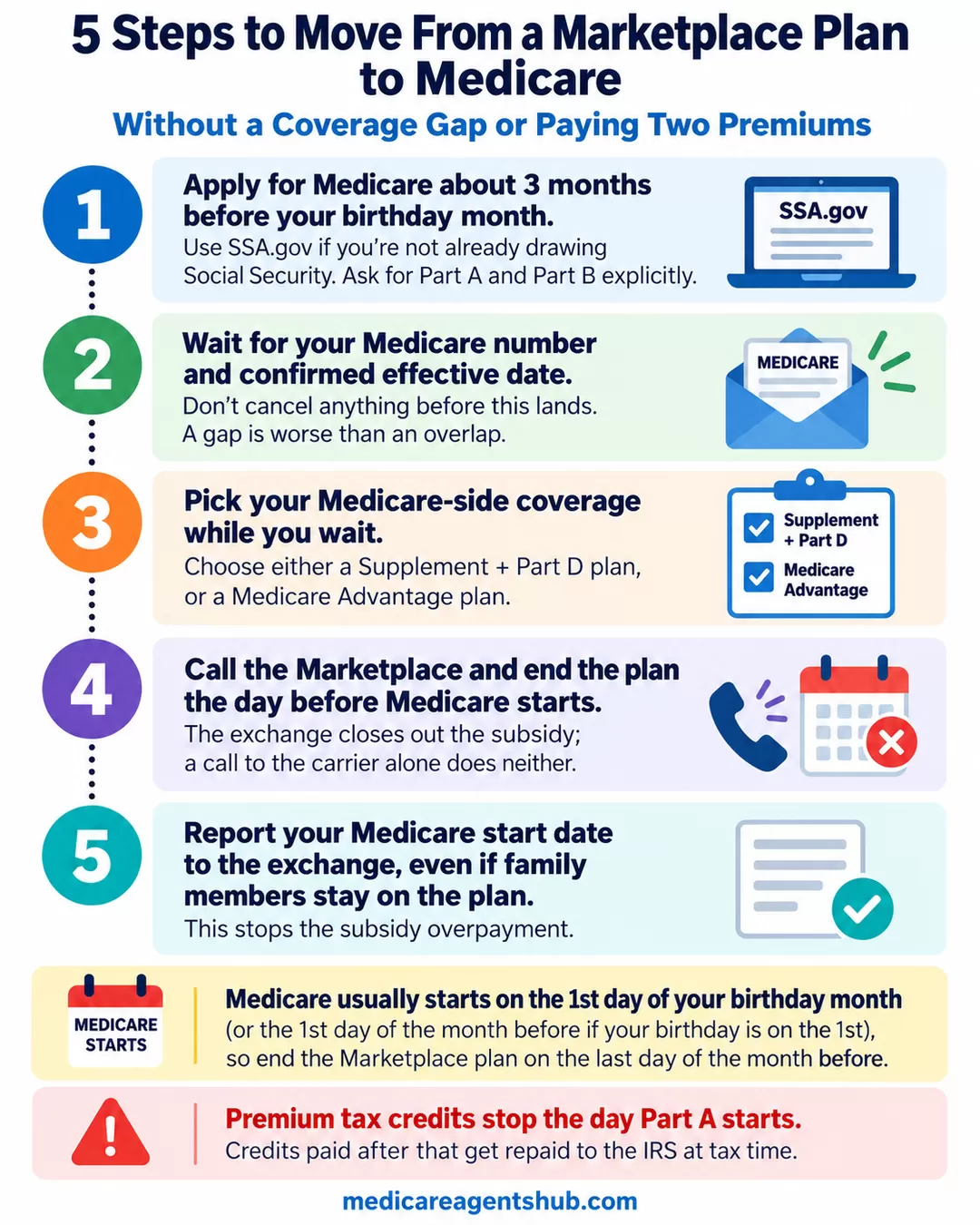
- Apply for Medicare about 3 months before your birthday month. Go through SSA.gov if you are not already drawing Social Security. Ask for Part A and Part B explicitly.
- Wait for your Medicare number and confirmed effective date. Do not cancel anything before this lands. A gap is worse than an overlap.
- Pick your Medicare-side coverage. Supplement plus Part D, or Medicare Advantage. Do this while you are waiting, not after.
- Call the Marketplace and end the plan the day before Medicare starts. The exchange processes the termination and closes out the subsidy. A call to the carrier alone does neither.
- Report the Medicare start date to the exchange even if you are keeping family members on the plan. This is what stops the subsidy overpayment.

What happens to my Covered California plan when I turn 65?
When you become eligible for Medicare at 65, your Covered California plan does not automatically turn into Medicare or automatically cancel. You need to coordinate the transition.If you qualify for premium-free Medicare Part A, you generally will no longer qualify for the financial help or premium tax credits that were lowering the cost of your Covered California plan.
The most important rule is: do not cancel your Covered California coverage until your Medicare enrollment has been approved and you have confirmed your Medicare effective date.
Once that date is confirmed, contact Covered California and have them schedule the Marketplace coverage to end so it transitions directly into Medicare without a gap in coverage.
Covered California recommends reporting your Medicare eligibility promptly and giving them advance notice when ending the plan.
If your spouse or other family members are younger than 65, they may be able to remain on Covered California even though you are moving to Medicare.
The goal is simple: confirm Medicare first, then coordinate the Covered California end date carefully so one coverage hands off to the other without leaving you uninsured.
One practical note for anyone with a mid-month birthday: Medicare starts on the first day of your birthday month, so the Marketplace plan should end on the last day of the month before. Getting those two dates wrong by a few weeks is what produces the double-premium month.
Questions worth asking before you cancel anything
If you are in this transition right now, these are the ones that decide the outcome:
- Do I qualify for premium-free Part A, or would I be buying it? (Social Security can confirm your quarters in one phone call.)
- Is anyone else on my Marketplace policy, and what happens to their premium when I come off it?
- What exact date does my Medicare coverage begin?
- Have I told the Marketplace about my Medicare start date, in writing, through the exchange?
Agents see the same two failures repeatedly. Someone cancels too early and spends a month uninsured. Or someone cancels through the wrong channel, keeps collecting credits they are no longer owed, and finds out at tax time.
Both are avoidable with a phone call. Agents certified on both Medicare and the Marketplace handle this exact handoff every fall, and there is no cost to you for the help. If you want someone who has run it before, find a licensed Medicare agent in your area and ask directly whether they are also certified on the exchange in your state.
You can also read what agents told other people asking whether Marketplace and Medicare can run at the same time, and the state-specific version of the question from Covered California members turning 65.