Does Medicare Cover Urgent Care, the ER, and Outpatient Surgery?
-
October 25, 2026

Reviewed by Ashley Luttjohann
Medicare Agent Licensed in IL, AK, AL & 44 other states
Walk into an urgent care clinic with a bad cut and Medicare pays under Part B. Walk into the emergency room across the street with the same cut and Medicare still pays under Part B, but the bill is built differently. Get admitted upstairs that night and Part A takes over.
Same body, same injury, three different cost structures. The door you walk through decides which part of Medicare pays and how much you owe.
Quick answer: Part B pays for urgent care, emergency room visits, and outpatient surgery, because all three are outpatient care. You pay the $283 Part B deductible for 2026, then 20% of the Medicare-approved amount, plus a facility copayment if the care happened in a hospital setting. Part A only starts paying once a doctor writes an order formally admitting you as an inpatient.
Does Medicare cover urgent care?
Yes. Urgent care falls under Part B, the medical insurance half of Medicare, because an urgent care clinic treats you and sends you home. Medicare calls this "urgently needed care," meaning a sudden illness or injury that needs attention soon but isn't life-threatening. A sprained wrist. Strep throat. A dog bite that needs stitches.
On Original Medicare you pay the Part B deductible first, then 20% of the Medicare-approved amount for the provider's services. If the urgent care clinic bills as a hospital outpatient department, you also owe a facility copayment on top of that 20%.
That last detail catches people. Two urgent care clinics a mile apart can produce different bills for the same visit, purely because one bills as a standalone practice and the other bills as a hospital outpatient department. Nothing on the front door tells you which is which. Ask at check-in.
One more thing worth confirming before you hand over your card: whether the clinic accepts Medicare assignment. Certain nonparticipating providers who don't accept assignment can bill you up to 15% above the approved amount (the limiting charge), which is what agents mean when they talk about Part B excess charges.

Do Medicare Parts A and B cover urgent care office visits?
Medicare Part B is actually what covers your urgent care visits because they fall under outpatient care. Usually, once you've met your Part B deductible for the year, Medicare covers 80% of the cost, and you'll be responsible for the remaining 20% coinsurance.Medicare Part A doesn't really come into play here since it’s for hospital stays, unless the urgent care visit results in you being admitted to the hospital. To keep your costs as predictable as possible, just make sure the clinic you're visiting accepts Medicare assignment.
Does Medicare Part A or Part B pay for the emergency room?
Part B, in most cases. The emergency department is an outpatient department of the hospital, so an ER visit where you're treated and discharged runs through Part B even though you were physically inside a hospital.
The ER bill has more moving pieces than an urgent care bill:
- A copayment for the emergency department visit itself
- A copayment for each individual hospital service you receive, like an X-ray or a CT scan
- 20% of the Medicare-approved amount for the doctors who treat you, after your Part B deductible
So a single ER trip can generate several copayments stacked on top of coinsurance. There's one piece of good news buried in the rules: each hospital outpatient copayment is capped at the Part A inpatient deductible, which is $1,736 in 2026. In most cases, the copayment for an individual hospital outpatient service cannot exceed that amount. Exceptions can apply, including services at critical access hospitals.
When an inpatient admission can eliminate ER copayments
If you're admitted to the same hospital as an inpatient for a related condition within 3 days of your emergency department visit, Medicare generally treats the ER services as part of your inpatient stay. You don't owe the separate emergency department copayments.
But you may still owe the Part A inpatient deductible and applicable Part B costs for doctors' services. Having the ER copayments waived doesn't necessarily mean your total hospital bill will be lower. The sequence of events changes how the bill is structured, though, and knowing the rule exists helps when you're trying to make sense of charges after the fact.

Does Medicare Part A or Part B pay for an emergency room visit, and does it change if I am admitted?
An emergency room visit is generally covered under Medicare Part B because the ER is considered outpatient care.If the hospital formally admits you as an inpatient, Medicare Part A generally covers the inpatient hospital stay from that point forward. Medicare Part B still covers the doctors and other professional services you receive while you are in the hospital.
There is an important distinction here: being kept overnight does not automatically mean you were admitted. You can spend one or more nights in the hospital under observation status and still be considered an outpatient for Medicare purposes. Part A generally does not begin covering the hospital stay until you are formally admitted as an inpatient with a doctor's order.
If you are admitted to the same hospital for a related condition within three days of the emergency room visit, Medicare generally treats the related ER services as part of the inpatient stay, so you do not pay the separate emergency department copayments.
So the simple answer is: ER first = usually Part B. Formal inpatient admission = Part A for the hospital stay, while Part B continues to cover the doctors.
Does Medicare Part A cover outpatient surgery?
No. Outpatient surgery is Part B, and this is probably the single most common mix-up seniors run into. The assumption is reasonable: surgery sounds serious, serious means hospital, hospital means Part A. Medicare classifies care by one thing only: whether a doctor formally admitted you.
Outpatient surgery happens in three settings, and all three bill under Part B:
- An ambulatory surgical center. You pay 20% of the approved amount to the center and 20% to the doctors who treat you, after the Part B deductible.
- A hospital outpatient department. 20% for the physicians, plus a hospital copayment per service, again capped at $1,736 per service.
- A doctor's office. 20% after the deductible, no facility fee.
Site of service shows up in what you pay, not only in the paperwork. The same outpatient procedure may cost less at an ambulatory surgical center than at a hospital outpatient department. Both settings charge for facility services, but their Medicare-approved payment amounts and patient cost-sharing can differ. If your surgeon offers you a choice of location, compare the estimated total cost at each facility before scheduling.
Worth saying plainly: Part B coinsurance has no annual out-of-pocket maximum on Original Medicare. There's no ceiling where the 20% stops. If covered services have a combined Medicare-approved amount of $60,000 and standard 20% Part B coinsurance applies, your share could be $12,000, and Medicare alone will not cap it. That's the whole reason people pair Part A and Part B with a Medigap policy or a Medicare Advantage plan.

Does Medicare Part A cover outpatient surgery, or is that strictly under Part B?
Outpatient surgery falls under Part B, not Part A. Part A is for inpatient hospital stays, skilled nursing, hospice, and some home health care. Once a procedure is done on an outpatient basis, meaning you're not formally admitted to the hospital overnight, it shifts to Part B coverage. You'll pay 20% of the Medicare-approved amount after your Part B deductible, and the facility may also charge a copay. This catches some people off guard because they assume anything happening at a hospital is Part A, but it really comes down to whether you're admitted as an inpatient or treated and sent home the same day.When Part A finally takes over
Part A starts paying at one specific moment: when a physician writes an inpatient admission order and the stay meets Medicare's coverage requirements. Arriving at the hospital doesn't trigger it. Getting a bed doesn't trigger it. Spending the night doesn't trigger it. The order does.
Once it is, you owe the $1,736 Part A deductible for that benefit period, which covers days 1 through 60 of the stay. Days 61 to 90 run $434 a day. Days 91 to 150 draw on lifetime reserve days at $868 a day. Part B keeps paying the doctors who see you while you're admitted, so an inpatient stay usually generates bills under both parts.
That deductible resets per benefit period, not per calendar year, which is why hospital days don't simply start over every January the way the Part B deductible does.

What's the cheapest way to get Medicare coverage if I only need basic hospital care?
Medicare Part A covers hospital care, and if you have worked and paid into Medicare taxes for at least 40 quarters (10 years), Part A is no cost to have, but there is out-of-pocket cost when you do have hospital stays. The inpatient hospital deductible for 2026 is $1,736 per benefit period, which covers 60 days. There are other options if you also activate your Medicare Part B. That’s more information than this space allows.Observation status: the overnight stay that isn't an admission
You can sleep in a hospital bed for two nights, eat hospital food, wear the gown, get woken up for vitals at 4 a.m., and still be an outpatient in Medicare's eyes. It's called observation status, and it bills under Part B.
The hospital has to notify you in writing if you're under observation for more than 24 hours. Read that notice. Observation days don't count toward the 3 consecutive inpatient days Medicare requires before it will pay for skilled nursing or rehab after a hospital stay, and they don't draw down your lifetime reserve days either.
Some Medicare Advantage plans and certain Medicare-approved programs, including some Accountable Care Organization arrangements, may waive the traditional three-day stay requirement. Ask your plan or hospital discharge coordinator which rules apply before arranging skilled nursing care.
Families discover this at the worst possible moment, usually at discharge, when the rehab facility asks for the inpatient paperwork and there isn't any. We've written about how the observation status trap actually plays out and what to ask while your relative is still in the bed.

Does Medicare cover hospital observation stays, and how is that different from being admitted as an inpatient?
Observation stays are covered by Medicare Part B. This means you are subject to the Part B deductible if you have not already met it. Then Medicare pays 80% of the cost, leaving you 20%. There will also be copays for any services performed or medications given during the stay.Which part pays: the quick version
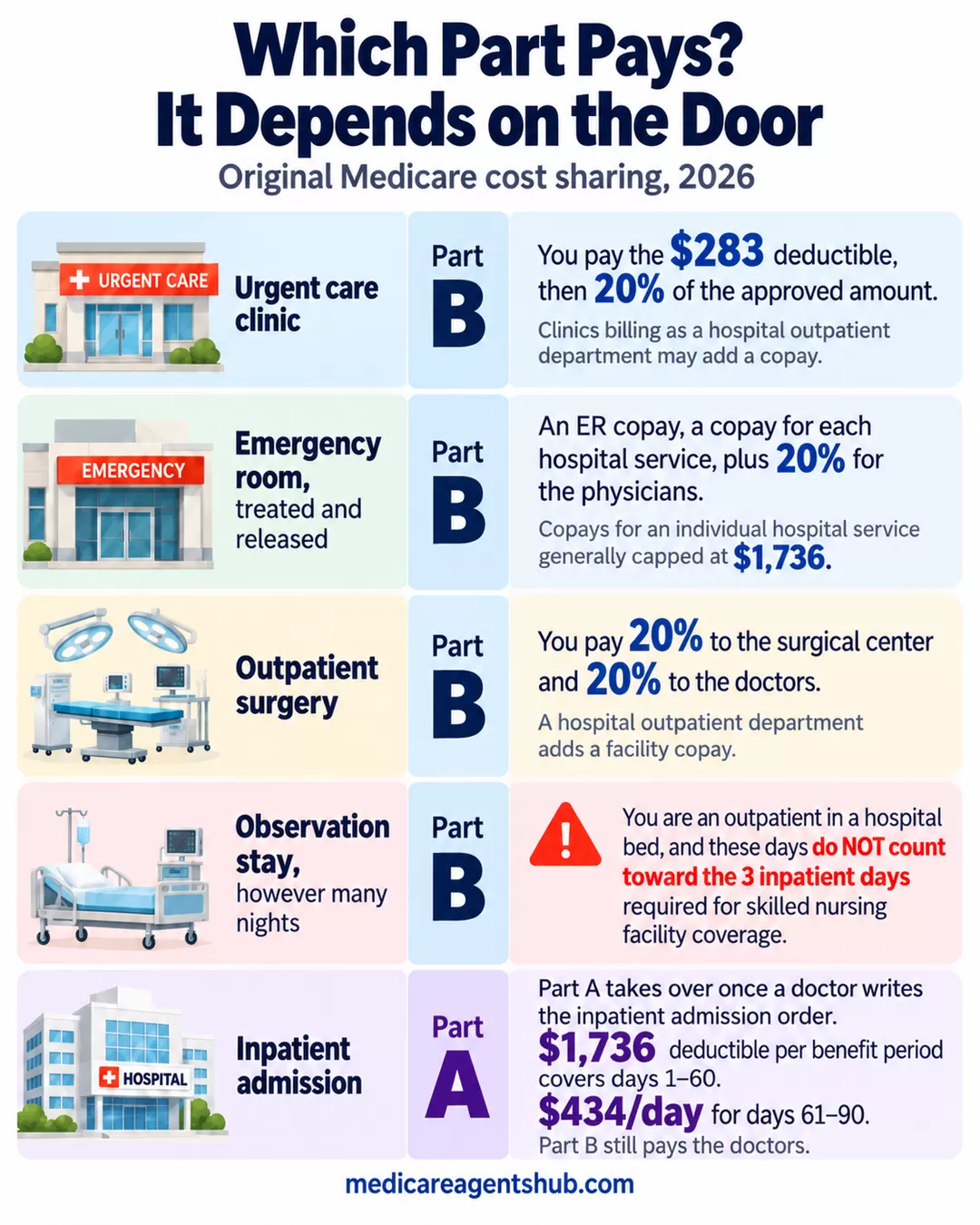
Side-by-side costs on Original Medicare in 2026
| Where you get care | Which part pays | What you owe |
|---|---|---|
| Urgent care clinic (standalone) | Part B | $283 deductible, then 20% of the approved amount |
| Urgent care (billed as hospital outpatient dept.) | Part B | 20% plus a hospital facility copayment |
| Emergency room, treated and released | Part B | ER copay, a copay per hospital service, plus 20% for physicians |
| Emergency room, admitted within 3 days for the same issue | Part A | Related ER copays waived; Part A inpatient deductible and applicable Part B physician costs may apply |
| Ambulatory surgical center | Part B | 20% to the center and 20% to the doctors |
| Hospital outpatient surgery | Part B | 20% for physician services plus a hospital facility copay, generally capped at $1,736 per service, with exceptions |
| Observation stay, any number of nights | Part B | 20% plus copays for services and drugs during the stay |
| Inpatient admission | Part A (hospital) + Part B (doctors) | $1,736 for days 1-60, then $434/day |
Every figure above assumes Original Medicare with no supplement. A Medigap plan absorbs most or all of the coinsurance and copays. Medicare Advantage plans have their own copayments, coinsurance, and annual out-of-pocket limits. Urgent care, emergency room, outpatient surgery, and inpatient hospital costs vary by plan. Some plans waive an emergency room copayment if you're admitted to the hospital. Check your plan's Evidence of Coverage for the exact amounts and conditions.
Three questions that change your bill
These are worth memorizing, because asking them in the moment is worth more than reading about them later.
1. "Is this clinic billing as a hospital outpatient department?" Ask at urgent care check-in. The answer tells you whether a facility copayment is coming.
2. "Am I admitted as an inpatient, or am I under observation?" Ask every day of a hospital stay. The answer can swing your bill by thousands and decides whether rehab afterward is covered.
3. "Can this procedure be done at a surgical center instead?" Ask your surgeon when scheduling anything elective. Sometimes the answer is no for medical reasons. When it's yes, it's usually cheaper.
Frequently asked questions
Does Medicare cover urgent care out of state?
On Original Medicare, yes. Part B works at any provider in the country that accepts Medicare, with no network and no referral. Medicare Advantage is different: plans must cover emergency and urgently needed care outside their service area, but cost sharing may differ from what you'd pay in-network. Routine care outside your service area may not be covered. Check your plan documents before you travel.
Do I need Part B to be covered at urgent care?
Yes. Part A on its own covers inpatient hospital care, skilled nursing, hospice, and some home health, and nothing in an urgent care clinic. People who enrolled in Part A only, usually because they were still working on an employer plan, have no outpatient coverage through Medicare at all.
Is the ER cheaper than urgent care under Medicare?
Almost never. Both run through Part B, but the ER layers a facility copayment and per-service copayments onto the 20% coinsurance. For anything that isn't an emergency, urgent care is the cheaper door. For anything that might be an emergency, go to the ER anyway. A stroke misread as a headache costs more than a copay.
What if I'm admitted after outpatient surgery goes wrong?
Then Part A picks up the inpatient stay from the point of admission forward, and the outpatient surgery itself stays on Part B. You can absolutely owe both deductibles for one bad week.
Does Medicare pay 100% of an emergency room visit?
Not on its own. Original Medicare charges coinsurance and copayments for ER visits, with no out-of-pocket maximum. A Medigap plan, Medicaid, or other coverage can reduce or eliminate what you owe, but Medicare by itself always leaves you a share.
Getting help with the gaps
The pattern across all of this is that Original Medicare pays most of the bill and leaves the rest open-ended. Urgent care, the ER, and outpatient surgery each leave you a 20% slice with no ceiling on it, and the hospital-based versions add copayments on top.
How you close that gap, with a Medigap policy, a Medicare Advantage plan, or neither, depends on your health, your budget, your state's rules, and which hospitals you'd actually want to use. A licensed agent can run those numbers against your situation in a single conversation, usually at no cost to you.
Browse licensed Medicare agents by state, or have one matched to your situation. You can also read how other agents answered whether Part A or Part B pays for an emergency room visit and whether Part A and B cover urgent care.