Medicare and Durable Medical Equipment (DME): What's Covered, What's Not, and How to Get What You Need
-
March 7, 2026

Reviewed by Austin Pierce
Medicare Agent Licensed in CO, AL, AR & 19 other states
If you or a loved one needs a wheelchair, oxygen concentrator, CPAP machine, walker, or hospital bed at home, Medicare likely covers it, but the process isn't always straightforward. Durable Medical Equipment (DME) is one of the most commonly needed Medicare benefits for seniors, yet it's also one of the most misunderstood.
This guide breaks down exactly what Medicare covers, how to qualify, what you'll pay out of pocket, and what to do if a claim is denied.
What Is Durable Medical Equipment (DME)?
Medicare defines Durable Medical Equipment as medically necessary items that are:
- Durable: built to withstand repeated use over time
- Used for a medical purpose: not purely for comfort or convenience
- Appropriate for home use: designed for use in a patient's residence
- Prescribed by a doctor: a physician must order it
This definition matters because items that fail any of these criteria, like a standard mattress or a bathroom grab bar that isn't medically prescribed, won't qualify for coverage.
Common DME Items Covered by Medicare
Medicare Part B covers a wide range of equipment. Here are the most commonly used items among seniors:
Mobility Equipment
- Manual wheelchairs: standard and lightweight models
- Power wheelchairs: when a manual chair isn't sufficient (requires face-to-face exam and detailed medical justification)
- Walkers and rollators: standard and wheeled models
- Canes and crutches
- Knee scooters: in some cases, as an alternative to crutches
Respiratory Equipment
- CPAP and BiPAP machines: for diagnosed sleep apnea (initial 3-month trial period applies)
- Oxygen concentrators and tanks: for chronic lung conditions like COPD
- Nebulizers: for delivering inhaled medications
- Suction pumps: for airway clearance
Home Care Equipment
- Hospital beds: when medically necessary for home recovery
- Patient lifts: Hoyer lifts and similar transfer devices
- Commode chairs: bedside commodes for patients with limited mobility
- Pressure-reducing mattresses: for preventing or treating bed sores
Other Commonly Covered Items
- Blood sugar monitors and test strips: for diabetics
- Continuous glucose monitors (CGMs): covered under Part B as of recent policy changes. See our full breakdown of Medicare-covered technologies for more on CGMs and other health tech.
- Infusion pumps: for IV medications administered at home
- Traction equipment
- Certain braces and prosthetic devices

I need a new wheelchair, and I'm not sure if Medicare will cover it. What's the process for getting durable medical equipment?
Yes — Medicare Part B covers wheelchairs as durable medical equipment (DME) if your doctor certifies it's medically necessary for use in your home.How to Get a Wheelchair Through Medicare
1. Visit Your Doctor
You’ll need a face-to-face appointment with your doctor or treating provider.
They must document your medical need for a wheelchair (ex: you have difficulty walking or getting around at home).
The doctor must write a prescription/order for the wheelchair.
2. Get the Order Sent to a Medicare-Approved DME Supplier
The supplier must accept Medicare assignment, or you may end up paying more out-of-pocket.
Not all suppliers do, so ask if they "accept assignment" before proceeding.
(For power wheelchairs, Medicare often requires prior authorization before approval. Once approved, Medicare will cover 80% of the Medicare-approved amount. You (or your supplemental insurance) cover the remaining 20% after meeting your Part B deductible.)
Which Part of Medicare Covers DME?
Medicare Part B covers durable medical equipment. This is true whether you're on Original Medicare or a Medicare Advantage plan, though the specifics of how you access and pay for equipment can differ significantly between the two.
If you're on Original Medicare, understanding how Part B actually works, including what it covers and what it costs, is important before pursuing any DME claim.

I need a new wheelchair, and I'm not sure if Medicare will cover it. What's the process for getting durable medical equipment?
Medicare Part B will help cover the cost of prescribed Durable Medical Equipment, but how this works can vary based on whether you just have Original Medicare, a Medicare supplement, or a Medicare Advantage plan.If you are on Original Medicare, you will be responsible for your Part B deductible, as well as a 20% coinsurance. You will need to confirm that the doctor (your primary care physician) prescribing the wheelchair, as well as the supplier for the wheelchair, are both enrolled with Medicare.
If you are on a Medicare Advantage plan, then you will need to follow your insurance company's rules for getting Durable Medical Equipment. You can contact your current plan provider to learn about their rules and what they will cover.
A Medicare supplement plan can help cover the remaining costs that are covered by Original Medicare as well. Coverage can vary by plan type, so it's important to review what plan you are on and what it covers.
You can always reach out to an agent (like myself) to assist you in understanding your unique situation.
Original Medicare (Part A + Part B)
With Original Medicare, DME coverage works like this:
- You pay the annual Part B deductible (the amount changes each year; check Medicare.gov for the current figure)
- After the deductible, you typically pay 20% coinsurance on the Medicare-approved amount
- Medicare pays the remaining 80%
- You must use a Medicare-approved DME supplier
That 20% coinsurance is uncapped, meaning for expensive equipment like a power wheelchair (which can run $3,000–$15,000+), your share can be substantial. This is one reason many beneficiaries pair Original Medicare with a Medigap supplement plan, which can cover most or all of that coinsurance.
Medicare Advantage Plans
Medicare Advantage plans must cover everything Original Medicare covers, including DME. However, they often have different cost-sharing structures: copays instead of coinsurance, prior authorization requirements, and specific supplier networks. Some plans offer additional benefits that go beyond what Original Medicare provides.
If you're comparing plan types, it's worth understanding the real cost differences between Medicare Advantage and Medigap, especially if you anticipate needing expensive equipment.
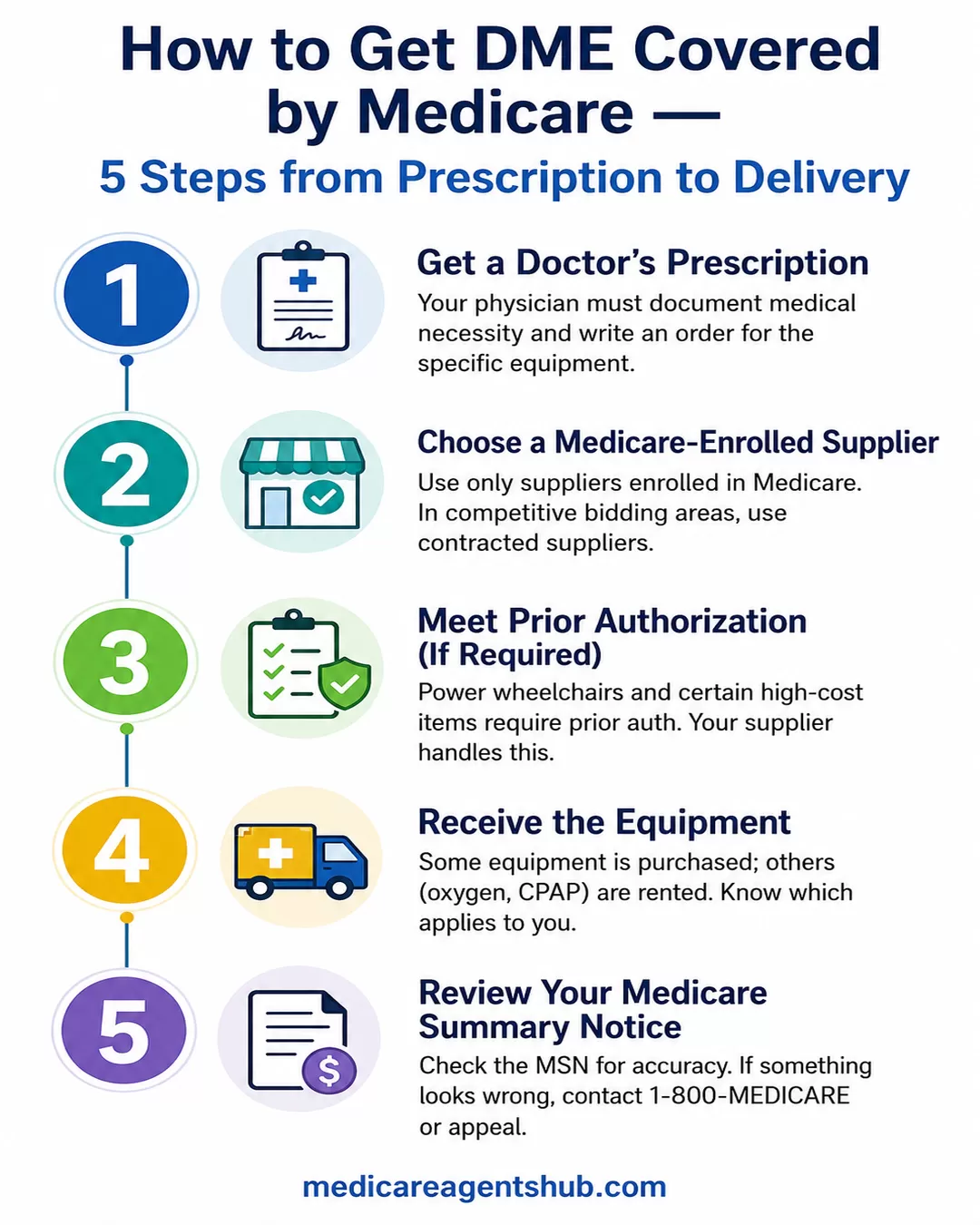
How to Get DME Covered by Medicare: Step by Step
Getting Medicare to pay for durable medical equipment involves a specific process. Skipping steps or working with the wrong supplier is one of the most common reasons claims get denied.
Step 1: Get a Doctor's Prescription
Everything starts with your physician. They must:
- Conduct a face-to-face examination (required for power mobility devices)
- Document the medical necessity: why you need this specific equipment
- Write a detailed prescription or Certificate of Medical Necessity (CMN)
Tip: Be specific with your doctor about your limitations. Vague documentation like "patient has trouble walking" is far more likely to be denied than "patient cannot ambulate more than 10 feet without severe dyspnea and risk of fall."
Step 2: Use a Medicare-Enrolled DME Supplier
This is where many people get tripped up. You must use a supplier that is enrolled in Medicare. If you buy equipment from a non-enrolled supplier, Medicare won't reimburse you. Period.
Medicare also uses a competitive bidding program in many metro areas. In these areas, you must use a contracted supplier for certain items, or you'll pay the full cost yourself. You can check which suppliers are contracted in your area at Medicare.gov's supplier directory.

What's the deal with Medicare covering medical equipment like wheelchairs- do I need a special approval?
After you meet the Part B deductible, you pay 20% of the Medicare-approved amount (if your supplier accepts assignment). It’s important to ask a supplier if they participate in Medicare or will accept assignment of your claims before you get DME. If a supplier participates in Medicare, they must accept assignment (which means, they can charge you only the coinsurance and Part B deductible for the Medicare approved amount).A non-participating provider doesn't have to accept assignment, but may choose to do so in your case. If a DME supplier doesn’t participate in Medicare or won't accept assignment, you may be charged more. For rented DME, make sure the supplier is willing to accept assignment for all rental months, otherwise you’ll have to pay the full cost of your DME upfront. If this happens, Medicare will pay you later for the amount it covers after your claims have been submitted and processed by Medicare.
https://www.medicare.gov/coverage/wheelchairs-scooters
Step 3: Prior Authorization (When Required)
Certain items, particularly power wheelchairs, power-operated vehicles (scooters), and some pressure-reducing mattresses, require prior authorization before Medicare will approve payment. Your DME supplier typically handles the prior auth process, but you should confirm this is underway before accepting delivery of the equipment. For a broader look at how prior authorization works across all types of Medicare coverage, see our guide on what agents want you to know about prior authorization.

What's the deal with Medicare covering medical equipment like wheelchairs- do I need a special approval?
Yes, Medicare Part B covers wheelchairs and power-operated vehicles (scooters) as Durable Medical Equipment (DME).For Manual Wheelchairs: You generally do not need "prior authorization," but you must have a doctor's prescription and a face-to-face evaluation.
For Power Wheelchairs/Scooters: Yes, you may need "prior authorization" (prior approval) for certain power-operated vehicles and power wheelchairs. Your doctor and the supplier handle this paperwork, which must be approved by Medicare before they deliver the chair.
Step 4: Understand Rental vs. Purchase
Not all DME is purchased outright. Medicare classifies equipment into categories that determine whether you rent or buy:
- Purchased items: walkers, canes, commode chairs, blood sugar monitors. You own them after a single purchase.
- Capped rental items: wheelchairs, hospital beds, patient lifts. Medicare rents these for up to 13 months, after which you own them.
- Oxygen equipment: rented for 36 months. After that, the supplier must continue providing equipment and supplies for an additional 24 months at no cost to you.
- CPAP machines: rented for 13 months with a mandatory 3-month compliance trial. If you don't demonstrate sufficient usage in the first 90 days, Medicare may stop covering it.

Does Medicare cover CPAP machines and sleep apnea treatment?
Yes, Durable Medical Equipment is covered under Part B at a 20% coinsurance rate after your Part B deductible has been reached. This is something that may have certain conditions that must be met before Medicare will approve it. Typically, that means you have been diagnosed by your doctor with sleep apnea through a sleep study.The CPAP Compliance Rule: What You Need to Know
CPAP coverage deserves special attention because Medicare applies a unique compliance requirement that catches many beneficiaries off guard.
During the first 90 days after receiving your CPAP machine, you must demonstrate that you're using it at least 4 hours per night for at least 70% of nights in a consecutive 30-day period. Your machine tracks this automatically. If you don't meet this threshold, Medicare may deny further coverage, and you could be stuck paying out of pocket or returning the equipment.
What you can do:
- Work closely with your sleep specialist and DME supplier during the trial period
- Ask about mask fitting and comfort adjustments early. Discomfort is the #1 reason people abandon CPAP
- Request a humidifier attachment if dryness is an issue (usually covered)
- Track your own usage through the machine's companion app
What Medicare Does NOT Cover
Understanding what's excluded is just as important as knowing what's covered:
- Comfort or convenience items: seat lift chairs (the lift mechanism itself isn't covered, only the seat), bathtub grab bars (unless medically prescribed), raised toilet seats, medical alert systems like Life Alert
- Items not prescribed by a doctor: even if you clearly need a walker, Medicare won't pay without a physician's order
- Non-durable items: disposable supplies like bandages, incontinence pads, or single-use gloves (some covered under Part B for specific conditions)
- Duplicate equipment: Medicare typically covers one of each type of item at a time
- Equipment from non-enrolled suppliers: this cannot be stressed enough
Some of these exclusions catch beneficiaries off guard. For a look at other items and services with unexpected coverage rules, see 8 surprising Medicare coverage answers from agents.

What's the deal with Medicare covering medical equipment like wheelchairs- do I need a special approval?
Good question!Yes — Medicare does cover medical equipment like wheelchairs, walkers, hospital beds, and oxygen, but there are a few rules to follow.
You’ll need a doctor’s order (a written prescription) that says the equipment is medically necessary for use in your home. After that, you must get it from a Medicare-approved supplier — not every store or website qualifies.
For some items, especially power wheelchairs or scooters, Medicare may require “prior authorization” — basically, an extra approval step before they’ll pay. Your doctor and the supplier usually handle that paperwork.
If you have a Medicare Advantage plan, it might have its own approval process or preferred suppliers, so it’s always good to check with the plan first.
What to Do If Your DME Claim Is Denied
DME denials are frustratingly common, and many of them are overturned on appeal. If you receive a denial, don't give up. You have the right to appeal, and the success rates at various appeal levels are encouraging.
The most common reasons for DME denials include:
- Insufficient documentation: the doctor's notes didn't adequately support medical necessity
- Wrong supplier: using a non-enrolled or non-contracted supplier
- Missing prior authorization: for items that required it
- Coding errors: incorrect HCPCS codes on the claim
If you're denied, start by requesting the detailed explanation from Medicare. Then work with your doctor to strengthen the documentation and file a formal appeal. Our guide on how to appeal a denied Medicare claim walks through the full five-level appeals process step by step.
DME and Medicare Advantage: Key Differences
If you're enrolled in a Medicare Advantage plan, your DME coverage works slightly differently than Original Medicare. Here's a side-by-side comparison:
| Feature | Original Medicare | Medicare Advantage |
|---|---|---|
| Suppliers | Any Medicare-enrolled supplier nationwide | Typically must use in-network suppliers |
| Cost sharing | 20% coinsurance (uncapped) after Part B deductible | Flat copay or coinsurance, capped by plan out-of-pocket max |
| Prior authorization | Required for certain items (power wheelchairs, some mattresses) | Often required for a wider range of equipment |
| Extra coverage | Standard DME only | Some plans cover items Original Medicare doesn't (e.g., certain bathroom safety equipment, OTC health items) |

I need a new wheelchair, and I'm not sure if Medicare will cover it. What's the process for getting durable medical equipment?
If you are on a Medicare Advantage plan, then you would have to contact the insurance company so they can help you find a DME provider that is in network. That company will then make arrangements to have the wheelchair delivered to your home. If you purchase a Medicare Supplement policy, you can work with any DME company as long as they accept Original Medicare, so you have more options and flexibility.The tradeoffs between plan types are real, and they matter most when you're facing significant equipment needs. If you're weighing your options, understanding the core differences between Medicare Advantage and Medicare Supplement plans is a good starting point.
Tips for Saving Money on DME
Even with Medicare coverage, DME costs can add up, especially if you need multiple items or expensive equipment. Here are practical ways to reduce your costs:
- Use assigned suppliers. Suppliers who "accept assignment" agree to charge only the Medicare-approved amount. You'll never pay more than 20% of that approved amount. If a supplier is Medicare-enrolled but does NOT accept assignment, they can bill you more than the approved amount, and you're responsible for the difference. Always ask before you order.
- Compare suppliers. Prices can vary between suppliers even for the same item. Get quotes from multiple Medicare-enrolled suppliers.
- Consider a Medigap plan. Plans that cover the 20% Part B coinsurance can save thousands on expensive equipment. Plan G is the most comprehensive option for people newly eligible for Medicare. Plans C and F also cover the Part B coinsurance but are only available to those who became eligible for Medicare before January 1, 2020.
- Check state assistance programs. Many states offer programs that help Medicare beneficiaries cover out-of-pocket costs. The State Health Insurance Assistance Program (SHIP) in your state can help you find options.
- Ask about refurbished equipment. For some items, Medicare-enrolled suppliers offer refurbished options at lower cost. You still pay 20% of the approved amount, but the base price may be lower.

How does Medicare cover COPD treatment and oxygen therapy?
1. Quitting SmokingMedicare Part B covers smoking cessation counseling, offering up to 8 face-to-face visits per year. Nicotine patches and other smoking aids may also be covered.
2. Oxygen Therapy
Medicare Part B helps cover oxygen therapy, including the rental of oxygen equipment and supplies. You pay 20% after you meet your deductible unless you have a Medigap policy.
3. COPD Medications and Bronchodilators
Copayment amounts will depend on your specific Part D plan.
4. Pulmonary Rehabilitation
Medicare Part B also covers pulmonary rehabilitation for moderate to severe COPD.
When to Talk to a Medicare Agent About DME
Navigating DME coverage can be complex, especially if you're choosing between Original Medicare and a Medicare Advantage plan, or if you need expensive equipment and want to minimize out-of-pocket costs. A local Medicare agent can help you:
- Compare how different plans handle DME coverage and costs in your area
- Identify whether a Medigap supplement would save you money based on your expected equipment needs
- Understand your plan's supplier network and prior authorization requirements
- Connect you with resources if you're struggling with a denied claim

I need a new wheelchair, and I'm not sure if Medicare will cover it. What's the process for getting durable medical equipment?
Medicare covers wheelchairs if they’re medically necessary, but you’ll need a doctor’s order and must go through a Medicare-approved supplier. You’ll owe 20% unless you have Medigap or a Medicare Advantage plan with different cost rules. The process to make sure you follow the appropriate rules with your plan is as follows: Talk with your doctor, get documentation from your doctor, choose a Medicare-approved supplier, confirm coverage and costs. This is a great example of why a Medicare advocate is so important! I will help you navigate these authorization processes with ease!DME is one of those Medicare benefits that seems simple on paper but gets complicated fast in practice. The right plan, and the right guidance, can make a real difference in both your coverage and your wallet.