10 Medicare Technologies Your Plan Might Already Cover
-
January 26, 2026

Reviewed by Kyle Billingsley
Medicare Agent Licensed in FL, AL, AR & 42 other states
Medicare coverage has come a long way from just hospital stays and doctor visits. Today's beneficiaries have access to technologies that would have sounded like science fiction a decade ago: from AI-powered diagnostics to smartwatch-based heart monitoring.
The problem? Most seniors don't know what's covered and what isn't. As technology changes the way seniors shop for Medicare plans, the gap between what's available and what people actually use keeps growing. We asked licensed Medicare agents across the country to break down 10 technologies that your plan might already pay for, and what to watch out for before you assume you're stuck paying out of pocket.
Quick look at what's covered:
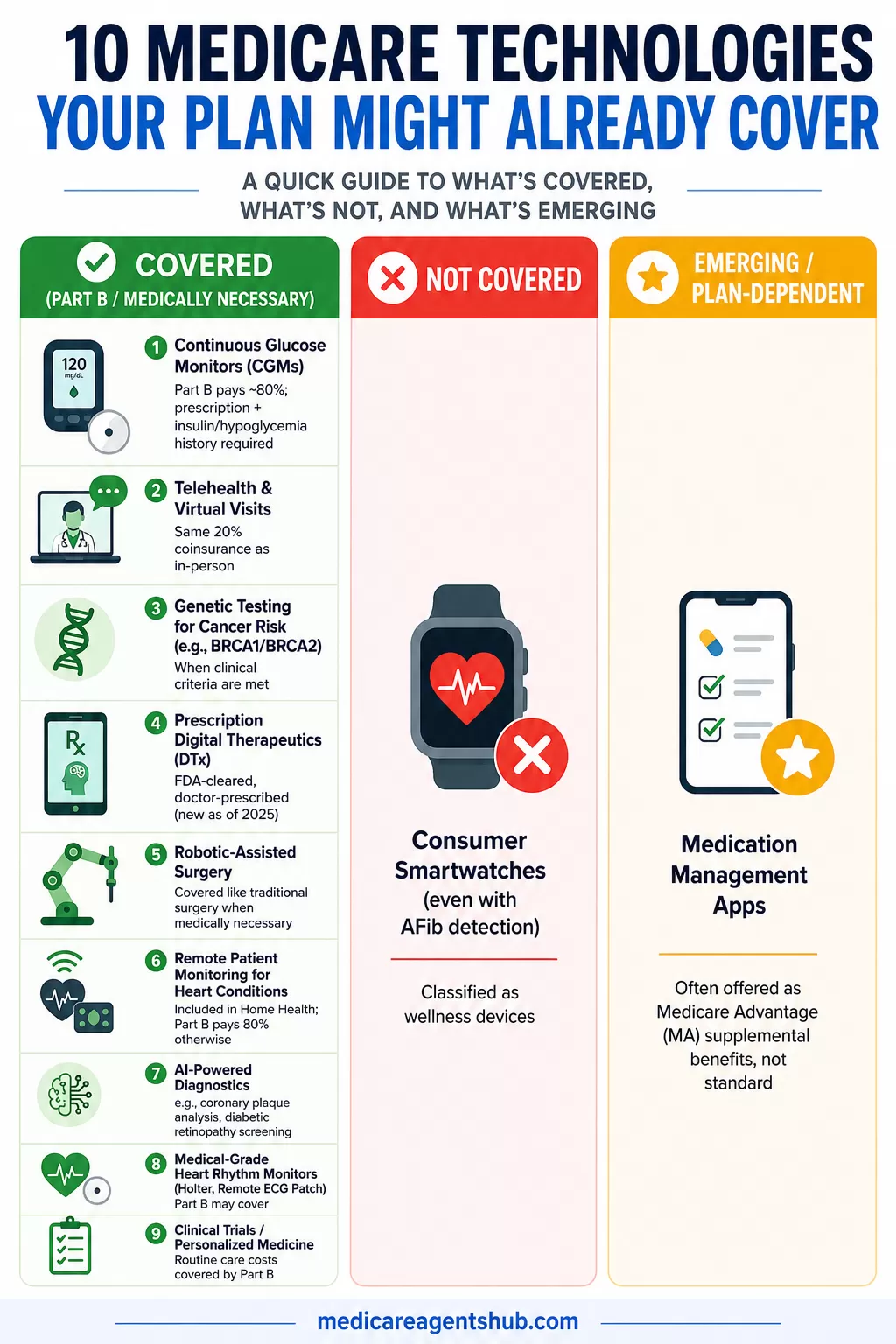
- Medical devices: Part B often covers prescribed devices like continuous glucose monitors and remote heart monitors when medically necessary.
- Virtual care: Telehealth is widely covered, with many pandemic-era flexibilities now permanent for mental health and select services.
- Advanced procedures: Robotic surgery and AI-assisted diagnostics are typically covered like their traditional counterparts.
- Not covered: Consumer wearables like smartwatches usually aren't covered, though some Medicare Advantage plans offer wellness allowances.
1. Continuous Glucose Monitors (CGMs)
If you're managing diabetes, you may already qualify for a continuous glucose monitor, a small wearable device that tracks your blood sugar around the clock and sends data to your smartphone. Medicare Part B covers CGMs as durable medical equipment, typically paying 80% of the approved cost.
To qualify, you'll generally need a prescription from your doctor and a documented history of insulin use or problematic hypoglycemia. The device itself must be FDA-approved and meet Medicare's requirements for CGM coverage. Your smartphone isn't covered, but the CGM and its supplies are.

I use a continuous glucose monitor for my diabetes that connects to my smartphone. Will Medicare cover this technology for someone with my condition?
Yes, Medicare can cover continuous glucose monitors (CGMs) for people with type 2 diabetes who meet specific criteria. Coverage is available under Medicare Part B as durable medical equipment. To qualify, you must have a diagnosis of diabetes and either be taking insulin or have a history of problematic hypoglycemia (low blood sugar). Your doctor must also prescribe the monitor and confirm that you've received adequate training on its use.2. Telehealth and Virtual Visits
Telehealth has become a permanent part of the Medicare landscape. Medicare Part B covers a wide range of virtual visits, including video appointments with doctors, specialists, and mental health providers. Mental health telehealth from home is a permanent benefit, and Congress has extended most other telehealth flexibilities that began during the pandemic, though rules for non-behavioral-health services can shift year to year.
You'll typically pay the same 20% coinsurance as an in-person visit. Some services may still require an in-person visit within a set window, especially for certain specialties. Medicare Advantage plans often offer even broader telehealth options. For the latest specifics, check Medicare's official telehealth coverage page before your appointment.

I live in a rural area with limited specialists and am interested in telehealth options. How does Medicare cover virtual visits for someone in my location?
Medicare covers telehealth visits under Part B, and living in a rural area helps. You can do most visits from home right now, but the rules may change after October 1, 2025, when some visits could require being at a clinic. Mental-health visits will still be allowed from home. Medicare Advantage plans often include even more telehealth options, so check your plan for details.3. Genetic Testing for Cancer Risk
If you have a family history of cancer, Medicare may cover genetic testing to assess your risk, but it's not automatic. Coverage depends on factors like your personal cancer history, the specific genes being tested, and whether your doctor deems it medically necessary.
For example, BRCA1 and BRCA2 testing for breast and ovarian cancer risk is covered for beneficiaries who meet specific clinical criteria. The test must be ordered by your physician and performed at a Medicare-approved laboratory.

I'm considering genetic testing to assess my cancer risk based on family history. Will Medicare cover this preventive approach in my situation?
If you have a family history of cancer, Part B will cover some genetic testing. It needs to be deemed as medically necessary and it includes BRCA testing, Lynch syndrome testing, and Next-Generation Sequencing (NGS) for advanced (stage III or IV), recurrent, or metastatic cancer.4. Prescription Digital Therapeutics (DTx)
This is one of Medicare's newest coverage areas. As of 2025, Medicare began covering certain FDA-cleared digital therapeutics, prescription software tools that deliver clinical interventions for conditions like depression, insomnia, and substance use disorders.
These aren't wellness apps you download yourself. They're prescribed by your doctor and billed through your provider, sometimes with new medical codes created by CMS. Some Medicare Advantage plans go further, covering the setup, monitoring, and even the tablet needed to run the app.

I use several prescription apps and digital therapeutics for my chronic conditions. Does Medicare provide any coverage for digital health tools in cases like mine?
Beginning in January of 2025, Medicare did approve some Digital Therapeutics when order by a provider. The approved therapeutics are:SleepioRx for Insomnia
Somryst for Chronic insomnia
DaylightRx for Generalized anxiety disorder
Rejoyn for Major depressive disorder
reSET for Substance use disorder
reSET‑O for Opioid use disorder
5. Robotic-Assisted Surgery
If your surgeon recommends a robotic-assisted procedure, like a robotic knee replacement, Medicare generally covers it the same way it covers traditional surgery, as long as it's deemed medically necessary and performed at a Medicare-approved facility.
Under Original Medicare, Part A covers inpatient procedures and Part B covers outpatient procedures. You'll still be responsible for your standard cost-sharing. The key requirement is that the surgeon must be a participating Medicare provider.

I'm interested in a robotic knee replacement surgery that my surgeon recommends for my specific anatomy. How does Medicare coverage work for this advanced procedure?
Medicare would normally cover this as long as Medically necessary. The coverage is based on the procedure not the technology for this6. Remote Patient Monitoring for Heart Conditions
If you're homebound with a heart condition, Medicare may cover remote monitoring as part of your care plan. How it works depends on your coverage type and care situation.
Under Medicare-certified Home Health, remote monitoring can be included in your plan of care at no additional cost. Outside of Home Health, Medicare Part B may cover remote physiologic monitoring when ordered by your doctor, with Medicare paying 80% and you covering the remaining 20%. Medicare Advantage plans must cover at least what Original Medicare covers, and some offer additional monitoring programs.

I'm homebound and need remote monitoring for my heart condition. What Medicare benefits might apply to someone in my situation?
Medicare may cover remote patient monitoring (RPM) under Part B if you have a qualifying chronic heart condition. This can include devices to track vitals like heart rate and rhythm, with your doctor receiving the data remotely. You may also qualify for chronic care management (CCM) and telehealth visits. Standard 20% coinsurance applies after meeting the Part B deductible.7. AI-Powered Diagnostic Tools
Artificial intelligence is making its way into Medicare-covered diagnostics. Medicare now covers AI-enabled tools for specific use cases, like AI-powered coronary plaque analysis for detecting heart disease and AI-based screening for diabetic retinopathy.
Coverage isn't universal for all AI tools, though. Medicare typically covers the underlying test or service (imaging, lab work) rather than "AI" as a standalone category. The fastest way to check is to ask your provider for the CPT/HCPCS billing code and verify coverage with Medicare or your plan.

I've heard about new AI-powered diagnostic tools for early disease detection. Does Medicare cover any of these cutting-edge technologies?
Yes, Medicare can cover certain AI powered diagnostic tools such as coronary plaque analysis, AI-powered analysis of electrocardiograms, AI-quantitative CT, and several others; however, full coverage depends on finalized CMS decisions and coding. Medicare is moving towards implementing more AI tools for traditional diagnostic testing, but coverage is going to depend on FDA clearance, coding, medical necessity, and specific Medicare plans.8. Smartwatches and Wearable Heart Monitors
Here's where expectations and reality diverge. Consumer smartwatches, even ones that detect atrial fibrillation, are generally not covered by Medicare. They're classified as wellness devices, not medical equipment.
However, if your doctor prescribes a medical-grade heart rhythm monitor (like a Holter monitor or remote ECG patch), Medicare Part B may cover both the device and the monitoring service. Some Medicare Advantage plans also include wellness perks that may cover wearable devices.

I'm considering a smartwatch that monitors my heart rhythm for atrial fibrillation. Will Medicare help cover this type of wearable technology?
Medicare doesn’t cover smartwatches like the Apple Watch or Samsung Watch, even if they check for AFib. They’re considered wellness devices, not medical equipment. Medicare only covers medical‑grade heart monitors that your doctor prescribes.Some Medicare Advantage plans may offer a technology or OTC allowance that can help pay for a smartwatch, but Original Medicare will not.
9. Medication Management Apps
This is still an emerging area for Medicare. Original Medicare doesn't broadly cover smartphone apps for medication management, but Medicare Advantage plans are increasingly offering digital health tools (including medication reminders, pharmacy apps, and adherence tracking) as supplemental benefits.
Most carriers provide their own tools for clients to view prescriptions, check Part D plan coverage, and estimate out-of-pocket costs. While these aren't standalone Medicare benefits, they're built into the plan experience.

My doctor wants me to use a smartphone app for medication management and adherence. Are there any Medicare programs that support this type of digital health solution?
Yes, Medicare Advantage (MA) plans can offer coverage for smartphone apps that help with medication management and adherence, as part of broader digital health solutions. Many private MA plans are expanding their digital health offerings, including telehealth services like virtual visits and medication reminders through apps.10. Clinical Trials and Personalized Medicine
If you're participating in a clinical trial, including one using personalized treatment based on your genetic profile, Medicare Part B generally covers the routine care costs associated with qualified trials. That includes doctor visits, hospital stays, lab work, imaging, and standard treatments you'd receive whether or not you were in the study.
The experimental treatment itself (like a new targeted drug) is typically covered by the trial sponsor, not Medicare. So are any tests or procedures required solely for the research (data collection that isn't part of your standard care). Genetic testing may be covered if it's considered medically necessary for guiding your treatment.

I'm participating in a clinical trial for a new cancer treatment that uses personalized medicine based on my genetic profile. How does Medicare coverage work in this situation?
Medicare covers approved clinical trials but its for drugs and procedures normally covered by Medicare. Medicare wont cover experimental drugs, devices or studies. It also wont cover extra testing. The trial sponsor should cover the trial. You should verify Medicare trial is approved. But remember Medicare covers the routing costs while the trial sponsor covers the treatment itselfThe Bottom Line: Ask Before You Assume
Medicare's technology coverage is broader than most people realize, but it's also more nuanced than a simple yes or no. Coverage depends on your specific plan type, whether a service is deemed medically necessary, and in some cases, whether your provider bills it correctly.

Will Medicare Advantage plans start offering more digital health tools like apps by 2030?
I believe they will. In fact, we're already seeing many Medicare Advantage plans offer digital tools like mobile apps, telehealth, virtual primary care, prescription management, fitness tracking, digital ID cards, and wellness programs.By 2030, I expect these tools to become even more common and more integrated, making it easier for members to manage appointments, medications, claims, benefits, and even communicate with their healthcare team—all from their phone or tablet.
Of course, every plan is different, so it's important to compare more than just the technology. Your doctors, prescriptions, benefits, and overall healthcare needs should always come first.
If you have questions about Medicare or would like a no-cost review of your options, I'm here to help.
Chuck Winslow
Community Ambassador
Life, Legacy & Retirement Solutions
Contact me.
Helping seniors, veterans, and families make confident Medicare decisions—at no cost.
The best move? Talk to a licensed Medicare agent who can review your situation and tell you exactly what your plan covers. Many of the technologies on this list are covered; you just need to know how to access them.