Does Medicare Cover Robotic Surgery, AI Diagnostics, and Genetic Testing?

-
January 23, 2026
Your surgeon recommends a robotic-assisted hip replacement. Your ophthalmologist uses an AI-powered scanner to check for diabetic retinopathy. Your oncologist orders genetic testing to see if a targeted cancer drug will work for you. Three very different situations, but they all raise the same question: will Medicare pay for this?
The answer depends on a distinction most beneficiaries never think about until they're staring at a bill. Medicare often evaluates whether the billed service is medically necessary and covered, rather than treating every new tool or technique as a separate benefit. But for some new devices, diagnostics, drugs, lab tests, and procedures, CMS or a Medicare Administrative Contractor may make a specific coverage determination. Understanding that framework explains most of how cutting-edge medicine gets covered, and why some of it doesn't.
Quick answer: Medicare may cover robotic surgery, AI-assisted diagnostics, and genetic testing when the underlying service is medically necessary, ordered by a provider, and fits within Medicare's coverage rules. Medicare generally does not cover a technology just because it is new, FDA-cleared, or personally requested. Coverage often depends on the billing code, diagnosis, whether a National Coverage Determination (NCD) or Local Coverage Determination (LCD) applies, and whether the provider or facility accepts Medicare.
Medicare coverage can vary based on the exact service, diagnosis, billing code, provider, facility, state or local contractor rules, and Medicare Advantage plan requirements. This article is educational and should not replace a written coverage decision from Medicare, your plan, or your provider's billing office.
Coverage details in this article reflect Medicare policies as of August 2026. Always verify with current CMS resources or your plan, as Local Coverage Determinations and billing rules can change.
How Medicare Decides What's "Experimental"
Medicare uses a formal process called a National Coverage Determination (NCD) to decide whether a treatment or service is covered nationwide. For anything not addressed by an NCD, regional Medicare Administrative Contractors (MACs) can issue Local Coverage Determinations (LCDs) that apply in their area. If neither exists, coverage comes down to whether the claim is coded as a service Medicare already recognizes.
This is where it gets interesting. A knee replacement is a covered procedure. Whether your surgeon does it freehand, with computer navigation, or with a robotic arm, the procedure code is generally the same. Medicare doesn't see "robotic surgery" as a separate thing to approve. It sees a knee replacement that happens to use a particular tool.

I'm interested in a robotic knee replacement surgery that my surgeon recommends for my specific anatomy. How does Medicare coverage work for this advanced procedure?
Medicare looks at is procedure covered. It doesn’t look at the technology that is used to do the procedure. As long as your dr says it is medically necessary and the drs office accepts Medicare assignment. There should be no issueSomething truly experimental works differently. If a treatment has no established procedure code, hasn't gone through the NCD or LCD process, or is only available through a research protocol, Medicare generally won't cover it. The FDA approval status of a device or drug matters too, but FDA clearance alone doesn't guarantee Medicare coverage. CMS makes its own determination.
Robotic Surgery: Covered More Often Than You'd Think
Robotic-assisted surgery is one of the most searched Medicare coverage questions online, and the answer is simpler than people expect. Medicare generally covers the underlying procedure, not the surgical method. If knee replacement surgery is medically necessary and your doctor recommends it, the fact that a robotic system guides the cuts doesn't typically change your coverage. The same logic applies to robotic-assisted prostatectomies, hysterectomies, cardiac valve repairs, and dozens of other procedures.
Your Medicare cost-sharing may be similar to the traditional version of the surgery if the robotic-assisted procedure is billed under the same covered procedure code. However, your actual costs can still vary based on inpatient vs. outpatient status, the care setting, your plan type, prior authorization requirements, network rules, and whether any noncovered charges are added. Under Original Medicare, Part A covers inpatient hospital stays (after the Part A deductible) and Part B covers outpatient procedures (with the annual deductible and 20% coinsurance). A Medicare Supplement plan can pick up some or all of that coinsurance. With Medicare Advantage, you'll follow your plan's copay structure and may need prior authorization.
Common robotic procedures Medicare typically covers
Because coverage follows the procedure code rather than the tool, most established robotic surgeries fall under existing covered benefits when they're medically necessary. Commonly performed robotic-assisted procedures Medicare beneficiaries encounter include:
- Robotic knee replacement (total or partial) — billed under the same CPT codes as traditional knee replacement, so coverage is generally the same
- Robotic hip replacement — same coverage framework as manual hip replacement
- Robotic hernia repair (inguinal, umbilical, hiatal, ventral) — covered when medically necessary, following the standard hernia repair codes
- Robotic prostatectomy — one of the most common robotic procedures, covered under the same codes as open or laparoscopic prostatectomy
- Robotic hysterectomy — covered when medically necessary for a qualifying diagnosis
- Robotic lung and thoracic surgery — including lobectomy and wedge resection, covered under the underlying thoracic procedure codes
- Robotic colon and colorectal surgery — including sigmoid colectomy and low anterior resection, following the same codes as non-robotic colorectal surgery
- Robotic kidney surgery — such as partial nephrectomy, covered under the underlying urologic procedure codes
In each case, Medicare reimbursement is tied to the primary procedure code, not to the robotic system itself. That's why the question "does Medicare cover this robotic surgery?" almost always comes back to "is the underlying procedure covered, and is it medically necessary?"
When robotic surgery can create an out-of-pocket cost
The one scenario where robotic surgery could create a coverage issue: if a facility charges a premium specifically for using the robot, that extra fee may not be covered by Medicare. Add-on billing codes like S2900 (used by some facilities for robotic-assisted procedures) are not separately reimbursed by Medicare and are typically bundled into the primary procedure payment. The procedure itself is covered, but an upcharge for a fancier tool is a different matter. Always ask the surgeon's billing office whether the robotic component adds any out-of-pocket cost beyond what Medicare covers for the standard procedure.

I'm interested in a robotic knee replacement surgery that my surgeon recommends for my specific anatomy. How does Medicare coverage work for this advanced procedure?
Medicare generally covers knee replacement surgery when it’s medically necessary, and the fact that it’s robotic-assisted usually does not make it a separate, uncovered service. Coverage still depends on the usual Medicare rules: whether the surgery is inpatient or outpatient, whether the facility and surgeon participate in Medicare, and what your plan requires for cost-sharing or prior authorization.How it usually works
If the surgery is outpatient, Original Medicare Part B typically helps pay after the Part B deductible, and you usually pay coinsurance on the Medicare-approved amount. If it’s inpatient, Part A generally applies to the hospital stay after the Part A deductible. The robotic system itself is usually treated as part of the surgical technique, not as a separate billable benefit, so the “advanced” part does not automatically create extra Medicare coverage.
What may affect your costs
Your out-of-pocket amount can change based on where the surgery is done, whether you have Original Medicare plus Medigap, or a Medicare Advantage plan. If you have Medigap, it may cover some or all of the 20% coinsurance under Original Medicare, depending on the supplement plan. With Medicare Advantage, the plan may require you to use in-network doctors and facilities and may have its own copays or authorization rules.
Best questions to ask
Ask your surgeon’s office whether the robotic procedure is billed the same way as standard knee replacement and whether the facility is Medicare-approved. Also ask whether the surgeon and hospital are in network if you have Medicare Advantage, and whether prior authorization is required. It’s also smart to ask for the exact CPT or billing code so your plan can estimate your share more accurately.
AI-Powered Diagnostics in 2026: The Quiet Revolution
Artificial intelligence is already reading medical images in Medicare-covered settings, and most patients have no idea. Several AI diagnostic tools have received FDA clearance and are being used in routine clinical care right now.
Diabetic retinopathy screening is the most established example. AI systems like IDx-DR (now called LumineticsCore) can analyze retinal images and detect diabetic eye disease without a specialist reviewing the scan. Medicare Part B covers diabetic eye exams for beneficiaries with diabetes, and autonomous AI screening like this now has an established reimbursement pathway under CPT code 92229. This code specifically covers remote imaging for detection of retinal disease, including when performed by an autonomous AI system without a specialist reviewing the scan in real time. Coverage still depends on the clinical context, provider, and plan rules. For patients in rural areas without easy access to an ophthalmologist, this technology is a practical game-changer.
CT scan quantification is another area where AI is already in use. Algorithms that measure coronary artery calcium scores, lung nodule sizes, or liver fat content from existing CT images are typically billed as part of the radiology interpretation. Medicare generally covers the CT scan and the reading when medically necessary. The AI is just a tool the radiologist uses, like a ruler or a calculator, so it doesn't typically trigger a separate coverage question.
Pathology and cancer detection AI tools are helping pathologists identify cancer cells in tissue samples and flag areas of concern in mammograms. Again, Medicare covers the pathology service or the mammogram itself. The AI assists the clinician rather than replacing the covered service, so coverage generally follows the procedure.
Where AI diagnostics can run into coverage trouble is when a standalone AI test doesn't map to an existing procedure code. If a company develops an AI tool that analyzes voice patterns to screen for Parkinson's disease, for example, that test would need its own coverage pathway because there's no existing procedure it fits under. Until CMS creates a billing code and makes a coverage determination, tests like that remain uncovered.
Genetic Testing: Where the Rules Get Strict
Genetic testing is the area where the experimental vs. covered line is sharpest, and where beneficiaries get surprised by bills most often.
The core rule: in Original Medicare, genetic testing is most likely to be covered when it is diagnostic or treatment-guiding, ordered by the treating physician, performed by an appropriate lab, and supported by Medicare coverage criteria. For cancer-related Next-Generation Sequencing (NGS) tests, CMS has a specific National Coverage Determination (NCD 90.2) that lays out requirements including cancer diagnosis, test type, a CLIA-certified lab (a federally regulated clinical lab), and treating physician order. NCD 90.2 covers both somatic testing (analyzing tumor DNA for treatment-guiding mutations) and germline testing (inherited genetic variants) under specific conditions for cancer patients. The word "diagnostic" is doing heavy lifting here. If you already have cancer and your oncologist orders genetic testing to determine which targeted therapy will work best, Medicare is very likely to cover it. If you want genetic testing purely because of family history and curiosity about your own risk, Medicare almost certainly will not under Original Medicare.

I'm considering genetic testing to assess my cancer risk based on family history. Will Medicare cover this preventive approach in my situation?
Medicare generally does not cover routine or predictive genetic testing for healthy individuals who only want to assess risk based on family history. Original Medicare requires a direct diagnosis, active signs, or symptoms of cancer, and the test must be ordered by your treating doctor to guide active management.Specific tests Medicare commonly covers include:
- BRCA1/BRCA2 testing for patients with a personal history of breast or ovarian cancer who meet clinical criteria
- Lynch syndrome testing for patients diagnosed with colorectal cancer
- Next-Generation Sequencing (NGS) for patients with advanced (stage III or IV), recurrent, or metastatic cancer, subject to the requirements in NCD 90.2
- Pharmacogenomic testing when a doctor needs to know how a patient will metabolize a specific medication
Tests Medicare typically does not cover:
- Direct-to-consumer genetic kits (23andMe, Ancestry, etc.)
- Predictive screening for diseases you don't currently have, based solely on family history
- Genetic testing ordered at health fairs or through unsolicited outreach (this is a common source of fraud, and Medicare has issued specific warnings about it)
A documented family history may matter for certain tests, especially when Medicare coverage criteria or a Medicare Advantage plan's rules recognize that risk factor. But family history alone often is not enough under Original Medicare to qualify for coverage. Beneficiaries should ask the ordering provider and the lab whether the test meets Medicare coverage criteria before the sample is collected.

Are genetic tests or screenings covered?
As of now (2025) if it’s medically necessary and ordered by a medicare participating doctor, genetic testing MAY be covered. Most preventive or elective testing will NOT be covered. If it’s diagnostic and part of a treatment plan (for cancer treatment, for example) it might be covered. Your best bet is to work with your doctor regarding the specific test, but know in advance if it’s elective it likely won’t be covered.Clinical Trials and Personalized Medicine
Clinical trials sit right at the boundary between experimental and covered. Medicare has a specific policy for qualifying clinical trials: it will cover the routine patient care costs you'd incur whether or not you were in the trial. That includes doctor visits, hospital stays, lab work, imaging, and treatment for complications.
What Medicare won't pay for is the investigational item itself. The experimental drug, the novel device, the cutting-edge genetic therapy being tested. That cost is almost always covered by the trial sponsor, which is usually a pharmaceutical company, a research university, or a cancer center.
This distinction matters most for the growing field of personalized medicine, where treatments are tailored to a patient's genetic profile. If genetic testing is part of your standard cancer care, Medicare may cover it. If it's done purely for research purposes, the trial sponsor pays. The line between those two can be blurry, so ask the trial coordinator for a written breakdown of which costs go to Medicare and which the study covers.

I'm participating in a clinical trial for a new cancer treatment that uses personalized medicine based on my genetic profile. How does Medicare coverage work in this situation?
Medicare may cover certain costs when you participate in a qualifying clinical trial, including routine medical care, monitoring, and treatment of complications related to the trial. However, the experimental treatment itself and services performed solely for research purposes may not be covered and may instead be paid for by the trial sponsor. Because personalized cancer treatments and genetic testing can have specific coverage requirements, it’s important to confirm exactly which services will be covered before treatment begins.If you are in a Medicare Advantage plan, some qualifying clinical trial costs may be covered through Original Medicare while you remain enrolled in your plan. Medicare Advantage has special rules for clinical trials, and certain routine costs may be processed through Original Medicare rather than your plan. Ask the plan, trial coordinator, and provider billing office how claims will be submitted.
Beneficiaries with Original Medicare and a Supplement plan generally have the most flexibility with clinical trials, since they can see any Medicare-accepting provider without network restrictions. Medicare Advantage enrollees may face network limitations, prior authorization requirements, or both.

Medicare Plan Solutions serving NY & CT offering multicarrier plans • Poughkeepsie, NY
How does Medicare handle coverage for experimental treatments or clinical trials?
Routine services that would normally be covered under Medicare may be covered for participation in a clinical trial. But, clinical trial services and experimental treatment will not be covered. Any covered services would most likely be subject to prior approval. Likewise, your OOP responsibility would apply for covered services. Your provider should work with Medicare or other Medicare plan coverage carrier regarding specific criteria to actually participate. I also recommend the patient discuss with a carrier nurse to determine any patient responsibilities.How to Protect Yourself Before a Procedure
Whether you're considering robotic surgery, an AI-assisted diagnostic, genetic testing, or a clinical trial, the steps to protect yourself financially are the same:
- Ask for the procedure code. Get the CPT or HCPCS code your provider plans to bill. This is the single most useful piece of information for predicting coverage.
- Call Medicare or your plan. With the procedure code in hand, call 1-800-MEDICARE (for Original Medicare) or your Advantage plan's member services line and ask specifically whether that code is covered.
- Request a written coverage decision. If you have Original Medicare, ask whether you should receive an Advance Beneficiary Notice of Noncoverage (ABN) before the service if there's any chance Medicare might not cover it. If you have Medicare Advantage, ask your plan for a written coverage decision or prior authorization when required. Either way, get it in writing before the procedure.
- Check the facility and provider. Make sure both the doctor and the facility are Medicare-approved. For Medicare Advantage, confirm they're in-network.
- Get prior authorization when required. Medicare Advantage plans frequently require prior authorization for surgeries and advanced diagnostics. Don't assume approval. Get it in writing before the procedure date.
Key takeaways to remember:
- Never agree to a new procedure, AI test, or genetic panel without the exact CPT or HCPCS billing code in hand.
- Get coverage confirmation in writing (ABN under Original Medicare, prior authorization under Medicare Advantage) before the service.
- Coverage can vary by state, MAC region, and Medicare Advantage plan. Verify with your plan before each service.
- Watch out for genetic testing pushed at health fairs or through unsolicited calls. That's a common fraud pattern.
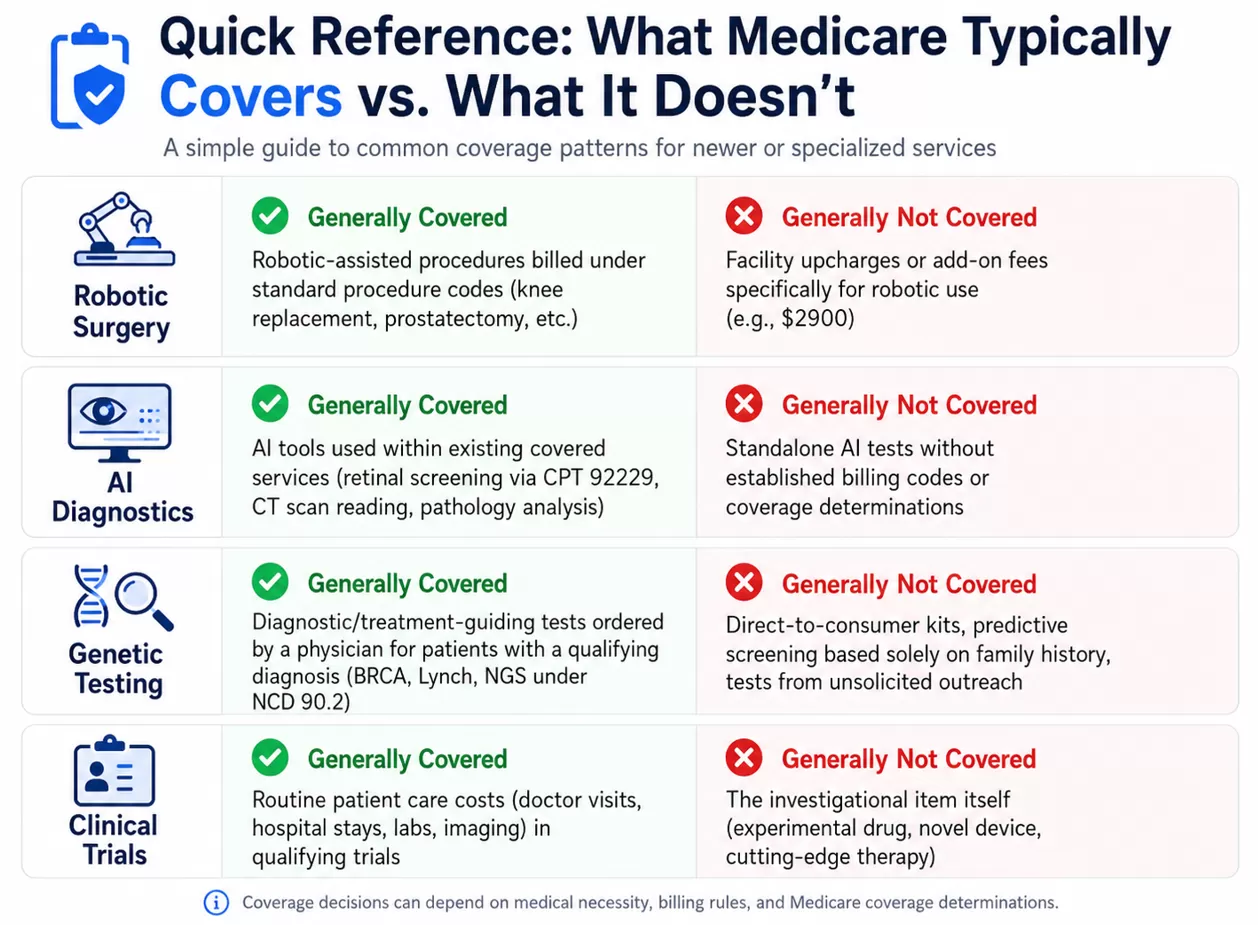
The technology your doctor uses is changing faster than most people realize. Medicare's coverage rules weren't designed for a world of robotic arms and AI image readers, but the framework is more flexible than it looks. Many advanced technologies are already covered because they're just new ways of delivering procedures Medicare has paid for all along. The key is knowing which side of the line your specific situation falls on, and confirming that before the procedure happens.
A licensed Medicare agent can help you understand how your specific plan handles coverage for new procedures and technologies, especially if you're weighing Original Medicare against Medicare Advantage for upcoming care.
Frequently Asked Questions
Does Medicare cover robotic knee replacement?
Medicare generally covers robotic-assisted knee replacement the same way it covers traditional knee replacement surgery. The robotic system is considered a tool the surgeon uses, not a separate service requiring its own approval. Your cost-sharing depends on inpatient vs. outpatient status, your plan type, and whether the facility adds any separate charge for the robotic component.
Does Medicare cover robotic hernia surgery?
Yes, Medicare generally covers robotic-assisted hernia repair (inguinal, umbilical, hiatal, or ventral) under the same coverage rules as traditional or laparoscopic hernia surgery, as long as the repair is medically necessary. The robotic component itself is not separately reimbursed. Ask the surgeon's billing office whether any facility fee is added for the robotic system.
Does Medicare cover AI medical tests?
Medicare may cover AI-assisted medical tests when the AI is used as part of a service Medicare already covers, such as a retinal exam, CT scan reading, or pathology analysis. If the AI tool operates within an existing covered clinical workflow and is billed under established procedure codes, Medicare generally treats it the same as the traditional version. Standalone AI tests without established billing codes are typically not covered.
Does Medicare cover genetic testing for cancer?
Medicare Part B may cover genetic testing for patients who already have a cancer diagnosis when the test is ordered by the treating physician, meets Medicare's coverage criteria, and is performed by an appropriate lab. For advanced cancer patients, CMS has a National Coverage Determination (NCD 90.2) that specifically addresses Next-Generation Sequencing tests. Predictive genetic testing based solely on family history is generally not covered under Original Medicare.
Does Medicare cover experimental treatments?
Medicare generally does not cover treatments that are considered experimental or investigational. However, if a treatment is delivered through a qualifying clinical trial, Medicare may cover the routine patient care costs (doctor visits, hospital stays, labs, imaging) while the trial sponsor covers the investigational item itself. Whether something counts as "experimental" depends on CMS coverage determinations, billing codes, and FDA status.
Does Medicare pay for clinical trials?
Medicare may cover routine patient care costs in qualifying clinical trials, including the medical services you would receive whether or not you were participating in the trial. The experimental treatment or drug is typically paid for by the trial sponsor. Medicare Advantage enrollees should check with both their plan and the trial coordinator, as some clinical trial costs may be processed through Original Medicare even while enrolled in an Advantage plan.
Does Medicare cover genetic testing based only on family history?
Under Original Medicare, genetic testing based solely on family history is generally not covered. Medicare coverage criteria for genetic tests typically require a current diagnosis or a direct clinical need for the test to guide treatment. Some Medicare Advantage plans may offer expanded preventive benefits that could include certain risk-based genetic screening, but this varies by plan. Always confirm coverage with your provider and plan before the sample is collected.
Official Medicare sources referenced in this article: