Does Medicare Cover THAT? 8 Surprising Coverage Answers from Agents

-
April 15, 2026

Reviewed by Michael Davis
Medicare Agent Licensed in MN, AL, AR & 42 other states
You know Medicare covers doctor visits and hospital stays. But what about a CPAP machine for your sleep apnea? A stairlift so you can safely stay in your home? Medical marijuana for chronic pain?
These are the questions that don't show up in the standard Medicare brochure, but they're the ones real seniors search for every day. We asked licensed Medicare agents across the country to weigh in on eight of the most surprising coverage topics. Some answers will frustrate you. Others might genuinely change how you think about your plan.
Here's what's actually covered, what's not, and why.
1. Does Medicare Cover Medical Marijuana?
Short answer: No, not even if your doctor prescribes it.
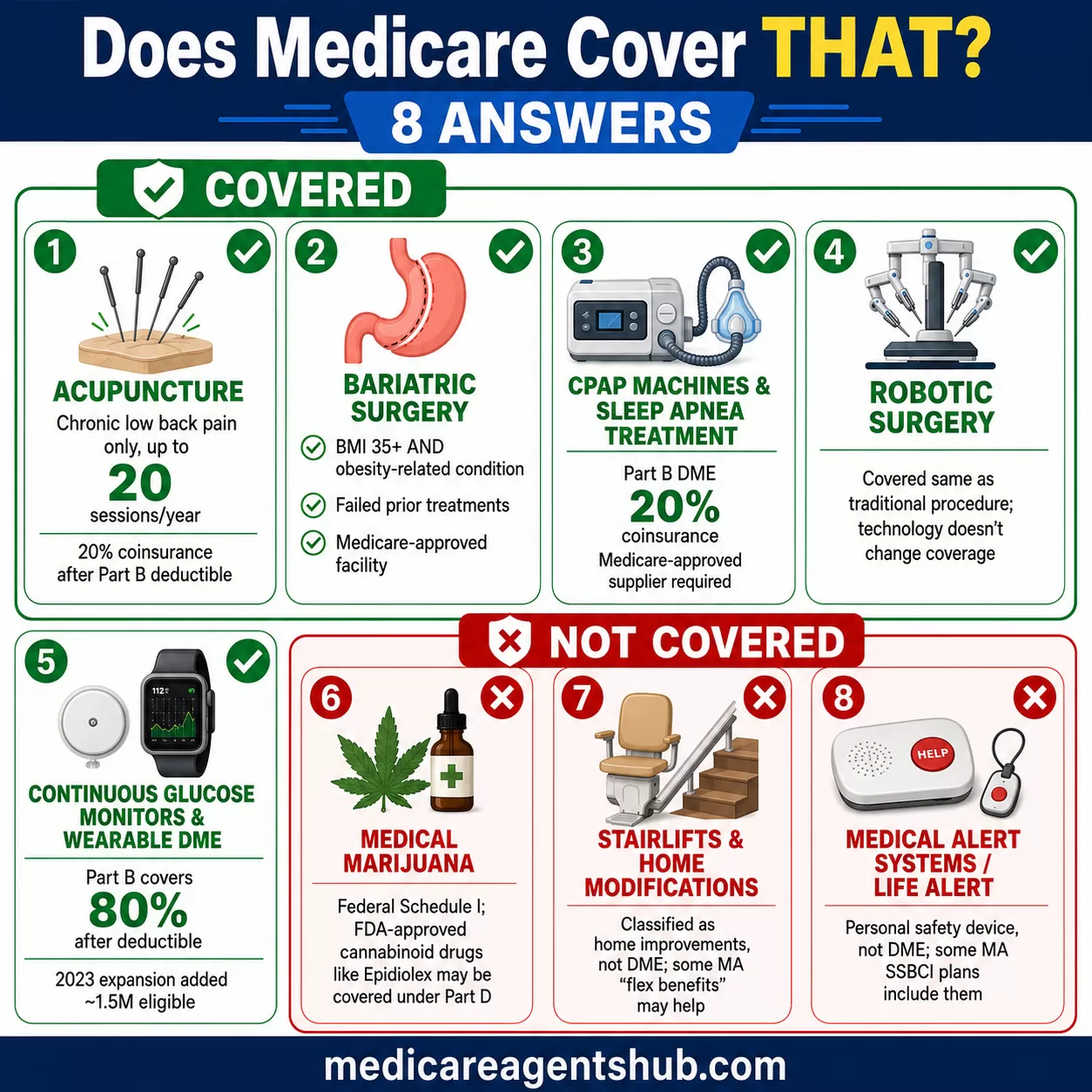
This is one of the most common questions seniors ask, especially in states where medical marijuana is legal. But Medicare is a federal program, and marijuana remains classified as a Schedule I controlled substance under federal law. That means no part of Medicare (not Part A, Part B, Part D, not even Medicare Advantage) can pay for it, regardless of your state's laws or your doctor's recommendation.
There is one important nuance: FDA-approved cannabinoid-based medications like Epidiolex (for certain types of epilepsy), Marinol, and Cesamet may be covered under Medicare Part D if they're on your plan's formulary and prescribed for an approved condition. But actual marijuana (flower, oils, edibles) is completely off the table.
If you're using medical marijuana for chronic pain or cancer, you'll pay entirely out of pocket. It's worth having a conversation with a licensed Medicare agent about what is covered for pain management, because there are real options.

Does Medicare cover medical marijuana if it's prescribed for chronic pain or cancer?
No, Medicare does not cover medical marijuana for chronic pain, cancer, or any other condition, regardless of state legality. Medicare will not pay for medical cannabis products, including flower, oils, or edibles.However, There are some exceptions for FDA approved cannabinoid-based drugs. Examples include Epidiolex (for specific epilepsy types), Dronabinol (Marinol) (for cancer-related nausea or AIDS-related weight loss), Syndros (dronabinol solution) and Cesamet (nabilone).
2. Does Medicare Cover Acupuncture?
Short answer: Yes, but only for one specific condition.
Original Medicare Part B covers acupuncture exclusively for chronic low back pain, defined as pain lasting 12 weeks or longer. You're allowed up to 12 sessions in 90 days, and if your condition improves, Medicare may approve up to 8 additional sessions for a maximum of 20 per year. You'll pay 20% coinsurance after your Part B deductible.
For anything beyond chronic low back pain (migraines, nausea, general pain management), Original Medicare won't cover acupuncture. However, many Medicare Advantage plans go further, offering expanded acupuncture coverage for additional conditions. Some plans also include other alternative therapies like chiropractic care or massage therapy as supplemental benefits.
The key takeaway: if acupuncture is important to you, check the Summary of Benefits for any plan you're considering. Coverage varies dramatically from plan to plan, and even zip code to zip code.

Does Medicare Advantage cover acupuncture or alternative therapies in some plans?
Yes, some plans do cover acupuncture. Medicare allows for acupuncture to be covered for a certain number of visits, but only for chronic low back pain. Each plan has different benefits regarding acupuncture, so it's best to check the summary of benefits or the evidence of coverage before choosing a plan, if you know you would like acupuncture treatments.3. Does Medicare Cover Stairlifts or Home Modifications?
Short answer: No. Medicare considers these home improvements, not medical equipment.
This one catches a lot of people off guard. Even if your doctor recommends a stairlift, grab bars, or a wheelchair ramp for safety, Original Medicare won't cover them. The reason? Medicare draws a hard line between durable medical equipment (DME) (items like wheelchairs, walkers, and hospital beds that you can move in and out of your home) and home modifications that are permanently attached to your home's structure.
A stairlift gets bolted to your stairs. A ramp gets built onto your porch. In Medicare's eyes, that makes them construction projects, not medical equipment. It doesn't matter how medically necessary they are.
That said, don't give up. Some Medicare Advantage plans now include limited home safety benefits (sometimes called "flex benefits") that may cover grab bars, ramps, or small modifications for members with chronic conditions. Beyond Medicare, there are real alternatives worth exploring: Medicaid waiver programs in many states cover home modifications for eligible seniors, VA benefits include grants for veterans, and various nonprofit organizations and Area Agencies on Aging offer financial assistance for aging-in-place upgrades.

Are home modifications (like stairlifts) ever covered by Medicare for safety reasons?
Medicare pays for stuff you can roll through the front door, not for hiring a carpenter. So Original Medicare won’t buy a stairlift or remodel your house. It will cover certain medical gear in the home like walkers, hospital beds, and patient lifts that pick you up, not lifts that take you up the stairs.Where it sometimes works is with certain Medicare Advantage plans. Some of them set aside a “home safety” or “flex” benefit for things like grab bars, ramps, or small fixes when they’re medically necessary and preapproved. A few plans will entertain bigger items in special cases, but it’s very plan specific and not common. If someone also has Medicaid or is a veteran, there may be separate programs that help with home modifications.
4. Does Medicare Cover Medical Alert Systems (Like Life Alert)?
Short answer: No. Original Medicare classifies these as personal safety devices, not medical equipment.
Despite how essential they feel for fall-prone seniors, medical alert systems don't meet Medicare's definition of durable medical equipment. A Life Alert pendant or fall-detection watch is considered a convenience or safety item, not something that treats, diagnoses, or manages a medical condition. So Original Medicare (Parts A and B) won't pay for the device or the monthly monitoring fees.
The exceptions? Some Medicare Advantage plans include medical alert systems as part of their supplemental benefits, particularly through Special Supplemental Benefits for the Chronically Ill (SSBCI) programs. Coverage varies widely: some plans provide a free device, others offer a discount, and many don't include it at all.
If this is a priority for you or a loved one, also check with your state Medicaid program, local aging agencies, and veteran's benefits. These are often better paths to getting a subsidized or free alert system than Medicare.

Does Medicare pay for medical alert systems?
Medical alert systems are not covered by original Medicare as they are not considered treatment devices that would be covered by part B durable medical equipment. There are currently some Medicare Advantage plans that do offer select alert systems, and other plans that may offer a discount.5. Does Medicare Cover Bariatric Surgery?
Short answer: Yes, if you meet strict medical criteria.
This is where things get nuanced. Medicare does not cover commercial weight-loss programs (like Jenny Craig or Weight Watchers), gym memberships, meal plans, or weight-loss medications prescribed solely for obesity. Elective bariatric surgery to lose weight? Also no.
But if obesity is creating serious health problems, Medicare can step in. Here's what is covered:
- Obesity screening and behavioral counseling — covered if your BMI is 30 or higher, provided by your primary care doctor in a clinical setting
- Bariatric surgery (gastric bypass, laparoscopic banding, sleeve gastrectomy) — covered when all of the following are true:
- Your BMI is 35 or higher
- You have at least one obesity-related health condition (type 2 diabetes, heart disease, COPD, high blood pressure)
- You've tried and failed other medically supervised weight-loss treatments
- The surgery is performed at a Medicare-approved facility
If you think you might qualify, start the conversation with your doctor now. The documentation requirements take time, and prior authorization is typically required.

Does Medicare cover weight-loss programs or bariatric surgery if I’m classified as obese?
Medicare does not cover general weight loss programs or things like gym memberships. It does cover certain obesity counseling visits with your doctor. Bariatric surgery can be covered if you meet specific conditions such as a body mass index of 35 or higher with at least one obesity related health problem and if other treatments have not worked. Your doctor has to document this and the surgery must be done at a Medicare approved facility.6. Does Medicare Cover CPAP Machines and Sleep Apnea Treatment?
Short answer: Yes. It's covered as durable medical equipment under Part B.
Good news if you've been diagnosed with sleep apnea: Medicare Part B covers both the diagnostic sleep study (in-lab or approved home sleep tests) and the CPAP machine and supplies when prescribed by a Medicare-enrolled provider. The sleep study is the first step; you need an official diagnosis before Medicare will approve the equipment.
Under Original Medicare, you'll pay 20% coinsurance after meeting your Part B deductible. If you have a Medicare Supplement (Medigap) plan, it may cover that remaining 20%. Medicare Advantage plans cover CPAP as well, though the specific copay varies by plan.
One important detail: Medicare requires that your CPAP machine and supplies come from a Medicare-approved supplier. Don't buy a machine on your own and expect reimbursement. Always verify the supplier accepts Medicare assignment before purchasing.

Does Medicare cover CPAP machines and sleep apnea treatment?
Yes, Medicare has covered my CPAP machine and supplies for years. You will need a prescription script to get the sleep apnea treatment covered by Medicare. Just make sure your CPAP comes from a Medicare approved supplier and the machine is on their approved list7. Does Medicare Cover Robotic Surgery?
Short answer: Yes. Medicare covers the procedure, regardless of the technology used.
This is one of the most pleasant surprises on this list. If your surgeon recommends a robotic-assisted procedure, whether it's a knee replacement, prostatectomy, or another surgery, Medicare doesn't care whether a robot was involved. Coverage is based on the procedure itself, not the technology used to perform it.
That means a robotic knee replacement is covered the same way as a traditional knee replacement, as long as it's deemed medically necessary and performed at a Medicare-approved facility by a Medicare-participating surgeon. The robotic component isn't billed separately; it's simply part of the surgical procedure.
Your out-of-pocket costs depend on your coverage type. With Original Medicare, Part A covers the inpatient stay and Part B covers outpatient services and doctor fees. You'll owe your deductible plus 20% coinsurance. With a Medigap plan, most or all of that 20% is covered. Medicare Advantage plans may require prior authorization and have their own copay structure for outpatient surgery.

I'm interested in a robotic knee replacement surgery that my surgeon recommends for my specific anatomy. How does Medicare coverage work for this advanced procedure?
Medicare does cover knee replacement surgery, including robotic-assisted procedures, as long as the surgery is considered medically necessary and performed at a Medicare-approved facility.The robotic component itself isn’t billed separately, so your coverage depends more on whether your surgeon and hospital accept your Medicare plan, and your out-of-pocket costs will vary depending on whether you have Original Medicare with a supplement or a Medicare Advantage plan.
8. Does Medicare Cover Continuous Glucose Monitors and Wearable Medical Devices?
Short answer: Yes. CGMs are covered as DME under Part B, and many other wearable devices qualify too.
If you have diabetes and use insulin (or have a history of problematic hypoglycemia), Medicare Part B covers continuous glucose monitors, including popular systems like the Dexcom G6/G7 and FreeStyle Libre 2/3, as durable medical equipment. Medicare expanded CGM eligibility in 2023, making approximately 1.5 million more people eligible. Your doctor must prescribe the device and confirm that you (or your caregiver) can use it properly.
Medicare covers 80% of the approved cost after your Part B deductible, and the device can connect to a smartphone app for real-time glucose tracking. Just note: Medicare won't pay for the smartphone itself.
Beyond CGMs, Medicare Part B also covers other wearable medical devices classified as DME, including insulin pumps and certain seizure monitors, when prescribed by a doctor and deemed medically necessary. The key requirement: the device must be FDA-approved, purchased from a Medicare-approved supplier, and used to manage a documented chronic condition.

Can Medicare cover wearable medical devices like insulin pumps or seizure monitors for chronic conditions?
Yes. Medicare can cover certain wearable medical devices, but only when they meet Medicare’s rules for Durable Medical Equipment (DME) and your doctor documents that they’re medically necessary. Devices like insulin pumps are often covered under Part B, while others, such as seizure monitors or wearable sensors, may be covered only if they’re FDA‑approved and classified as DME.The key is that your doctor must show Medicare why you need the device and that it meets Medicare’s equipment criteria. If it does, Medicare will review it for coverage.
If you rely on any wearable medical technology, always verify that your specific device model and supplier are Medicare-eligible before purchasing. Buying first and hoping for reimbursement is a recipe for an expensive surprise.

I use a continuous glucose monitor for my diabetes that connects to my smartphone. Will Medicare cover this technology for someone with my condition?
Yes! Medicare Part B can cover a continuous glucose monitor (CGM) if your doctor prescribes it and you meet certain requirements, like having diabetes and needing insulin or having issues with low blood sugar. Medicare will cover the CGM and the supplies as durable medical equipment, though you’ll still be responsible for 20% of the approved cost after your Part B deductible.Just keep in mind that Medicare won’t pay for your smartphone — even if the CGM connects to an app. The device itself needs to meet Medicare’s requirements, and your doctor has to prescribe it and make sure you know how to use it. If you have a Medicare Advantage plan instead, coverage is usually similar, but it’s a good idea to double-check with your plan to be sure.
The Bottom Line: Always Ask Before You Assume
Medicare's coverage rules aren't always intuitive. A $3,000 robotic surgery? Covered. A $30/month medical alert pendant? Not covered. The pattern isn't about cost; it's about how Medicare classifies things: medically necessary treatment vs. home modification vs. personal convenience.
The biggest takeaway from these eight answers is that your specific plan matters enormously. Original Medicare, Medicare Advantage, and Medigap plans all handle these topics differently. What's excluded under Original Medicare might be a free supplemental benefit under the right Advantage plan, and vice versa.
If you're wondering whether Medicare covers something specific to your situation, don't guess. Talk to a licensed Medicare agent who can look at the actual plans available in your area and match them to your needs. That's what they're there for, and the consultation doesn't cost you a thing.