Supplements, Herbs, and Homeopathy: Medicare's Coverage Rules

-
November 7, 2025

Reviewed by Gabrielle Moore
Medicare Agent Licensed in IN, AL, AR & 42 other states
If you're navigating the world of holistic health and aging, you're probably asking: "Does Medicare cover supplements, herbs, homeopathy or other natural/alternative-medicine treatments?" The short answer: often not, but as always with Medicare, the full story is more nuanced. Here's what's covered, what's not, and how to fill the gaps.
What Medicare Does Cover (and Why It Matters)
Original Medicare (Part A for hospital, Part B for medical) is built around "medically necessary" and "accepted standard of care" services. That means if a therapy or item is recognized, prescribed by a qualified provider, and meets defined conditions, it may be covered. For example:
-
Under Part B, Medicare covers some outpatient prescription drugs in certain settings.
-
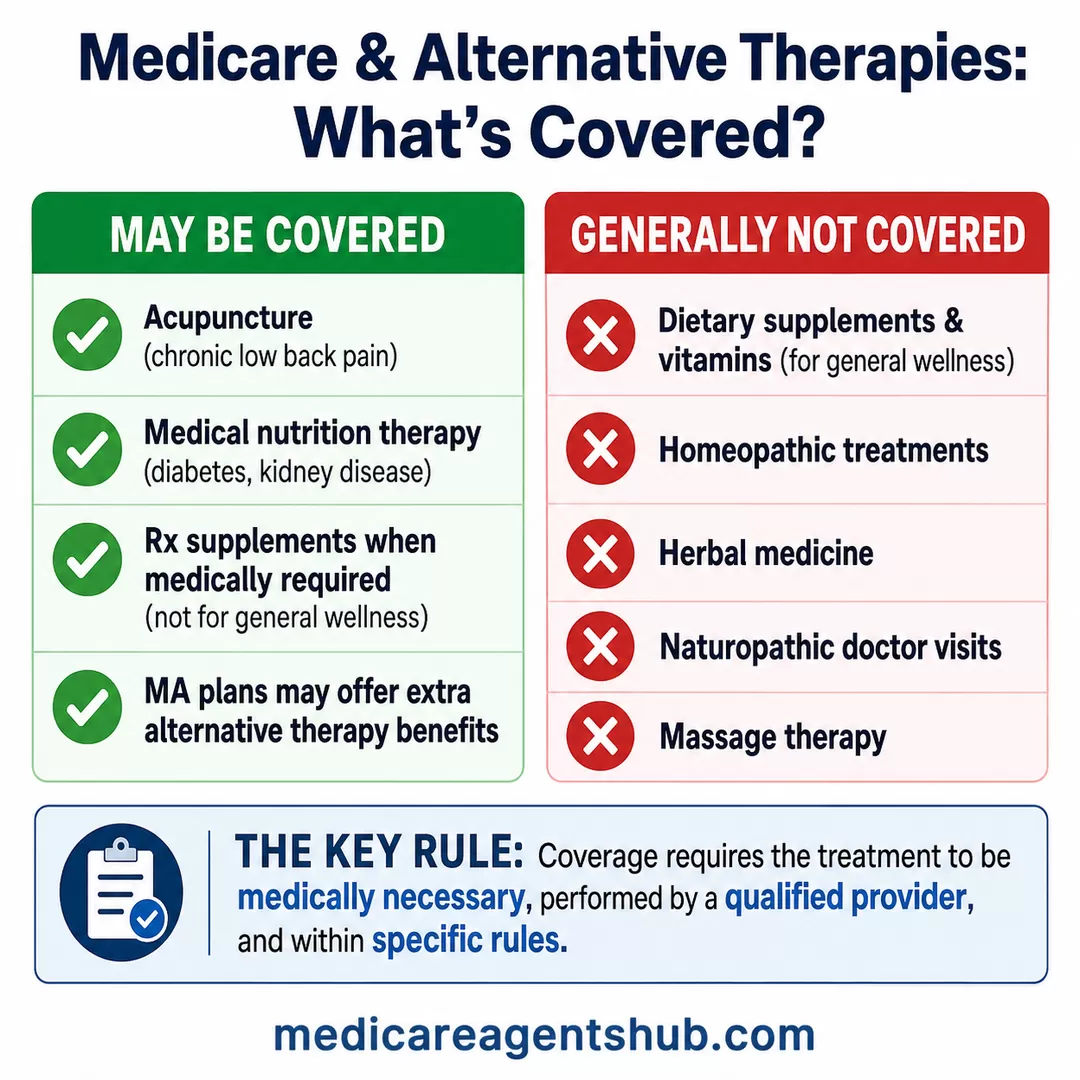
Also under Part B, Medicare covers acupuncture for chronic lower back pain, when provided by a qualified practitioner.
-
In some cases for nutritional therapy: Medicare may cover medical nutrition therapy (e.g., for diabetes, kidney disease) and in very limited situations oral nutritional supplements when medically required (not simply wellness).
So, yes, there are conditions under which related services get coverage. However they are specific, limited, and don't always line up with what many people mean by "natural medicine."

My doctor wants me to try acupuncture for my back pain. Will Medicare cover any of this?
Medicare may cover some acupuncture. If the treatment is for chronic lower back pain, your doctor prescribes it and you receive it from a Medicare approved practitioner, Medicare may pay for up to twelve sessions, and possibly eight additional if progress is being made. It will not pay for any other reasons.What Medicare Does Not Cover (and That Includes Most Supplements, Herbs, Homeopathy)
When it comes to herbs, dietary supplements, homeopathic remedies, broad alternative-medicine visits, and naturopathic doctors, the coverage picture is quite restrictive. Here are some key points:
-
Visits to naturopathic doctors (NDs) are generally not covered under Original Medicare, because NDs are not recognized as eligible providers under Medicare.
-
Homeopathy (which uses highly diluted substances with the aim of triggering the body's own healing) is typically considered an alternative therapy, and known to fall outside standard Medicare coverage.
-
Dietary supplements, vitamins, herbs: In most cases, Medicare does not pay for them simply because they are "good for wellness" or preventive. Unless there is a specific medically-necessary indication, these items are not covered.
-
Alternative therapies broadly: services like massage therapy, many homeopathic remedies, herbal medicine, unproven treatments. These are often listed among items and services Medicare doesn't cover.
Are Homeopathic and Naturopathic Doctors Covered by Medicare?
In most cases, no. Original Medicare does not recognize homeopathic doctors or naturopathic doctors as eligible providers, so office visits to either are not billable to Medicare. That's true even when the practitioner holds a state license. A few Medicare Advantage plans include limited allowances for alternative-medicine visits as an extra benefit, but coverage is plan-specific and not guaranteed. If you rely on a homeopath or naturopath, expect to pay out of pocket unless your MA plan explicitly lists that benefit.
In plain language: if you walk into an alternative-health clinic and expect Medicare to pay for "herbal remedies" or "homeopathic treatments" the answer is almost always no (at least under Original Medicare).

Does Medicare cover supplements, herbs, homeopathy or other natural / alternative-medicine treatments?
Original Medicare does not cover supplements, herbs, homeopathy, or most alternative treatments.Not covered:
• Vitamins and dietary supplements
• Herbal remedies
• Homeopathic treatments
• Naturopathic care
Limited exceptions:
• Chiropractic spinal manipulation
• Acupuncture for chronic low back pain only
Part D covers FDA-approved prescription drugs, not over-the-counter or natural products.
Some Medicare Advantage plans offer small OTC allowances, but coverage is limited and varies by plan.
Why This Matters: Trade-Offs and Perspectives
From the patient's viewpoint: If you're someone who values natural medicine, herbs, homeopathy, etc., you'll probably feel frustrated by how limited coverage is. You might ask: "I'm paying into Medicare, why can't I use it for the therapies I believe in?" That's a fair question. The system is designed around conventional medicine, scientific evidence, and recognized provider types. Many herbal or homeopathic treatments lack large-scale clinical trials that satisfy Medicare's "medically necessary" standard.
From Medicare's design viewpoint: The agency must decide what it will pay for, and the standard tends to lean toward treatments backed by evidence and widely accepted in mainstream medicine. That means many alternative therapies fall outside. But Medicare does evolve. For instance, acupuncture coverage for chronic low back pain is a relatively recent expansion.

Does Medicare Advantage cover acupuncture or alternative therapies in some plans?
Yes. Some Medicare Advantage plans do cover acupuncture and other alternative therapies, but it depends on the specific plan.Original Medicare only covers acupuncture for chronic lower back pain under strict rules.
Medicare Advantage plans, however, can offer extra benefits — and some include additional acupuncture visits, chiropractic care, massage therapy, or other wellness options.
Coverage varies by plan, so it’s important to check the plan’s Summary of Benefits to see what’s included and what the copays are.
From the integrative health viewpoint: Many practitioners of naturopathy, homeopathy, and holistic medicine argue that these treatments have value, especially for prevention, wellness, and long-term health maintenance. They point out that Medicare's system is slow to adapt to new models of care. The organization representing naturopathic physicians has been actively advocating for inclusion in Medicare coverage.
So you're caught between: wanting access to more of these alternative treatments (and being willing to pay out of pocket) vs. understanding that coverage will be limited unless the treatment meets specific conditions.
The short video below breaks down how Medicare views alternative therapies in plain terms.
What You Should Do If You're Exploring Supplements, Herbs, or Homeopathy Under Medicare
Here are some practical steps you can take:
-
Check whether your therapy is medically necessary. Ask your doctor: does this treatment meet accepted standards of medical practice, and is it "medically necessary"? If not, likely no Medicare coverage.
-
Check provider qualification. For therapies that are covered (for example, acupuncture under specific conditions), the provider must meet Medicare's standards (state license, accredited school, etc.).
-
Review your plan carefully. If you have a Medicare Advantage (Part C) plan, it may offer extra benefits for alternative therapies beyond Original Medicare, but it depends on the plan. Some MA plans now include benefits most people don't even realize they have.
-
Ask about supplements and herbs explicitly. Even if your doctor prescribes a vitamin or supplement, it doesn't guarantee coverage. For example, Medicare might cover a vitamin D analog when used to treat a diagnosed condition, but not simply for "general wellness."
-
Consider working with an agent. Medicare's fine print can be tough. It helps to talk with a licensed Medicare agent who knows the details of alternative therapy coverage and can help you compare plans in your area. Through Medicare Agents Hub, you can find an agent who specializes in this kind of question and help you evaluate plans that may offer broader benefits for holistic care. If you'd rather start with a free public option, your State Health Insurance Assistance Program (SHIP) offers unbiased Medicare counseling at no cost.
-
Plan for out-of-pocket expenses. If you believe strongly in an herb, homeopathic treatment, or wellness supplement, expect you may need to cover the cost yourself (or through a supplementary private insurance plan) unless you meet the narrow criteria for coverage. Understanding what Original Medicare doesn't cover can help you plan ahead.
-
Keep documentation. If you end up getting a treatment that you hope might be covered (or partially covered), make sure you have documentation from your physician stating the medical necessity, the diagnosis, and the provider's credentials.

Does Medicare Advantage cover acupuncture or alternative therapies in some plans?
It will depend on your particular Medicare Advantage plan. Check the specific plan’s Evidence of Coverage (EOC) or call the provider to confirm coverage for specific treatments.many Medicare Advantage (Part C) plans cover acupuncture and some alternative therapies, often offering broader coverage than Original Medicare. While Medicare only covers acupuncture for chronic low back pain (up to 20 visits/year), some Advantage plans include coverage for other conditions like nausea, migraines, or other pain types.
Frequently Asked Questions
Does Medicare cover naturopathic or homeopathic doctors?
Original Medicare does not cover visits to naturopathic doctors or homeopathic practitioners, because neither is recognized as an eligible Medicare provider. A small number of Medicare Advantage plans offer limited allowances for alternative-medicine visits as a supplemental benefit, but you'll need to confirm coverage in your specific plan's Evidence of Coverage before booking.
Will my Medicare Advantage plan cover vitamins or supplements?
Some Medicare Advantage plans include an over-the-counter (OTC) allowance that can be used toward vitamins, supplements, and certain wellness items. The amount and eligible products vary widely by plan and by year, so check your plan's OTC catalog before assuming a specific supplement qualifies.

Does Medicare cover supplements, herbs, homeopathy or other natural / alternative-medicine treatments?
Medicare does not cover most of such treatments.You should check specific notations in the Medicare & You Booklet available at Medicare.gov.
Some Medicare Advantage plans offer over-the-counter benefits in addition to what Medicare requires they cover. It would be a plan-by-plan possible benefit, extra coverage.
Medicare Supplement plans do not typically cover anything which Medicare does not cover. Although I have seen one plan which does offer over-the-counter, additional benefits.
Does Medicare Part D cover herbal remedies or homeopathic drugs?
No. Part D formularies are limited to FDA-approved prescription drugs. Herbal products, homeopathic preparations, and dietary supplements are excluded by law, even if a doctor recommends them.
How do I find out if a specific alternative treatment is covered?
Start with your provider's billing office and ask whether the service is billable to Medicare under a specific diagnosis code. You can also call 1-800-MEDICARE, review your plan's Evidence of Coverage, or ask a licensed Medicare agent to look it up against your specific plan.
The Takeaway
Medicare generally does not cover supplements, herbs, or homeopathy unless the treatment is clearly medically necessary, performed by a qualified provider, and fits within very specific coverage rules. For anyone leaning into natural or holistic medicine, the key is understanding those rules and not assuming automatic coverage.
You can still use these therapies, but often you'll pay out of pocket, or you'll need to pick a plan (perhaps a Medicare Supplement or Medicare Advantage plan) that offers extra benefits. A knowledgeable Medicare agent can walk you through your options, highlight which plans in your region may offer better coverage for holistic or alternative treatments, and help you avoid surprises. If you're curious about other coverage rules that catch people off guard, our breakdown of 8 surprising Medicare coverage answers goes beyond alternative medicine.
This article is for informational purposes and is not medical advice. Always consult your healthcare provider and your Medicare plan for guidance specific to your situation.