Medicare for veterans: how to get the most out of Medicare with VA benefits

-
Last Updated September 28, 2026

Reviewed by Sebastian Michaud
Medicare Agent Licensed in AL, AR, AZ & 41 other states
Veterans who receive benefits from the VA are often unsure whether they need Medicare. Most do best with both. VA benefits and Medicare are separate systems that cover different ground, and using them together gives you broader coverage than either one alone.
Quick answer: You don’t have to enroll in Medicare to keep your VA benefits, and most veterans should anyway. VA care only covers you inside VA facilities. Medicare covers the doctors, hospitals and pharmacies outside them. Skipping Part B at 65 gets expensive if you later lose VA eligibility, move away from a VA facility, or want to see a civilian doctor, because the Part B late enrollment penalty is permanent.
Should I get Medicare if I have coverage from the VA?
Enrolling in Medicare when you are eligible is often the recommended route. Coverage and benefits between the VA and Medicare are different.
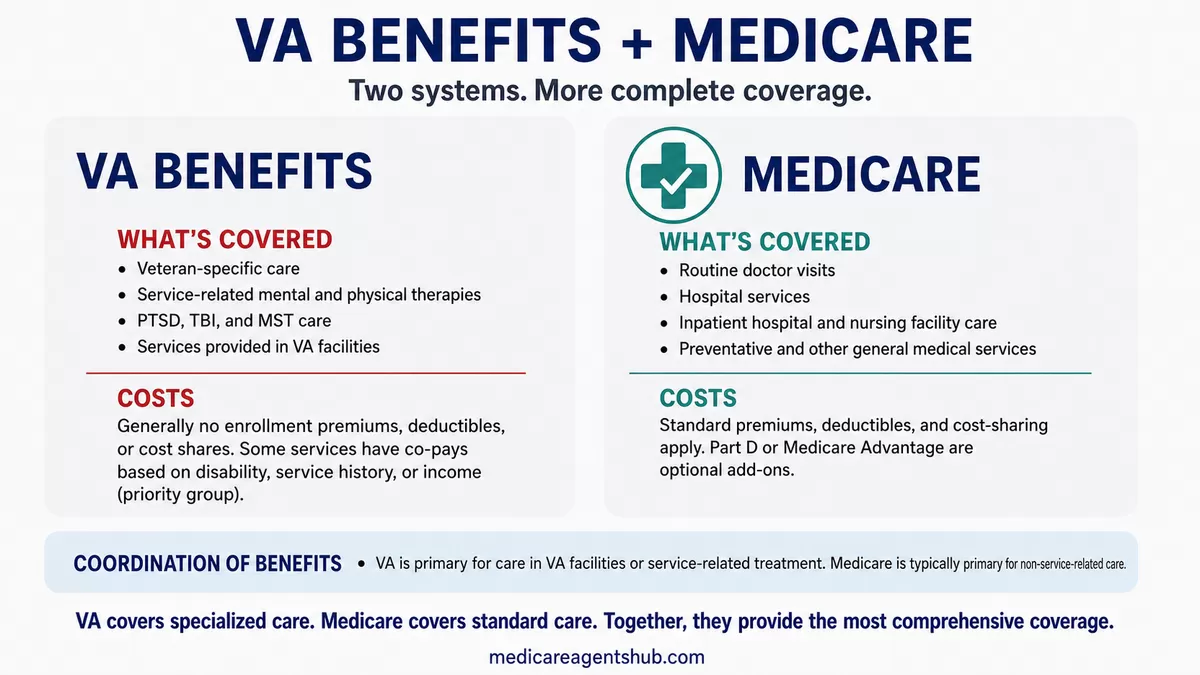
Medicare and its parts cover services from hospitals, doctors, and other general medical services. For your routine and regular doctor visits and health care, Medicare will provide coverage. VA benefits will not cover Medicare costs.
VA benefits cover services that are unique to veterans. Common services from the VA include mental and physical therapies for conditions suffered due to military service. These services are often provided in VA facilities and are not covered by Medicare.
Medicare vs VA health care: what each one covers
| Type of care | Which system pays |
|---|---|
| Care at a VA hospital or clinic | VA. Medicare pays nothing for care delivered at a VA facility. |
| Treatment for service-connected conditions (PTSD, TBI, military sexual trauma) | VA |
| Prescriptions filled at a VA pharmacy | VA |
| Visits to a non-VA doctor or specialist | Medicare |
| Inpatient stay at a community (non-VA) hospital | Medicare |
| Emergency care at the nearest non-VA hospital | Usually Medicare. The VA only pays for outside emergency care in limited situations, and the rules are strict. |
| Prescriptions filled at a retail pharmacy | Part D or a Medicare Advantage drug plan |
| Routine dental, vision and hearing | VA covers some of this for enrolled veterans. Original Medicare doesn’t. Many, but not all, Medicare Advantage plans include it, so check the specific plan documents. |
If you qualify for both VA health care and Medicare, the usual advice is to do both: apply for VA health care and enroll in Medicare. Together they cover the most ground.

I’ll be turning 65 in April. I have full VA coverage and good hospital and doctor coverage through Eisenhower here in the desert. The VA doesn’t provide dental care. Do I still need to enroll in Medicare, and if so, which part makes sense for my situation?
Yes, you should enroll in Medicare Parts A and B when you turn 65 to gain more healthcare options and avoid potential late enrollment penalties, even with VA coverage.* Part A (hospital insurance) is often premium-free and complements your VA coverage for hospital stays.
* Part B (medical insurance) covers doctors and outpatient services outside the VA system.
Enrolling gives you the choice to use VA care or civilian providers, provides flexibility if VA benefits change, and allows you to add a Part D prescription plan for a wider network of pharmacies.
VA Benefits: When to apply and what to know?
When you can apply comes down to eligibility. Veterans who meet basic service and discharge requirements qualify for VA health care.
Eligibility depends largely on time and length of service, disability status, character of discharge, and more. To verify eligibility, you can see qualifying factors on va.gov.
You can apply at any time after you leave the service, but applying within one year of your separation date protects you against having certain conditions treated as pre-existing, so it’s worth doing sooner rather than later.
Whether you should apply comes down to your needs, though if you’re eligible there’s rarely a reason not to. VA health care has no monthly premium and no deductible. Copays are a different story, and they depend on your priority group. Veterans in groups 1 through 6 often pay little or nothing, especially for service-connected care. Veterans placed in groups 7 and 8, generally those with higher incomes and no service-connected disability rating, do pay copays for some services and prescriptions. Check the current VA copay rates on va.gov before you assume your care is free.
Upon enrollment, you are assigned to a priority group. This will determine your coverage and costs. Your coverage and costs can change over time, as can your priority group assignment.
After enrolling, specialized care is available to you, often aimed at treating health issues and other issues common with elderly veterans. Examples of these services include care for post-traumatic stress disorder (PTSD), traumatic brain injuries (TBI), and military sexual trauma (MST).
If you have VA coverage, you are not required to enroll in Medicare. However, you are able to, and it is encouraged.
Medicare coverage: When to apply and what to know?
Individuals qualify for Medicare once they reach the age of 65, except in certain cases that qualify them earlier. There are also other periods in which you may enroll instead, however these are more circumstantial. Typically, you initially enroll in Medicare Parts A and B, though some may defer part B if they still work. You also have the choice to add Part D prescription drug coverage, or get a Medicare Advantage plan. What you enroll for largely depends on the coverage you need.
A VA disability rating on its own doesn’t make you Medicare-eligible, which catches some veterans off guard. Medicare before 65 comes through Social Security Disability Insurance, and it starts after 24 months of SSDI payments. A 100% VA rating and an SSDI award are separate decisions made by separate agencies.
Most Medicare beneficiaries are enrolled in Parts A and B, either on Original Medicare or through a Medicare Advantage plan. This covers your regular doctor visits, inpatient hospital and nursing facilities, preventative services, and more. Where VA benefits cover your specialized care, Medicare will cover your standard care.
The best time to apply is during your initial enrollment period. This period begins 3 months before you turn 65 and lasts until 3 months afterwards. Enrolling later could subject you to late enrollment fees. Even with VA benefits, Medicare works alongside to offer more complete health care coverage.

What are some lesser-known benefits or services that my Medicare plan might cover that I could be missing out on?
Did you know your Medicare plan might include hidden perks you're not using? From monthly OTC allowances and free gym memberships to dental, vision, hearing, meal delivery, and even rides to the doctor — many Medicare Advantage plans go way beyond basic coverage. Some even offer in-home help, teletherapy, and free smartphones for qualifying members. Don’t leave benefits on the table — check your plan or talk to a licensed agent to unlock everything you’re entitled to!VA and Medicare together: which one pays first?
One thing that trips a lot of veterans up: VA and Medicare do not coordinate benefits the way two civilian insurance plans do. There’s no primary and secondary payer between them, and one won’t pay the balance the other leaves behind.
Instead, each system pays for care delivered inside its own network. When you use a VA facility, the VA pays. When you use a non-VA doctor or hospital, Medicare pays (if the service is covered). This is why enrolling in both matters: each one covers the ground the other doesn’t. See our companion piece on how VA coverage and Medicare fit together for more detail.

I have VA health benefits and Medicare — which one pays first when I get care?
When you have both VA benefits and Medicare, the two programs do not work together or coordinate to share the cost of a single medical bill. Instead, who pays depends entirely on where you go for care.If you go to a VA facility or use VA-authorized care, the VA covers it. Medicare does not pay for services received within the VA system.
If you go to a regular, civilian doctor or hospital, Medicare covers it. The VA will not pay for routine medical care outside its own network unless it was specifically pre-approved by them.
Essentially, you choose which system to use each time you need medical treatment, and that program handles the bill entirely.
Should I buy Medicare Part D if I have VA drug coverage?
If your prescription drugs are covered by VA benefits, you do not need Medicare Part D. Additionally, VA coverage for drugs is considered “creditable coverage” by CMS. This means you won’t have to pay a penalty if you decide to sign up for Part D later. You will have 63 days after losing VA drug benefits to enroll in Part D.
However, VA health care is limited to VA pharmacies, facilities and providers. You may consider signing up for Part D if:
- Your drugs are not covered by the VA
- You need your prescription filled at a nearby pharmacy, as opposed to a VA pharmacy
- Co-payments for the drugs are lower on a Part D plan than from VA. VA copays for prescription drugs can vary by priority level.
Can you have a Medicare Advantage plan and VA benefits?
Yes. Joining a Medicare Advantage plan doesn’t touch your VA eligibility or your priority group. Plenty of veterans carry both.
The catch is that the two never talk to each other. The VA won’t bill your Medicare Advantage plan for care you get at a VA facility, and that care doesn’t count toward your plan’s deductible or out-of-pocket maximum. If the VA handles most of your health care, you may be paying premiums on a plan you barely touch.
Three things to check before you sign up:
- The network. Advantage plans are built around local doctors and hospitals. If you live an hour from the nearest VA clinic and expect to use civilian providers for routine care, network breadth matters more than any extra benefit on the brochure.
- Overlapping extras. Dental, vision, hearing and over-the-counter allowances are the main pitch on most Advantage plans, and enrolled veterans already get some of that from the VA. Picking a plan for the extras alone is a bad trade when you’re covered twice.
- Drug coverage. Most Advantage plans bundle Part D. Fill everything at a VA pharmacy and that piece sits unused, and VA copays are usually lower anyway.
There’s no single best Medicare plan for veterans. It comes down to how much of your care runs through the VA. Veterans who use the VA for nearly everything often do fine keeping plain Original Medicare as a backstop for emergencies and civilian visits. Veterans who rarely set foot in a VA facility tend to get more out of an Advantage plan or a Medicare Supplement.
How do I know what is right for me?
Everyone has different health needs, so your coverage should be unique to your needs. As a general rule, we recommend you enroll in VA coverage and Medicare when eligible. However, your situation may not require it.
Your personal and family needs should be considered first and foremost. Each program should be considered for its costs and coverage. VA representatives, your state’s State Health Insurance Assistance Program (SHIP) counselors, and Medicare Advocates are all available to answer questions and make recommendations. SHIP counseling is free and unbiased, and it’s a good first stop if you’re just trying to understand your options.
See also how a local licensed agent can help, and thank you for your service!

What are the different benefits of Medicare Advantage from Medicare? Is Medicare Advantage more beneficial for someone with several health issues?
Medicare Advantage combines hospital, medical, and often drug coverage into one plan and may add benefits like dental, vision, and hearing. It usually has lower premiums but copays for services and a provider network, while Original Medicare with a supplement offers broader doctor access and more predictable costs, often better if you have several health issues. Not all doctors accept Advantage plans, so access can be limited. Since costs and coverage vary by plan and location, it’s best to review your options with an insurance agent to see which works best for your situation.Key takeaways for veterans
- Enroll in Medicare Parts A & B when eligible, even if you have VA coverage. The two systems complement each other.
- VA and Medicare don’t pay for each other’s services. VA covers care at VA facilities; Medicare covers care outside of it.
- VA drug coverage counts as creditable. You won’t face a Part D late enrollment penalty if you enroll later, as long as you sign up within 63 days of losing VA drug benefits.
- Missing your Medicare initial enrollment window can cost you. Late enrollment penalties for Part B stick with you for life.
Finding a Medicare agent who works with veterans
Your situation is unique. The best way to sort through your options is to talk with a licensed agent who understands both systems. Find a local Medicare agent in our directory to connect with someone who can help.
Need expert help? Consider Medicare Advocates
Medicare Advocates are specialists in Medicare coverage. They are licensed in all 50 states with trusted carriers to bring you the best plans available in your area. They offer Medicare reviews, consultations, and plan enrollment in person, over the phone, and online, and provide a link for consumers to shop themselves. They also partner with doctors, clinics, and other healthcare providers to educate their patients and guide them to coverage that matches their situation.
Disclosure: Medicare Advocates is a partner of MedicareAgentsHub.com.