Texas Medicare Brokers on the Mistakes They See Every Enrollment Season

-
July 18, 2026
Texas has more than 4.5 million Medicare beneficiaries, a figure that grows by roughly 10,000 new enrollees every month. But what makes Texas uniquely tricky for Medicare decisions isn't the size alone. It's the geography. A senior in downtown Houston faces completely different plan options, provider networks, and carrier competition than someone 200 miles west in Junction or 400 miles south in the Rio Grande Valley.
We asked the people who deal with this complexity daily. Medicare Agents Hub lists thousands of licensed Texas Medicare brokers, serving communities from Houston and Dallas to San Antonio, Austin, and the rural stretches in between. We put seven questions to them about the decisions that trip up Texas seniors most often.
Their responses covered enrollment timing, plan costs, the supplement window, and whether working with a local broker still matters in 2026. Some disagreed with each other. All of them had something worth hearing.
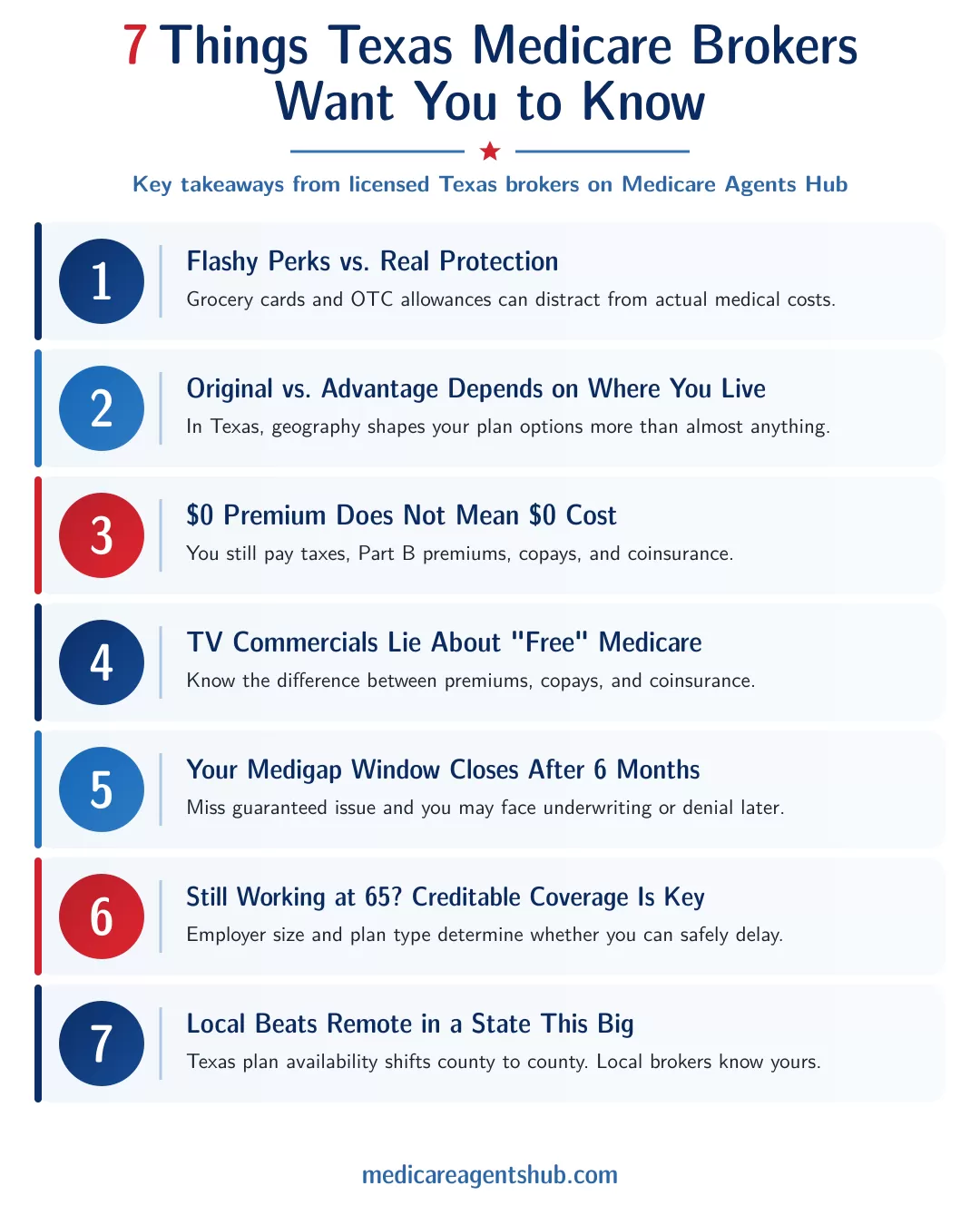
Flashy perks are distracting you from real protection
When we asked Texas brokers about the biggest mistake seniors make when enrolling, one answer stood out: people fall for the extras and ignore the core coverage.

What is the biggest mistake seniors make when enrolling in Medicare?
The biggest mistake seniors make is prioritizing short-term extra perks over long-term financial protection. Far too often, people place a greater value on flashy ancillary benefits—like healthy food allowances or grocery cards—instead of focusing on core medical costs like Inpatient Hospital copays, Specialist visit copays, and Urgent Care copays. Choosing a plan based on minor perks rather than medical exposure can lead to devastating consequences.A single unexpected inpatient hospital stay under the wrong plan can result in massive, life-altering medical bills. I have worked with many clients who struggle to get out from under these financial obligations, and for some seniors, the medical debt caused by a poorly chosen plan can physically outlive them.
I frequently meet with clients who deeply regret ignoring my advice in hindsight. They later wish they had chosen a plan with minimal ancillary benefits and the lowest overall maximum out-of-pocket expenses instead. When enrolling, your primary goal should always be safeguarding your health and finances against major medical emergencies. The extra perks should only be viewed as a secondary bonus.
This is a pattern Texas brokers see constantly during AEP. The TV ads push grocery allowances, OTC benefits, and meal delivery services, and seniors pick plans based on those perks without checking hospital copays, specialist access, or maximum out-of-pocket limits. In a state where a single ER visit in Houston's Texas Medical Center can run $15,000+, the difference between a plan with a $5,000 MOOP and one with $8,900 matters far more than a $50 monthly food card. If you've been choosing plans based on extra benefits alone, you're probably making one of the most common enrollment mistakes agents see nationwide.
Original Medicare vs. Advantage depends on where you live in Texas
We asked brokers the question that generates the most debate in Medicare: is Original Medicare or Medicare Advantage better? In Texas, the answer splits along geographic lines.

Is Original Medicare or Medicare Advantage better? Why do you recommend one over the other?
It truly varies by the individual person's needs as well as their geograhic location.Original Medicare provides more freedom to choose from any provider who accepts Medicare nationwide which is about 99% of them, but Medicare Advantage plans will have a limited network of providers to choose from and often require referrals, etc.
Texas has 254 counties. In the DFW metroplex and Houston metro, Medicare Advantage penetration is above 55%, with dozens of plan options competing for enrollment. Carriers like Humana, UnitedHealthcare, and Aetna fight aggressively for market share in those ZIP codes. But drive 90 minutes outside any metro area and the picture changes. Rural counties in West Texas and the Panhandle may only have 3 or 4 MA plans available, with narrower networks and fewer providers participating. For a rancher in Pecos County, Original Medicare with a Medigap plan might be the only way to see a specialist without driving 3 hours. That geographic variation is why the Advantage vs. Supplement decision can't be answered with a blanket recommendation.
The $0 premium question: no such thing as a free ham sandwich
Few things confuse Texas seniors more than the "free" Medicare Advantage marketing. We asked brokers directly: are these plans really free?

Are Medicare Advantage plans really "free," or is that just clever marketing?
Well, I learned in high school economics class that "there is no such thing as a free ham sandwich". Yes, it might be FREE to you, but somebody had to raise the pig and grow the wheat.Medicare Advantage plans may be "Zero Premium" to you, but you paid taxes (along with everyone else) and you pay a Part B premium (along with everyone else) so the government can pay the insurance companies to provide the Medicare Advantage plans.
I wouldn't call it "clever marketing". When I discuss options with a person who is turning 65, we look at the true annual out of pocket cost of having an Advantage plan VS a Medicare Supplement (MediGap) plan. The premium amount is only one part of the equation.
Tim's economics lesson applies perfectly to Texas Medicare. You paid into the system for decades through payroll taxes. You're still paying your Part B premium ($185/month in 2026 for most people). And when you actually use the plan, you'll face copays for doctor visits, coinsurance for procedures, and potentially thousands in out-of-pocket costs if you're hospitalized. The $0 premium just means there's no additional monthly charge on top of Part B. The actual cost shows up when you need care. In Texas metros, where competition drives carriers to offer more $0 plans, this distinction matters because you'll have 20+ "free" options that all cost very different amounts when you get sick.
The biggest misconception: TV says Medicare is free
When we asked about the most common misconception about Medicare, Texas brokers kept circling back to the same frustration: advertising that tells people everything is free.

What is one of the the most common misconceptions people have about Medicare?
That it is free. The T.V. commercials are misleading. Medicare is not free. Zero dollar Advantage Plans are not free and zero dollar drug plans are not free. Anything being touted as free, still has a cost. You must know the difference between a premium, a copay, and coinsurance. There is always a cost to every plan with the exception of a Full Dual Special Needs Plan for which most people do not qualify.Texas has no state income tax, which means many retirees have higher net income and sometimes assume Medicare will be similarly generous. It won't. You'll pay Part B premiums, potentially Part D premiums, and either a supplement premium or point-of-care costs through an Advantage plan. And if your modified adjusted gross income crosses certain thresholds, IRMAA surcharges add hundreds more per month. The brokers who brought up the "free" myth weren't being cynical. They were describing what happens daily in their offices: seniors walking in expecting everything to be covered, then learning they have a $1,736 Part A deductible for every hospital benefit period.
Why your first 6 months on Medicare matter most
We asked Texas agents about Medicare decisions people regret, and the Medigap guaranteed issue window dominated the conversation.

What's one Medicare decision that too many people regret later?
The decision to not go with a Medicare Supplement plan during your guaranteed issue period, the six month period that starts the month you turn 65.Or the decision to not go with a Medicare Supplement when you are younger and healthy enough to pass underwriting may be a decision that could be regrettable.
Donnie nails the timing issue. During your 6-month Medigap open enrollment period (starting the month you turn 65 and have Part B), insurers must sell you a supplement regardless of health. After that window closes, Texas insurers can and do underwrite. That means if you develop diabetes, have a cardiac event, or get diagnosed with anything significant, you could be denied supplemental coverage entirely. Texas does not have a Medigap birthday rule or annual guaranteed issue like some states do. Once that initial window passes, your health history follows you into every application.
Turning 65 while still working? Creditable coverage is key
Texas has a massive working-past-65 population, driven partly by no state income tax (less incentive to retire early) and a strong energy, tech, and healthcare job market. We asked brokers: should you enroll at 65 or delay?

If a senior is turning 65 but still working, should they enroll in Medicare or delay it?
If you are turning 65 and still working, you can usually delay Medicare as long as your current job-based coverage is considered 'creditable' by Medicare. If your coverage is not creditable, or you don't have any, you should enroll when you are first eligible, because delaying could cause a late enrollment penalty later.The critical word here is "creditable." Your employer plan must meet Medicare's minimum standards, and your employer must have 20+ employees for the group coverage to remain primary. If either condition isn't met, you need to enroll in Medicare at 65 or face lifetime late enrollment penalties. In Texas, where small businesses employ a massive share of the workforce, this 20-employee threshold catches people regularly. If you work for a 15-person company in Midland, your situation is completely different from someone at a 500-person firm in Dallas.
Why local knowledge beats a national call center in Texas
In a state with 268,596 square miles and 254 counties, Medicare plan availability shifts dramatically from one ZIP code to the next. We asked agents about the benefits of working with a local broker versus remote.

What benefits are there to working with a Medicare Agent near me vs remote/virtual?
Both can be great—it really comes down to your preference.Working with a local agent can be nice if you prefer face-to-face conversations or want someone nearby who understands your area.
That said, a virtual agent can offer the same guidance, plan comparisons, and ongoing support—just in a more convenient, flexible way.
In either case, the most important thing is working with someone knowledgeable, responsive, and independent who can help you find the right plan and support you year after year.
Chad's balanced take reflects reality for most Texas seniors. A local broker in San Antonio knows which Advantage plans include the major hospital systems there (Methodist, Baptist, University Health). A broker in Dallas knows which networks include Baylor Scott & White and UT Southwestern. That kind of carrier-to-provider knowledge doesn't travel well across state lines or through a 1-800 number. And in rural Texas, where the nearest in-network provider might be 60+ miles away, a broker who understands local network gaps can steer you away from a plan that looks good on paper but leaves you driving to Lubbock for a cardiologist.
Frequently asked questions about choosing a Medicare plan in Texas
How many Medicare Advantage plans are available in Texas?
That depends entirely on your county. Harris County (Houston) typically has 50+ MA plan options from a dozen carriers. Dallas and Tarrant counties are similarly competitive. But rural counties in West Texas, the Panhandle, and parts of East Texas may have fewer than 10 options. The number of available plans is not the same as the number of good options for your situation.
Does Texas have a Medigap birthday rule?
No. Unlike states such as California, Oregon, and Connecticut, Texas does not offer annual guaranteed-issue windows for Medigap policyholders. Your best (and possibly only) opportunity for guaranteed access to a supplement is your initial 6-month open enrollment period at age 65. After that, medical underwriting applies.

Can I switch from a Medicare Advantage plan to a Supplemental/Medigap plan during the Annual Enrollment Period without answering health questions?
Unless you live in a "Birthday Rule" state or are in a "Special Enrollment Period" you must answer health questions and medically qualifyAre Medicare brokers in Texas free to use?
Yes. Licensed Medicare brokers are compensated by the insurance carriers, not by you. An independent broker can compare plans from multiple companies and help you find coverage that matches your doctors, prescriptions, and budget. There's no fee for their time or recommendations.
Can I change my Medicare plan if I pick the wrong one in Texas?
You can switch MA plans during the Annual Enrollment Period (October 15 through December 7) or during the Medicare Advantage Open Enrollment Period (January 1 through March 31). Switching from Medicare Advantage back to Original Medicare with a Medigap supplement is harder after your initial enrollment window closes, because Texas insurers can require medical underwriting at that point.

Can I switch from a Medicare Advantage plan to a Supplemental/Medigap plan during the Annual Enrollment Period without answering health questions?
It depends on what state you're in. In Texas there is a six month open enrollment period that starts on your Medicare Part B enrollment date. If you are beyond the six month open enrollment window, you are outside of the 'guarantee issue' period and you may need to go through health underwriting (answering medical questions) when trying to switch from a Medicare Advantage plan to a Medigap plan.Does Texas's lack of state income tax affect Medicare costs?
Not directly. Medicare premiums and costs are set federally. But higher net retirement income (because you're not paying state tax) can push you above IRMAA thresholds, resulting in higher Part B and Part D premiums. If your MAGI exceeds $106,000 (single) or $212,000 (married filing jointly), you'll pay surcharges. A financial advisor familiar with Texas retirement planning can help you manage this.
What to do next
Every Texas broker we heard from agreed: the stakes are too high and the plan variation too wide to sort through alone. Whether you're approaching 65 in the Houston suburbs, already on Medicare in El Paso, or working past 65 at a company in Austin, a 30-minute conversation with a licensed broker costs nothing and can save you thousands over time.
Medicare Agents Hub lists thousands of licensed Medicare brokers across Texas who understand the county-level differences that shape your plan options. The brokers quoted in this article are real professionals in our directory, and many are available to help today.
Find a licensed Texas Medicare broker near you and start the conversation before your next enrollment window opens.