Medicare and Telehealth: What Seniors Need to Know About Virtual Visits in 2026

-
March 25, 2026
Telehealth has become one of the most significant changes in healthcare over the past several years. What was once a niche service primarily available in rural areas is now a standard part of how millions of Americans receive medical care. For Medicare beneficiaries, understanding how telehealth works, what's covered, and what it costs can make a real difference in how you manage your health.
Whether you're interested in seeing your doctor from home, managing a chronic condition with remote monitoring, or simply want to know your options, this guide covers everything you need to know about Medicare and telehealth in 2026.
What Is Telehealth and Why Does It Matter for Seniors?
Telehealth (also called telemedicine) refers to receiving healthcare services remotely using technology like video calls, phone calls, or digital monitoring devices. Instead of driving to a doctor's office, you can consult with your provider from your living room.
For seniors, this is especially valuable for several reasons:
- Mobility challenges: Getting to appointments can be difficult for those with limited mobility or who no longer drive
- Rural access: Seniors in rural areas often live far from specialists and medical facilities
- Chronic disease management: Regular check-ins for conditions like diabetes, heart disease, or COPD are easier to maintain virtually
- Reduced infection risk: Avoiding waiting rooms means less exposure to flu, COVID, and other illnesses
- Convenience: No travel time, no parking hassles, and appointments often available sooner

How has telemedicine enhanced personalized healthcare?
Telemedicine has allowed the opportunity for care to those who have transportation or general mobility issues, and cannot reach medical advice in a timely manner. Being an Urgent care, or Behavioral health request, the individual can talk to or in some cases video chat with a health professional. In rural areas where doctors may not be as readily available, telemedicine can connect the patient with their own primary care physician. Keep in mind to carefully check your insurance for specific coverage and costs involved by using telemedicine to access care.Telehealth isn't meant to replace all in-person care, but for many routine visits, follow-ups, and consultations, it's a practical and effective alternative.
What Medicare Covers for Telehealth Visits
Medicare's telehealth coverage has expanded significantly in recent years. Here's how coverage breaks down between Original Medicare and Medicare Advantage.
Original Medicare (Parts A and B)
Under Medicare Part B, telehealth services are covered when they are medically necessary. Covered telehealth services include:
- Office visits with your primary care doctor or specialist
- Mental health services, including therapy and psychiatric consultations
- Preventive health screenings and annual wellness visits
- Chronic care management check-ins
- Certain specialist consultations, including cardiology, endocrinology, and dermatology
- Physical and occupational therapy evaluations (in some cases)
- Speech-language pathology services

Does Medicare pay for telehealth visits with specialists, or is it limited to primary care?
Medicare does pay for telehealth visits with specialists, not just primary care providers. Beneficiaries can use telehealth services to consult with a wide range of healthcare professionals, including specialists such as cardiologists, endocrinologists, and mental health providers. Coverage may vary depending on the specific service and provider, so it is important to check for any restrictions or requirements related to telehealth visits under Medicare.Medicare Advantage (Part C)
Medicare Advantage plans are required to cover at least everything Original Medicare covers, but many go further. A large number of Medicare Advantage plans now offer expanded telehealth benefits, including:
- $0 copay telehealth visits with in-network providers
- 24/7 virtual urgent care access
- Dedicated telehealth platforms built into the plan
- Behavioral health visits with no geographic restrictions
- Remote patient monitoring programs for chronic conditions
If telehealth access is important to you, Medicare Advantage plans often provide more robust virtual care options than Original Medicare alone. An experienced Medicare agent can help you compare telehealth benefits across plans in your area.
Types of Telehealth Services Available
Telehealth isn't just video calls with your doctor. Medicare recognizes several types of virtual care, each serving different needs.
Live Video Visits
This is what most people think of when they hear "telehealth." You and your provider connect via video in real time, similar to a FaceTime or Zoom call. These visits work well for:
- Routine follow-ups and check-ins
- Medication reviews
- Mental health counseling
- Discussing test results
- Dermatology consultations (showing a rash or skin condition on camera)
Audio-Only (Phone) Visits
Not everyone has reliable internet or a device with a camera. Medicare now covers audio-only telephone visits for many services, recognizing that phone-based care is still valuable. This is particularly important for seniors who may not be comfortable with video technology or who live in areas with poor broadband access.
Remote Patient Monitoring (RPM)
Remote patient monitoring uses devices that track your health data and send it to your care team automatically. Common examples include:
- Blood pressure monitors that transmit readings to your doctor
- Continuous glucose monitors for diabetes management
- Heart rate and rhythm monitors for cardiac patients
- Pulse oximeters for those with respiratory conditions
- Weight scales for heart failure patients

I'm homebound and need remote monitoring for my heart condition. What Medicare benefits might apply to someone in my situation?
Medicare may cover remote monitoring for your heart condition, but the coverage depends on how you receive your care.If you are homebound and receiving Medicare‑certified Home Health, remote monitoring may be included in your plan of care at no cost to you, although it cannot replace in‑person skilled nursing visits and is not paid for separately by Medicare.
If you are not in Home Health, Medicare Part B may cover remote physiologic monitoring when ordered by your doctor, with Medicare paying 80% and you responsible for the remaining 20% unless you have supplemental coverage.
If you are enrolled in a Medicare Advantage plan, these plans must cover everything Original Medicare covers, and some may offer additional monitoring programs depending on the plan.
Because this is a general overview, your specific situation may look different. If you’d like to talk through how these rules apply to you, you and a family member are welcome to contact me for an educational conversation.
This information is for educational purposes only and is not a solicitation of insurance. Medicare benefits vary based on individual circumstances and program rules. I do not represent Medicare, CMS, or any government agency. For guidance specific to your situation, please consult Medicare directly or speak with a licensed professional.
Medicare covers RPM services when ordered by your physician, and many Medicare Advantage plans include RPM as part of their chronic care management programs.
Store-and-Forward
This type of telehealth involves sending medical information (like images, lab results, or records) to a specialist for review at a later time, rather than in a live session. It's commonly used in dermatology, radiology, and pathology.
Telehealth Costs: Original Medicare vs. Medicare Advantage
Understanding your out-of-pocket costs for telehealth visits is important for budgeting your healthcare expenses.
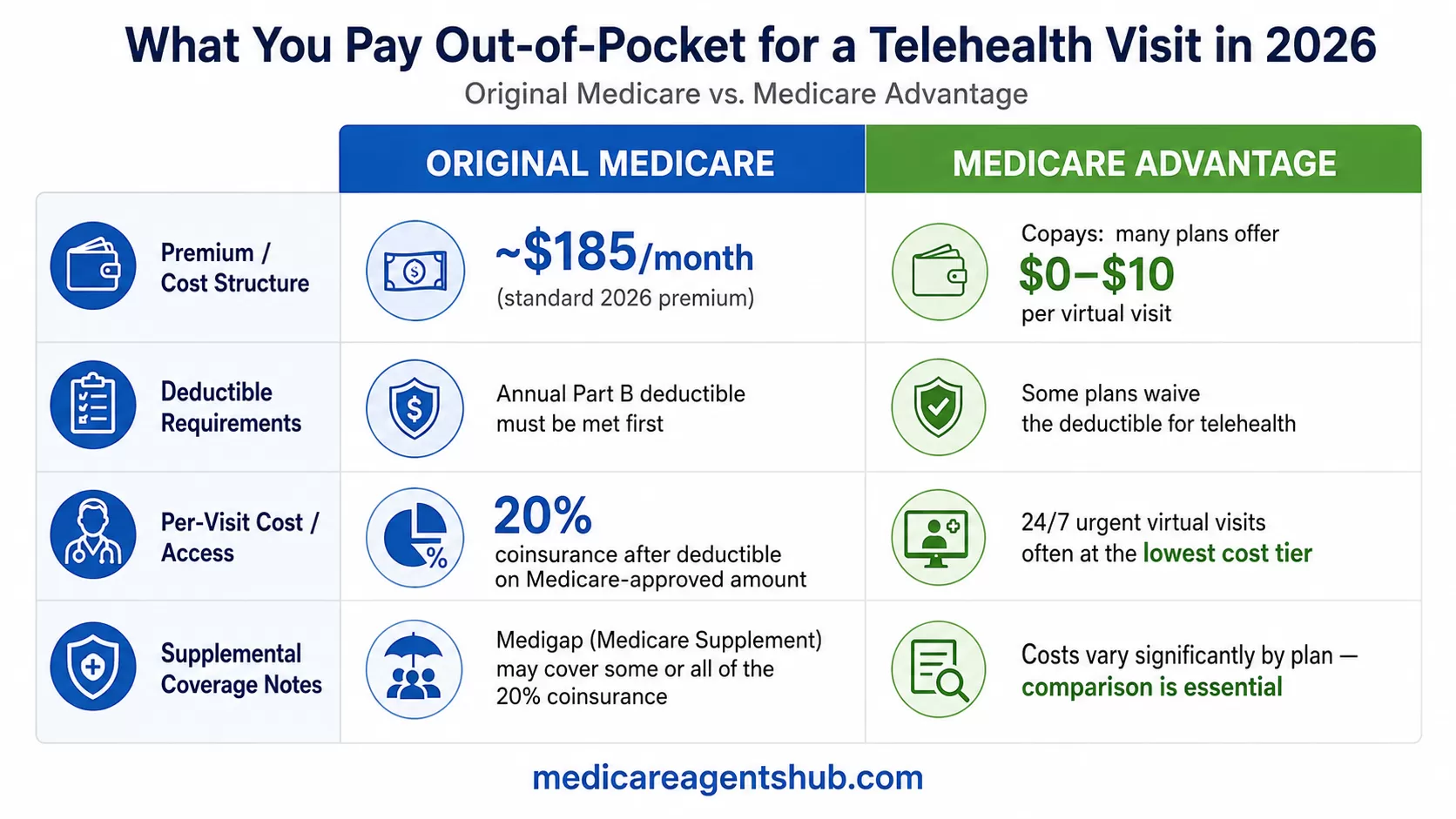
- Part B premium: Standard monthly premium applies (most people pay $185/month in 2026)
- Deductible: The annual Part B deductible must be met first
- Coinsurance: After the deductible, you typically pay 20% of the Medicare-approved amount for telehealth visits
- Medigap coverage: If you have a Medicare Supplement plan, it may cover some or all of that 20% coinsurance
- Copays: Many plans offer $0–$10 copays for virtual visits
- No deductible for telehealth: Some plans waive the deductible for virtual visits
- 24/7 access: Urgent virtual visits are often covered at the lowest cost tier
- Plan variation: Costs vary significantly by plan, so comparing options is essential
For many beneficiaries, Medicare Advantage plans offer lower out-of-pocket costs for telehealth services compared to Original Medicare. However, you'll want to consider the full picture, including network restrictions and other coverage factors. Learn more about comparing Medicare Advantage and Medigap costs.
How COVID Changed Telehealth Coverage, and What's Here to Stay
Before the COVID-19 pandemic, Medicare's telehealth coverage was extremely limited. Beneficiaries generally had to live in a rural area and visit a designated healthcare facility to receive telehealth services. The pandemic changed all of that virtually overnight.
During the public health emergency, Congress and CMS enacted sweeping temporary expansions, including:
- Allowing telehealth visits from home instead of requiring a clinical setting
- Removing geographic restrictions so all beneficiaries could access telehealth
- Covering audio-only phone visits for the first time
- Expanding the types of providers who could deliver telehealth services
- Allowing mental health visits via telehealth without prior in-person requirements

Is telehealth still covered under Medicare in 2026?
Telehealth coverage under Medicare has been an evolving topic since it expanded significantly during the COVID-19 pandemic, and 2026 brings some important updates. Congress extended many of the telehealth flexibilities through the end of 2026, meaning Medicare beneficiaries can still access a wide range of telehealth services from their home rather than having to travel to an originating site like a rural clinic or hospital. This includes visits with doctors, mental health providers, and certain specialists conducted via video or phone. Medicare Advantage plans have generally been even more flexible with telehealth benefits than Original Medicare, so if you are on an Advantage plan it is worth reviewing your plan documents or calling your carrier to understand exactly what is covered. The telehealth landscape has shifted frequently in recent years, so checking with your agent or visiting medicare.gov for the most current guidelines is always a smart move.Since then, Congress has extended many of these flexibilities, and several have been made permanent or extended through ongoing legislation. Telehealth is one of many innovations shaping Medicare's future. As of 2026, key provisions that remain in effect include home-based telehealth access, audio-only visits for mental health and certain other services, and expanded provider eligibility. However, some provisions require periodic congressional renewal, so it's worth staying informed about any changes that may affect your coverage.

CMS says Medicare payments are safe for now with the government shut down and providers should issue ABNs for expired telehealth services, expecting a congressional fix — but if the shutdown lasts and Congress doesn’t act, what ripple effects could eventually hit providers or beneficiaries?
If the shutdown drags on and Congress doesn’t extend the authority, providers could start losing reimbursement for certain telehealth services, leading to more ABNs, more denied claims, and a real “do we keep offering this?” squeeze—especially for smaller practices. For beneficiaries, that can translate into fewer telehealth options, unexpected out-of-pocket bills, and delayed care (particularly for rural and homebound patients) as offices pull back to avoid financial risk.If you're concerned about whether your telehealth benefits may change, a local Medicare agent can help you stay up to date on the latest rules.
How to Set Up and Prepare for a Telehealth Visit
If you've never done a telehealth visit before, it's simpler than you might think. Here's how to get ready.
Before Your Appointment
- Check your technology: You'll need a smartphone, tablet, or computer with a camera and microphone for video visits. For audio-only visits, a regular phone works fine.
- Test your internet connection: A stable Wi-Fi connection will help prevent dropped calls or frozen video. If your internet is unreliable, ask about phone-only options.
- Download any required apps: Your provider may use a specific platform (like MyChart, Doxy.me, or Zoom for Healthcare). Download and test it before your appointment.
- Find a quiet, well-lit space: Good lighting helps your doctor see you clearly, and a quiet room ensures you can hear each other.
- Gather your information: Have your Medicare card, medication list, and any questions or symptoms you want to discuss ready.
During Your Appointment
- Speak clearly and don't rush
- Show any visible symptoms on camera if relevant
- Ask questions just as you would in person
- Take notes or ask a family member to join for support
- Confirm next steps, prescriptions, and follow-up plans before ending the call
After Your Appointment
- Review any notes or summaries sent through your patient portal
- Fill prescriptions promptly if anything was prescribed
- Schedule follow-ups as recommended
- Check your Explanation of Benefits (EOB) to confirm the visit was covered correctly
If you need help with the technology side, many providers offer tech support, and some Medicare Advantage plans include digital literacy resources for members.
Limitations: When You Still Need In-Person Care
Telehealth is powerful, but it has its limits. Some situations require a hands-on examination or in-person testing that simply can't be done through a screen.
You should see a provider in person for:
- Emergencies: Chest pain, stroke symptoms, severe injuries, or breathing difficulty require immediate in-person emergency care
- Physical exams: Your provider may need to feel for lumps, listen to your heart and lungs with a stethoscope, or check reflexes
- Lab work and imaging: Blood draws, X-rays, MRIs, and other diagnostic tests must be done at a facility
- Procedures and surgeries: Any hands-on medical procedure requires in-person care
- Initial specialist consultations: Some specialists prefer an in-person first visit before transitioning to telehealth follow-ups
- Certain mental health situations: While mental health services work well via telehealth, some providers may require periodic in-person check-ins
A good approach is to use telehealth for routine visits, follow-ups, and ongoing management while reserving in-person visits for situations where physical examination or testing is needed. Your doctor can help you figure out which appointments work best virtually.
How a Medicare Agent Can Help You Find Plans with Strong Telehealth Benefits
Not all Medicare plans offer the same telehealth benefits. Coverage, costs, platforms, and provider networks for virtual care can vary significantly between plans. This is where working with a knowledgeable Medicare agent makes a real difference.
A local Medicare agent can:
- Compare telehealth benefits across Medicare Advantage plans available in your area
- Identify plans with $0 copay virtual visits if cost is a priority
- Find plans with 24/7 telehealth access for urgent care needs
- Check whether your current doctors offer telehealth through a specific plan's network
- Explain remote monitoring benefits if you have a chronic condition that could benefit from RPM
- Help during enrollment periods so you can switch to a plan with better virtual care options
Medicare agents are licensed, and their services typically come at no cost to you. They're paid by the insurance companies, not by beneficiaries. If telehealth access is important to your healthcare routine, make sure to bring it up when discussing plan options with your agent.
Frequently Asked Questions About Medicare and Telehealth
Can I use telehealth if I live in a rural area with limited internet?
Yes. Medicare covers audio-only (phone) visits for many services, so you don't necessarily need a video connection. Some plans also partner with community centers or libraries that offer internet access for telehealth visits.

I live in a rural area with limited specialists and am interested in telehealth options. How does Medicare cover virtual visits for someone in my location?
Medicare does cover telehealth, and it can be especially helpful in rural areas.• Original Medicare (Part B) covers virtual visits with approved providers. You usually pay 20% after the deductible.
• Through Jan 30, 2026, most telehealth visits are covered from your home, even in rural areas.
• After that, most services will require you to be in a rural area and at an approved medical site (not always at home), except for mental health, stroke care, and some dialysis services, which are still covered from home.
• Medicare Advantage plans often offer broader telehealth access from home, sometimes with low or $0 copays.
Do I need a referral for a telehealth visit?
It depends on your plan. Original Medicare generally does not require referrals, but some Medicare Advantage plans (especially HMOs) may require one for specialist telehealth visits. Check your plan's rules.
Is telehealth secure and private?
Yes. Medicare-approved telehealth platforms are required to meet HIPAA privacy and security standards. Your medical information is protected just as it would be during an in-person visit.
Can I get prescriptions through a telehealth visit?
Yes. Your provider can prescribe medications during a telehealth visit, and prescriptions can be sent electronically to your pharmacy.
What if my doctor doesn't offer telehealth?
If your current provider doesn't offer virtual visits, you may be able to use your plan's telehealth platform to see other in-network providers virtually. Many Medicare Advantage plans have dedicated telehealth partnerships that give you access to a broad network of virtual providers.
The Bottom Line
Telehealth has gone from a pandemic necessity to a permanent part of Medicare healthcare. Telehealth is just one example of how technology is changing the way seniors shop for Medicare and access care. For seniors, it offers convenience, better access to specialists, and a practical way to stay on top of chronic conditions without the burden of constant travel to medical offices.
Whether you're on Original Medicare or a Medicare Advantage plan, virtual visits are likely covered for many of the services you use most. The key is understanding what your specific plan covers, what it costs, and when in-person care is still the better choice.
If you're not sure how your current plan handles telehealth, or if you want to find a plan with stronger virtual care benefits, connect with a local Medicare agent who can walk you through your options.