Medicare Mental Health Benefits: What's Covered in 2026

-
October 31, 2025

Reviewed by Joel McClure
Medicare Agent Licensed in NJ, AL, AR & 42 other states
Medicare covers many mental health services, including outpatient therapy, psychiatric visits, depression screenings, inpatient psychiatric care, intensive outpatient care, partial hospitalization, substance use disorder treatment, and many related prescriptions. Costs depend on whether care falls under Part A, Part B, Part D, or a Medicare Advantage plan.
Below is a full breakdown of how Medicare mental health benefits work in 2026, what you can expect to pay, and how to get the most from your coverage.
Key Takeaways
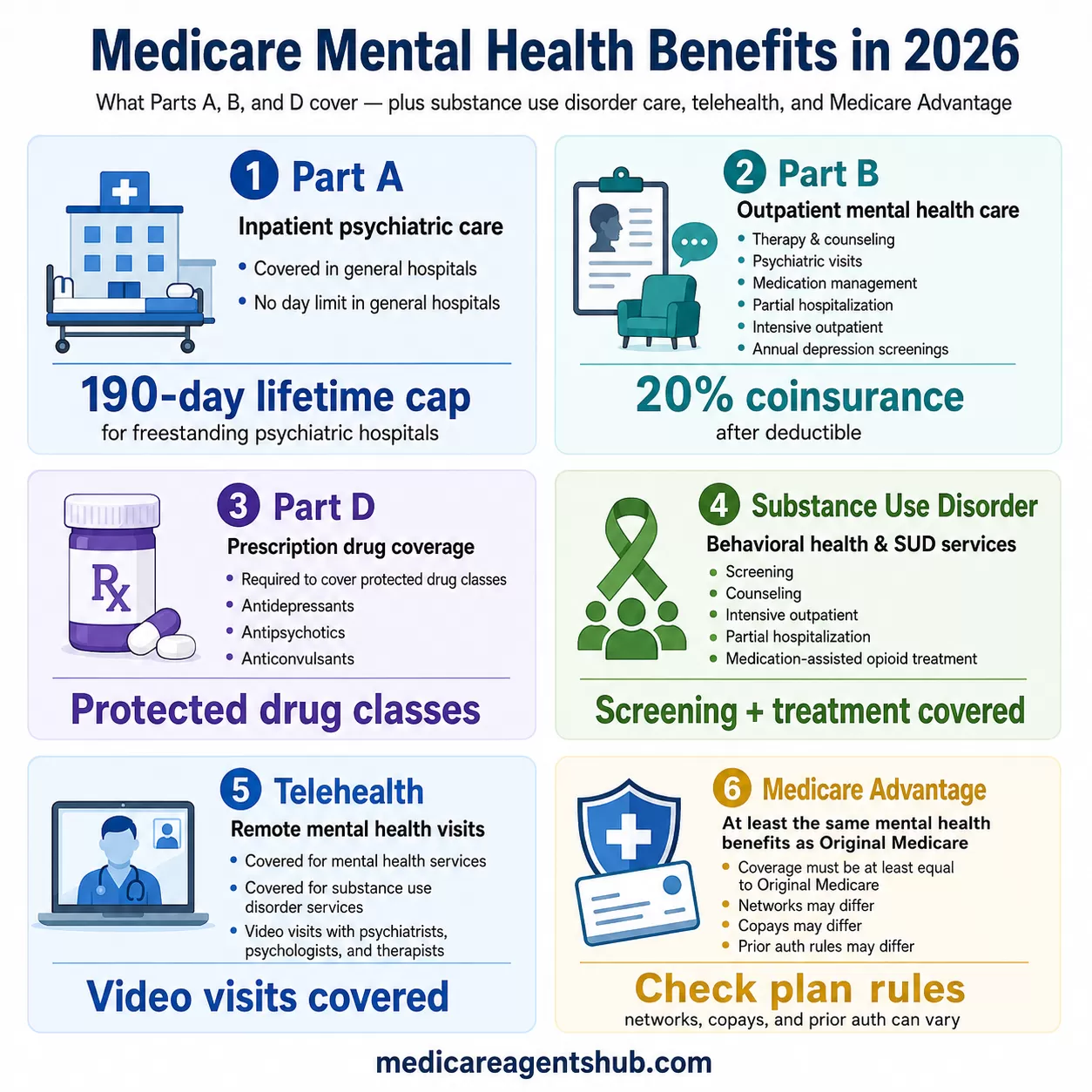
- Part B covers outpatient therapy, counseling, psychiatric visits, and annual depression screenings (you pay 20% coinsurance after the deductible).
- Part A covers inpatient psychiatric care in general hospitals with no day limit. Freestanding psychiatric hospitals have a 190-day lifetime cap.
- Part D is required to cover antidepressants, antipsychotics, and anticonvulsants as protected drug classes.
- Telehealth is available for mental health and substance use disorder services.
- Medicare Advantage plans must cover at least the same mental health benefits as Original Medicare, but may have different networks, copays, or prior authorization rules.
Who is eligible for Medicare mental health benefits?
Medicare is available to people age 65 or older, some younger people with disabilities, and people with end-stage renal disease under certain conditions. If you qualify for Medicare due to a disability before age 65, you have the same mental health benefit access as those who enroll at 65. Once you have Medicare, you are eligible for mental health benefits under its parts. According to the official Medicare booklet "Medicare & Your Mental Health Benefits," Original Medicare (Parts A and B) covers a wide range of outpatient and inpatient mental health care services.
It is important to note that if you are enrolled in a Medicare Advantage plan (Part C) or have a Medigap policy, your coverage may vary in details though the baseline benefits are required.
What mental health services does Medicare cover?
Medicare covers inpatient, outpatient, partial hospitalization, prescription drug, and substance use disorder services in the context of mental health. Below is a breakdown:
Inpatient Mental Health Services (Part A)
If you are admitted to a general hospital or a psychiatric hospital as an inpatient for a mental health condition, Medicare Part A covers those services. Psychiatric care in a general hospital's psychiatric unit follows standard Part A hospital rules with no special day limit. However, there is a lifetime limit of 190 days for care in a freestanding psychiatric hospital under Original Medicare. This distinction matters: if you receive inpatient psychiatric treatment in a general acute-care hospital, the 190-day cap does not apply. Learn more about inpatient hospital coverage on Medicare.gov.
Outpatient Mental Health Services (Part B)
This includes therapy, counseling (individual and group), psychiatric evaluation, medication management, family counseling (if the main purpose is treatment of your condition), partial hospitalization programs, intensive outpatient programs, substance use disorder treatment, and screening services. Medicare Part B also covers annual depression screenings and other preventive services, including those offered during preventive screening visits. For full details on covered outpatient services, see the outpatient mental health care page on Medicare.gov.

Are mental health services like therapy fully covered under Original Medicare?
This is a great question. Services therapy, counseling, clinical social worker, psychiatric evaluations, and medication management are recognized as outpatient treatment and fall under Part B coverage. Like other outpatient services there are some out of pocket costs to be aware of like the Part B deductible which is expected to be $288 in 2026. Once the deductible is met, you would be responsible for a 20% of the Medicare approved costs. So, in short, Original Medicare does NOT fully cover mental health services.However, there are other Medicare options available for those who have a higher need for these types of services. One option to consider is Medicare Advantage Plans (Part C). These plans often have low to no costs mental health services built into the packages. Another option would be adding a Medigap plan to help cover costs not covered by Part B. There are also community resources available and Telehealth expansions. Speak with a Medicare specialist about your specific needs so they can help you tailor your coverage to fit you. Consultations are always available at no cost and no obligation.
Prescription Drugs (Part D)
If you have Medicare Part D (or your Medicare Advantage includes drug coverage), a range of medications used to treat mental illness are required to be covered. Antidepressants, anticonvulsants, and antipsychotics are all protected drug classes under Medicare Part D, meaning every plan must include them on its formulary. You can also explore ways to save money on your Medicare prescriptions.

Does Medicare pay for antidepressants or anti-anxiety medications?
Yes, Medicare does cover antidepressants and anti-anxiety medications, and these actually fall into a protected drug class under Medicare Part D, which means plans are required to cover substantially all medications in that category. This is good news for beneficiaries who rely on these prescriptions because it offers stronger protections compared to other drug categories where plans have more flexibility to limit coverage. That said, the tier your specific medication falls on and your cost sharing can still vary quite a bit from plan to plan, so what you pay out of pocket depends on which Part D plan or Medicare Advantage plan you are enrolled in. Generic versions of these medications are often covered at very low cost sharing, while brand name options may sit on a higher tier with a larger copay or coinsurance. Also worth knowing is that starting in 2025, the $2,000 out-of-pocket cap on Part D drug costs provides an additional layer of protection if your medication costs run high. If you are concerned about what you are paying for a specific prescription, running a plan comparison during Annual Enrollment each fall is the best way to make sure you are on the most cost effective plan for your needs.Substance Use Disorder Services
Medicare covers screening, counseling, intensive outpatient, and partial hospitalization services for substance use disorders. For example, it covers opioid use disorder treatment services, including medication-assisted treatment and counseling. The Medicare mental health benefits booklet provides a full list of covered substance use disorder services.
Telehealth and Remote Services
Telehealth for mental health and substance use disorder services is also supported under Medicare. This can be especially valuable for beneficiaries in rural areas or those with mobility challenges.
How much does Medicare mental health care cost?
While Medicare covers many mental health services, you will still have cost-sharing (deductibles, coinsurance, and premiums) depending on the part and your plan. These amounts can change each calendar year.
- Outpatient services under Part B: After you meet the Part B annual deductible, you generally pay 20% of the Medicare-approved amount for the service, if the provider accepts assignment.
- Inpatient services under Part A: You will owe the Part A deductible for each benefit period and may have daily coinsurance after certain days in the hospital.
- Prescription drug costs: These depend on your specific Part D plan's rules, including what tier the medication is in, whether it is preferred, and your plan's deductible/copay structure.
For the most current deductible and coinsurance amounts, visit Medicare.gov. Costs are updated annually, so checking before each calendar year helps you plan ahead.
If you have a Medicare Advantage plan, some mental health benefits may have different rules, networks, or copays. It is wise to check your plan details.

I need both a psychiatrist for medication and a therapist for talk therapy. How does Medicare coordinate coverage for these different providers?
Medicare can provide coverage for both of these providers. Both would be covered under the Part B portion of Medicare.The psychiatrist would be considered a specialist. For medication management you would typically see them once every 1-3 months. If you are on a Medicare supplement, once you reach your deductible, your supplement will pay. If you are on a Medicare Advantage plan, you will have a copay specific to that plan. You may also have a network requirement and a referral requirement. Be sure to confirm that the provider takes your plan and you have all required referrals.
The therapist will also fall under Part B. It will be paid the same way. The only caveat is that you must make sure the therapist is able to bill Medicare. Medicare did expand the types of therapists that can bill Medicare, but it is still your responsibility to make sure the provider has enrolled and accepts Medicare assignment.
Mental health coverage in Medicare Advantage (Part C)
Every Medicare Advantage plan must cover at least the same mental health services as Original Medicare. That includes outpatient therapy, psychiatric visits, annual depression screenings, inpatient psychiatric care, partial hospitalization, intensive outpatient programs, substance use disorder treatment, and telehealth. Where Advantage plans differ is in how you access that care.
Common differences to check on any Medicare Advantage plan before enrolling:
- Provider networks. Most Advantage plans use HMO or PPO networks. Your therapist or psychiatrist has to be in-network for the plan to pay its normal share. Out-of-network mental health care is often more expensive or not covered at all under an HMO.
- Prior authorization. Advantage plans may require prior authorization for inpatient psychiatric stays, partial hospitalization, or intensive outpatient programs. Original Medicare generally does not.
- Copays instead of coinsurance. Instead of 20% coinsurance under Part B, Advantage plans usually charge a flat copay per therapy or psychiatry visit. That copay is set by the plan and shown in the Summary of Benefits.
- Referrals. HMO-style Advantage plans may require a referral from your primary care doctor before you can see a psychiatrist or licensed therapist.
- Extra benefits. Some Advantage plans add benefits Original Medicare doesn't cover, such as expanded telehealth, wellness programs, or care coordination for behavioral health.
If mental health care is a priority, compare the therapist and psychiatrist networks of any Advantage plan you're considering. A plan with a great premium and low copays doesn't help much if the in-network provider list is thin in your area. Medicare Supplement (Medigap) plans paired with Original Medicare avoid network restrictions entirely, which can matter if you already have a provider you want to keep.

I've been diagnosed with bipolar disorder at age 66. How should I structure my Medicare coverage to ensure I get the mental health care I need?
Medicare Advantage plans recognize the importance of mental health coverage. Most plans give beneficiaries the opportunity to see a therapist for a low out-of-pocket cost. If you don’t already have a therapist, your plan can provide access to in-network providers. Many plans also include inpatient mental health coverage.If you take prescriptions, you can review the plan’s formulary to see whether your medications are covered under the plan you choose. I can assist with you search.
What mental health services are not covered by Medicare?
Although Medicare covers many mental health services, there are some important limitations to keep in mind. Original Medicare limits inpatient care in freestanding psychiatric hospitals to a lifetime maximum of 190 days. This cap does not apply to psychiatric units within general acute-care hospitals, where standard Part A hospital rules govern your stay. Access can also be a challenge because not all mental health providers accept Medicare, and some may limit the number of Medicare patients they see.
Certain services that might be beneficial, such as long-term residential mental health programs or emerging therapies, may not be fully covered or could come with stricter requirements. Even when a service is covered, beneficiaries are still responsible for deductibles, coinsurance, and copayments.
For those enrolled in Medicare Advantage plans, additional rules may apply. These can include network restrictions, prior authorization requirements, or different cost structures for mental health services. Understanding these limitations is important to plan care effectively and avoid unexpected out-of-pocket costs.
How can you maximize your Medicare mental health benefits?
Here are some practical pointers to help you leverage your benefits:
- Ask whether the provider accepts Medicare. Before scheduling, confirm the provider accepts Medicare and works with your plan (Original Medicare or Advantage). If they don't, you may incur higher out-of-pocket costs.
- Use preventive screening opportunities. Medicare covers an annual depression screening and the "Welcome to Medicare" preventive visit in your first 12 months of Part B, as well as the yearly Wellness Visit. These are good times to bring up mental health concerns with your provider.
- Know your plan's rules. If you are on a Medicare Advantage plan, review the plan's Summary of Benefits to see how mental health services are covered, whether you need referrals, and whether there are added benefits beyond Original Medicare.
- Explore telehealth options. If mobility or transportation is an issue, check whether your provider offers tele-behavioral health or virtual visits covered under Medicare.
- Keep track of prescription drug coverage. If you take mental health medications on an ongoing basis, review your Part D plan annually (during Open Enrollment) to verify that your medications remain on the formulary and to check your estimated costs.
- Ask for help if you are struggling. If you experience suicidal thoughts, feelings of hopelessness or isolation, or have other serious symptoms, seek help immediately. The national Suicide & Crisis Lifeline (dial 988) is free and operates 24/7.
- Keep documentation. Make sure you have records of diagnoses, referrals, treatment plans, and provider appointments in case you need to appeal a coverage or payment decision.
Why does Medicare mental health coverage matter?
For many older adults and those approaching retirement age, mental health is often overlooked in favor of physical health conditions. Yet evidence shows mental health conditions (such as depression, anxiety, or substance use disorders) are common among Medicare beneficiaries. Coverage by Medicare provides an important safety net so you can access therapy, counseling, inpatient care, or medications when needed.
Good mental health also supports better outcomes in managing chronic physical health conditions, maintaining independence, and improving quality of life. So if you are enrolled in Medicare or approaching eligibility, it is wise to treat mental health as a crucial part of your health plan.
Frequently Asked Questions About Medicare and Mental Health
Does Medicare cover therapy?
Yes, Part B covers individual and group therapy from psychiatrists, psychologists, clinical social workers, and other licensed professionals. You pay 20% coinsurance after the Part B deductible. Your provider must accept Medicare assignment for the lowest out-of-pocket cost.
Does Medicare cover psychiatrists?
Yes, Medicare Part B covers psychiatric evaluation, diagnosis, medication management, and therapy provided by psychiatrists. As with other outpatient providers, you pay 20% coinsurance after meeting the Part B deductible. Confirm your psychiatrist accepts Medicare before scheduling.
Does Medicare cover antidepressants?
Medicare Part D plans are required to cover antidepressants as a protected drug class. Your specific copay or coinsurance depends on your plan's formulary and the drug's tier placement. Review your plan's drug list annually during Open Enrollment to check coverage and costs.
Does Medicare cover inpatient mental health care?
Yes. Medicare Part A covers inpatient psychiatric care in general hospitals with no day limit. In freestanding psychiatric hospitals, there is a 190-day lifetime limit. You pay the Part A deductible per benefit period plus daily coinsurance after day 60.
Does Medicare cover telehealth therapy?
Yes, Medicare covers telehealth for mental health and substance use disorder services. This includes video visits with psychiatrists, psychologists, and licensed therapists. Telehealth can be especially helpful for beneficiaries in rural areas or those with limited mobility.
Final Thoughts
If you are a current or future Medicare beneficiary, you should know that Medicare does cover a wide range of mental health services. Knowing what is covered, understanding your costs, and being proactive about finding a provider will help you make the most of your benefits. Mental health is just as important as physical health, and Medicare provides the tools you need to take care of both.
Not sure which plan gives you the best mental health coverage for your situation? Talk with a licensed Medicare agent in your area. Consultations with agents listed in our directory are free, and there is no obligation to enroll.
Written by: Medicare Agents Hub Editorial Team
Reviewed by: Licensed Medicare insurance agents
Last updated: July 7, 2026
This article is for informational purposes only and does not constitute medical or insurance advice. Coverage details may vary by plan. Contact a licensed Medicare agent or visit Medicare.gov for guidance specific to your situation.