Best Supplemental Insurance Companies for Medicare: What Brokers Actually Recommend

-
Last Updated July 30, 2026

Reviewed by Rodney Powell
Medicare Broker Licensed in TX, AK, AL & 29 other states
Medicare Supplement Plans Are Standardized. So Why Does the Company Matter?
If you've been searching for the best Medicare Supplement insurance company, the answer starts with a fact that surprises most people: every Medigap plan is federally standardized. A Plan G from one carrier covers the exact same things as a Plan G from another. The benefits are identical by law. (You may see this type of coverage called Medicare Supplement insurance, Medigap, or simply "supplemental insurance for Medicare." They all refer to the same thing.)
So if the coverage is the same, what are you actually shopping for? We asked licensed Medicare brokers across the country to explain what separates one company from another, which carriers they recommend, and how to keep your costs down long-term.

In your experience, what are the best Medicare Supplement insurance companies and why?
That is a very common question!Here is the simple truth about Medicare Supplement insurance: The plans are standardized.
This means that Plan G is Plan G, no matter who sells it. Company A and Company B provide the exact same coverage. Because the benefits are identical, you are essentially shopping for the best price and company stability.
I usually advise my clients not to overpay for a "brand name," because the medical coverage does not change.
I would be happy to show you which companies are currently offering the best rates in your zip code.
That point is the foundation for the rest of the comparison. Once a shopper understands that a Plan G is a Plan G, the "best company" question becomes less about who has the most recognizable name and more about which carrier offers the strongest combination of price, stability, claims handling, and long-term value in that person's area.
What Actually Differentiates One Carrier From Another
If the benefits are identical across companies, experienced brokers focus on a specific set of factors when recommending a carrier. These are the criteria that matter once you've decided on a plan letter.

In your experience, what are the best Medicare Supplement insurance companies and why?
Since all Medicare Supplement plans all function the same. Plan G, no matter what carrier, acts as a "Plan G". Plan N as a "Plan N". What is important is a.) How quickly are claims processed? b.) What is the level of communication with both members and brokers? c.) What is a specific carrier's rate stability? d.) What is a specific carrier's rate increases - long term? e.) What is a carrier's S&P rating / Am Best Rating???In other words, the cheapest premium is not always the whole story. A carrier with strong claims service, clear communication, good financial ratings, and a history of reasonable rate increases may be a better long-term choice than a company that simply looks cheapest on day one.
The size of the company's enrollee pool is another factor that doesn't get enough attention. A larger risk pool tends to produce more predictable claims experience, which directly affects how stable your premiums stay over time.

In your experience, what are the best Medicare Supplement insurance companies and why?
When I evaluate Medicare Supplement companies, I look at the past rate increases, and AM Best ratings. I also look at the number of enrollees in each of the plans. Statistically, more enrollees spread out the financial risk increasing the likelihood of better price stability.Top Medicare Supplement Insurance Companies Brokers Recommend
When we asked brokers to name names, the same carriers kept coming up. Here's what they said about the companies they trust for their clients.

In your experience, what are the best Medicare Supplement insurance companies and why?
When considering Medicare Supplement insurance (Medigap) companies, several stand out due to their reputation for customer service, financial stability, and broad plan availability. Frequently recognized providers include Humana, UnitedHealthcare, Mutual of Omaha, Aetna, and Cigna. These organizations are noted for reliable claims processing, nationwide coverage options, and a history of strong financial performance. Additionally, they typically offer a range of Medigap plans that can suit diverse healthcare needs and budgets.It is important to review the specific benefits, premiums, and network details of each plan before making a decision. For further information about coverage criteria and policies, you may wish to consult resources such as the Medicare Coverage Criteria Policies for more detail.
The brokers did not all agree on one universal winner, which is exactly what you would expect in a state-by-state, zip-code-specific market. Still, a handful of names came up repeatedly because of their size, pricing, service reputation, or rate stability.
The Major National Carriers
Several large insurers consistently appear at the top of broker recommendations. Each has built a reputation for different strengths, from pricing to customer service to extra benefits beyond the standard Medigap coverage.

In your experience, what are the best Medicare Supplement insurance companies and why?
In review of Medicare supplement insurance companies, several factors such as financial stability, customer service, plan options, and pricing play an important role in determining the best providers. Some highly rated companies include AARP/UnitedHealthcare, Mutual of Omaha, and Anthem Blue Cross Blue Shield. AARP/UnitedHealthcare has an extensive network and coverage options, available to a wide demographic with user-friendly resources and competitive pricing. Mutual of Omaha has strong financial ratings and a variety of plans, offering additional benefits that appeal to many seniors. Anthem Blue Cross Blue Shield has a great presence in multiple states, providing various plans and a solid customer support system.In addition to company reputation and coverage options, premium affordability and claims process efficiency are important aspects that help the consumers choice. Companies like Cigna and Humana have gained a foothold for their competitive premiums and streamlined claims processes, which means policyholders can access care without undue hassle. Another important consideration is the availability of additional perks such as wellness programs and telehealth services, which can enhance the overall value of a Medicare supplement plan. In the end, the best Medicare supplement insurance company will depend on an individuals needs and preferences, which means beneficiaries must thoroughly research and compare options to find a plan that meets their healthcare requirements and financial situation.
The takeaway is not that every one of these carriers will be the best choice in every market. Instead, these are the kinds of companies brokers often start with when comparing options: large, recognizable insurers with broad availability, competitive pricing in many areas, and enough market presence to be worth including in a side-by-side review.
Anthem vs Humana Medicare Supplement: How Brokers Compare Them
Anthem Blue Cross Blue Shield and Humana are two of the most searched-for Medicare Supplement carriers, and shoppers frequently ask brokers how the two stack up. Because Medigap plans are federally standardized, an Anthem Plan G and a Humana Plan G cover the exact same benefits. The comparison comes down to price, rate history, service, and availability in your zip code.
Brokers generally point out that Anthem's Blue Cross Blue Shield brand carries strong local recognition in the states where it operates, and its rate stability in some markets is a common reason brokers include it in a comparison. Humana is often noted for competitive introductory pricing and household discounts in areas where it markets Medigap aggressively, though its footprint and pricing competitiveness for Medicare Supplement (as opposed to Medicare Advantage) vary widely by state.
Neither one is universally cheaper. The right answer depends on where you live, your age at enrollment, tobacco status, and whether either carrier is actively rate-competitive in your area for the plan letter you want. Brokers who represent both can pull quotes side by side and show you the actual premium difference for the same Plan G or Plan N in your zip code, along with each carrier's rate increase history.
The Case for Mutual Insurance Companies
Not every broker defaults to the biggest household names. Some prefer carriers with a fundamentally different ownership structure, one where the company answers to policyholders rather than Wall Street.

In your experience, what are the best Medicare Supplement insurance companies and why?
I personally like mutual insurance companies. They don't have stock holders and so aren't trying to beat the market, make quarterly earnings, or impress analysts. That being said not all mutual companies are great. I personally like Physician's Mutual and Medico.I also like UnitedHealthcare (UHC). As much as I dislike UHC's other plans and Medicare Advantage Plans they acutally do a good job with their Medicare Supplements. Essentially, they have the largest risk pool in the nation. With that large risk pool comes consistency in claims and therefore rate increases.
This highlights an important point: some brokers weigh ownership structure and long-term incentives heavily. Others focus more on current pricing, rate history, or local availability. The best recommendation often comes from comparing those factors together rather than choosing a company based on brand alone.
A Closer Look at United American
One carrier that flies under the radar compared to the big names but has a devoted following among brokers who sell it is United American. Here's a specific case for why.

In your experience, what are the best Medicare Supplement insurance companies and why?
United American, for the following reasons:1. Lowest rate for the HDG, high deductible G plan, which in the long run, will save a lot of money!
2. Great customer service! You can reach a live person in the US!
3. Ability to create an online profile to see your claims.
4. At the 2-yr anniversary, gives you a 30-day window to change your plan within United American without health underwriting.
5. If you do change your plan within United American, your original issue age is kept.
United American is a good example of why local broker experience matters. A company may not be the first name a consumer thinks of, but brokers who regularly compare plans may know where a particular carrier is especially competitive, especially for options like High-Deductible Plan G or for clients who value customer service and internal plan-change flexibility.
The Reality of Rate Increases
No matter which company you choose, your premium will go up over time. No carrier is immune to rising medical costs and an aging population. But how a company structures its rates, and how your policy is rated, makes a real difference in what you'll pay five or ten years down the road.

Is there a Medigap Plan company with a non-increasing premium? I heard Blue Cross/Blue Shield Offers this. If so, how expensive is it?
No. All private companies are going to be affected by risk and inflation.But you want to try a find a company that issues an INDIVIDUAL policy, not a Group policy. Why should have to be subject to the spread pricing of the costs of the group, if you are a healthy person and the rest of the group is a higher risk than you? Also, if you can find an ISSUE AGE policy provider, that will make a difference as well.
Beyond that, pricing will react to the risks and the inflation that the carrier is subject to.
That is why the initial premium should never be the only number you look at. A low starting rate can become less attractive if the carrier has a pattern of sharp increases, while a slightly higher premium from a more stable carrier may be easier to live with over time.
This is a big part of why working with an independent broker pays off. They track rate history across carriers in your area and can steer you toward companies with the best long-term track record. As one Florida broker put it:

Is there a Medigap Plan company with a non-increasing premium? I heard Blue Cross/Blue Shield Offers this. If so, how expensive is it?
In my experience I have never seen a company that does not have a true Medigap plan that does not have premium increases at least every couple of years. The reason you use me is to be the expert that knows which companies have the least amount and frequency of increases.For a deeper look at what drives rate increases and what you can do about them, see our full breakdown of why Medicare Supplement rates increase and how beneficiaries can reduce costs.
How to Save Money on Your Medicare Supplement
Picking the right carrier is step one. But even after you've chosen a company and a plan, there are ways to keep your costs in check year after year. The biggest mistake people make is setting it and forgetting it.

How can I save money on my Medicare Supplement?
One of the easiest ways to save money is to shop your Medigap rates each year, because the same Plan G can cost very different amounts depending on the company. You can also save by using a household discount or switching to a company with lower age‑based increases, as long as you can pass their health questions it will be a savingsThis is especially important because Medigap pricing can change even when your benefits do not. If you are healthy enough to qualify for a different carrier, an annual review may uncover meaningful savings without requiring you to give up the plan letter you already like.
Keep in mind that switching Medicare Supplement companies may require medical underwriting unless you qualify for a guaranteed-issue right or live in a state with special switching rules.
If you're already on a supplement and wondering whether your current plan is still the best deal, brokers can run a comparison at no cost. See how to spot a good broker who will actually shop the market for you.
Plan G vs. Plan N: Which Plan Letter Should You Pair With Your Carrier?
Once you've narrowed down your carrier, the next decision is which plan letter. For most people shopping today, it comes down to Plan G or Plan N. They cover similar ground but trade off premiums against out-of-pocket costs in different ways.

What are the pros and cons of Medicare Supplement Plan G VS Medicare Supplement Plan N?
Plan G is great if you want full coverage and don’t want to worry about copays or surprise bills. G covers almost everything except the Part B deductible. Plan N has lower monthly premiums, but you’ll pay small copays for doctor and ER visits, and it doesn’t cover excess charges. I usually recommend Plan G for folks who want peace of mind, and Plan N for those who are healthy and want to save on premiums.Don't compare carriers in isolation. Pick a plan letter first, then compare that same letter across carriers in your zip code. The "best" company for Plan G in one area may not be the best-priced option for Plan N, and a shopper who rarely visits the doctor may be comfortable trading some predictability for a lower monthly premium.
For a full comparison of when Plan G isn't the automatic best choice, see Plan G Isn't Always King: When Plan N, Plan K, or High-Deductible G Actually Beats It.
How to Choose the Right Company for You
There's no single "best" Medicare Supplement company that works for everyone. The right carrier depends on your zip code, your health, and what you value most, whether that's the lowest premium today or the most stable rates over the next decade.

In your experience, what are the best Medicare Supplement insurance companies and why?
When choosing a Medicare Supplement Company, look at their financial ratings. When possible, choose a B+ rated company or better. I personally prefer A rated companies for my insurance products. a good indication of how financially sound the company is. Also look at the number of insureds, as the larger the pool of folks with that insurance, the risk gets spread around and possible rate increases may be impacted by these numbers. Also work with an agent who can offer more than one company for your Medicare Supplement plan so you have choices and can discuss in more detail with the agent.But the brokers we spoke with kept coming back to the same advice:
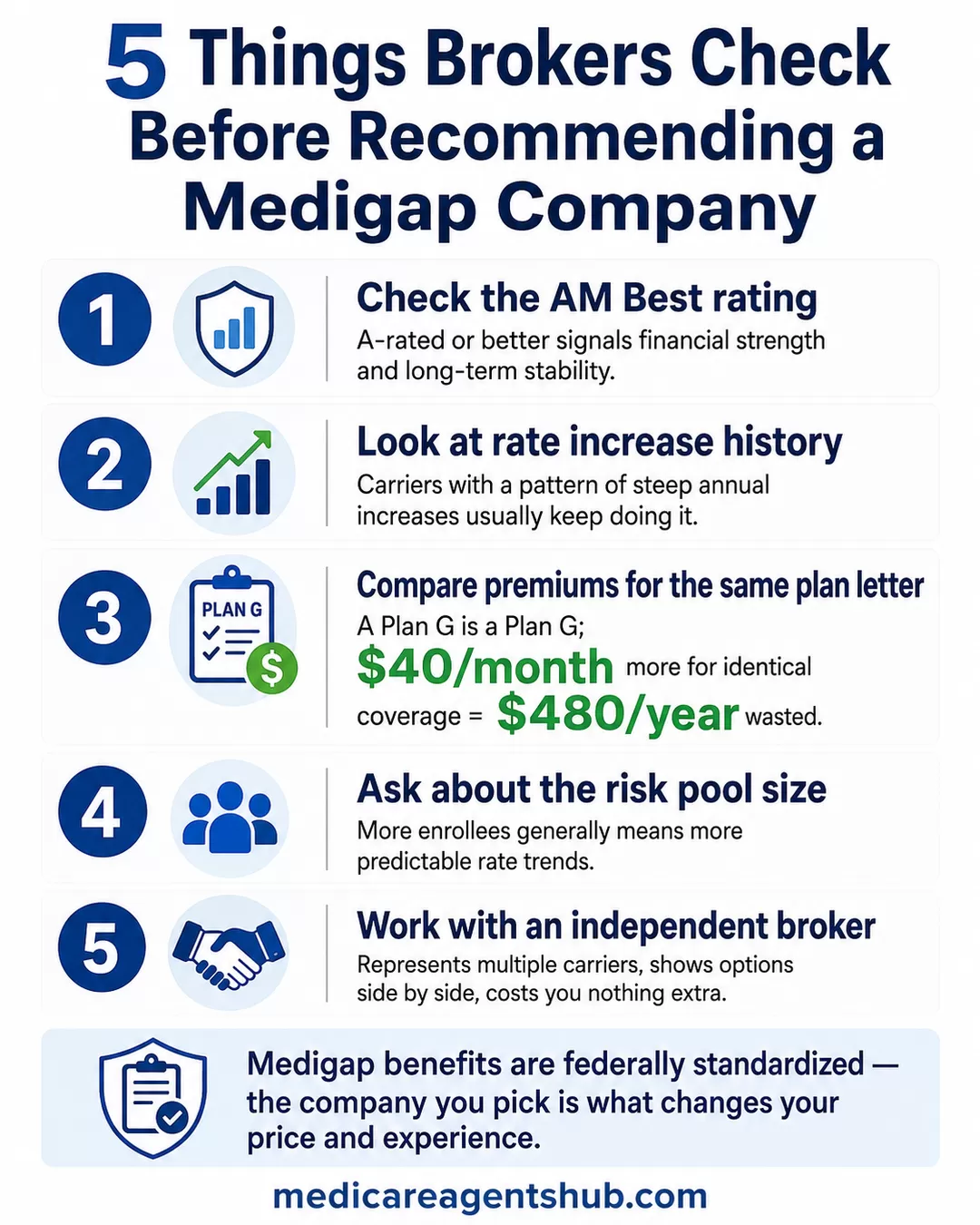
- Check the AM Best rating. A financially strong company (A-rated or better) is more likely to offer stable premiums and stay in the market long-term.
- Look at rate increase history. Past performance isn't a guarantee, but carriers with a pattern of steep annual increases are likely to continue that trend.
- Compare premiums for the same plan letter across carriers. A Plan G is a Plan G. If one company charges $40 more per month for identical coverage, that's $480 a year you don't need to spend.
- Ask about the risk pool size. More enrollees in a plan means more predictable claims, which helps keep rate increases in check.
- Work with an independent broker. A broker who represents multiple carriers can show you options side by side. A local independent broker has no reason to push one company over another, and their help doesn't cost you anything extra.
These recommendations should not be read as a universal ranking. Medicare Supplement premiums and carrier competitiveness vary by state, zip code, age, tobacco status, household discounts, and underwriting rules.
The bottom line: the best Medicare Supplement insurance company is not simply the biggest brand or the lowest premium. Because Medigap benefits are standardized, the smarter comparison is between companies offering the same plan letter in your area. Look at price, rate history, financial strength, customer service, and the size of the carrier's risk pool. Then review those options with an independent Medicare broker who can compare multiple companies side by side.
Enter your zip code on our Find a Medicare Agent page to connect with a local independent broker who can pull quotes from multiple carriers side by side, at no cost to you.
How to Compare Medicare Supplement Companies
| Factor | Why It Matters |
|---|---|
| Premium for the same plan letter | Benefits are standardized, so overpaying for the same Plan G may not make sense |
| AM Best rating | Helps indicate financial strength and long-term viability |
| Rate increase history | Shows how premiums have changed over time |
| Risk pool size | Larger pools may produce more predictable rate trends |
| Claims and customer service | Affects the experience after enrollment |
| Local availability | Not every carrier is equally competitive in every zip code |
Frequently Asked Questions
What is the best Medicare Supplement company?
There is no single best company for everyone. The right choice depends on your zip code, age, health status, plan letter, and what matters most to you, whether that is the lowest starting premium, the most stable long-term rates, or the best customer service. An independent Medicare broker can compare carriers in your area side by side at no cost to you.
Are all Medicare Supplement Plan G policies the same?
Yes. Medigap plans are federally standardized, so a Plan G from one company covers the exact same benefits as a Plan G from any other company. The differences between carriers come down to premium, rate stability, customer service, claims handling, and financial strength.
Does the company matter if Medigap plans are standardized?
It does. While the coverage is identical, premiums can vary significantly between carriers in the same zip code. Companies also differ in how often they raise rates, how large their risk pool is, and how they handle claims and customer service. Those differences add up over time.
Which Medicare Supplement company has the most stable rates?
Rate stability varies by state and by the specific plan. Carriers with large, well-diversified risk pools and strong AM Best ratings tend to have more predictable rate trends. Mutual insurance companies are sometimes favored for rate stability because they answer to policyholders rather than shareholders. Your broker can pull rate increase history for carriers in your area.
Should I choose the cheapest Medicare Supplement company?
Not necessarily. A low starting premium can be appealing, but if that carrier has a history of steep annual increases, you may end up paying more over time. It is worth comparing the starting price alongside the company's rate increase track record, financial rating, and customer service reputation.
Can I switch Medicare Supplement companies later?
In most cases, yes, but switching typically requires medical underwriting. That means the new carrier can ask health questions and may decline your application if you have certain conditions. Exceptions exist during guaranteed-issue periods or in states with special consumer protections. If you are considering a switch, talk to a broker about your options and timing.
Updated for 2026 and based on input from licensed Medicare insurance agents. Medicare Agents Hub is not affiliated with Medicare or the federal government and does not sell insurance.