How to Spot a Bad Medicare Broker: Insider Red Flags From 50+ Licensed Agents

-
Last Updated August 17, 2026

Reviewed by Madaly Buhr
Medicare Broker Licensed in CA, AL, AR & 41 other states
Most people shopping for Medicare have no idea what a bad broker looks like until they're already enrolled in the wrong plan. The signs are subtle. A broker who seems helpful might actually be steering you toward the plan that pays them the highest commission, not the plan that fits your health needs.
We asked more than 50 licensed Medicare agents and brokers a simple question: How would you spot a bad one in your own industry? Their answers were blunt, specific, and surprisingly consistent. What follows is the field guide they wish every senior had before their first meeting.
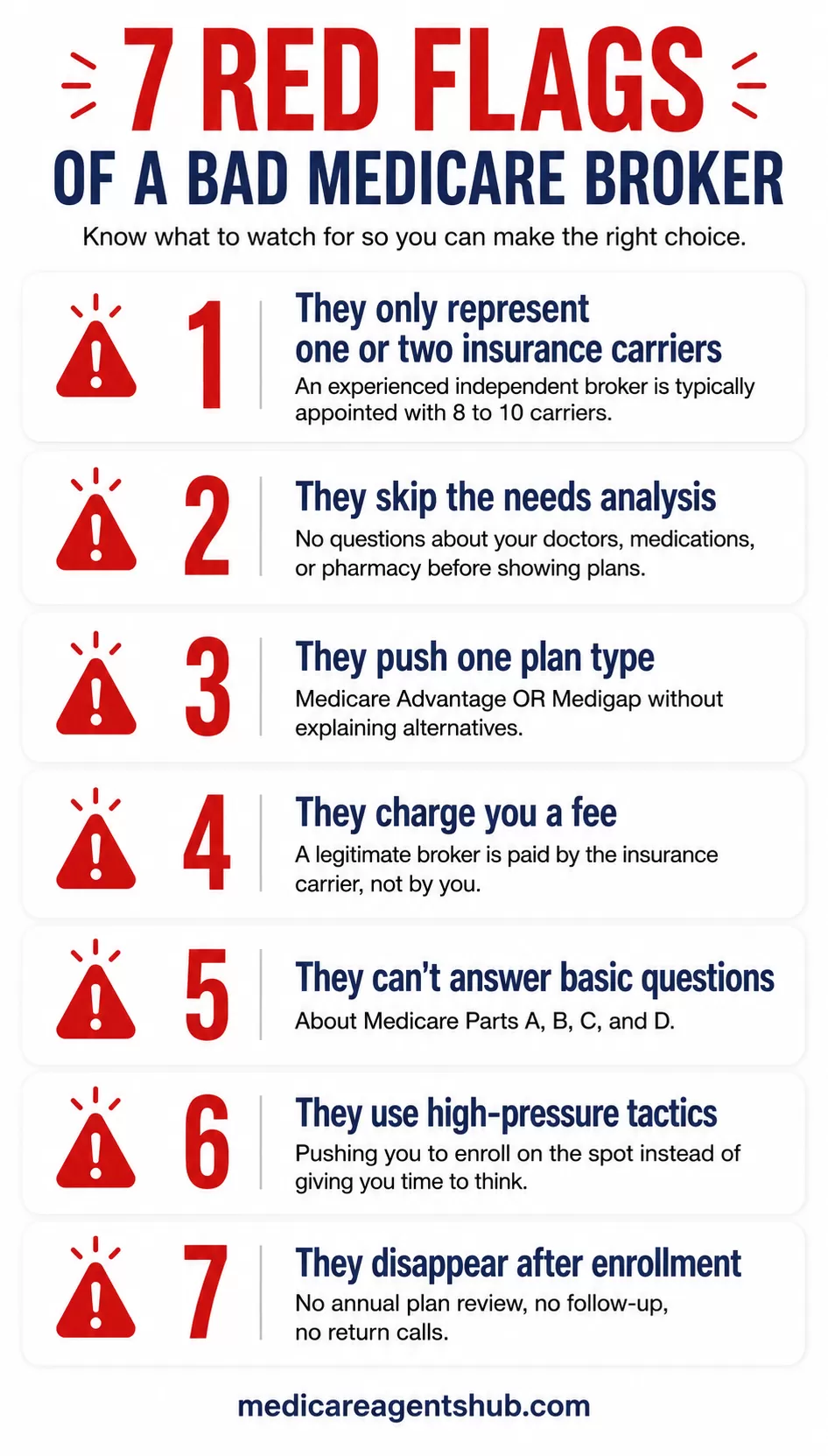
Red Flag #1: They Only Represent One or Two Carriers
This is the single fastest way to size up a Medicare broker, and agents brought it up more than any other red flag. An experienced, independent broker is often appointed with 8 to 10 insurance carriers, though that number can be lower in smaller or rural markets where fewer plans are sold. A broker who only carries two or three is either brand new to the industry or is a "captive" agent tied to a single company.
Why does this matter? A captive agent can only show you plans from their employer. If that company doesn't offer the best option for your situation, you'll never hear about it. You're essentially walking into a Ford dealership and expecting them to tell you the Toyota is better.

How can I tell the difference between an experienced Medicare Broker and an inexperienced Medicare Broker?
An experienced broker is usually independent broker and is appointed with 8-10 insurance carriers. Rookies are usually only licensed with 2-3.When you sit down with a broker, ask directly: "How many insurance companies do you represent?" If the answer is one or two, you're not getting a full picture of what's available in your area. An independent broker with multiple carrier appointments has no reason to push one plan over another because they can compare across the entire market.
Understanding the difference between a Medicare broker and a Medicare agent is the first step. Brokers represent you. Captive agents represent their company.
Red Flag #2: They Skip the Needs Analysis
Every agent we spoke with agreed on this point: a good broker asks questions before recommending anything. If someone jumps straight to showing you a plan without first learning about your situation, they're selling, not advising. For a list of questions agents think you should ask during these conversations, we've compiled recommendations from dozens of licensed professionals.
Here's what a proper needs analysis looks like. Before any plan discussion, your broker should ask for:
- A list of your current doctors and specialists
- All prescription medications you take, including dosages
- Your preferred hospital and pharmacy
- How often you travel out of state
- Your monthly budget for healthcare
- Any upcoming procedures or health concerns
Without this information, there is no way to determine which plan actually fits. A broker who doesn't ask for your doctor list before recommending a Medicare Advantage plan has no idea whether your doctors are even in that plan's network. That's not an oversight. It's reckless.
Agents also flagged the time factor. A thorough initial meeting should take 30 to 45 minutes at minimum. If someone is rushing you through in 15 minutes, they're cutting corners that could cost you thousands in surprise bills later.
Red Flag #3: They Push One Plan Type Without Explaining Alternatives
This is where commission bias shows up most clearly. Multiple agents told us that Medicare Advantage plans pay significantly higher commissions than Medicare Supplement (Medigap) policies. That financial incentive can influence which plans get presented and which ones quietly disappear from the conversation.

Why do some agents push Medicare Advantage plans over Medigap-should I be skeptical?
In all honesty, yes, you should be skeptical. Both Medicare Advantage and Medigap plans have their own pros and cons. The Advantage plans typically pay a higher commission to the agent which is the answer to your question. Not everyone is in this business for the right reasons.A good agent/broker will explain, in detail, how each type of plan works and let you decide which way you want to go. Feeling pushed should always be a red flag.
A trustworthy broker will walk you through both Medicare Advantage and Medigap options, explain the trade-offs of each, and let you decide based on your health, your budget, and your preferences. If you leave a meeting having only heard about one type of plan, that broker failed you.
The red flag isn't that a broker recommends Medicare Advantage. For many people, it genuinely is the better fit. The red flag is when they won't explain why they're recommending it, won't discuss alternatives, or seem annoyed when you ask about Medigap. A good broker educates. A bad broker sells. You can learn more about the real cost comparison between Medicare Advantage and Medigap to come prepared.
One caveat worth knowing: in most states, Medigap insurers can deny you coverage or charge more based on your health history if you apply outside your initial Medigap Open Enrollment Period. That means switching from Medicare Advantage back to Medigap later isn't always guaranteed. A good broker will bring this up before you commit. You can review the details on Medicare.gov's guide to when you can buy Medigap.

Can I switch from a Medicare Advantage plan to a Supplemental/Medigap plan during the Annual Enrollment Period without answering health questions?
Yes, in most cases, you will have to answer health questions.During the Annual Enrollment Period (October 15–December 7), you can leave your Medicare Advantage plan and return to Original Medicare. However, enrolling in a Medicare Supplement (Medigap) plan usually requires medical underwriting in most states.
The only time you can get a Medigap plan without health questions is during your Initial Enrollment Period (three months before your 65th birthday, the month of your birthday and three months after your birthday) or if you qualify for a special guaranteed issue situation for example if your current plan is not renewed.
Important: Always apply and get approved for the Medigap plan before dropping your Medicare Advantage plan to avoid coverage gaps.
Red Flag #4: They Charge You a Fee
This one is straightforward and non-negotiable. Legitimate Medicare brokers do not charge you anything for plan selection or enrollment. Not for a consultation. Not for a quote. Not for enrollment. Not for ongoing service. If someone asks you to pay a fee to help you pick or sign up for a Medicare plan, that is a serious warning sign. (Some advisors offer broader retirement or financial planning for a fee, but that is a separate service from Medicare plan selection.)
Medicare agents and brokers are compensated entirely by the insurance carriers. The commission is built into the plan, and it's the same amount whether you enroll through a broker, through the carrier directly, or on your own at Medicare.gov. Using a broker costs you nothing extra.

Do I have to pay extra to use a local Medicare Licensed Insurance agent?
You do not pay any extra to work with a local Medicare licensed insurance agent. In most cases, agents are compensated by the insurance companies, so their services come at no direct cost to you. Your plan premium is the same whether you enroll on your own or with the help of an agent—so you can benefit from expert guidance and support without paying additional fees.Multiple agents pointed out that charging a fee for Medicare services isn't just unethical. It's a potential violation of CMS regulations governing how Medicare products are marketed and sold. If someone asks you for money, end the conversation and report them to your state's Department of Insurance.
Red Flag #5: They Can't Answer Basic Questions
Medicare is not simple. Parts A, B, C, and D each have their own rules, enrollment windows, and penalties. A competent broker should be able to explain the following without hesitation:
- The difference between Original Medicare and Medicare Advantage
- How Part D prescription drug coverage works, including formularies and tiers
- What a Maximum Out-of-Pocket (MOOP) limit means and why it matters
- When you can and can't switch plans
- How prior authorization works on Medicare Advantage plans
- Late enrollment penalties and how to avoid them
If your broker hesitates, gives vague answers, or deflects your questions, they may not have the training or experience to guide you properly. Several agents noted that fumbling through basic Medicare concepts is one of the clearest signs of someone who is new to the business and still learning at your expense. One way to gauge expertise is by understanding agent designations and what certifications a qualified broker should hold.
Experienced agents complete annual training and recertification with both CMS and every carrier they represent. That ongoing education is what allows them to explain things like how prior authorization actually works and what happens when your plan changes year to year.
Red Flag #6: They Use High-Pressure Tactics
Agents were unanimous on this one: pressure is the hallmark of a bad broker. If someone is rushing you to sign today, telling you the offer expires soon, or making you feel like you'll lose coverage if you don't act immediately, walk away.
Good brokers give you time. They provide materials, answer follow-up questions, and encourage you to think it over. The CMS rules that govern Medicare sales exist specifically to protect you from high-pressure situations. Any broker who violates the spirit of those rules is prioritizing their paycheck over your wellbeing.
Watch out for these specific pressure tactics:
- "This plan is only available today." Medicare plans have defined enrollment periods. Nothing expires because you waited a day to think about it.
- "I can only hold this rate for 24 hours." Medicare plan premiums are set by the carrier and filed with CMS. Your broker has no control over pricing.
- "Just sign here and we'll go over the details later." You should never enroll in a plan you don't fully understand.
- Calling you repeatedly without your permission. CMS strictly limits how Medicare plans can be marketed. Unsolicited calls are a violation.
Red Flag #7: They Disappear After Enrollment
Enrollment is day one, not the finish line. Several agents emphasized that ongoing service after you sign up is one of the biggest differences between a good broker and a bad one. Plans change every year. Your health changes. Your medications change. A broker who enrolls you and vanishes is a broker who collected a commission and moved on.
Before you commit to working with someone, ask: "What happens after I enroll?" A quality broker will review your plan annually during the Annual Enrollment Period, check whether your doctors and medications are still covered, and help you switch if something better becomes available.

What are the red flags I should look for when interviewing agents? I want to make sure I'm not just getting sold to but genuinely advised.
Ask to see their copy of your written permission to contact you. It is illegal for someone to contact you without your permission. That's first clue. Ask for a copy of their current Medicare Certification. It is a certificate from AHIP or NABIP. If they are not currently certified you are probably dealing with someone that can only sell a small percentage of your choices and may only sell one company. You may not even see your alternatives, prices or options. Lastly, look at the Department of Insurance website for complaints. Obviously, if you are "pressured" in any way; pressured to make an appointment, a decision, or choice, then terminate the call or tell the agent you will find a Certified, licensed agent, that has no complaints and successful enough to not apply pressure.How to Verify a Broker's License and Complaint History
You don't have to take anyone's word for it. Every state has a Department of Insurance (DOI) website where you can look up any broker's license status, how long they've been licensed, and whether any complaints have been filed against them.
Here's how to check:
- Ask the broker for their full name and license number. Any legitimate broker will hand this over without hesitation.
- Visit your state's DOI website. Most have a "Verify a License" or "Producer Lookup" tool.
- Check their license issue date. This tells you how long they've been in the industry. An agent licensed for less than a year may be perfectly knowledgeable, but you should expect them to have a mentor or supervising broker backing them up.
- Look for complaints or disciplinary actions. Any pattern of complaints is a serious warning sign.
- Verify their AHIP certification. All agents selling Medicare Advantage or Part D plans must complete annual AHIP (America's Health Insurance Plans) certification. You can ask to see their certificate.
Taking five minutes to verify a license can save you from months of headaches with a plan that doesn't fit. If you want more guidance on what to look for during the selection process, our Medicare agent selection guide covers the full checklist.
Your Broker Screening Checklist
Use this list before your next meeting with a Medicare broker. If you can check every box, you're likely working with someone trustworthy.
- Verified their license on your state's DOI website
- Confirmed they are independent (not captive to one carrier)
- Checked online reviews and asked for referrals
- They asked about your doctors, medications, and pharmacy before showing any plan
- They explained both Medicare Advantage and Medigap options
- They discussed the pros and cons of each plan type
- They gave you time to think and didn't pressure you to enroll immediately
- They did not charge you any fee for their services
- The meeting lasted at least 30 minutes
- They provided written materials and their contact information
- They offered to do an annual plan review
- They answered follow-up questions promptly
The Bottom Line
The agents who answered these questions didn't sugarcoat it. Bad brokers exist in every market, and they survive because most consumers don't know what to look for. But now you do.
The red flags are specific and verifiable. Count their carriers. Watch whether they ask about your doctors. Listen for whether they explain alternatives. Check their license. And if anyone asks you for money, leave.
Working with the right broker costs you nothing and can save you thousands. Working with the wrong one can lock you into a plan that doesn't cover your doctors, doesn't cover your medications, and may be impossible to change until the next enrollment period. The five minutes you spend screening a broker is the best investment you can make in your Medicare coverage.