Are "Free" Medicare Seminars Worth Attending? Agents Say It Depends on This One Word
-
Last Updated September 16, 2026

Reviewed by Matt Temmen
Medicare Broker Licensed in MO, AL, AR & 42 other states
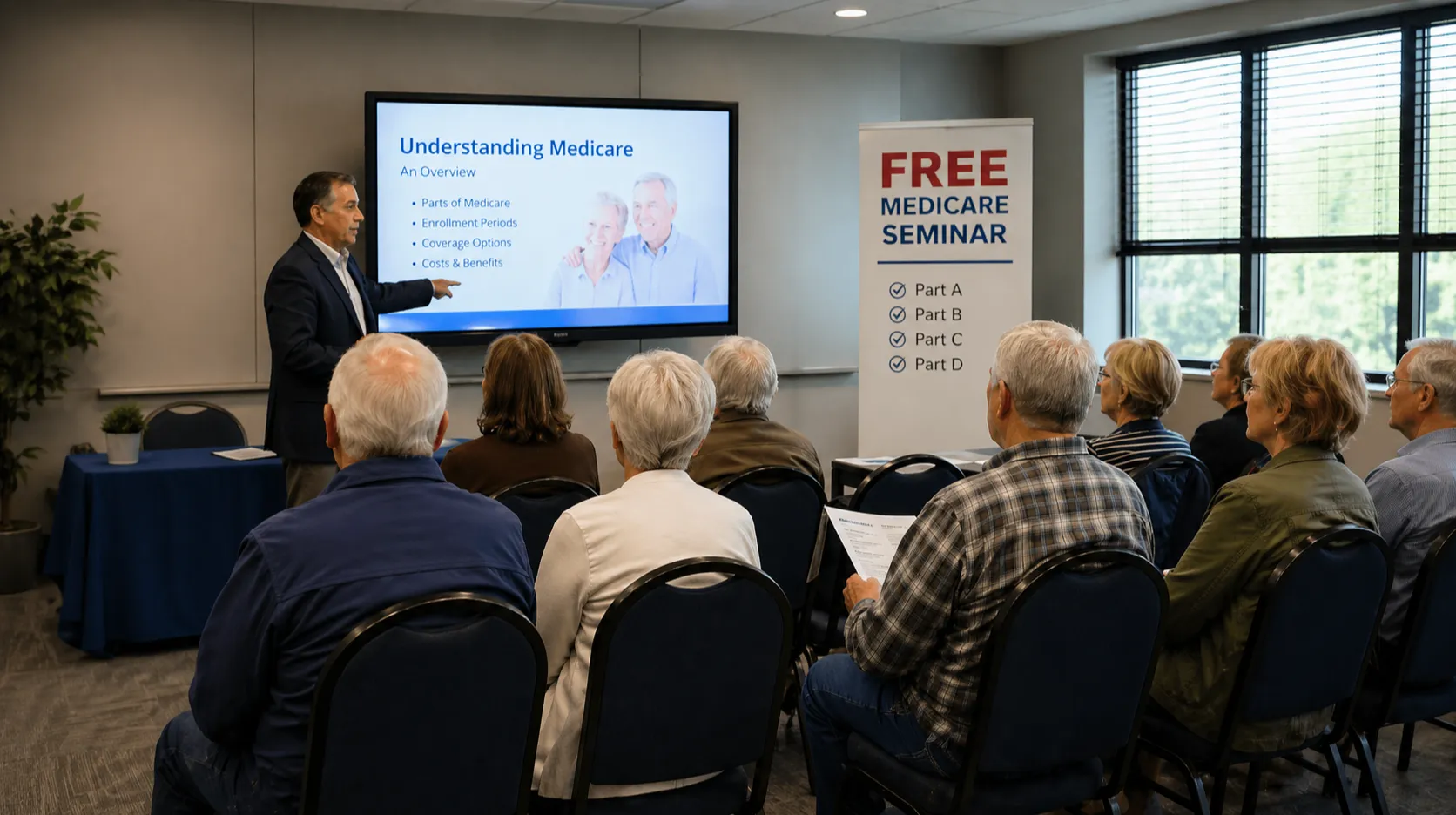
That one word is "educational."
If a Medicare seminar is labeled an educational event, CMS (the Centers for Medicare & Medicaid Services) enforces strict rules about what can and cannot happen in that room. No plan-specific sales pitches. No collecting your personal information. No enrollment pressure. The presenter can explain how Medicare works, walk through enrollment timelines, and outline your options in general terms. That's it.
But if the event is registered as a sales or marketing event, the rules change. Specific plans, benefits, and copays are fair game. And the line between "helpful information" and "high-pressure pitch" gets blurry fast.
We asked licensed Medicare agents whether free seminars are worth your time. Their answers were surprisingly candid.
The Two Types of Medicare Events (and Why the Label Matters)
CMS recognizes two distinct categories of Medicare events, and the difference between them determines everything about your experience.
Educational events are designed to teach Medicare basics. The presenter cannot mention specific carriers, discuss plan-level benefits, distribute marketing materials, or attempt to enroll anyone. They can explain Parts A, B, C, and D. They can walk through enrollment periods, penalties, and the difference between Medicare Advantage and Medigap. But if they start naming carriers or quoting copays, they're violating federal guidelines.
Sales or marketing events are where specific plans get discussed. Agents can present plan details, compare benefits, and even help you enroll. These aren't inherently bad. But they do come with a different set of expectations, and you should walk in knowing the difference.
| What Happens | Educational Event | Sales / Marketing Event |
|---|---|---|
| Discuss specific carriers or plans | Not allowed | Allowed |
| Compare plan benefits and copays | Not allowed | Allowed |
| Distribute marketing materials | Not allowed | Allowed |
| Enroll attendees at the event | Not allowed | Allowed |
| Collect attendee contact info | Only if attendee volunteers it | Allowed |
| Follow-up contact after the event | Only if you ask for it | Allowed within the terms you agreed to |
A Scope of Appointment (SOA) is a CMS-required form you sign that spells out exactly which types of plans an agent is allowed to discuss with you. It puts you in control of the conversation before it starts.

I went to a free Medicare seminar and it felt like a timeshare pitch. Are any of those events actually helpful?
There are two types of Medicare events, educational events designed to answer your general questions about Medicare and sales events that are geared to talk about a specific products.When signing up to get your general Medicare questions answered, be sure to ask if this is an educational event or sales event.
Also, keep in mind, unless you specifically requested information by phone or email, you should NOT be getting unsolicited phone calls asking you to attend these kinds of events, as this is a violation of Medicare agent regulations or get sales information at Educational Events.
Before you RSVP to any Medicare event, ask the organizer one question: "Is this an educational event or a sales event?" That single answer tells you exactly what to expect when you walk through the door.
What CMS Rules Actually Protect You From
CMS didn't create these event categories arbitrarily. They exist because seniors were being enrolled into plans they didn't fully understand, sometimes at events that felt more like timeshare presentations than Medicare education. These protections are spelled out in the official Medicare Communications and Marketing Guidelines (MCMG), the rulebook every licensed agent is required to follow. CMS publishes the current version on its managed care marketing page if you want to read the rules yourself.
Here's what the regulations actually say:
- No uninvited contact. An agent cannot call, email, or visit you unless you specifically requested it. Getting a cold call inviting you to a seminar? That's a violation.
- The 48-hour SOA rule. This one gets misquoted a lot, so here's what it actually says: it is not a blanket waiting period on all contact. In most cases, your signed Scope of Appointment has to be on file at least 48 hours before a one-on-one sales appointment can take place. (CMS allows exceptions, such as walk-in appointments or when you're inside the final days of a valid election period.) The separate protection after an educational event is simpler: the agent cannot follow up with you at all unless you asked them to.
- Scope of Appointment (SOA). Before any sales conversation happens, you must sign a document specifying which topics you want to discuss. The agent can only talk about what you authorized. This protects you from bait-and-switch tactics.
- No personal info collection at educational events. At a true educational seminar, the presenter cannot gather your phone number, email, or health details. If someone is passing around a sign-in sheet asking for contact information at an "educational" event, that's a red flag.

I went to a free Medicare seminar and it felt like a timeshare pitch. Are any of those events actually helpful?
There are 2 types of events that you can register with CMS: sales events which are meant to steer or “sell” a product and educational events which is prohibited from discussing copays or features. They can only be generic in nature. The RULES are that you are not even allowed to distribute marketing materials or contact attendees without them soliciting you in a separate appointment. The challenge is not every agent follows the rules and people inherently will want to know the details of copays and features when you open it up for questions. I think it’s just important to know what type of event you are going to (you can ask) and know that there are no obligations just because you listen. It sounds like you just encountered someone that wasn’t very good at it.Think an event crossed the line? You can report misleading or high-pressure Medicare marketing tactics by calling 1-800-MEDICARE or filing a complaint with the CMS Part C & D compliance office.
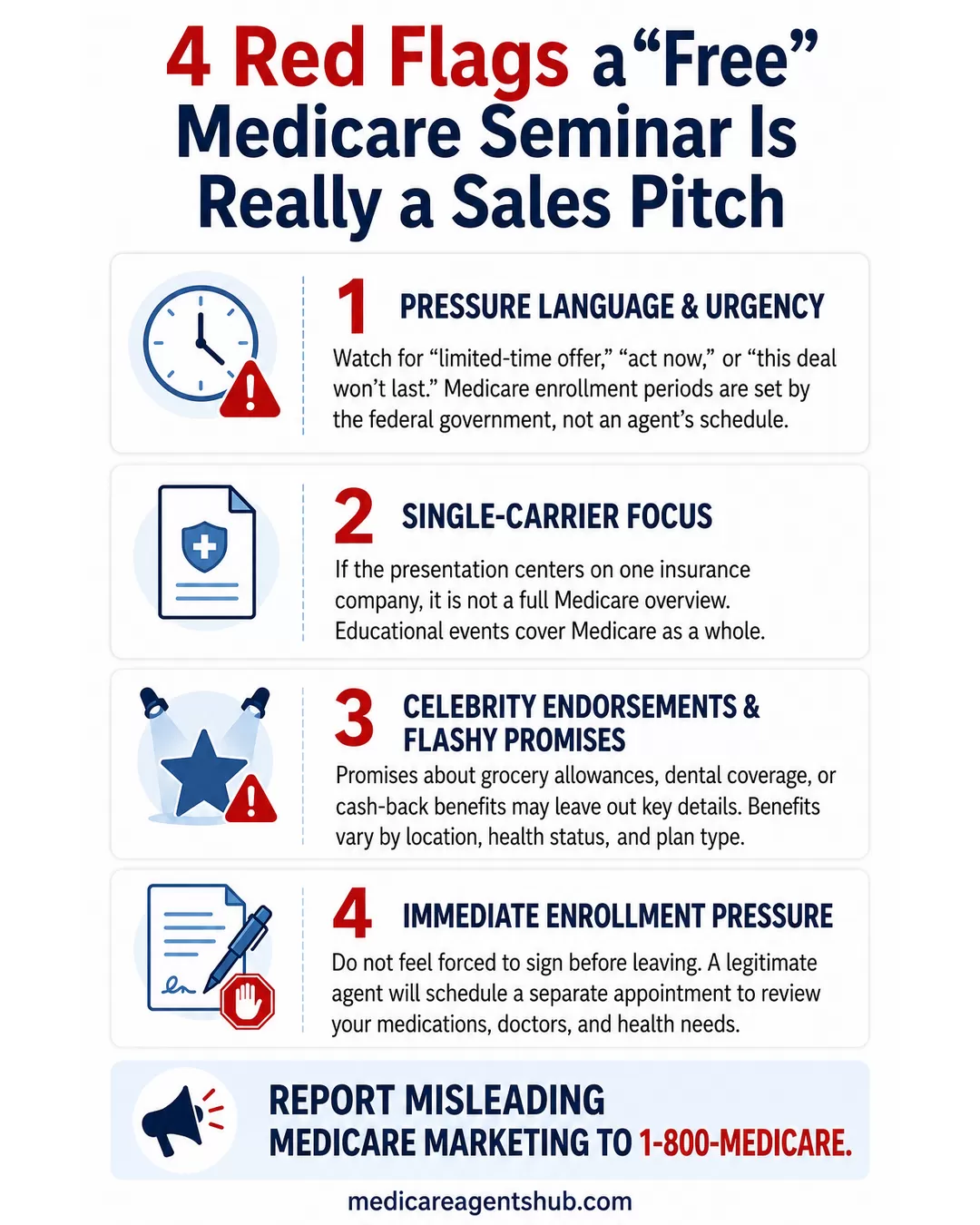
Red Flags That a Seminar Is Really a Sales Pitch
Not every seminar that calls itself "educational" actually is. Some agents and agencies push the boundaries of CMS rules, and others ignore them entirely. Here are the warning signs to watch for. Many of them overlap with the red flags agents use to spot a bad Medicare broker in any setting.
Pressure Language and Urgency
Phrases like "limited-time offer," "you need to act now," or "this deal won't last" have no place at a Medicare educational event. Medicare enrollment periods are set by the federal government. They don't change because an agent wants to close a sale before you leave the room.
Single-Carrier Focus
If the entire presentation revolves around one insurance company's plans, you're at a marketing event, regardless of what the flyer said. A genuine educational seminar covers Medicare as a whole, not one company's product line.

I went to a free Medicare seminar and it felt like a timeshare pitch. Are any of those events actually helpful?
It depends on who is doing the presentation. If it is sponsored by a carrier it will definitely be a sales pitch for that carrier's advantage plans. They will discuss the basics of Medicare but then they will lead you to their productsYou will have better luck if you find a local broker that is offering an educational session. They will still want your business but they will be able to tell you about multiple carriers and products. You will have more choices and a more interested partner because brokers are not employed by the carriers. They depend on referrals from happy clients.
Celebrity Endorsements and Flashy Promises
Those TV commercials with famous faces promising "extra benefits you're missing out on" have bled into in-person events, too. The same tactics that make those ads misleading apply in a seminar setting. Benefits vary by location, health status, and plan type. Blanket promises about grocery allowances, dental coverage, or cash-back benefits rarely tell the full story.

Don't you think Medicare should ban all those celebrity Medicare Advantage commercials?
I absolutely 100% believe that celebrities should not be endorsing any products unless they themselves are customers of those same said products. Also, more than likely, celebrities do not and are not Medicare Advantage recipients, as they have the means and income to pay for other coverage.Immediate Enrollment Pressure
If someone tries to get you to sign paperwork before you've left the building, stop. A legitimate agent will schedule a separate appointment where they can review your specific medications, doctors, and health needs. Anyone rushing you through enrollment at a group event is not putting your interests first.
For a deeper look at misleading marketing tactics, agents have shared their thoughts on the most misleading Medicare Advantage ads and how they handle them with clients.
When a Seminar Is Genuinely Worth Your Time
The agents we spoke with weren't anti-seminar. Many of them host educational events regularly and take pride in running sessions that leave attendees better informed, not pressured. The good ones share a few common traits.
They're carrier-agnostic. The presenter discusses Medicare as a program, not as a gateway to one company's plans. You'll hear about Medicare Advantage and Medigap side by side, with honest pros and cons for each.
They welcome questions without steering. A well-run event lets you ask about anything related to Medicare. The presenter answers honestly, even when the answer is "that depends on your situation, and we'd need to look at it one-on-one."
They don't collect your info unless you offer it. At the end of a real educational session, you might have the option to leave your contact information if you want a follow-up. But nobody is passing around a mandatory sign-in sheet.
They're hosted by independent brokers, not captive agents. An independent broker represents multiple carriers, which means they can show you a wider range of options. A captive agent works for one company and can only sell that company's products. That distinction matters when you're trying to get unbiased information. If you're unsure about the difference, this breakdown of brokers vs. agents explains it clearly.

I went to a free Medicare seminar and it felt like a timeshare pitch. Are any of those events actually helpful?
Some are helpful, but a lot of them are really lead-generation events dressed up as education. The useful ones focus on explaining Medicare basics, enrollment timelines, penalties, Medigap vs. Medicare Advantage, Part D, and how to compare options; the less useful ones spend most of the time steering people toward one plan, one carrier, or setting a one-on-one appointment. A good rule is this: if the event feels balanced and educational, it may be worth attending, but if it relies on pressure, fear, “limited-time” language, or pushes you to enroll before you’ve had time to compare your choices, treat it like a sales pitch.How to Verify a Seminar Before You Go
You don't have to gamble on whether an event will be helpful or a waste of your afternoon. A few quick steps can save you the trouble.
- Ask the organizer directly: "Is this event registered with CMS as an educational event or a sales/marketing event?" If they can't answer clearly, that's your answer.
- Check who's hosting: Is it a local independent broker, a community center, or a SHIP (State Health Insurance Assistance Program) office? SHIP counselors are federally funded, unpaid by insurance companies, and can't sell you anything — you can find your state's office through the national SHIP directory. These tend to run genuinely educational sessions. Is it branded with a single insurance carrier's logo? Expect a sales presentation.
- Look for "Medicare 101" in the title: Events labeled "Medicare 101" or "Introduction to Medicare" are almost always educational in nature. Events titled "Learn About Your New Benefits" or "Find Out What You're Missing" tend to be sales-oriented.
- Read the fine print on the invitation: CMS requires certain disclaimers on event marketing materials. If the flyer says "For Educational Purposes Only," the presenter is bound by educational event rules.

I went to a free Medicare seminar and it felt like a timeshare pitch. Are any of those events actually helpful?
Many “free Medicare seminars” are mostly sales pitches, not education. Only attend ones labeled “Medicare 101” or go one on one with an independent agent to get real, personalized help without pressure.If you'd rather skip the group setting entirely, you can always find a local Medicare agent for a one-on-one conversation. Many agents offer free consultations that cover the same ground as a seminar but are tailored to your specific situation.
The Bigger Picture: Why This Matters
The flood of Medicare marketing doesn't stop at seminars. TV ads, mailers, phone calls, and online ads all compete for your attention during enrollment season. Agents themselves are frustrated by the volume of misleading information that reaches their clients.

Why does Medicare allow insurance companies to bombard seniors with confusing mail and TV ads?
Insurance carriers are for-profit companies. Their Medicare Advantage plans make money by spending less on a member's healthcare than the government payments they receive from Medicare. So, the more people they enroll, the more money they make.The Centers for Medicare & Medicaid Services (CMS) has strict restrictions and guidelines on what insurance companies, agencies, and agents/brokers can and cannot advertise.
Unfortunately, many agencies and marketing firms slip in phrases like "if eligible" and "qualified members" with their ads. This is especially true when pushing Over-the-Counter (OTC) cards that can be used to pay for groceries.
I personally have had dozens of calls from seniors asking how they get their $[insert 4-digit number] check. I've had to explain that some ads walk the fine line using phrases that make it seem like people are entitled to big-dollar checks, rebates, and even free dental coverage.
Bottom line is they are legal, provided they don't flat out say something that is definitely untrue (which is why they qualify with those phrases like "if eligible" and "qualified members") to enroll as many people as possible.
This is why it's wise to use a licensed health insurance broker who is certified to sell Medicare Advantage plans (like me) instead of going through Medicare.gov or an insurance agency where you talk to an agent in a call center who has quotas to meet.
This is exactly why understanding the word "educational" matters so much. When you know what a legitimate educational event looks like, you can filter out the noise. You can attend a seminar with confidence, knowing what rules the presenter must follow and what behavior should make you walk out.
And if you've already been through the seminar circuit and still feel confused, that's normal. Medicare is a complex system with moving parts that change every year. The agents who do this well will tell you the same thing: find one person you trust, make sure they represent multiple carriers, and let them do the heavy lifting of comparing plans against your actual doctors, medications, and budget.
For a broader look at how agents approach education, this article on how Medicare agents educate their clients covers the strategies good agents use beyond seminars. And if you're comparing plan types on your own, Medicare Advantage vs. Medicare Supplement is a good starting point.
Rather skip the seminar?
You can get the same information one-on-one, without a room full of strangers or a sales presentation. Browse licensed agents in your area and talk to someone who can look at your actual doctors, medications, and budget.