Understanding Agent Designations: A Comprehensive Guide

-
Last Updated September 19, 2026

Reviewed by Madaly Buhr
Medicare Broker Licensed in CA, AL, AR & 41 other states
Designations, as they relate to Medicare health insurance agents, are 3 or 4 letter acronyms often found on an agent's listing, website, or email signature. These designations not only signify the expertise and qualifications of insurance agents but can also guide consumers in choosing the right professional for their Medicare needs.
- Know the significance of agent designations in the insurance industry
- Discover common health and Medicare insurance designations
- Learn the meanings behind the acronyms and what they represent
The Role of Agent Designations: What's the Point?
Insurance agent designations are a benchmark of professional education, ethical standards, and specialized knowledge in the field of health and Medicare insurance. These credentials indicate that an agent has undergone rigorous training and has a deep understanding of specific areas of the insurance industry.
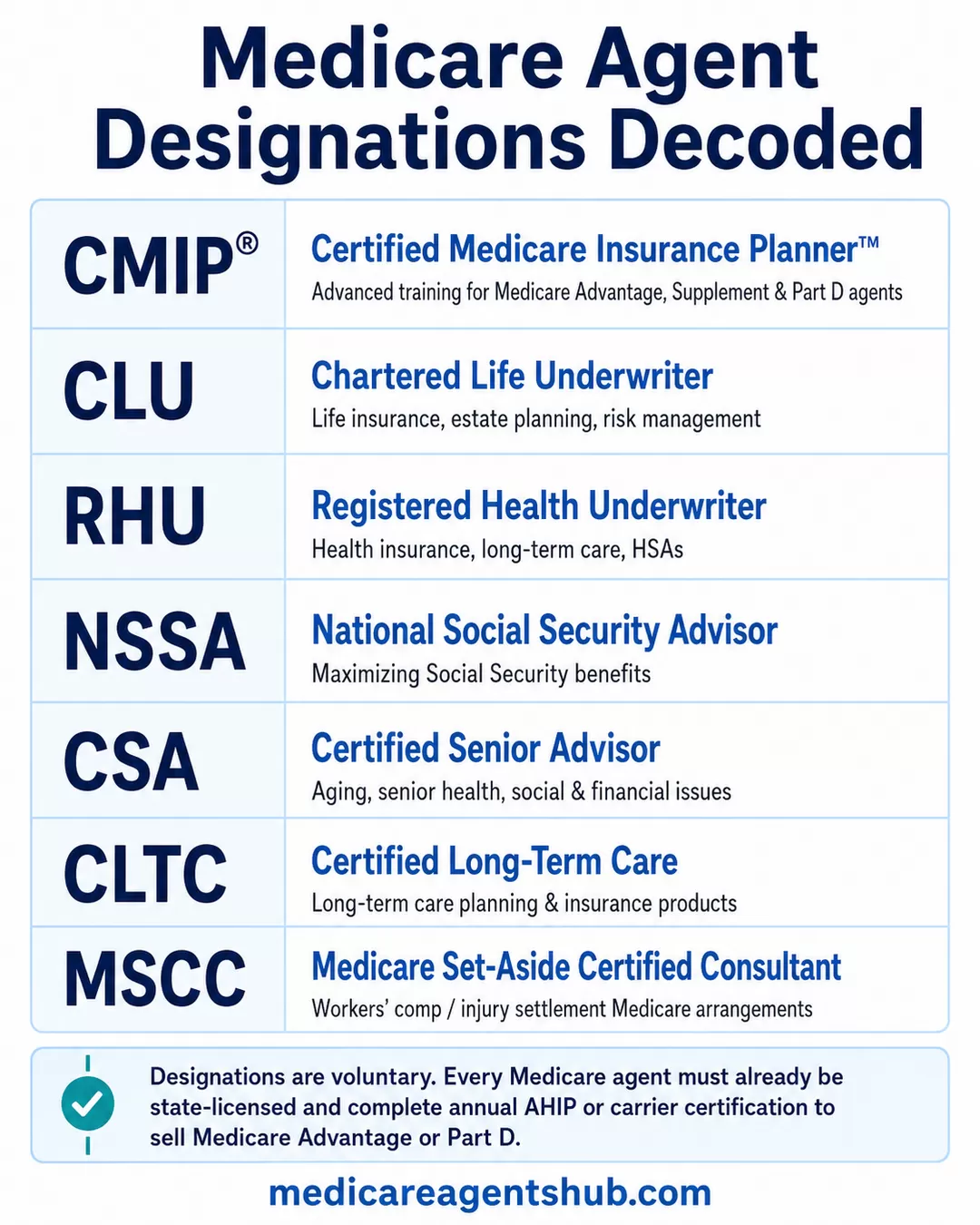
Keep in mind: designations are voluntary. Every Medicare agent must already be licensed by their state's Department of Insurance, and agents who sell Medicare Advantage or Part D plans must complete annual AHIP or carrier-specific certification. Designations sit on top of those baseline requirements. None of the designations on this page are issued, required, or endorsed by Medicare, CMS, or any other federal agency. They come from independent educational and professional organizations, and each one sets its own coursework, exam, and renewal rules. To verify an agent's license or speak with a neutral counselor, you can also reach out to Medicare's "Talk to Someone" tool or your state's SHIP program.

What's the difference between a Medicare broker and a Medicare agent?
Many independent Medicare advisors use the words "Broker" and "Agent" interchangeably, but there is a difference. All brokers are agents but not all agents are brokers.An Agent means they are licensed and can represent a plan.
A Broker means they are licensed and can represent multiple plans.
Beware of "captured" agents, or agents that work specifically for one company. They're good people but their hands are also tied if that company has a down year or if your doctor leaves their network. They only have 1 option to show you, even if it's not a good fit at all.
Common Professional Designations that Medicare Insurance Agents May or May Not Hold
-
Certified Medicare Insurance Planner™ (CMIP®): One of several recognized advanced designations for experienced Medicare Advantage and Medicare Supplement / Prescription Drug Plan agents. It is not required by CMS or any state for Medicare sales, but signals additional training beyond baseline licensing. The same organization also issues the CMIS™ and CMIR™ designations for related roles.
-
Chartered Life Underwriter (CLU): This designation is one of the oldest and most respected in the insurance industry. A CLU has advanced knowledge of life insurance, estate planning, and risk management, which is essential for advising clients on long-term financial planning and insurance needs.
-
Certified Insurance Counselor (CIC): Professionals with a CIC designation have comprehensive knowledge across various domains of the insurance industry, including property, casualty, life, and health insurance. Their broad expertise makes them valuable for providing well-rounded advice to clients.
-
Registered Health Underwriter (RHU): RHU designees specialize in health insurance and employee benefits. This designation signifies advanced knowledge in medical insurance, long-term care insurance, and health savings accounts (HSAs), crucial for advising on individual and group health plans.
-
Chartered Healthcare Consultant (ChHC): This relatively new designation focuses on the complexities of healthcare reform and the Affordable Care Act. Agents with a ChHC are well-versed in the latest healthcare policies and can provide expert advice on compliance and strategic planning for businesses and individuals.
-
National Social Security Advisor (NSSA): Although not solely focused on health insurance, professionals with an NSSA certification specialize in advising clients on maximizing their Social Security benefits. This is particularly relevant for seniors navigating Medicare options and planning for retirement.
-
Certified Senior Advisor (CSA): The CSA designation indicates comprehensive knowledge about aging and the important health, social, and financial issues that affect the majority of seniors. CSAs are equipped to understand and meet the unique needs of older adults, including those related to Medicare and other health insurance decisions.
-
Certified Employee Benefit Specialist (CEBS): This designation is highly regarded in the field of employee benefits and compensation. Professionals with a CEBS designation have a comprehensive understanding of health insurance benefits, retirement planning, and compensation. They are particularly skilled in designing and managing benefits plans for organizations.
-
Fellow, Life Management Institute (FLMI): The FLMI designation signifies expertise in life and health insurance products, operations, and administration. Professionals with this designation possess a deep understanding of the insurance industry's practices and principles, making them valuable resources for complex policy and administration questions.
-
Health Insurance Associate (HIA): Professionals with an HIA designation have specialized knowledge in health insurance, including managed care, health insurance products, and the regulatory environment. This designation is particularly relevant for those working in or with health insurance companies and healthcare management organizations.
-
Certified Health Insurance Executive (CHIE): The CHIE designation is aimed at senior-level executives and leaders in the health insurance industry. It covers strategic planning, leadership, and critical issues affecting the health insurance sector. This credential demonstrates a commitment to excellence in leadership and an in-depth understanding of the challenges and opportunities in health insurance.
-
Disability Income Associate (DIA): This designation focuses on the complex field of disability income insurance. Professionals with a DIA designation have specialized knowledge in underwriting, managing, and advising on disability income policies, an important aspect of financial planning and risk management.
-
Medicare Set-Aside Certified Consultant (MSCC): This unique designation is for professionals who specialize in Medicare Set-Aside arrangements, which are financial agreements that allocate a portion of a workers' compensation or personal injury settlement to cover future medical expenses related to the injury that would otherwise be payable by Medicare. MSCC designees are experts in navigating the intersection of healthcare, insurance, and legal considerations in these arrangements.
-
Accredited Advisor in Insurance (AAI): This designation signifies a strong understanding of insurance underwriting, coverages, and key insurance principles. Professionals with an AAI designation are equipped to provide high-quality advice on a broad range of insurance products and services.
-
Registered Employee Benefits Consultant (REBC): This designation focuses on the specialized field of employee benefits, including health insurance, retirement plans, and other employee benefit programs. Professionals with an REBC designation are experts in designing, implementing, and managing employee benefits packages.
-
Certified Long-Term Care (CLTC): The CLTC designation focuses on the field of long-term care planning, including insurance products and strategies to manage long-term care risks. Professionals with this designation are skilled in helping clients plan for long-term care needs and selecting the appropriate insurance products to meet those needs.
Do I Need to Choose an Agent With Lots of Designations?
Selecting an agent with certain designations is truly a matter of preference. Just because an agent doesn't have a particular designation doesn't mean that they can't help you in a variety of ways - both in and outside of Medicare insurance. Agents who invest in earning advanced designations do demonstrate a commitment to their profession and to the level of service they give clients. Some agents advertise their designations. Others never mention them. If you aren't sure whether or not your agent has a specific designation, be sure to ask.
Credentials are only one signal, and usually not the most important one. How an agent actually works with you matters more: which carriers they're contracted with, how they get paid, and whether they give you room to think. Our guides on the red flags that should make you walk away and how Medicare agents get paid cover both of those in detail.
Key Takeaways
- You don't need an agent with every credential; state licensing and annual Medicare certification (AHIP or carrier training) are the real baseline.
- Extra designations can signal deeper training in a specialty area (long-term care, senior advising, employee benefits, Social Security), but they aren't required to sell Medicare.
- No credential on this page carries a government stamp of approval. Every one of them is awarded by a private organization, not by Medicare.
- Ask your agent about their license, training, and which product lines they're contracted for.
- If you want a second opinion, your state's SHIP program offers free, unbiased Medicare counseling.
Navigating Your Medicare Choices
Choosing the right Medicare plan involves considering various factors, including cost, coverage, and the network of healthcare providers. With the help of a qualified agent, you can navigate these choices more easily, ensuring that you find a plan that best suits your health needs and financial situation. Whether you're looking for advice on standard Medicare, Medicare Advantage Plans, or Medicare Supplement Insurance (Medigap), a well-credentialed agent can provide the guidance you need.
Once you know what the different health insurance agent designations mean, you have a clearer picture when selecting an insurance agent. It takes some of the mystery out of choosing Medicare coverage, and it makes it easier to ask an agent the right questions before you enroll in anything.

Why do some agents push Medicare Advantage plans over Medigap-should I be skeptical?
There are 3 potential reasons that an agent might do this:1 - Medicare Advantage is easier to sell than a Medicare supplement when it comes to talking points. They are often $0 plans that offer additional benefits, whereas Medigap plans have additional premiums and no extra benefits. Advantage plans may even reduce your Part B premium. So, on paper, they sound amazing and are easier to get someone to say yes to.
2 - Compensation for Medicare Advantage plans is higher than for Medigap plans. Unfortunately, there are agents who sell plans based on their best interest and not the client's.
3 - They may not be contracted to sell Medigap plans.
Generally, agents should take a neutral standpoint. They should explain the pros and cons of all coverage types and help the client choose what is best for them and their situation. Any agent who pushes one specific plan or coverage is usually doing a disservice to the client.
Other Insurance Agent Designations
Below are some less common designations that you might encounter when shopping for a Medicare insurance agent near you. Please note this is not an exhaustive list of insurance agent designations.
Financial planning, investments and estate designations
- Accredited Asset Management Specialist (AAMS)
- Accredited Estate Planner (AEP)
- Associate Financial Advisor (AFA)
- Accredited Financial Counselor (AFC)
- Accredited Financial Services Representative (AFSR)
- Accredited Wealth Manager Advisor (AWMA)
- Board Certified in Estate Planning (BCE)
- Chartered Asset Manager (CAM)
- Certified Annuity Specialist (CAS)
- Certified Estate Advisor (CEA)
- Certified Estate Planner (CEP)
- Chartered Financial Analyst (CFA)
- Certified Financial Planner (CFP)
- Certified Fund Specialist (CFS)
- Chartered Financial Consultant (ChFC)
- Chartered Market Analyst/Financial Analyst Designate (CMA/FAD)
- Certified Manager of Financial Advisors (CMFA)
- Chartered Mutual Fund Counselor (CMFC)
- Chartered Portfolio Manager (CPM)
- Chartered Trust and Estate Planner (CTEP)
- Chartered Wealth Manager (CWM)
- Estate Planning Law Specialist (EPLS)
- Financial Advisers International Qualification (FAIQ)
- Fellow, Financial Service Institute (FFSI)
- Financial Services Specialist (FSS)
- Master Financial Advisor (MFA)
- Master of Science in Financial Services (MSFS)
- Professional Financial Advisor (PFA)
- Registered Financial Specialist (RFS)
- Registered Paraplanner (RP)
Retirement, pension and senior living designations
- Chartered Advisor for Senior Living (CASL)
- Chartered Retirement Planning Counselor (CRPC)
- Chartered Retirement Plans Specialist (CRPS)
- Chartered Senior Financial Planner (CSFP)
- Member, American Society of Pension Actuaries (MSPA)
- Qualified 401k Administrator (QKA)
- Qualified Pension Administrator (QPA)
- Qualified Plan Financial Consultant (QPFC)
- Retirement Income Specialist (RIS)
- Retirement Plans Associate (RPA)
Health, disability and long-term care designations
- Certified Professional Disability Management (CPDM)
- Disability Healthcare Professional (DHP)
- Health Care Anti-Fraud Associate (HCAFA)
- Healthcare Customer Service Associate (HCSA)
- HIPAA Associate (HIPAAA)
- HIPAA Professional (HIPAAP)
- Long-Term Care Professional (LTCP)
- Managed Healthcare Professional (MHP)
- Medical Management Associate (MMA)
Insurance underwriting, claims and service designations
- Associate in Annuity Products and Administration (AAPA)
- Accredited Insurance Examiner (AIE)
- Associate in Insurance Services (AIS)
- Associate in Life and Health Claims (ALHC)
- Associate in Life Management Institute (ALMI)
- Associate in Underwriting (AU)
- Chartered Insurance Professional (CIP)
- Certified Insurance Service Representative (CISR)
- Certified Professional Insurance Agent (CPIA)
- Certified Risk Manager (CRM)
- Fellowship of the Chartered Insurance Institute (FCII)
- Fellow Chartered Insurance Professional (FCIP)
- Fraternal Insurance Counselor Fellow (FICF)
- Fellow, Life and Health Claims (FLHC)
- Life Underwriting Training Council Fellow (LUTCF)
- Professional Customer Service Program (PCS)
- Professional Insurance Sales Association (PISA)
- Personal Lines Coverage Specialist (PLCS)
- Senior Claim Law Associate (SCLA)
General business and clinical credentials
- Certified Public Accountant (CPA)
- Master of Business Administration (MBA)
- Master of Science in Management (MSM)
- Registered Nurse (RN)
Designations show the depth of training a health insurance professional has taken on. Knowing what they mean helps seniors exploring Medicare options pick local insurance advisors who have put in the extra training in the specific areas of insurance that match what they need.
Medicare Agents Hub recognizes the value of connecting consumers with highly qualified professionals. Our directory includes agents and advisors who hold many of these designations, so seniors can find guidance that fits their situation. There's real value in consulting a specialized local agent who works in your coverage type every day. It takes most of the guesswork out of the decision. That's why we've received countless reviews from seniors that found their insurance agent by using Medicare Agents Hub.
Ready to talk with someone? Search our directory for a licensed local Medicare agent, or contact your state's SHIP program for free, one-on-one Medicare counseling.
