What Is a Medicare Broker? How Brokers Help, How They're Paid, and When to Use One

-
Last Updated October 8, 2026

Reviewed by Matt Temmen
Medicare Broker Licensed in MO, AL, AR & 42 other states
A Medicare broker is a licensed insurance professional who represents multiple insurance carriers and helps you compare Medicare plans side by side. Unlike captive agents who work for a single company, brokers are independent, so they can shop across dozens of plans from different carriers to find coverage that fits your health needs, prescriptions, preferred doctors, and budget.
Their services cost you nothing. Brokers are paid by the insurance companies through commissions that are built into the plan's price whether you use a broker or not. If the plan costs the same either way, getting expert guidance is a no-brainer.
This guide covers everything you need to know: how brokers differ from agents, how they're compensated, what they can and can't do, and when it makes sense to use one versus going it alone.
Key takeaways
- A broker's help costs you nothing. Insurance carriers pay them, and charging you a fee is against CMS rules.
- Brokers represent multiple carriers, so you see more plans than a captive agent can show you.
- They check your doctors and prescriptions, compare costs, handle enrollment, and stay on call afterward.
- The plan's premium is identical whether you use a broker or enroll on your own.
What Does a Medicare Broker Actually Do?
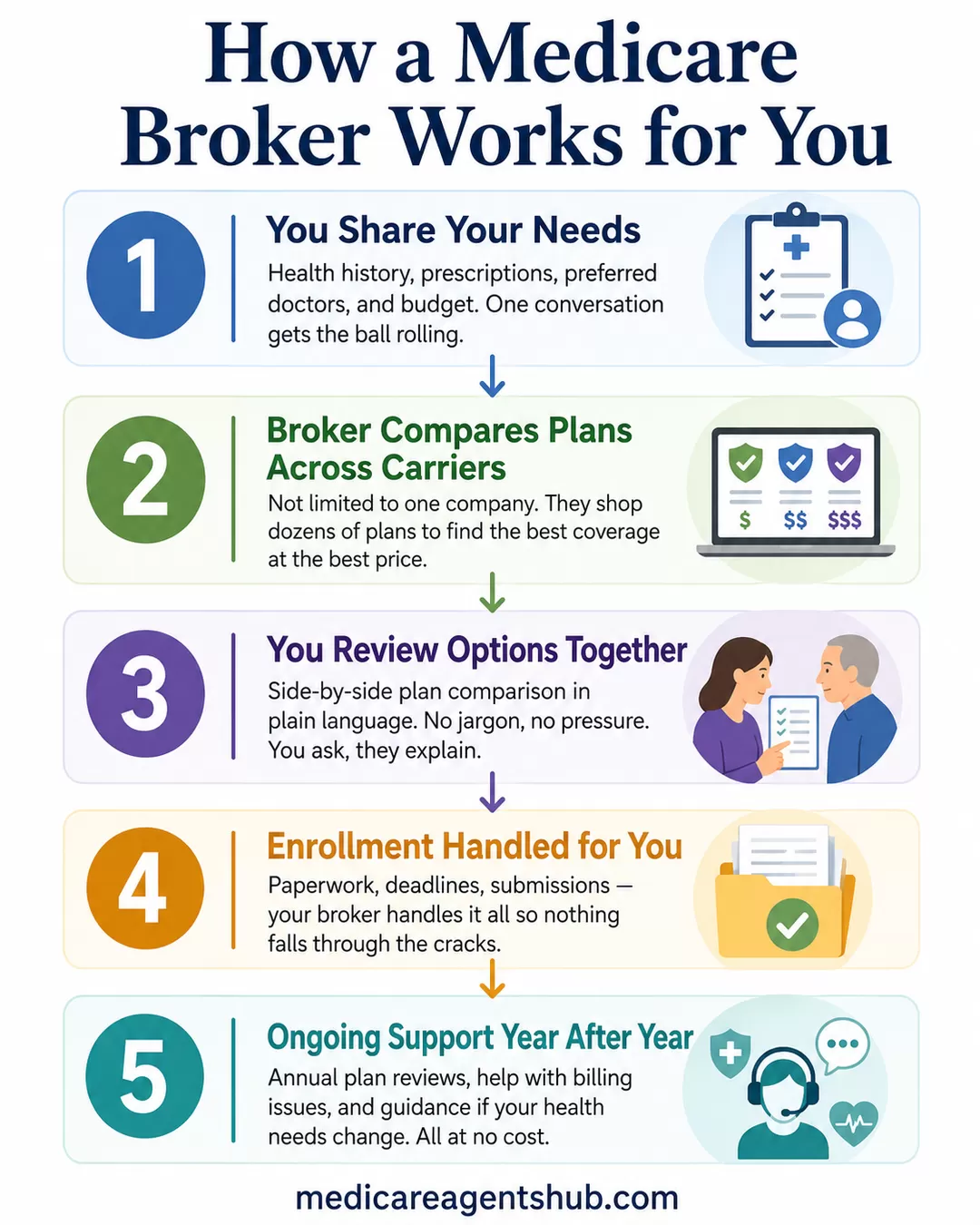
A Medicare broker starts by learning about your situation: your health history, current prescriptions, preferred doctors, and financial picture. From there, they compare available plans across several insurance carriers, weighing the real-world pros and cons of each option.
They check that your doctors are in-network, verify your medications are covered, and walk you through costs and benefits without the usual insurance jargon. Once you've made a decision, the broker handles the enrollment process from start to finish, including paperwork, deadlines, and submissions.
But the relationship doesn't end at enrollment. A good broker stays in your corner year after year, helping you review your coverage annually and adjust if your health needs or the plan landscape changes.
Medicare Broker vs. Medicare Agent: Is There a Difference?
The terms "broker" and "agent" are often used interchangeably, and in practice the line between them has blurred. But there is a traditional distinction worth understanding.
A captive agent works for a single insurance company and can only offer that company's plans. An independent agent (often called a broker) is contracted with multiple carriers and can compare plans across companies. Most Medicare professionals today operate as independent agents, giving them the ability to shop the market on your behalf.
The key question isn't really "broker or agent?" It's "how many carriers do they represent?" An agent contracted with only one or two companies has a limited view of your options. A broker or independent agent with contracts across many carriers can give you a true apples-to-apples comparison.
You will also see the same people marketing themselves as Medicare advisors, Medicare consultants, or Medicare specialists. None of those are separate licenses. They all describe a licensed insurance agent, and the title tells you nothing about how many carriers they carry or how much of their business is Medicare. Judge them on their license, their carrier contracts, and their experience, not the word on their business card.

What's the difference between a Medicare broker and a Medicare agent?
So, agents typically work for one carrier, while brokers typically have more than one carrier that they can represent. Now, out in the real world, agent and broker get used a lot interchangeably. So, what you need to do is ask the person that you're working with which companies they represent. If they only represent one, they're working more as an agent. If they represent several, then they're gonna be working as a broker.
The one good thing about it is for brokers, all the different companies they represent, especially for advantage plans, their compensation is regulated by CMS, and it's the same for all. So they don't really have a financial incentive to work one plan over another plan. Their main incentive should be to find the plan that best fits you, so you'll be happy with the coverage that you have. You'll be happy with that agent, and you'll provide referrals and send your friends their way.
We'd love to help you. For more questions, stay tuned.
Medicare Advantage Brokers vs. Medigap Brokers
Some Medicare brokers specialize. A Medicare Advantage broker focuses on Medicare Advantage plans (Part C) from private insurers, comparing HMO, PPO, and PFFS options along with the drug coverage, dental, vision, and hearing extras that often come bundled in. A Medigap broker (or Medicare Supplement broker) focuses on standardized Medicare Supplement plans that pair with Original Medicare, where the plan letters (Plan G, Plan N, etc.) are identical across carriers but the premiums are not.
Most independent brokers handle both because the right answer depends on your health, budget, and how you feel about network restrictions. If a broker only sells Medicare Advantage or only sells Medigap, ask why. A broker who covers both product types can give you a fair comparison instead of steering you toward the one product they're set up to sell.
Medicare Broker Compensation: How Brokers Get Paid
Medicare brokers are paid commissions by the insurance carriers, not by you. When you enroll in a plan through a broker, the insurance company pays them a commission, and for Medicare Advantage and Part D that amount is capped by federal rules.
For Medicare Advantage and Part D plans, the Centers for Medicare & Medicaid Services (CMS) sets the maximum commission a carrier is allowed to pay. Each insurance company then sets its own rate up to that cap, so in practice the payout is the same or very close across the plans a broker offers. That removes most of the financial incentive to steer you toward one Medicare Advantage plan over another, but it isn't a guarantee that every plan pays identically. It's always fair to ask a broker whether any plan they're recommending pays them differently than the alternatives.
Medicare Supplement (Medigap) commissions work differently. They are not set by CMS and can vary from one insurer to another, and even by state. They typically pay less upfront but include renewal commissions in subsequent years. That structure creates a natural incentive for brokers to keep clients happy long-term, because keeping customers on the books is how they build a sustainable business. Because the payout isn't uniform, it's fair to ask a broker why they're recommending a specific Medigap carrier over another so you know the recommendation is about your long-term needs, not the commission.

How do Medicare brokers get paid, and does it affect the plan they recommend?
Medicare brokers are paid by the insurance company after you enroll, not by you, and it shouldn’t affect their recommendation.How they get paid:
A set commission (regulated by Centers for Medicare & Medicaid Services)
Typically the same amount across plans in the same category (Medicare Advantage or Part D)
Paid whether you enroll directly or through a broker
Does it affect recommendations?
It shouldn’t, rules require brokers to recommend plans based on your needs
But: brokers can only offer plans from companies they’re contracted with.
Do Medicare Brokers Charge a Fee? (Are Brokers Really Free?)
No, Medicare brokers do not charge you a fee. You pay nothing extra to use a Medicare broker. The commission is built into the plan's premium whether you use a broker, enroll directly with the carrier, or sign up through Medicare.gov. The price of the plan is the same regardless of how you enroll.
It is actually illegal for a Medicare agent or broker to charge you a fee. CMS rules explicitly prohibit agents from charging beneficiaries for their services. If anyone asks you to pay for Medicare enrollment help, that's a red flag. Knowing how to spot a bad Medicare broker can help you avoid scams and high-pressure tactics.
So the real question isn't whether a broker is free; it's why you wouldn't get expert help when the cost is the same either way.

What Happens in a Free, No-Obligation Medicare Consultation
Most brokers offer a free consultation before you commit to anything, and knowing what that conversation looks like takes a lot of the anxiety out of booking it.
It usually starts with a phone call, a video meeting, or an in-person visit. The broker asks for your ZIP code, your current prescriptions and dosages, the doctors and hospitals you want to keep, whether you travel or split the year between two states, and roughly what you can afford each month. Then they run those details against the plans they can offer in your county and walk you through the realistic options, including what each one would cost you in premiums, copays, and drug costs over a full year.
No obligation means exactly that. You do not have to enroll in anything, you do not owe the broker money if you walk away, and you can take the comparison they built and think about it, show it to family, or check it against Medicare.gov before deciding. Nothing is binding until you sign an enrollment application, and a broker is not allowed to enroll you without your explicit consent.
It is also independent of the government. A broker is a privately licensed professional, not a Medicare employee or a government representative, and the consultation is not a government program. That independence is the point: they can compare private Medicare Advantage, Part D, and Medigap products side by side, which no government help line will do for you. It also means a broker should never imply they are calling on behalf of Medicare or the federal government. If one does, end the conversation.
Do You Need a Local Medicare Broker, or Can They Be in Another State?
This is the question behind almost every "Medicare broker near me" search, and the answer is simpler than people expect. What legally matters is not how close the broker is to you. It is whether they hold an active insurance license in the state where you live, plus appointments with the carriers whose plans they want to sell you. A broker three hours away who is licensed in your state can help you. A broker across the street who is not licensed in your state cannot.
Plenty of brokers are licensed in several states, and some are licensed in dozens. That is why a cross-country broker can legitimately run a no-obligation consultation for you, and it is also why you should just ask: which states are you licensed in, and are you licensed in mine?
Where local knowledge genuinely helps:
- Plan availability is county-level. Medicare Advantage and Part D options change from one county to the next, and a broker who works your area every day already knows which carriers are strong there.
- Provider networks are local. Knowing which hospital systems and medical groups fight with which insurers is the kind of thing you learn from working a market, not from a database.
- In-person help. If you would rather sit at a kitchen table with the paperwork in front of you, or you want someone who can meet a family member too, local is the only way to get that.
- State Medigap rules. A few states have their own Medicare Supplement rules and extra guaranteed-issue windows, and local brokers tend to know them cold.
Where a non-local broker can be the better choice: if you need a specific carrier your local brokers do not carry, if you split the year between two states, or if you simply prefer handling everything by phone and email. Many people are better served by a licensed, responsive broker two states away than by a nearby one who is hard to reach in November.
If you want to start local, our directory is searchable by ZIP code so you can see licensed Medicare brokers and agents near you and the states each one covers. If you would rather have us narrow it down, you can also tell us what you need and get matched with an agent.
Medicare Broker Services: What Brokers Can and Cannot Do
A good broker can save you significant time and confusion. But it's important to understand the boundaries of what any broker can offer.
Services a Medicare broker CAN provide:
- Compare plans from every carrier they're contracted with
- Check whether your doctors are in-network and your prescriptions are covered
- Explain the differences between Medicare Advantage and Medigap in plain language
- Handle enrollment paperwork and ensure deadlines are met
- Help resolve post-enrollment issues like billing problems or network changes
- Review your coverage annually and recommend changes when better options exist
What a broker CANNOT do:
- Offer every plan on the market. Brokers can only sell plans from carriers they hold contracts with. Some brokers are more independent than others, so always ask how many carriers they represent. If you want to see every plan available in your area, cross-check with Medicare.gov's Plan Finder or your local SHIP program.
- Enroll you in certain plan types. A handful of plans are never sold through brokers at all. Employer or union retiree group plans are arranged through the former employer's benefits office, PACE programs enroll you directly through the local PACE organization, and the remaining Medicare cost plans are handled by the carrier. A broker can explain these options, but can't sign you up for them.
- Give you legal or tax advice. Questions about Medicaid spend-down, trusts, estate planning, or how an IRA withdrawal affects your premiums belong with an elder law attorney or a tax professional. A broker can flag the issue and tell you who to call.
- Make medical decisions for you. A broker can lay out your options, but ultimately you need to review plan details carefully and make the final call.
- Guarantee the "best" plan exists. What's best depends on your specific health needs, which can change year to year.
- Override plan rules or CMS regulations. If a plan doesn't cover a specific service, your broker can't change that, but they can help you find one that does.
As licensed agents on our platform consistently point out: not all brokers are the same. The key is finding one who's upfront about what they can offer and genuinely focused on your needs.

Are there disadvantages to working with a Medicare broker/agent?
Not all brokers are the same. Some only work with certain insurance companies, so you might not see every option. Others may not focus deeply on Medicare details, like which doctors are in-network or which drugs are covered. Some may concentrate more on enrollment than on making sure the plan really fits your needs long-term.The good news? A great broker will be upfront about what they can offer and focus on finding the plan that’s truly right for you.
I specialize in Medicare plans and enjoy building long-term relationships with my clients. My goal is to guide you through your options and help you feel confident in choosing the plan that fits your life best.
When It Makes Sense to Use a Medicare Broker
Most people benefit from working with a broker, especially in situations like:
- Turning 65 and enrolling for the first time. The number of options can be overwhelming without guidance
- Losing employer coverage because transitioning to Medicare has strict timelines and easy-to-miss deadlines
- Managing chronic conditions or expensive prescriptions because getting drug coverage wrong can cost thousands
- Feeling overwhelmed by Part D, Medigap, or Medicare Advantage choices. There's no shame in wanting a professional's perspective
- Reassessing coverage during the Annual Enrollment Period because plans change every year, and what worked last year may not be optimal now
- Moving to a new state because plan availability and networks vary dramatically by location
That said, a broker isn't a requirement. If you're comfortable digging into plan details on your own or you want strictly unbiased, education-only guidance, using Medicare.gov and SHIP can be enough on their own.
Experienced agents consistently say that people who try to navigate Medicare alone often end up spending more money or making mistakes that can't be fixed until the next enrollment window.

Who can help me figure out this Medicare "maze and alphabet soup" it's so confusing.
Medicare can absolutely feel overwhelming between Part A, Part B, Part C, Part D, Medigap lettered plans, enrollment windows, and income-based premiums, but the good news is you do not have to figure it out alone. A licensed independent Medicare agent is trained to cut through all of that confusion, explain your options in plain language, and match you with coverage that actually fits your life and budget. Best of all, working with an agent costs you nothing since they are compensated by the insurance carriers, not by you. There is also a free government program called SHIP, which stands for State Health Insurance Assistance Program, that provides unbiased Medicare counseling if you want a second opinion or just want to learn more before making any decisions.Medicare Broker vs. SHIP vs. Medicare.gov
A broker isn't the only way to get Medicare help. Here's how the three main options compare:
| Medicare broker / independent agent | SHIP counselor | Medicare.gov / 1-800-MEDICARE | |
|---|---|---|---|
| What it is | A licensed professional contracted with multiple insurance carriers | Federally funded, education-only counseling through your State Health Insurance Assistance Program | The official government website and help line |
| Compares plans for you | Yes, across every carrier they are contracted with | Explains your options, but will not recommend a specific plan | You compare them yourself with the Medicare Plan Finder tool |
| Can enroll you | Yes, start to finish | No. SHIP counselors do not sell insurance | Yes, through the official site or help line |
| Cost to you | Free. Paid by commission from the carrier | Free. No sales component at all | Free |
| Help after enrollment | Year-round, including an annual plan review | Limited. Staffing varies by state, with a mix of volunteers and part-time paid counselors, so availability and depth of Medicare knowledge differ | General support only, with no personal advocate |
| Best for | People who want personalized plan comparisons and hands-on help | People who want purely educational, sales-free guidance | Self-directed research and verifying plan details |
These options aren't mutually exclusive. Many people start with Medicare.gov research, consult SHIP for an unbiased overview, and then work with a broker for the actual plan comparison and enrollment. Using multiple resources gives you the most complete picture.
Questions to Ask Before Choosing a Broker
Not all brokers provide the same level of service. The best brokers are educators first, salespeople second. Before committing, ask these questions:
- How many insurance carriers do you represent? More carriers means a broader comparison. If they only represent one or two companies, you're not getting a true market view.
- Are you licensed and certified to sell Medicare in my state? Every state requires specific licensing. Confirm they hold current certifications.
- How long have you been working with Medicare clients? Experience matters, but so does attitude. An agent with a few years of focused Medicare experience may serve you better than one with decades of general insurance work.
- Will you help me review my plan each year? The best brokers proactively reach out before each enrollment period. If they disappear after the initial sale, that's a sign they're not invested in the relationship.
- Can you explain my options in plain language? If you leave a conversation more confused than when you started, that's a red flag.
It's also completely fine, and smart, to meet with more than one broker before deciding. Comparing their advice helps you understand your options better and find someone you trust.

How can I tell the difference between an experienced Medicare Broker and an inexperienced Medicare Broker?
One of the biggest differences is how they approach the conversation. An experienced Medicare broker will usually ask about your doctors, prescriptions, and overall needs before recommending a plan. They should also be able to clearly explain the differences between Medicare Advantage, Medicare Supplement, and Part D options without pushing just one company.It’s also helpful to work with someone who represents multiple insurance companies and offers ongoing support after enrollment. A local Medicare broker can be especially valuable since you may have the option to meet in person and have someone you trust to help review your coverage year after year.
The Ongoing Value of a Medicare Broker
A broker's support doesn't end once your application is submitted. Your health may change, new plans may become available, or insurance companies may alter their networks or drug formularies mid-year.
A broker can help you navigate issues that pop up after enrollment, such as billing problems, provider network changes, or a medication getting dropped from the formulary. If your doctor leaves your plan's network, your broker can guide you through next steps and help you understand when you can make changes.
Having a broker in your corner means having someone to help manage your healthcare coverage over time, not just during enrollment season. That ongoing relationship is one of the most underappreciated benefits of working with an independent agent.

How can I make sure I'm not overpaying for my Medicare plan, and are there any tools or resources you recommend?
One of the best ways to ensure that you are maximizing your retirement income is to work closely with your agent. A trustworthy broker/agent will have frank conversations with you about ALL of the plans available in your service area. (typically based on the county of your zip code).By consulting with Medicare.gov, you and your agent have the ability to see ALL of those plans. I thorough needs analysis will reveal many things, including your medical needs as well as your budget goals.
An agent who wants to be in business for the long haul will send you to the most suitable plan for your needs, knowing that you can always review. Additionally, when you know you have an honest and caring individual guiding you through a confusing process, you give them referrals.
Common Misconceptions About Medicare Brokers
Based on thousands of questions answered by licensed agents on our platform, here are the most common misunderstandings seniors have about working with a broker:
For Medicare Advantage, CMS caps commission amounts and carriers set their own rate up to that cap, so brokers earn the same or nearly the same commission no matter which MA plan you choose. The incentive to steer you toward a specific MA plan is largely gone, though a broker can still tell you if one plan pays differently than another. Medigap commissions are not CMS-regulated and can vary by carrier, so it's fair to ask a broker why they're recommending one Medigap plan over another. A broker focused on long-term retention knows that putting you in the wrong plan means losing you as a client.
Not necessarily. Brokers can only offer plans from carriers they're contracted with. Most independent brokers carry contracts with the major carriers in your area, but it's always worth asking which companies they represent. You can cross-reference on Medicare.gov's Plan Finder to see if anything was missed.
The premium is identical whether you use a broker, call the carrier directly, or enroll on Medicare.gov. There's no discount for cutting out the middleman because the broker's commission is already built into the plan's pricing structure.
You're never locked in. You can switch brokers, work with a different agent, or handle things on your own at any point. Your plan stays the same regardless.
Frequently Asked Questions
What is the difference between a Medicare broker and a Medicare agent?
Traditionally, a "broker" represents multiple insurance carriers while an "agent" may work for a single company. In practice, most Medicare professionals today are independent agents who work with multiple carriers, functioning as brokers even if they use the agent title. The important thing is to ask how many carriers they represent.
Do Medicare brokers charge a fee?
No. It is against CMS rules for any Medicare agent or broker to charge beneficiaries a fee. They are compensated entirely through commissions paid by insurance carriers.
How do I find a good Medicare broker near me?
Look for brokers who represent multiple carriers, have strong reviews from other seniors, and are willing to explain your options without pressure. You can search for a licensed Medicare broker in your area through our directory of 20,000+ agents and brokers nationwide.
Do I need a broker to sign up for Medicare?
No. Enrolling in Original Medicare (Part A and Part B) is handled by the Social Security Administration, and a broker cannot do that step for you. Where a broker becomes useful is the private side of Medicare: Medicare Advantage, Part D prescription drug plans, and Medicare Supplement policies. If all you want is Part A and Part B, you can enroll through Social Security on your own and never speak to a broker.
Can a regular health insurance broker help with Medicare plans?
Only if they are set up for it. Selling Medicare Advantage and Part D requires an active state license, appointments with each carrier, and the annual Medicare training and certification CMS requires, which is separate from anything a broker does for under-65 or employer coverage. Plenty of health insurance brokers handle both, but some only work the under-65 market. Ask directly whether Medicare is a regular part of their business and which Medicare carriers they are appointed with.
Can I use a Medicare broker during any enrollment period?
Yes. Brokers can help you during your Initial Enrollment Period (turning 65), the Annual Enrollment Period (October 15 – December 7), Special Enrollment Periods, and the Medicare Advantage Open Enrollment Period (January 1 – March 31).
Medigap works on a different clock. In most states you can apply for a Medicare Supplement policy any month of the year, but outside your six-month Medigap Open Enrollment Period you may have to answer health questions and go through medical underwriting. Some states add their own guaranteed-issue windows, like birthday and anniversary rules, so check how your state handles it before you plan a switch.
Should I use a broker or just go to Medicare.gov?
They're not mutually exclusive. Medicare.gov is a great research tool, but it won't give you personalized recommendations. A broker adds value by analyzing your specific health situation, medications, and doctors, then recommending plans based on your individual needs rather than leaving you to sort through dozens of options alone.
Find a Medicare Broker Near You
Medicare is too important to leave to guesswork. A broker gives you access to more choices, less confusion, and real peace of mind, all at no cost to you. Whether you're enrolling for the first time or reassessing your current coverage, the right broker can help you make smarter, more confident decisions.
Our directory lists 20,000+ licensed Medicare brokers and independent agents nationwide, searchable by ZIP code so you can find local help in minutes. Find a licensed Medicare broker near you and get the personalized guidance you deserve.
To create this guide, our editorial team drew on insights from licensed, independent Medicare agents and brokers nationwide who contribute answers to Medicare Agents Hub. All information is fact-checked against current CMS guidelines and reviewed periodically for accuracy. For official Medicare information, visit Medicare.gov or contact your local SHIP program.