I Made a Medicare Mistake. Stories From Seniors Who Picked the Wrong Plan

-
Last Updated October 9, 2026

Reviewed by Andrew Duncan
Medicare Agent Licensed in CA, AL, AR & 42 other states
Nobody walks into Medicare expecting to get it wrong. You do the research. You weigh the options. You pick a plan that sounds right. And then the bills start showing up - or the premiums keep climbing - or your doctor tells you they can't help because your plan won't cover what you actually need.
These are not hypothetical situations. They come from real questions seniors ask real Medicare agents every day on Medicare Agents Hub. The names below are composites, but the situations are pulled directly from the kinds of mistakes agents see most often. Each story ends with what an agent would have recommended instead.
The Snowbird Who Picked Medigap and Now Can't Afford It
Call her Linda. She retired at 65, split the year between Michigan and Florida, and did what she thought was the smart thing: she picked a Medigap plan so she could see any doctor in either state. No networks. No referrals. Total freedom.
Five years later, Linda is paying over $300 a month in Medigap premiums on top of her Part B premium and a standalone Part D plan. Her premiums have gone up every year since she enrolled. She doesn't use much care - a couple of doctor visits a year, nothing major. She's spending thousands annually for peace of mind she rarely cashes in on.
Linda isn't unusual. Agents hear this story constantly. They describe the trade-off in straightforward terms: Medigap buys predictability and the freedom to see any doctor anywhere, but for someone who barely uses care, the cost can feel disproportionate to the benefit. Premiums typically run $150 to $300 or more per month on top of Part B and a standalone Part D plan, and they tend to climb every year as the policyholder ages. The real sting is that once you leave Medigap for a Medicare Advantage plan, getting back in usually means passing medical underwriting - which gets harder with age.
Agents say the right question is not whether the original choice was a mistake, but whether the plan still fits the person's situation today. Premiums go up, health needs change, and what made sense at 65 may not make sense at 72.

I went with Medigap because I travel a lot, but now I'm paying a fortune in premiums. Did I make a mistake?
You chose Medigap for the flexibility it offers, especially while traveling, and that was a smart move if seeing doctors nationwide without network restrictions is important to you. But if the premiums are starting to feel like too much, it may be time to review your plan.It may be time to shop your Medigap plan — to see if there’s a more cost-effective option that still fits your lifestyle and health needs. Rates can vary significantly between insurance companies for the exact same coverage, so there may be room to save without sacrificing benefits.
What an agent would have told Linda: Medigap is the right call for snowbirds who see doctors regularly in both states. But for someone who's healthy and travels for leisure more than for medical care, a Medicare Advantage PPO with a nationwide network could have delivered similar flexibility for $0 or near-$0 per month. One caveat: not every PPO branded as "nationwide" actually has true parity outside its home service area, and out-of-network visits usually carry higher cost-sharing. The trade-off is copays when you use services - but if you barely use services, those copays may add up to far less than $3,600-plus a year in Medigap premiums. And if Linda wanted to try Advantage while keeping a safety net, she could have used her 12-month trial right to switch back to Medigap without underwriting if it didn't work out.
The Senior on Original Medicare With No Safety Net
Call him Frank. He turned 65, signed up for Medicare Parts A and B, and stopped there. His doctor's office told him Original Medicare was good coverage. Frank liked that he could keep all his doctors without worrying about networks. He figured Medicare would handle his bills.
Then he needed an outpatient procedure. Medicare paid 80%. Frank owed the other 20% - which came to over $4,000. He called the billing department, confused. Nobody had explained to him that Original Medicare has no annual out-of-pocket maximum. There is no ceiling. If you need surgery, imaging, specialist visits, physical therapy - you pay 20% of all of it, with no limit.
Agents see Frank's situation all the time, and they are blunt about it. Standing on Original Medicare with no supplemental coverage is one of the costliest mistakes in the program. Beneficiaries are responsible for roughly 20% of all outpatient charges with no annual cap according to Medicare.gov. That exposure is manageable for a routine office visit, but for something major like open heart surgery, 20% can mean tens of thousands of dollars out of pocket.

I chose Original Medicare to keep my doctors, but now I'm drowning in bills. Should I have gone with Advantage instead?
Yessss. Original Medicare has NO max out-of-pocket, meaning you could go broke with the 80/20 split.What an agent would have told Frank: Original Medicare is excellent coverage - when it's paired with something else. During Frank's initial enrollment, he had guaranteed issue rights to buy a Medigap plan with no health questions asked. A Plan G supplement would have capped his annual exposure to just the Part B deductible ($283 in 2026). If he couldn't afford the Medigap premium, a Medicare Advantage plan would have at least given him an annual out-of-pocket maximum - a worst-case number he could plan around. Either way, standing on Original Medicare alone was the one option that left him completely exposed.
Frank's gap is the most expensive one on this list, and the easiest to miss. A licensed agent can look at what you have now and tell you in a few minutes whether there's a ceiling on your costs. Have an agent review your coverage.
The Cataract Surprise: When "Covered" Doesn't Mean "Fully Paid"
Call her Gloria. She needed cataract surgery. Her doctor said Medicare would cover it. She went in, had the procedure, and everything went smoothly - until the bill arrived. Medicare covered the surgery and a basic monofocal lens. But her doctor had recommended a multifocal lens to correct her astigmatism and reduce her need for glasses. That upgrade? Out of pocket. The bill was over $2,000 per eye.
Gloria felt blindsided. How could her plan cover the surgery but not the lens she actually needed?
This is one of the most common coverage surprises in Medicare. Agents explain it the same way almost universally: Medicare considers the standard monofocal lens medically necessary. Anything beyond that - toric lenses for astigmatism, multifocal lenses, extended depth of focus lenses - is classified as an elective upgrade. The surgery itself is covered, but the premium lens is not. That gap between what Medicare calls "covered" and what the patient actually needs is where the surprise hits.
The mechanism behind the bill is straightforward. When the surgeon recommends an upgraded lens, the patient is being offered a non-covered service. Providers are legally required to present an Advance Beneficiary Notice - a document explaining the upgrade is not covered and the patient will pay the difference. Most people sign it without fully understanding the implications, which is how the bill ends up feeling like a blindside.

My plan covered my cataract surgery but not the lenses I actually needed-how do they get away with that?
They cover the standard lenses. They don’t cover any upgrades, which is usually the case. Before you have surgery you should go over this with the provider.What an agent would have told Gloria: Before any scheduled procedure, ask the surgeon's office for an itemized breakdown of what Medicare will and won't cover. Ask specifically whether any part of the procedure involves upgrades that fall outside "medically necessary" coverage. Some Medicare Advantage plans offer additional vision benefits that may help offset some of these costs. And if you've already had the surgery, check the bill carefully - make sure you were only charged for the upgrade portion, not for services that should have been covered under Medicare.
The $0 Premium Trap: When Copays Become the New Premium
Call him Ray. He picked a Medicare Advantage plan because the premium was $0. No monthly cost beyond his Part B. That sounded like a deal. He'd save hundreds a month compared to a Medigap plan.
Then Ray started using his coverage. A primary care visit here, a specialist there, imaging, lab work. Every service came with a copay. $35 for the specialist. $295 for the outpatient procedure. $50 for the ER visit that turned out to be nothing. By March, Ray had spent more in copays than he would have spent in Medigap premiums for the same period - and he still had nine months to go.
Agents describe this as the most common version of Medicare sticker shock. A $0 premium does not mean $0 cost. It means the plan front-loads savings and shifts expenses to the back end. Every office visit, every specialist referral, every imaging order comes with a copay, and for someone who uses care regularly, those copays add up fast.
The structure is not a flaw - it is how these plans are designed. Medicare Advantage trades lower monthly premiums for higher per-service cost sharing. For someone who rarely sees a doctor, that trade-off works. For someone like Ray, it means the plan costs more in practice than it ever would have on paper.
The maximum out-of-pocket on many Medicare Advantage plans runs from $4,000 to $9,000 or more annually, and not every dollar you spend counts toward it. For a senior with multiple specialists, regular lab work, or a hospitalization, the "free" plan can end up costing more than the Medigap plan with the scary-looking monthly premium.

I picked a Medicare Advantage plan based on the low premium, but now I'm facing high copays. Did I make a mistake?
The short answer is yes and no. Medicare Advantage plans are often attractive to people who don't want to pay a hefty sum every month, especially if they aren't working with much. For someone who is relatively healthy, this isn't a bad option- since they won't encounter as many situations where they're paying these high out of pocket costs. But once you need those X-rays or the worst case scenario happens, that's when you really see how costly being on an MA plan can be.One option to help mitigate those costs is to get on a Hospital Indemnity plan if there's one available in your area. These plans are made to cover those out of pocket costs you'll see with MA plans. They do come with their own premiums, but they usually end up still being way cheaper than paying for a supplement, and you get to keep all your coverages like dental, vision, prescription drugs from your MA plan.
If a person can afford a supplement, I usually suggest they go that route. If you are considering going on a supplement, you may have to go through underwriting to do so- some exceptions apply here; but if you are able to get onto one, the more the plan covers, the more you pay in premiums. Take a look at Plan N or Plan G for Supplements if you qualify- you'll pay a lot every month, but you'll often pay nothing for services when you need them.
What an agent would have told Ray: Never pick a plan based on premium alone. An agent doing a proper needs assessment would have looked at Ray's doctor visits, specialist frequency, prescriptions, and anticipated procedures for the year. They would have run the numbers: total annual Medigap premiums versus total projected copays and out-of-pocket costs on two or three Advantage plan options. For someone who sees multiple specialists regularly, that comparison often reveals that a $0 premium is not the same as $0 cost. And for seniors on a tight budget who do choose Advantage, a hospital indemnity plan can help cover the biggest out-of-pocket hits.
What All of These Stories Have in Common
Linda, Frank, Gloria, and Ray all made reasonable decisions based on incomplete information. Linda picked the safest plan but didn't account for what ten years of rate increases would do to her budget. Frank trusted that "Medicare" meant "covered." Gloria assumed a surgeon's recommendation would be a covered service. Ray chased the lowest number on the comparison sheet.
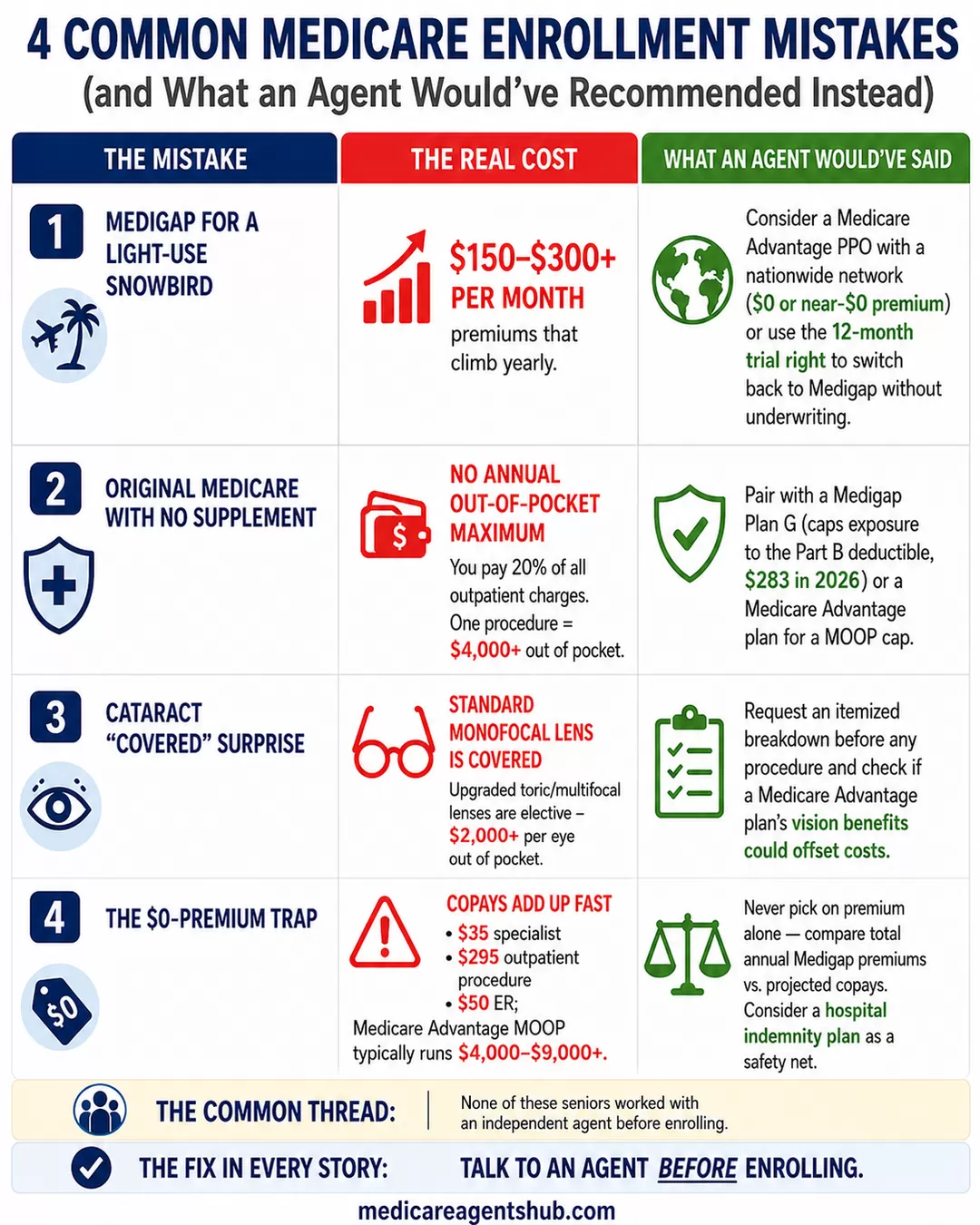
None of them worked with an independent agent or broker before enrolling. That's the thread running through every one of these stories. Agents hear these questions after the fact - after the bills arrive, after the premiums climb, after the surprise at the surgeon's office. The fix is almost always the same: a conversation that happens before enrollment, not after.
A good agent does a health risk assessment. They check your doctors against plan networks. They look at your prescriptions. They ask about travel, about your budget, about whether you'd rather pay predictable premiums or take on some risk with copays. They lay out the trade-offs in plain language - no sales pitch, just math and honesty.
If any of these stories sound familiar, you're not stuck. Medicare has multiple enrollment periods throughout the year that allow you to make changes. The Annual Enrollment Period runs October 15 through December 7 every year. And finding someone to walk through your options costs nothing - agents and brokers are paid by the insurance companies, not by you.
If you're more comfortable talking to someone who doesn't sell plans, every state runs a State Health Insurance Assistance Program offering free one-on-one counseling, and you can reach Medicare directly too. Agent, SHIP counselor, or Medicare itself - what matters is that somebody looks at your situation before you enroll, not after.

Can I switch from a Medicare Advantage plan to a Supplemental/Medigap plan during the Annual Enrollment Period without answering health questions?
You can only sign up for a Medicare Supplement/Medigap plan without answering health questions under a few circumstances. These include:1) You're in your first 6 months of Part B enrollment
2) You've in a Medicare Advantage plan and still in the first year of enrolling in it. (Also called a Trial Right)
3) Two lesser known situations:
- You move out of the service area of your Medicare Advantage plan, or
- Your Medicare Advantage plan terminates your plan without cause
You can find a local Medicare agent right here on Medicare Agents Hub. They've already answered the questions behind these stories. Now they can answer yours.