9 Unusual Medicare Situations (And What Agents Say You Should Do)

-
February 28, 2026

Reviewed by Annabelle Gerhardt-Hobbs
Medicare Agent Licensed in MI, AL, AR & 41 other states
Most Medicare advice assumes a straightforward path: you turn 65, you retire, you enroll. But for millions of Americans, it's not that simple. These are the unusual Medicare situations that most guides completely skip over: getting married in your 70s, qualifying through kidney disease, navigating coverage as a green card holder, or moving to a U.S. territory.
These uncommon Medicare problems catch people off guard because the rules aren't obvious and the stakes are high. One wrong move can mean late enrollment penalties, coverage gaps, or thousands in unexpected costs. The good news? Licensed Medicare agents deal with these Medicare edge cases every day. Here are 9 unusual Medicare situations and what agents across the country say you should do.
1. Getting Married Late in Life
If you're getting married in your 60s, 70s, or beyond, Medicare itself doesn't change. It's individually based, meaning each spouse maintains their own coverage. But the financial ripple effects of marriage on your Medicare costs can be significant.
Why this catches people off guard: Combining incomes with a spouse can push your modified adjusted gross income (MAGI) into a higher bracket, triggering IRMAA surcharges that increase your Part B and Part D premiums. Many newlyweds don't realize this until they see their first joint tax return reflected in Medicare billing, sometimes two years later.
Who benefits most: On the upside, if you didn't work enough quarters to qualify for premium-free Part A on your own, you may now qualify through your spouse's work history, as long as they've worked at least 10 years and you've been married for at least one year. This can save you hundreds of dollars per month in Part A premiums.

How does getting married late in life affect my Medicare coverage or costs?
Getting married later in life can either save you money (if you qualify for premium-free Part A through a spouse’s work history) or cost you more (if combined income triggers IRMAA). But it doesn’t merge your coverage—you’ll each still have your own Medicare.2. Starting Dialysis and Becoming Eligible Through ESRD
End-Stage Renal Disease (ESRD) is one of the few conditions that makes you eligible for Medicare regardless of your age with no disability waiting period required. If you start dialysis or receive a kidney transplant and aren't already on Medicare, you become eligible and must apply through Social Security.
Why the timing matters: Coverage doesn't start immediately. There's typically a three-month waiting period from when dialysis begins, and if you have commercial insurance through an employer, that plan remains your primary coverage for the first 30 months. After that, Medicare takes over as primary. Planning around this transition matters. Gaps in coverage during this window can lead to enormous out-of-pocket costs.
One exception to the wait: The three-month waiting period can be waived if you train for and begin a home dialysis program before the third month. For patients who qualify medically, this can mean earlier Medicare coverage and fewer coordination-of-benefits headaches.
Who's most affected: This situation hits hardest for people under 65 who have never interacted with Medicare before. The enrollment process, coordination of benefits, and coverage timeline are confusing even for people who understand Medicare basics. Working with a knowledgeable agent early, ideally as soon as you receive a diagnosis, can prevent costly mistakes.

If I start dialysis, how does that change my Medicare eligibility or coverage?
You can qualify for Medicare at any age, if you start dialysis due to End-Stage Renal Disease (ESRD). Coverage typically begins on the first day of the fourth month of dialysis, or earlier if you start home dialysis training. Medicare helps pay for inpatient and outpatient dialysis, supplies, and medications, with options to add drug coverage or supplemental plans for out-of-pocket costs.3. Retiring Early from the Federal Government
If you spent your career in federal service under FERS or CSRS and took early retirement, your Medicare eligibility doesn't change. You're still entitled to enroll at 65. The bigger question is how your Federal Employees Health Benefits (FEHB) plan interacts with Medicare, and whether you need both.
Why this gets complicated: FEHB is considered creditable coverage, so you won't face late enrollment penalties if you delay Part B while covered by FEHB. However, most advisors recommend enrolling in both Part A (usually free) and Part B, even if your FEHB coverage is strong. FEHB plans coordinate well with Medicare and can significantly reduce your cost-sharing, essentially turning Medicare into secondary insurance that picks up what FEHB doesn't.
The risk of waiting: If you skip Part B at 65 and later drop FEHB coverage, you'll face a permanent late enrollment penalty: 10% for every 12-month period you could have had Part B but didn't. That penalty applies for the rest of your life. This is one of the most expensive Medicare mistakes federal retirees make.

I worked for the federal government for 30 years and took early retirement. How does my federal retirement affect my Medicare options?
After working for the Federal Government for 30 years, you are eligible for Medicare Part A & B even if you retired early.Enrolling in Medicare doesn't affect your FEHB premiums, but it does change the order in which you receive health insurance coverage. When you enroll in Medicare, it becomes the primary payer for your medical expenses. Your FEHB will continue to be your secondary insurance.
Navigating an unusual Medicare situation? Talk to a licensed Medicare agent who's dealt with cases like yours. It's free and can save you from costly mistakes.
4. Green Card Holder Turning 65
If you're a lawful permanent resident approaching 65, there's a critical residency requirement that many immigrants don't learn about until it's too late: you must have lived continuously in the U.S. for at least 5 years to qualify for Medicare. If you've been here fewer than 5 years, you're not yet eligible, even if you're over 65.
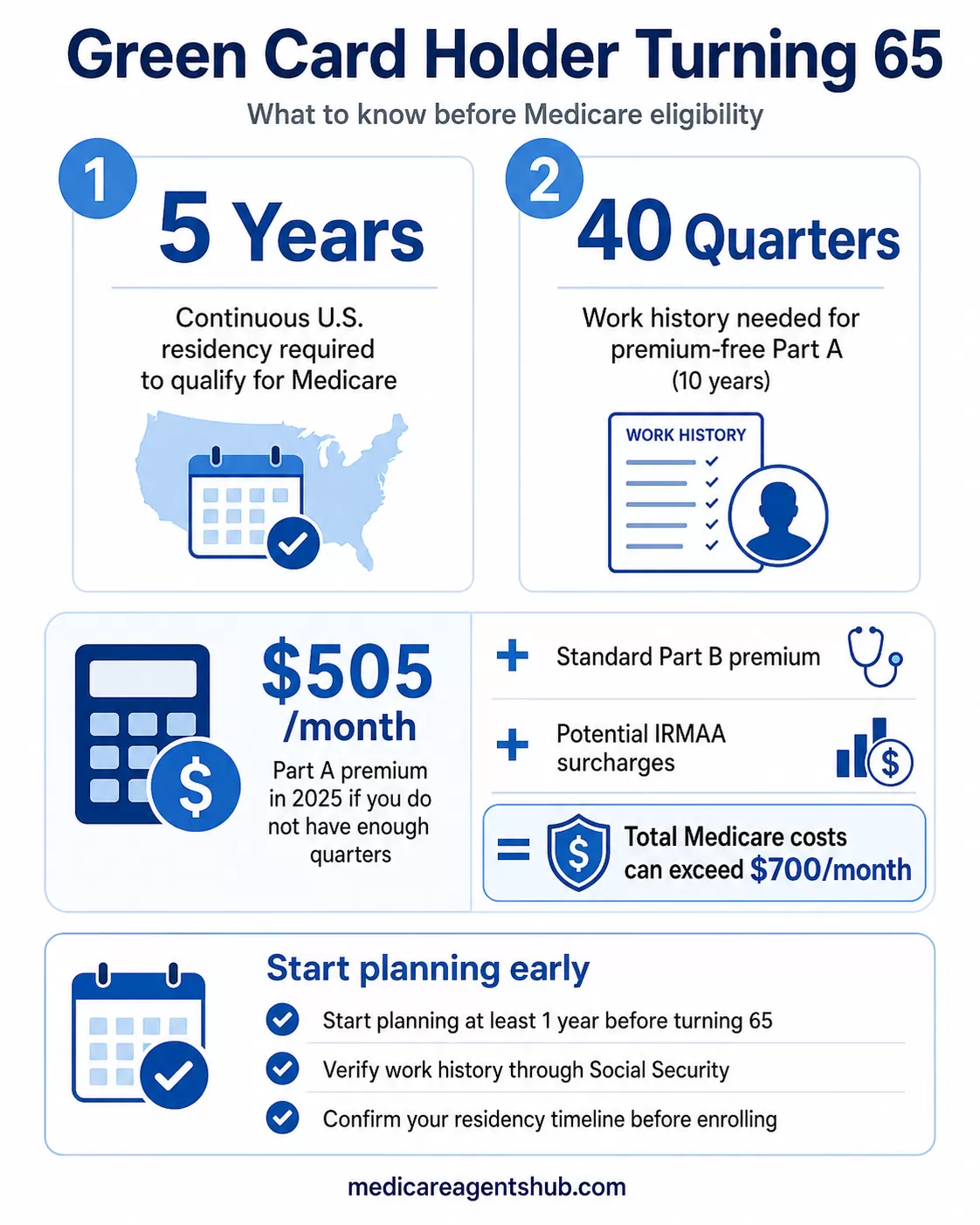
Why the costs can be steep: Once you meet the residency requirement, you can enroll. But if you haven't worked in the U.S. long enough to earn 40 quarters (10 years) of Social Security credits, you'll need to pay a Part A premium (currently over $500/month) in addition to the standard Part B premium. Combined with potential IRMAA surcharges, total Medicare costs for green card holders without full work history can exceed $700/month. Official current figures are posted on Medicare.gov's cost page and update each year.
How to prepare: Start planning at least a year before you turn 65. Verify your work history through Social Security, confirm your residency timeline, and understand exactly what you'll owe. Eligibility rules can be complex, and working with an agent who understands immigration-related Medicare scenarios is critical. Skipping Part B once you're eligible triggers the same 10%-per-year late penalty everyone else faces, regardless of citizenship status.

I'm a green card holder who's been in the US for 4 years and turning 65 soon. Am I eligible for Medicare?
Answer in simple terms:As a green card holder, you’ll be eligible for Medicare after you’ve lived in the U.S. for 5 continuous years. At that point, when you turn 65, you can apply — but unless you (or your spouse) have 10 years of work history paying Medicare taxes, you’ll need to pay for Part A.
5. Filing for Bankruptcy Due to Medical Bills
Medical debt is the leading cause of bankruptcy in the U.S., and many Medicare beneficiaries wonder what happens to their coverage after filing. The good news: bankruptcy does not affect your Medicare eligibility or benefits. Your coverage stays exactly the same. Medicare cannot be taken away as part of a bankruptcy proceeding.
Why it still matters for your Medicare picture: Bankruptcy can change your financial profile in ways that interact with Medicare. A lower income after bankruptcy may qualify you for Medicaid alongside Medicare (dual eligibility), Medicare Savings Programs that pay your premiums, or the Extra Help program that covers Part D prescription costs. These programs can save thousands per year.
What to watch for: If you're in a Chapter 13 repayment plan, medical providers who accept Medicare assignment may be included in your repayment schedule. It's also worth reviewing your Medigap or Medicare Advantage plan to make sure it adequately covers the types of care that led to the debt in the first place. You don't want to end up in the same situation again. One note: a Medigap or Part D plan itself can be dropped for unpaid premiums, but that only affects the private policy — your underlying Medicare stays intact.

I'm on Medicare but recently declared bankruptcy due to medical bills. How will this affect my coverage and options going forward?
The bankruptcy by itself has no effect on your Medicare coverage. However, you may want to explore as to whether you may qualify for some financial help based on your income and assets. The Medicare Savings Program (thru your state Medicaid) would pay your Part B premium for you if qualified and the Low Income Subsidy (thru the Social Security Administration) would provide savings on your prescription drug costs.6. Considering Concierge Medicine While on Medicare
Concierge medicine, where you pay an annual retainer (typically $1,500–$5,000+) for enhanced access to a primary care doctor, can work alongside Medicare, but it requires understanding how the pieces fit together. The retainer fee itself is not covered by Medicare. It's a private arrangement between you and the practice for perks like same-day appointments, longer visits, and direct phone access.
How it works with Medicare: Many concierge practices still bill Medicare for covered services like office visits, lab tests, and preventive screenings. You're essentially paying extra for access and convenience, while Part B covers your standard medical services regardless of whether your doctor runs a concierge practice.
Watch for opt-out doctors: Some concierge physicians have formally opted out of Medicare. If that's the case, Medicare pays nothing toward your care with that doctor. You'd owe 100% of every visit, lab, and procedure out of pocket in addition to the retainer. Always confirm the doctor's Medicare status before signing a contract.
Who should consider it: Concierge medicine makes the most sense for beneficiaries who want a closer doctor-patient relationship, have complex health conditions requiring frequent appointments, or simply value the convenience of guaranteed access. Before signing up, ask the practice directly: do they still bill Medicare, or are they fully opted out? The answer changes the financial math significantly.

I'm considering concierge medicine but already have Medicare. How would these work together?
Sometimes when people say concierge medicine, they actually mean direct primary care. Direct primary care is usually a clinic offering memberships. Typically they do not bill insurance. If you're referring to concierge medicine, this typically means the provider will bill insurance, but they limit the number of patients that they take. In this case, you would have to confirm that the provider accepts medicare or your advantage plan.Not sure how your situation affects Medicare? Find a licensed Medicare agent near you who can walk you through your specific options at no cost.
7. Receiving Care Through the Indian Health Service (IHS)
If you're a member of a federally recognized tribe and receive all your medical care through IHS at no cost, you might wonder whether Medicare is even necessary. The short answer: it's not required, but it's highly recommended, and not just for your own benefit.
Why Medicare matters even when IHS is free: IHS is a healthcare provider system funded by Congress; it's not insurance. Its services can be limited by budget constraints, staffing shortages, and geographic access. Medicare gives you the flexibility to see specialists and providers outside of IHS facilities, which is especially important for services that IHS may not fully cover like advanced surgical care, specialized cancer treatment, or mental health services.
The community benefit: Enrolling in Medicare also brings federal insurance dollars into the IHS system. When an IHS facility bills Medicare for your care, that revenue helps fund services for the entire tribal community. Many tribal health advocates actively encourage enrollment for this reason.

I am a member of a federally recognized tribe here in Arizona. I receive all my medical needs through the Indian Health Service at no cost. Do I still have to have Medicare?
When you have Medicare, IHS can bill Medicare for covered services, which helps stretch the IHS budget and allows them to provide more care to the community.If you ever need to see a doctor or go to a hospital that isn’t part of IHS, Medicare will cover those costs, while IHS generally will not. Without Medicare, you could be responsible for the full cost of any non-IHS care.
8. Living Part of the Year Abroad
Medicare generally does not cover healthcare services outside the United States, which creates a real dilemma for the growing number of retirees who spend weeks or months abroad each year. You're paying premiums for coverage that doesn't follow you overseas. So what are your options?
The penalty trap: You could drop Part B to avoid paying premiums while you're not using the coverage. But re-enrolling later means waiting for the General Enrollment Period (January–March), a coverage gap until July, and a permanent late enrollment penalty of 10% for every year you went without Part B. Dropping Part B without penalty is only possible if you have qualifying group coverage through a large employer (yours or a spouse's) — a foreign national health plan or private international insurance does not count as creditable coverage. For most retirees living abroad, that means the penalty trap is real.
The smarter approach: Keep Part B active and add a Medigap plan with foreign travel emergency coverage. The following Medigap plans all include this benefit:
- Plan C
- Plan D
- Plan F
- Plan G
- Plan M
- Plan N
These plans cover 80% of emergency care abroad after a $250 deductible, up to a lifetime limit. That way you're protected both at home and abroad without risking penalties.

If I live part of the year abroad, do I still have to pay for Medicare if I don’t use it?
Yes. The only way to "turn off" your Medicare is to have other credible insurance. Plus, if you have Original Medicare with a supplement (G, N) that supplement will reimburse for up to 80% of emergency medical care out of the country. The safest bet is to keep your coverage intact and enjoy your time out of the USA.9. Moving to a U.S. Territory
If you're considering a move to Guam, the U.S. Virgin Islands, Puerto Rico, American Samoa, or the Northern Mariana Islands, your Medicare coverage doesn't follow you the same way it does when you move between states. This is one of the biggest surprises for retirees seeking an affordable, tropical retirement within U.S. borders.
What changes: While you can keep Part A and Part B, Medicare Advantage plans and Part D prescription drug plans are not available in most territories. Puerto Rico is the main exception — it runs its own Part D and Medicare Advantage market with a different set of plans than the mainland. Outside Puerto Rico, you'd be limited to Original Medicare, and finding providers who accept Medicare assignment can be extremely difficult, especially outside major metro areas.
How to prepare: Each territory has its own SHIP (State Health Insurance Assistance Program) and local Medicaid programs administered differently from the 50 states. Before making the move, contact Medicare directly, research local provider availability, and consider whether a Medigap plan will be available to supplement your coverage. Some beneficiaries maintain a stateside address specifically to keep their Medicare Advantage or Part D plan active.

What happens to my Medicare coverage if I move to a U.S. territory like Guam or the Virgin Islands?
Original Medicare (Part A and B) covers you in U.S. territories—Guam, Puerto Rico, the Virgin Islands, American Samoa, and the Northern Mariana Islands—just as it does in the 50 states. However, Medicare Advantage and Part D plans are often not available in these territories, so you may lose that coverage and must return to Original Medicare.Planning a major life change that could affect your Medicare? Connect with a local Medicare broker who can help you understand exactly what changes, and what stays the same.
When Life Doesn't Follow the Standard Path
Whether you're getting married, starting dialysis, moving abroad, or facing any of the other situations covered above, the common thread is the same: your Medicare path can shift in ways the standard guides never anticipate. Being proactive beats reacting after a penalty or coverage gap has already hit.
Medicare was designed for the typical case, but real life is full of exceptions. If you're dealing with a major life change, an unusual eligibility situation, or a coverage gap you didn't expect, the best thing you can do is talk to a licensed Medicare agent who's seen it before. Rules and dollar amounts can shift year to year, so a quick check against SSA, Medicare.gov, or a local agent before you act is always worth it.
These aren't hypothetical scenarios. Agents deal with every one of these situations regularly. The earlier you get expert guidance, the fewer surprises you'll face.