8 Questions to Ask When Helping Your Parents With Medicare

-
April 13, 2026
If you're helping an aging parent navigate Medicare, you already know it's overwhelming. There are dozens of plans, confusing enrollment windows, and a maze of coverage rules, and that's before factoring in your parent's specific health needs and preferences.
You don't have to figure it all out yourself. A licensed Medicare agent can walk you through the process, but only if you know the right questions to ask. We asked agents across the country what caregivers should be asking, and here are the 8 questions they hear most (and wish they heard more).
1. How Do I Start the Medicare Conversation Without Making It Awkward?
This is the first hurdle for most adult children: bringing up Medicare without making a parent feel like they're losing control. Agents say the key is framing it as a partnership, not a takeover.
Choose a quiet, relaxed setting, not during a stressful moment. Position the conversation around protecting their independence and making sure they're getting the most out of what they've paid into. Agents consistently recommend having this talk early, before enrollment deadlines create pressure.

How can you create a comfortable environment for discussing Medicare with your parents?
If you come from a place of love and concern for your parents then you’re starting off correctly. Another very important part is to have a broker with you that can speak very clearly and explain answers very simply. Medicare can be difficult, so presenting an environment in which Medicare can be simplified and questions can get answered is a good scenario.2. How Can I Make Sure My Parent Feels Supported, Not Steamrolled?
Even with the best intentions, it's easy for caregivers to take over the process. Agents say the most effective approach is involving your parent in conversations about their health, budget, and preferences, then presenting clear, unbiased information so they can make their own decision.
Having a trusted family member present during agent meetings helps. So does active listening: really hearing what your parent cares about, whether that's keeping a specific doctor, minimizing monthly costs, or having coverage for a chronic condition.

What are some ways to ensure your parents feel supported during the Medicare decision-making process?
I will say the biggest way you can support your parents in the Medicare process is by going to their Medicare appointments with them and to understand the process alongside them. I encourage family members to attend with my client so they can be a support role and help them make the right decision for their healthcare. I am willing to go above and beyond for my clients to make sure they have the right tools to make the right decisions.3. My Parent Wants to Switch Plans. How Do We Check if Their Doctors Are Covered?
This is one of the most common caregiver questions, and it's critical. Medicare Advantage plans have limited provider networks, and switching plans without checking could mean losing access to a trusted doctor.
Agents recommend making a complete list of every provider your parent sees: primary care, specialists, hospitals, and pharmacy. Then use the plan's online provider search tool or call the doctor's office directly to confirm they're in-network. Don't assume. Verify.

My mom is considering switching to a Medicare Advantage plan because her friends say it's better. She's scared of losing her current doctors. How can we check?
One, no one should ever pick a plan because their "friends" say it's better. I cannot tell you how many people made that mistake. Medicare insurance needs are different for everyone.Two, she should be concerned about her doctors accepting the insurance because Medicare Advantage plans are network plans. But that is why you have me as a broker to check all the networks to make sure your doctors accept the plan you may be switching to.
4. My Parent Has Alzheimer's and the Bills Are Piling Up. How Do I Manage This?
Managing Medicare paperwork for a parent with Alzheimer's or dementia is one of the most stressful caregiver situations. Bills arrive that look like they might be duplicates. Explanation of Benefits (EOBs) look like bills but aren't. And the volume of paperwork can feel impossible to keep up with.
Agents recommend establishing a simple system: a binder, file box, or accordion folder with labeled sections for Medicare, doctor bills, pharmacy, EOBs, and paid receipts. Setting up automated payments and designating a legal representative to manage finances can prevent late fees and reduce confusion.

I'm caring for my dad who has Alzheimer's with lots of medications and I keep getting bills I don't understand. Any tips for not drowning in paperwork?
I would first get a labeled binder to get medical bills, doctor’s notes, and prescription information all separated. Start small and pick one category a week to go through starting with bills. Once you have everything caught up make sure to set 30 minutes to an hour once a week to go through incoming mail, file documents, and shred junk. I hope this is the help you were looking for!5. My Parent Has Dementia. How Do I Get Legal Authority to Manage Their Medicare?
If your parent still has the mental capacity to understand what they're signing, they can grant you a Durable Power of Attorney (POA), giving you broad authority over medical and financial decisions. They can also complete CMS Form 10106 to authorize you to access their Medicare information.
If your parent no longer has capacity, you'll need to go through the courts for guardianship. That's a longer and more expensive process. Agents universally recommend getting these documents in place early, while your parent can still participate in the decision. Because POA and guardianship rules vary by state, it's worth checking with an elder-law attorney to make sure the paperwork you sign will actually be honored where your parent lives. Understanding dementia coverage starts with having the legal framework to act.

I'm caring for my elderly parent with dementia. How can I get legal authority to manage their Medicare?
To legally manage your parent's Medicare benefits when they have dementia and are unable to make their own decisions, you'll need to obtain either a power of attorney (POA) or become their legal guardian or conservator. A POA allows you to act on their behalf if they are still capable of signing legal documents. If they are incapacitated, you'll need to petition the court for guardianship or conservatorship.6. Can My Son or Daughter Help Me With My Medicare Plan?
Yes, but there are rules about what they can do without formal authorization. Your child can help you research plans, compare options, look up doctors and drug formularies, and sit in on meetings with an agent.
However, to speak with Medicare or your plan on your behalf when you're not present, they'll typically need written authorization: either a Durable Power of Attorney or a completed CMS-1696 Appointment of Representative form. Some plans also accept verbal authorization during a phone call if you're on the line, but that permission usually only lasts for that specific call and doesn't replace a formal POA for ongoing management.

Is my son or daughter allowed to help me with my Medicare plan?
Yes, your son or daughter is absolutely allowed to help you with your Medicare plan. I personally welcome trusted family members into the conversation because it keeps everyone on the same page and makes the process smoother and more comfortable for you. You’re always in control of your decisions — your child is simply there to support you, ask questions, and help you feel confident throughout the process.7. Should I Sign My Parents Up for Medicare Myself?
If your parents are approaching 65, still working with employer coverage, or simply confused by the process, stepping in to help is often the right call. Agents say this is especially important for parents over 80, where cognitive decline can make navigating Medicare increasingly difficult.
The practical approach: meet with a local Medicare agent, go through your parent's doctors, prescriptions, and preferences, then bring the recommendation back to your parent for their input. If you have POA, you can handle the enrollment directly.

Should I sign my parents up for Medicare?
Yeah, probably. Because, to be completely blunt, if you don’t help, there’s a good chance they’re going to end up in a plan that doesn’t fit or costs way more than it should.I just helped my own mom with it this year, and even with all the experience I have, it still took some digging to get everything lined up the right way. We had to go over her doctors, prescriptions, what she wanted to keep, what she didn’t care about - it’s not as simple as just picking the one with the lowest premium.
If you’re not familiar with how Medicare works, it’s easy to get overwhelmed. The commercials, the mail... It’s nonstop. And unfortunately, most of it’s designed to push people into plans that may or may not work for them. Sometimes the heavy sales tactics work in a way that our parents end up paying a high price to learn a lesson the hard way.
So yeah, be involved. Help them ask the right questions, or at least make sure they’re working with someone who will. Research what you can, speak to someone who is highly referred, and when something feels off - trust your gut.
Medicare isn’t hard if you’ve got good guidance, but it can be a mess if you go in blind.
8. I'm Planning My Parent's Medicare and Long-Term Care. How Do I Make This Less Stressful?
This is the question that ties everything together. Planning Medicare and long-term care simultaneously is genuinely stressful, and agents say the biggest source of overwhelm is trying to solve everything at once.
Their advice: break it into small, clear steps. Start with legal documents (POA, healthcare proxy, advance directives). Then tackle Medicare coverage separately from long-term care planning. They're related but distinct. And the most important thing agents say? Medicare does not cover long-term custodial care. Medicare may pay for a short stint of skilled nursing or rehab after a qualifying hospital stay, but it won't cover ongoing help with bathing, dressing, or day-to-day supervision in a nursing home or assisted living. That's where private long-term care insurance, Medicaid, or personal savings come into play. Understanding that one fact simplifies a lot of the planning.

I am planning out my mothers Medicare and long term care and it is quite stressful. What is some advice to make this process more manageable?
Find a broker! And more specifically find a broker that may have some knowledge of LTC or financial background. When looking at Medicare a good broker will guide you through the process seamlessly. Then, they or a financial advisor they have a relationship with should help with the LTC piece. LTC coverage is not from everyone and the policy needs to be written to fit your mother's needs. But my advice is always to find a good professional!Before You Meet With a Medicare Agent: A Caregiver Checklist
Once you've decided to sit down with a licensed agent, a little preparation goes a long way. Agents say the most productive meetings happen when the caregiver shows up with this information ready:
- Parent's Medicare card (or Medicare number)
- List of all doctors and specialists your parent currently sees
- Prescription list with dosages (the pharmacy can print this)
- Preferred pharmacy name and location
- Current plan documents (if they're already enrolled in a plan)
- Budget concerns (what they can realistically afford in monthly premiums and out-of-pocket costs)
- Legal documents (POA, healthcare proxy, or CMS authorization forms, if applicable)
Having these on hand lets the agent run accurate plan comparisons instead of working from guesswork. It also cuts the meeting time significantly, which matters if your parent tires easily or has trouble sitting through long appointments.
One more thing to expect at that first meeting: the agent will ask your parent to sign a Scope of Appointment form before any plan discussion can start. It's a required Medicare rule, not a sales tactic, and it simply documents which types of coverage you agreed to talk about.

An agent asked me to sign a scope of appointment for before we could discuss my Medicare insurance or part D plan. What is an SOA? Is this normal? Are call centers exempt from this practice?
A signed Scope of Appointment form is mandatory according to Medicare rules. The SOA will list all of the allowable subjects to be discussed in your meeting or conversation with your agent. The permitted subjects are Advantage Plans, Supplements, Prescription Drug Plans, Hospital Indemnity Plans and Dental/Vision/Hearing Plans. Call centers are not exempt from this regulation.What You Can Handle vs. What Requires Your Parent
One of the most common points of confusion for caregivers is the line between tasks you can do on your own and steps that legally require your parent's involvement. Here's a plain-English breakdown:
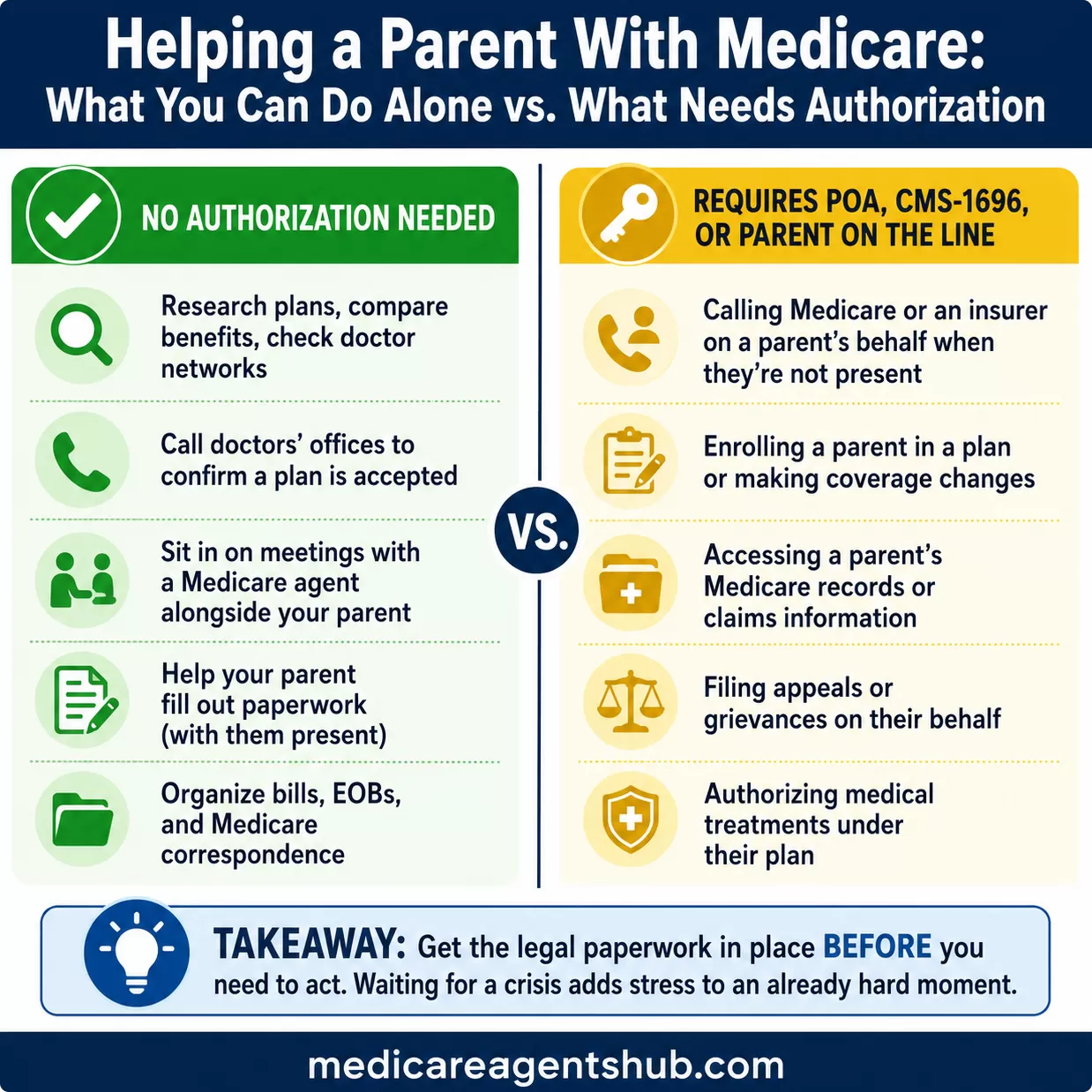
What you can do without formal authorization:
- Research plans, compare benefits, and check doctor networks
- Call doctors' offices to confirm they accept a specific plan
- Sit in on meetings with a Medicare agent alongside your parent
- Help your parent fill out paperwork (with them present)
- Organize bills, EOBs, and Medicare correspondence
What typically requires authorization (POA, CMS-1696, or your parent on the line):
- Calling Medicare or an insurance company on your parent's behalf when they're not present
- Enrolling your parent in a plan or making changes to their coverage
- Accessing your parent's Medicare records or claims information
- Filing appeals or grievances on their behalf
- Authorizing medical treatments under their plan
The takeaway: do all the legwork you can on your own, but get the legal paperwork in place before you need to act on their behalf. Waiting until a crisis hits to sort out authorization adds stress to an already difficult situation.
You Don't Have to Do This Alone
Caregiving is hard enough without trying to become a Medicare expert overnight. Licensed agents work with families in your situation every day. They've seen every complication, every emotional conversation, and every confusing bill. Reaching out for help isn't a sign you can't handle it. It's the smartest move you can make. Find a local Medicare agent who can help your family today.
Caregivers often ask whether there's a cost, or whether an agent is steering them toward one company. Agents are paid by the insurance carriers, not by you, and independent agents can compare plans across multiple carriers.

Are Medicare agents paid by specific insurance to sign up clients to their plans only
There are 2 kinds of agents - Captive and Independent. A Captive agent works for only one Advantage plan, therefore can only show a prospective client plans from that company and can only get paid commission from that company. An Independent agent can be appointed with many companies, therefore that agent's only incentive is to enroll the client in the most suitable plan for the client.Frequently Asked Questions
Can I call Medicare on behalf of my aging parent?
You can call 1-800-MEDICARE (1-800-633-4227) with your parent, but to speak on their behalf when they're not on the line, you'll need written authorization. The simplest route is having your parent complete CMS Form 10106, which grants you access to their Medicare information. A Durable Power of Attorney or CMS-1696 Appointment of Representative form gives broader authority.
Do I need power of attorney to help my parent with Medicare?
Not for everything. You can research plans, attend agent meetings, and help organize paperwork without any legal documents. But if you need to enroll them in a plan, make coverage changes, or speak to Medicare on their behalf without them present, you'll need either a POA or a completed CMS authorization form. Agents strongly recommend getting these documents in place early, while your parent can still participate in the decision.
Can a Medicare agent meet with both me and my parent together?
Absolutely. Agents say family meetings are some of their most productive appointments. Having you there means someone is taking notes, asking follow-up questions, and helping your parent process the information afterward. Most agents welcome it and some prefer it, especially when working with elderly parents who may feel overwhelmed by the details on their own. Find an agent near you to set up a family consultation.
Related Reading for Caregivers
- A Family Guide to Hospice and Medicare - One family's experience navigating hospice coverage under Medicare.
- Medicare Fatigue: Why So Many Seniors Feel Overwhelmed - The emotional side of Medicare decisions and how to cope.
- The Importance of Annual Medicare Plan Reviews - Why caregivers should revisit coverage every year.