How Many Chiropractic Visits Does Medicare Cover in a Year?

-
August 11, 2026

Reviewed by Michael Davis
Medicare Agent Licensed in MN, AL, AR & 42 other states
Original Medicare has no set annual limit on chiropractic visits. But before you start booking weekly appointments, there's a catch: Part B only covers one specific thing at the chiropractor's office, and everything else comes out of your pocket.
Quick answer: Medicare Part B covers manual manipulation of the spine to correct a subluxation, with no yearly visit cap as long as treatment is medically necessary. It does not cover X-rays, massage, exams, or maintenance visits at the chiropractor. Medicare Advantage plans often include broader chiropractic benefits but typically cap visits at 15-20 per year.
What Medicare Part B actually covers at the chiropractor
Medicare's chiropractic benefit is narrow. As of 2026, Part B pays for one thing: manual manipulation of the spine to correct a vertebral subluxation (a misalignment of the spinal bones). That's it.
Your chiropractor has to document that the subluxation exists and that spinal manipulation is medically necessary to treat it. The treatment must be aimed at fixing an active problem, not just keeping your back feeling loose.

Does Medicare cover chiropractic appointments?
Yes, Medicare (Part B) covers chiropractic care, but only for spinal manipulation (adjustment) to correct a subluxation (misaligned bone in your spine), not for general back pain, exams, X-rays, or maintenance therapy. You pay 20% coinsurance after your deductible, and the chiropractor must be enrolled with Medicare; other services (massage, acupuncture, extremities) and tests are usually not covered, though Medicare Advantage plans might offer moreYou'll pay 20% of the Medicare-approved amount after meeting your annual Part B deductible. If your chiropractor accepts Medicare assignment, they can't charge more than the approved rate.
Source: Medicare.gov: Chiropractic services.
No annual visit limit (with a big asterisk)
This is where things get misunderstood. Original Medicare does not impose a hard cap on how many times you can see a chiropractor in a year. If every visit is medically necessary and your chiropractor documents it properly, Medicare keeps paying its share.

How many chiropractic visits does Medicare cover per year?
Original Medicare has no set limit on chiropractic visits if they are medically necessary to treat a spinal subluxation.Medicare does NOT pay for routine, preventive, or long-term maintenance visits once a condition has stabilized.
Also Medicare Part B does not cover X-rays ordered or taken by a chiropractor. Medicare does NOT cover massages, acupuncture, or other non-spinal treatments.
The asterisk: "medically necessary" does real work in that sentence. Medicare will cover treatment for an active condition that's expected to improve. Once your chiropractor determines you've reached maximum therapeutic benefit, the visits stop being covered, regardless of how many you've used.
In practice, most courses of chiropractic treatment under Original Medicare run somewhere between 8 and 20 visits before the provider documents that the condition has stabilized or improved as much as it's going to.
When Medicare stops paying: the maintenance care cutoff
Watch out: The single most common reason people get surprise chiropractic bills is the shift from active treatment to maintenance care. Once your chiropractor documents that visits are keeping you stable rather than producing improvement, Medicare stops paying — even if you've had only a few visits that year.
Maintenance means visits designed to prevent a condition from getting worse or to maintain your current state, not to produce further improvement.

My dad’s back pain is getting worse. Can Medicare cover ongoing chiropractic care, or is it just short-term treatment?
Medicare only covers chiropractic care when there’s a specific spinal issue they expect to improve, not for long‑term upkeep.Once your dad reaches the point where the chiropractor is mainly helping him stay comfortable, keeping things loose, preventing flare‑ups, or doing regular maintenance visits. Medicare stops paying for it.
In simple terms, Medicare will help when the goal is to fix something, but not when the goal is to keep you feeling good over time.
Hope that helps
Your chiropractor is required to tell you when they believe treatment has shifted from active to maintenance. At that point, you're responsible for the full cost. Some chiropractors offer cash-pay rates for maintenance visits, but don't assume Medicare will keep covering them just because you're still in pain.
What Medicare does NOT cover at the chiropractor
The list of excluded services is longer than the covered list. Under Original Medicare, the chiropractor's office can bill Medicare for spinal manipulation only. Everything else is on you:
- X-rays ordered or performed by the chiropractor
- Exams and evaluations (initial or follow-up)
- Massage therapy
- Acupuncture (when performed by the chiropractor)
- Extremity adjustments (shoulders, knees, ankles)
- Physical therapy modalities like ultrasound, electrical stimulation, or heat/cold packs
One nuance worth knowing: if your primary care doctor orders an X-ray of your spine and it's done at a separate imaging facility, Medicare may cover that imaging under Part B. The restriction is specifically on X-rays ordered by or taken at the chiropractor's office.
Medicare Advantage plans often cover more
If broader chiropractic coverage matters to you, Medicare Advantage plans are worth looking at. Many Part C plans include supplemental chiropractic benefits that go well beyond what Original Medicare offers.
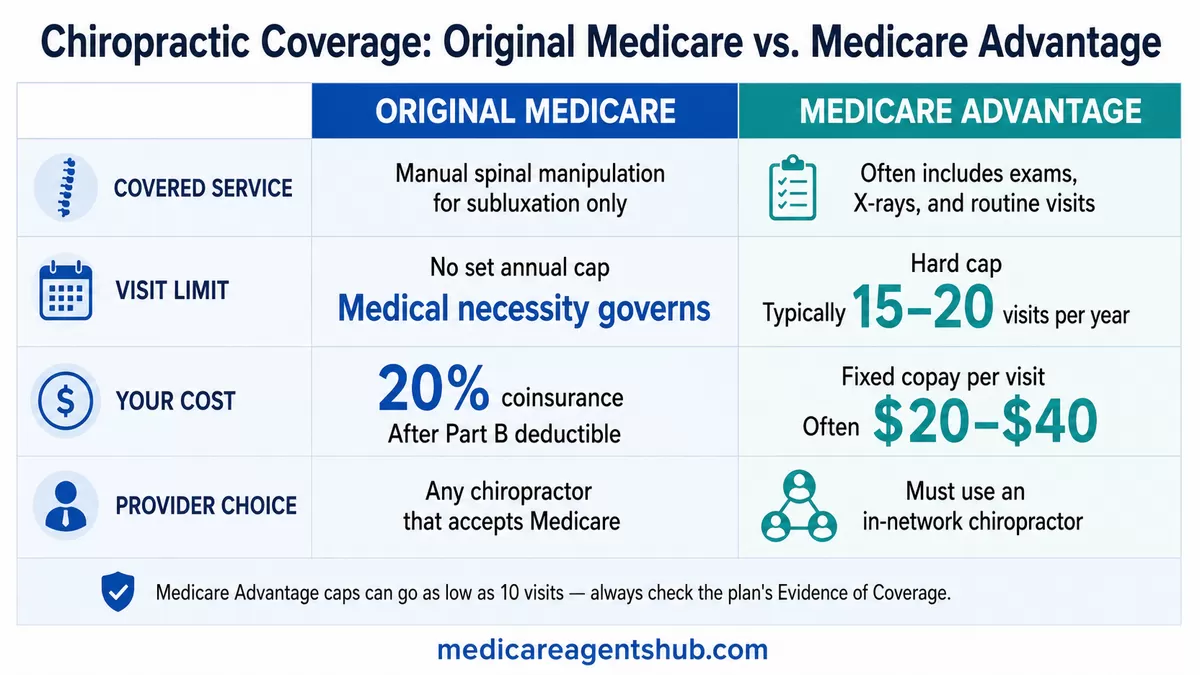
Here's how the two stack up:
| Feature | Original Medicare (Part B) | Typical Medicare Advantage plan |
|---|---|---|
| Covered service | Manual spinal manipulation for subluxation only | Often includes exams, X-rays, and routine visits |
| Visit limit | No set annual cap (medical necessity governs) | Hard cap, typically 15-20 visits per year |
| Your cost | 20% coinsurance after Part B deductible | Fixed copay per visit (often $20-$40) |
| Provider choice | Any chiropractor that accepts Medicare | Must use an in-network chiropractor |
Common Medicare Advantage chiropractic benefits include coverage for routine chiropractic visits (not just subluxation treatment), X-rays and exams at the chiropractor's office, and a fixed copay per visit instead of 20% coinsurance. The trade-off is that hard visit cap. Some plans cap as low as 10 visits. Always check the Evidence of Coverage document for your specific plan.
What about acupuncture for back pain?
Since many people looking into chiropractic coverage are dealing with back pain, it's worth knowing that Medicare Part B separately covers acupuncture for chronic low back pain. This benefit allows up to 12 sessions in 90 days, with an additional 8 sessions available if you're showing improvement (20 total per year).
This is a separate benefit with its own rules. The provider has to meet specific Medicare requirements — it can't just be any licensed acupuncturist. They generally need to be a doctor, or work under a doctor's direct supervision, to qualify.
How to get the most from your chiropractic coverage
A few practical steps to avoid surprise bills:
Verify your chiropractor accepts Medicare. Not all do. If they don't accept assignment, you could owe more than the standard 20%. Check which providers participate through Medicare's online tool or call the office directly.
Ask about your treatment plan upfront. Your chiropractor should be able to estimate how many visits they expect to need and when they'd anticipate shifting to maintenance care. Get this in writing if possible.
If you want more coverage, talk to a broker. A licensed Medicare agent can compare Advantage plans in your area that include supplemental chiropractic benefits. The right plan can save you hundreds if you're a regular chiropractic patient.
Keep your own records. Track your visits, what was performed at each one, and any communication about medical necessity. If Medicare denies a claim, having your own documentation helps with appeals.
This article is for informational purposes only and is not medical, legal, or benefits advice. Coverage rules can change; confirm details with your provider, your plan, or a licensed Medicare agent before making decisions.