Does Medicare Cover Dexcom Continuous Glucose Monitors?

-
August 19, 2026

Reviewed by Michael Davis
Medicare Agent Licensed in MN, AL, AR & 42 other states
If you have diabetes and use (or want to use) a Dexcom continuous glucose monitor, the short answer is yes. Medicare covers Dexcom CGMs. But there are eligibility rules, costs, and plan-type differences worth knowing before you order one.
Quick answer: Medicare Part B covers Dexcom G6 and G7 continuous glucose monitors as durable medical equipment (DME). You'll need a diabetes diagnosis, a doctor's prescription, and either insulin use or a history of problematic hypoglycemia. After your Part B deductible ($257 in 2026), you pay 20% coinsurance.
How Dexcom CGMs are covered under Medicare
Dexcom continuous glucose monitors fall under Medicare Part B as durable medical equipment. That puts them in the same category as insulin pumps, blood glucose meters, and other durable medical equipment Medicare covers. The rules come straight from Medicare.gov's CGM coverage page, which spells out the current eligibility and cost-sharing.
Part B pays 80% of the Medicare-approved amount. You're responsible for the remaining 20% coinsurance after meeting your annual Part B deductible.
Both the Dexcom G6 and Dexcom G7 (including the G7 15-day system) are Medicare-approved. Coverage includes the CGM sensors, transmitters, and receiver. If you use a smartphone as your display, you'll still need to have a compatible receiver available to qualify. Dexcom's own Medicare page confirms this receiver requirement and lists which supplies are eligible.

Does Medicare cover Dexcom continuous glucose monitors?
Yes, Medicare can cover a Dexcom continuous glucose monitor if your doctor prescribes it and you meet the coverage requirements, such as using insulin or having a history of serious low blood sugar.It is usually covered through Medicare Part B. With a Medicare Advantage plan, the supplier, approval rules, and your cost can vary, so I always recommend checking the plan before ordering it.
Who qualifies for Medicare CGM coverage
Not everyone with diabetes automatically qualifies. Medicare has four requirements you need to meet:
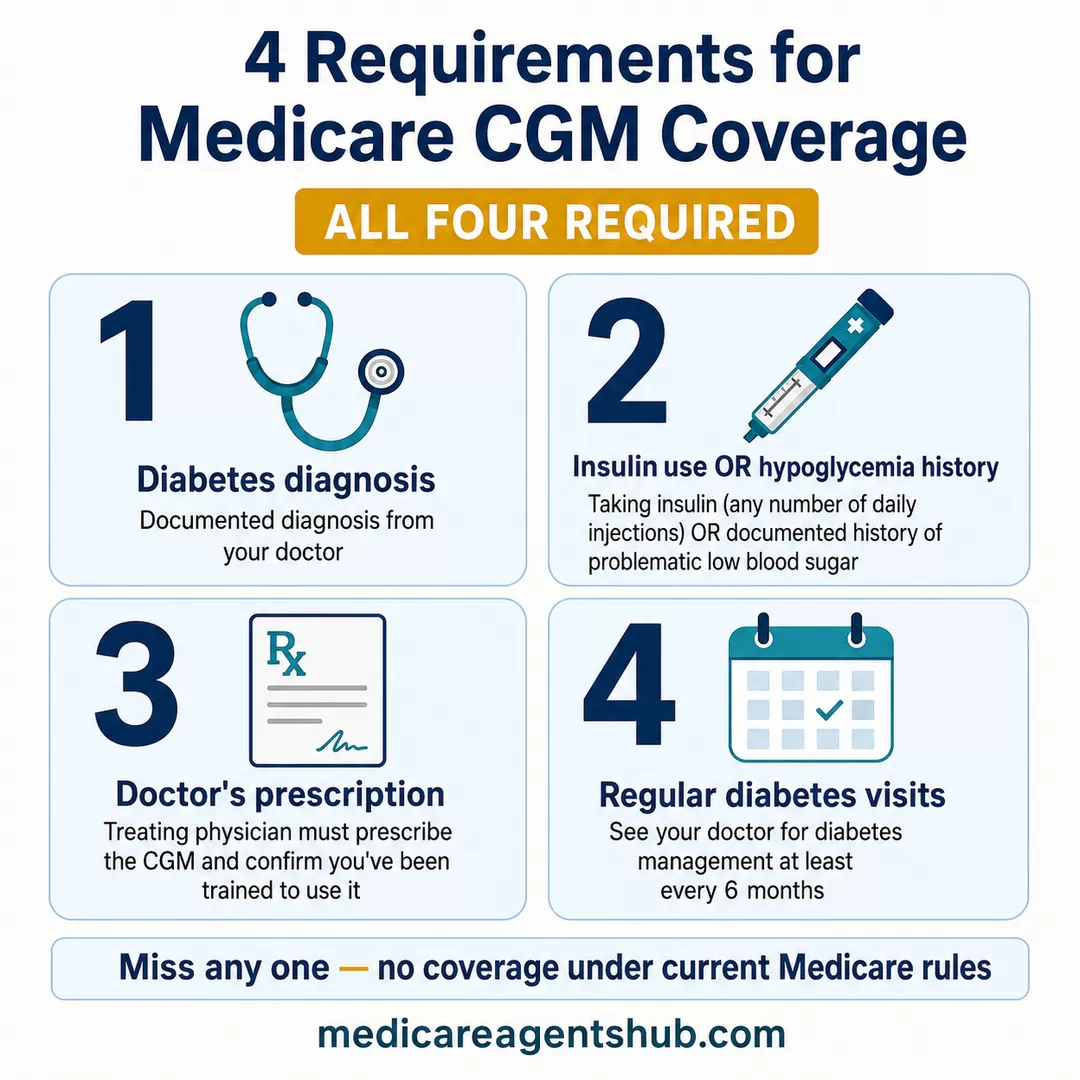
- Diabetes diagnosis. You need a documented diagnosis from your doctor.
- Insulin use or hypoglycemia history. You must be taking insulin (any number of daily injections) or have a documented history of problematic low blood sugar episodes.
- Doctor's prescription. Your treating physician must prescribe the CGM and confirm you've been trained on how to use it properly.
- Regular diabetes management visits. You need to see your doctor for diabetes management at least every 6 months.
All four boxes need to be checked. If you manage your diabetes without insulin and don't have hypoglycemia issues, Medicare won't cover a CGM under current rules.
What you'll pay out of pocket
On Original Medicare (Part A and Part B only), the math is straightforward.
First, you pay the annual Part B deductible: $257 in 2026 (check Medicare.gov for the current year's amount if you're reading this later). After that, Medicare picks up 80% of the approved cost. You pay the remaining 20% coinsurance on every CGM supply order.
That 20% adds up over a year. Dexcom sensors need regular replacement (every 10 or 15 days depending on the model), and transmitters have their own replacement schedule.
A Medigap (Medicare Supplement) plan can cover most or all of that 20% coinsurance. If you're already on a Plan G or Plan N, check your policy. Most Medigap plans cover Part B coinsurance for DME, which means your out-of-pocket cost for Dexcom supplies could drop to little or nothing beyond your premiums.

I use a continuous glucose monitor for my diabetes that connects to my smartphone. Will Medicare cover this technology for someone with my condition?
Yes, Medicare may cover a continuous glucose monitor that connects to your smartphone, but you have to meet certain criteria. Under Medicare Part B, CGMs are covered as durable medical equipment if you have diabetes and your doctor prescribes the device because you use insulin or have a history of significant low blood sugar episodes. The doctor must confirm you know how to use the device and typically needs to see you for diabetes management visits at least every six months. If you qualify, Medicare usually pays about 80% of the approved cost after the Part B deductible, and many modern systems can send your glucose readings directly to a smartphone app.Dexcom coverage under Medicare Advantage
If you're on a Medicare Advantage plan instead of Original Medicare, Dexcom CGMs are still covered. Every MA plan must cover everything Original Medicare covers, including Part B DME benefits.
But the details differ. Your Medicare Advantage plan may:
- Require you to use specific DME suppliers in their network
- Have different prior authorization or approval steps
- Charge a flat copay instead of 20% coinsurance
- Cap your annual out-of-pocket spending (which Original Medicare doesn't do)
Some MA plans actually make CGMs cheaper than Original Medicare does. Others are more restrictive about which brands or models they'll cover. Call your plan before ordering to confirm your cost and supplier requirements.
Chronic Condition Special Needs Plans (C-SNPs)
If you have diabetes, you may qualify for a C-SNP, a type of Medicare Advantage plan built around managing specific chronic conditions. These plans often include extra benefits like expanded diabetes supply coverage, care coordination with endocrinologists, and lower cost-sharing on related medications and equipment.

Are there Medicare plans that also help with chronic conditions like diabetes or high blood pressure that run in my family?
Yes, there are Medicare plans designed to provide additional support for people with certain chronic health conditions. These are called Chronic Condition Special Needs Plans (C-SNPs). If you have a qualifying condition—such as diabetes, chronic heart disease, or other eligible chronic illnesses—you may be able to enroll in a plan that offers benefits and care coordination.Keep in mind that having a family history of a condition alone does not qualify you. You must have a diagnosis of an eligible chronic condition to enroll in a C-SNP.
If you have been diagnosed with a chronic condition, I'd be happy to review your options and see if you qualify for a plan that could better meet your healthcare needs.
Other diabetes supplies Medicare covers
Dexcom isn't the only glucose monitoring option covered. Medicare also covers:
- FreeStyle Libre 2 and Libre 3 continuous glucose monitors (same eligibility rules as Dexcom)
- Traditional blood glucose meters, test strips, and lancets
- Insulin pumps and the insulin used in them (covered under Part B as DME)
- Diabetes self-management training when referred by your doctor
- Medical nutrition therapy for diabetes management
For people with prediabetes, the Medicare Diabetes Prevention Program covers coaching and education sessions designed to help delay or prevent progression to type 2 diabetes.
If you're weighing Dexcom against other Medicare-covered health technologies, the decision usually comes down to personal preference and your doctor's recommendation. Both Dexcom and FreeStyle Libre are FDA-approved therapeutic CGMs that Medicare treats equally from a coverage standpoint.
How to get your Dexcom covered
The process is fairly simple, but it does require coordination between you, your doctor, and your supplier.
- Talk to your doctor. They need to prescribe the CGM and document that you meet all four eligibility requirements.
- Find a Medicare-enrolled DME supplier. Your supplier must be enrolled in Medicare and, ideally, accept Medicare assignment. If you're on an MA plan, you may need to use an in-network supplier.
- Confirm coverage with your plan. For Original Medicare, coverage is standard if you qualify. For Medicare Advantage, call your plan to verify prior authorization requirements and your cost-sharing.
- Keep up with your diabetes visits. Missing that 6-month check-in with your doctor could jeopardize ongoing coverage.
If you're managing Medicare alongside chronic conditions, working with a licensed Medicare agent can help you compare plans and find the best fit for your DME and prescription drug needs. An agent can check whether your doctors and preferred suppliers are in-network and whether a C-SNP or specific MA plan would save you money on diabetes-related care.