What Is a Medicare Scope of Appointment (SOA)? What Seniors Need to Know Before Signing
-
September 15, 2026

Reviewed by Joel McClure
Medicare Agent Licensed in NJ, AL, AR & 42 other states
You called about a Medicare plan, and before the agent will say a word, they slide a form across the table (or email you a link) and ask you to sign it. That paper is the Scope of Appointment, or SOA. It's not a contract, it's not an enrollment, and it doesn't lock you into anything. But it is required by Medicare, and knowing what it does (and doesn't) do can save you a confusing conversation.
Quick answer: A Scope of Appointment is a CMS-required form that lists which Medicare products (Advantage, Part D, or Medigap) you're giving an agent permission to discuss with you. It's not an enrollment, it doesn't cost anything, and you can walk away after signing it. Agents must get it before the meeting starts, and they can only talk about the products you checked off.
What a Scope of Appointment actually is
The Scope of Appointment is a one-page form the Centers for Medicare & Medicaid Services (CMS) requires any licensed agent to collect before they can discuss a Medicare Advantage plan or a standalone Part D prescription drug plan with you. It exists because of past marketing abuses. Agents used to knock on doors "to talk about Medicare" and then pitch three products the beneficiary never asked about. The SOA rule was written to stop that.
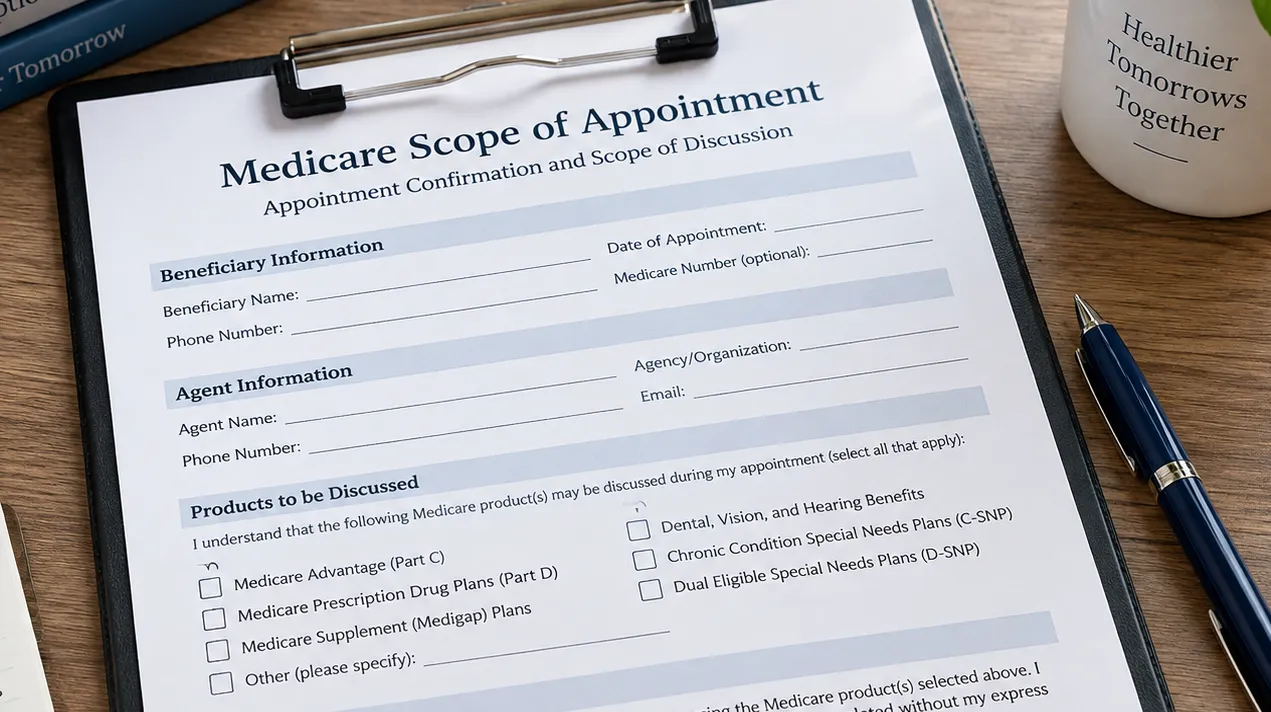
The form is short. It has your name, the date, the agent's name and license info, and a set of checkboxes for the product types you agree to discuss:
- Medicare Advantage (Part C) and cost plans
- Standalone Prescription Drug Plans (Part D)
- Dental, Vision, or Hearing add-ons offered through Medicare Advantage
You initial the boxes for what you're willing to talk about. If you check "Medicare Advantage" only, the agent legally cannot pivot the meeting into a Part D pitch. If you want to switch topics later, they have to stop, get a new SOA, and start over (or in practice, note the new scope and continue with your verbal agreement, though most agents will just re-do the paperwork to be clean).

An agent asked me to sign a scope of appointment for before we could discuss my Medicare insurance or part D plan. What is an SOA? Is this normal? Are call centers exempt from this practice?
The Scope of Appointment (SOA) form is required to be signed 48 hours prior to any scheduled appointment where Medicare Prescription Drug (Part D) plans or Medicare Advantage (Part C) plans benefits are being discussed. The SOA lays out what will be discussed during your appointment with the agent/broker. Only plan types selected on the SOA can be discussed during your meeting. It must be signed by both the Medicare beneficiary and the Medicare agent/broker. The form is a Medicare requirement and all agents, included call center agents, are required to comply with the regulation.There are three exceptions to the 48 hour rule:
1) Walk in without prior appointment
2) Inbound call initiated by the beneficiary
3) Within 4 days of the end of a valid election period
Why Medicare requires it
The SOA came out of years of complaints. Seniors were being cold-called, door-knocked, and cornered at "free lunch" Medicare seminars, then walked through enrollment paperwork for plans they didn't ask to hear about. CMS built the SOA rule to force agents to define the conversation in writing before it happens. If a compliance audit ever pulls the file, the agent has to prove you agreed in advance to hear about the products they pitched.
For you, the practical effect is simple. The SOA slows the meeting down for 30 seconds and gives you a written record of what you agreed to discuss. If an agent pushes past that scope, they're breaking a CMS marketing rule, and you can report them.
What the SOA is not
- Not an enrollment. Signing it doesn't sign you up for anything. You can end the meeting five minutes in and walk away with zero obligation.
- Not a contract with the agent. You aren't hiring them or committing to buy through them.
- Not a credit check or financial disclosure. The form asks for basic contact info and product preferences, not your bank account.
- Not the same as HIPAA authorization. Some agents will also ask you to sign a separate release so they can pull your prescription list from Medicare's system. That's a different form.
When is a Scope of Appointment required?
This is where a lot of seniors (and some agents) get tripped up. The SOA rule only covers specific Medicare products. Here's the breakdown.
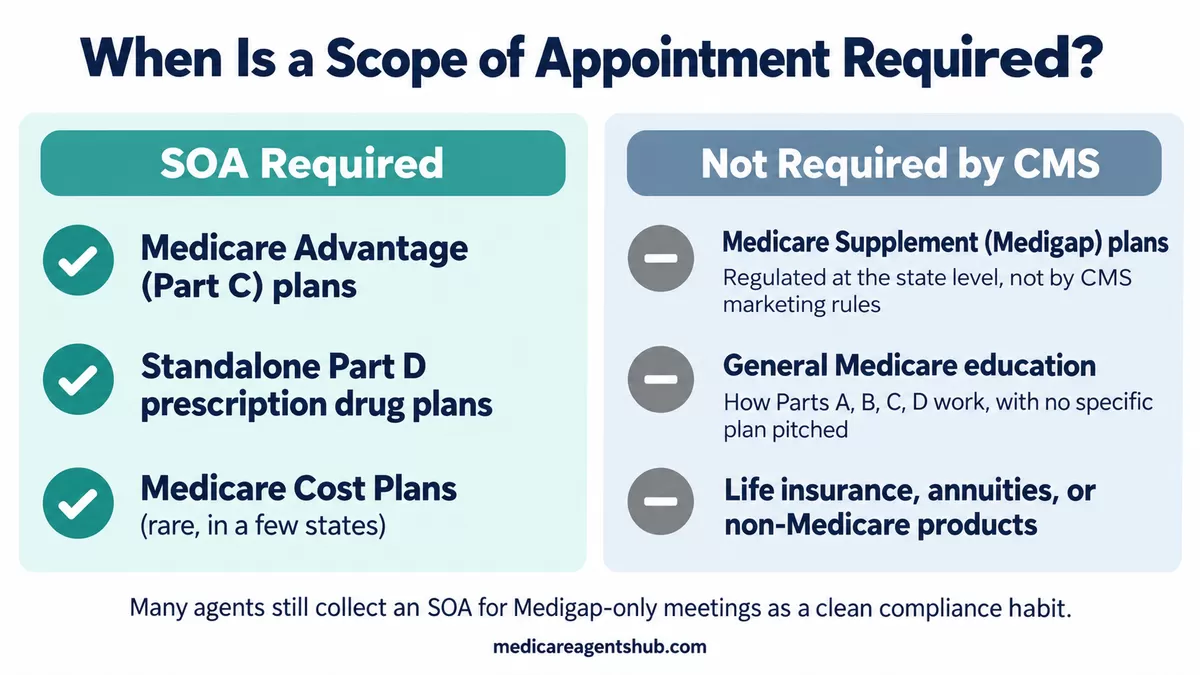
SOA required:
- Medicare Advantage (Part C) plans
- Standalone Part D prescription drug plans
- Medicare Cost Plans (rare, in a few states)
SOA not required by CMS:
- Medicare Supplement (Medigap) plans, since these are regulated at the state level, not by CMS marketing rules
- General Medicare education (agent explains how Parts A, B, C, D work without pitching a specific plan)
- Life insurance, annuities, or non-Medicare products
In practice, many agents will still collect an SOA even for a Medigap-only conversation. Two reasons: they don't know for sure the meeting will stay Medigap-only, and it's a clean compliance habit. If you're only interested in a Medigap policy, you can politely say so and skip the form, but don't be surprised if the agent asks anyway.

Do you need a scope of appointment to discuss Medicare Supplement plans?
Yes a scope of appointment is required to discuss any medicare product, the 48 hour rule has changed thoughThe 48-hour rule (and why it went away)
For years, CMS required agents to collect the SOA at least 48 hours before a scheduled appointment. That rule was a headache. If a senior called on Tuesday wanting to enroll before the Annual Enrollment Period closed on Sunday, and the agent couldn't meet until Thursday, the 48-hour window forced awkward delays.
CMS softened this. The 48-hour advance rule now has exceptions. In-person walk-ins, meetings during the last four days of a valid enrollment period, and certain other situations let the agent collect the SOA at the start of the appointment instead of two days ahead. Most brokers today collect the SOA electronically the moment you schedule, which sidesteps the whole timing issue.
The upshot for you: if you're rushing to enroll and the agent asks you to sign an SOA on the spot, that's fine. It's still valid.
Who has to fill out the SOA?
You (the beneficiary) or someone with legal authority to act for you, like a power of attorney. The agent fills in their own information and license number. Administrative staff at the agency can often help send the form out or process it, but the beneficiary's signature has to be yours (or your POA's).
If a family member is helping you sort out Medicare, they can sit in on the meeting, but unless they have documented POA, they can't sign the SOA on your behalf. This trips up adult children a lot when they're helping a parent navigate Medicare enrollment.

Does the SOA need to be completed by a licensed agent, or can administrative staff complete it on the agent’s behalf before the agent contacts the client? This question specifically refers to clients in the USVI.
An administrative assistant could fill out the scope of appointment, but both the licensed agent and the client need to sign it. It is a short form and the licensed agent should be able to complete it without assistance from an administrator.Are call centers exempt?
No. If you call a 1-800 Medicare number that connects you to a licensed agent, and that agent starts discussing a specific Medicare Advantage or Part D plan, they still need a verbal SOA on the recorded call. You'll hear them read a script: "Do I have your permission to discuss Medicare Advantage plans with you today?" That verbal yes is the SOA equivalent for phone calls. It's captured in the recording as the compliance record.
General inbound calls where the agent only answers educational questions ("How does Medicare Part B work?") don't require an SOA. The moment the conversation shifts to a specific plan, though, the scope rule kicks in.
Can you meet with more than one agent?
Yes, and you should if you're not sure. Each agent will have their own SOA. Signing one doesn't lock you in with that agent or block you from talking to others. The SOA is per-agent, per-appointment. If you sit down with three brokers to compare recommendations, you'll sign three SOAs. That's normal.
Some seniors worry that signing an SOA means they've "committed" to that agent. They haven't. The form is a permission slip for the conversation, not a loyalty pledge.

Is it ok to meet with multiple Medicare Brokers and Agents as I start looking for help?
I would suggest talking with a couple different Insurance Agents or Brokers as you start looking for Medicare help. Some Agents or Brokers only work with one carrier for supplemental plans. Some are too pushy, some may have the knowledge but can't communicate that well to transfer that knowledge to the people they are helping. Many different reasons to talk to a couple different people.Red flags around the SOA process
The SOA itself is routine paperwork, but how an agent handles it can tell you a lot. Watch for these:
- They skip the SOA entirely. If a licensed agent starts pitching a Medicare Advantage plan without any form or verbal permission, they're breaking CMS rules. That's a compliance issue and a sign they cut corners elsewhere too.
- They ask you to pre-sign a blank form. Every box should be checked or left blank based on your actual preference. A blank SOA "for later" is not okay.
- They push you to check every product type "just in case." You should only check what you actually want to discuss. If they say "just check them all so we don't have to redo it," that's lazy at best and coercive at worst.
- They tell you the SOA is required to get a quote for Medigap. It isn't. If someone tells you that, they may not know the rules well.
- They add products to the discussion that weren't on the SOA. If you checked Medicare Advantage only and they pivot to Part D or dental, that's a scope violation.
These aren't necessarily deal-breakers, but they're worth noticing. For a fuller list of warning signs, our guide on how to spot a bad Medicare broker covers the red flags 50+ licensed agents said they see most often.
What happens after you sign
The meeting starts. The agent walks you through whatever product types you checked. They can pull plan options, compare drug formularies, run cost estimates, and answer questions. If you decide to enroll, they'll walk you through the enrollment application (which is a separate form).
If you decide not to enroll, you thank them and leave. The signed SOA sits in the agent's compliance file for 10 years, which is CMS's retention requirement. That's it. No follow-up obligation on your end.
If you want time to think, ask for the plan documents in writing and take them home. A good agent will not pressure you to sign the enrollment application in the same sitting. If they do, that's another red flag worth noting.
How to prepare for an SOA meeting
Before you sit down with an agent, know what you want to discuss. If you're brand new to Medicare, "everything" is a fair answer, and you can check all the product types on the SOA. If you already have Original Medicare and only want to add a Part D plan, check Part D and skip the rest.
Bring these to the meeting:
- Your Medicare card (or your Medicare number)
- A list of your prescriptions, including dosages
- A list of your doctors and preferred hospitals, so the agent can check network coverage
- Notes on any upcoming procedures or ongoing conditions
The more the agent knows up front, the more useful the meeting is. And it keeps the conversation focused on your actual situation rather than a generic pitch. If you're not sure what to ask, our list of questions agents think you should ask about Medicare is a good starting point.
Common SOA questions from seniors
Do I have to sign it? If you want to discuss a Medicare Advantage or Part D plan with an agent, yes. Without a signed SOA, the agent legally cannot continue the plan-specific conversation. But you're never obligated to meet with the agent in the first place.
Can I change my mind after signing? Yes. Signing the SOA doesn't obligate you to enroll or to keep meeting. You can end the appointment at any time.
Does the SOA expire? The SOA covers the meeting it was signed for. For a follow-up meeting weeks later, most agents will collect a fresh one.
What if the agent adds a product after we start? They should stop, note the change on the SOA (or start a new one), and get your initials for the added product before continuing.
Can I get a copy? Yes. Ask for one. A good agent will offer without being asked.
Bottom line
The Scope of Appointment form isn't something to worry about. It's a CMS-mandated speed bump that protects you from surprise pitches. Sign it, understand which products you agreed to discuss, and use it as a reason to be specific about what you actually want out of the meeting.
If you're looking for a licensed agent to sit down with, our directory of Medicare agents across the country lists thousands of professionals you can filter by location, specialty, and language. Every agent listed is licensed to help you compare plans.