Medicare GLP-1 Bridge Program: Weight Loss Drug Coverage in 2026
-
March 20, 2026
GLP-1 receptor agonists like Ozempic, Wegovy, and Zepbound have helped millions of Americans lose significant weight, but Medicare coverage for these drugs has been severely restricted. That changes in July 2026, when the new Medicare GLP-1 Bridge program begins offering coverage at just $50 per month for eligible beneficiaries.
What Are GLP-1 Drugs and Why Do They Matter?
GLP-1 receptor agonists (often just called "GLP-1s") are injectable or oral medications that mimic a natural hormone your body produces after eating. They work by slowing digestion, reducing appetite, and helping regulate blood sugar levels. Originally developed to treat Type 2 diabetes, they turned out to have a powerful side effect: significant weight loss.
The most well-known GLP-1 drugs include:
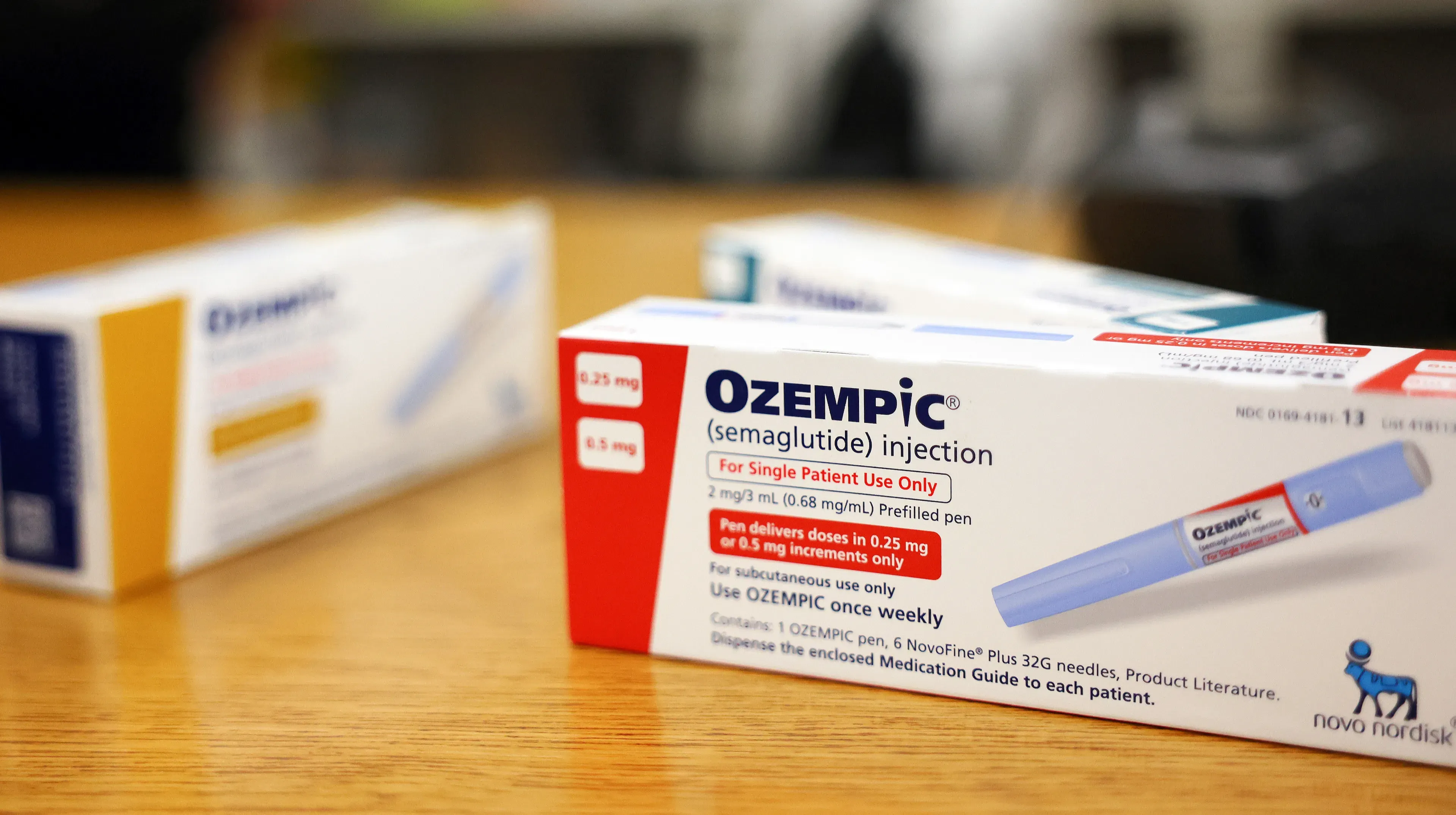
- Ozempic (semaglutide) - FDA-approved for Type 2 diabetes
- Wegovy (semaglutide) - FDA-approved for chronic weight management and cardiovascular risk reduction
- Mounjaro (tirzepatide) - FDA-approved for Type 2 diabetes
- Zepbound (tirzepatide) - FDA-approved for chronic weight management and obstructive sleep apnea
- Foundayo (orforglipron) - a newer oral GLP-1 option
Here's an important detail many people miss: Ozempic and Wegovy contain the exact same active ingredient (semaglutide), made by the same manufacturer (Novo Nordisk). The difference is the FDA-approved use. The same is true for Mounjaro and Zepbound. Both contain tirzepatide, made by Eli Lilly, but are approved for different purposes. This distinction matters enormously for Medicare coverage, as you'll see below.
How Medicare Has Traditionally Handled Weight Loss Drugs
Historically, Medicare Part D has been prohibited by federal law from covering medications prescribed solely for weight loss or cosmetic purposes. This exclusion has been in place since the Part D prescription drug benefit launched in 2006.
That means even though GLP-1 drugs have proven remarkably effective for weight management, Medicare beneficiaries who wanted them strictly for weight loss had to pay entirely out of pocket, often $1,000 or more per month at list price.
However, Medicare Part D can cover these drugs when they're prescribed for a covered medical condition. For example:
- Ozempic and Mounjaro may be covered when prescribed for Type 2 diabetes management
- Wegovy may be covered to reduce the risk of cardiovascular death, heart attack, or stroke in adults with established cardiovascular disease who are overweight or obese
- Zepbound may be covered for moderate to severe obstructive sleep apnea in adults with obesity
Coverage for these approved indications depends on your specific Part D plan's formulary. If you take insulin or other diabetes medications through Part D, you'll want to understand how Medicare handles diabetes drug coverage as a whole.

What are some ways to save on prescription drug costs?
There are several ways to save on your prescription drug costs. First, make sure you revisit your drug plan every year. Formularies change. Deductibles and co-payments change. It is good to stay on top of all of these things.Second, ask your doctor if there is a generic for the medication you are taking. Generics are generally less expensive and will save you a lot of money.
Third, make sure you communicate with your doctor. Sometimes a person might keep taking a drug they no longer need. Go over your medications with your doctor and make sure you are all on the same page.
Finally, make sure your preferred pharmacy is accepted by your prescription drug plan. Some pharmacies are considered "preferred" while others show as just "in network." If you stick to preferred pharmacies or get your drugs through mail order, you will often get better pricing. Overall, these are great suggestions to help you save more money. Being proactive about your medications can help you save money.
Does Medicare Cover My GLP-1 Drug? Coverage by Medication
One of the most common questions Medicare beneficiaries have is whether their specific GLP-1 medication is covered. The answer depends on which drug you take, why it was prescribed, and whether you qualify for the new Bridge program. Here's a breakdown for each medication.
Does Medicare Cover Ozempic (Semaglutide)?
Ozempic is FDA-approved for Type 2 diabetes, not weight loss. If your doctor prescribes Ozempic for diabetes management, your Part D plan may cover it depending on the plan's formulary and any prior authorization requirements. Ozempic is not included in the GLP-1 Bridge program because the Bridge only covers drugs with a weight-loss indication. If you're using Ozempic off-label for weight loss, Medicare will not cover it.
Does Medicare Cover Wegovy (Semaglutide)?
Wegovy contains the same active ingredient as Ozempic (semaglutide) but is FDA-approved for chronic weight management and cardiovascular risk reduction. Medicare Part D may cover Wegovy when prescribed to reduce the risk of heart attack, stroke, or cardiovascular death in adults with established heart disease who are overweight or obese. Starting July 2026, Wegovy is also one of the three drugs covered under the GLP-1 Bridge program for weight loss at a $50/month copay, manufactured by Novo Nordisk.
Does Medicare Cover Mounjaro (Tirzepatide)?
Mounjaro is FDA-approved for Type 2 diabetes and may be covered by your Part D plan when prescribed for that condition. Like Ozempic, Mounjaro is not included in the GLP-1 Bridge program because it carries a diabetes indication rather than a weight-loss indication. Coverage depends on your plan's formulary. Mounjaro is made by Eli Lilly and contains the same active ingredient (tirzepatide) as Zepbound.
Does Medicare Cover Zepbound (Tirzepatide)?
Zepbound is FDA-approved for chronic weight management and moderate to severe obstructive sleep apnea in adults with obesity. Part D may cover it for the sleep apnea indication depending on your plan. Starting July 2026, Zepbound (KwikPen formulation only) is covered under the GLP-1 Bridge program for weight loss at a $50/month copay. Zepbound is manufactured by Eli Lilly.
Does Medicare Cover Foundayo (Orforglipron)?
Foundayo is a newer oral GLP-1 option, which sets it apart from the injectable alternatives. Starting July 2026, all formulations of Foundayo are covered under the GLP-1 Bridge program at a $50/month copay. The oral format may appeal to beneficiaries who prefer not to use injections. For coverage outside of the Bridge program, check your Part D plan's formulary for availability.
The Medicare GLP-1 Bridge Program: $50/Month Coverage Starting July 2026
In late 2025, the Centers for Medicare & Medicaid Services (CMS) announced a groundbreaking demonstration program called the Medicare GLP-1 Bridge. For the first time ever, Medicare will cover GLP-1 medications specifically for weight loss, not just for diabetes or other conditions.
Key Details of the GLP-1 Bridge
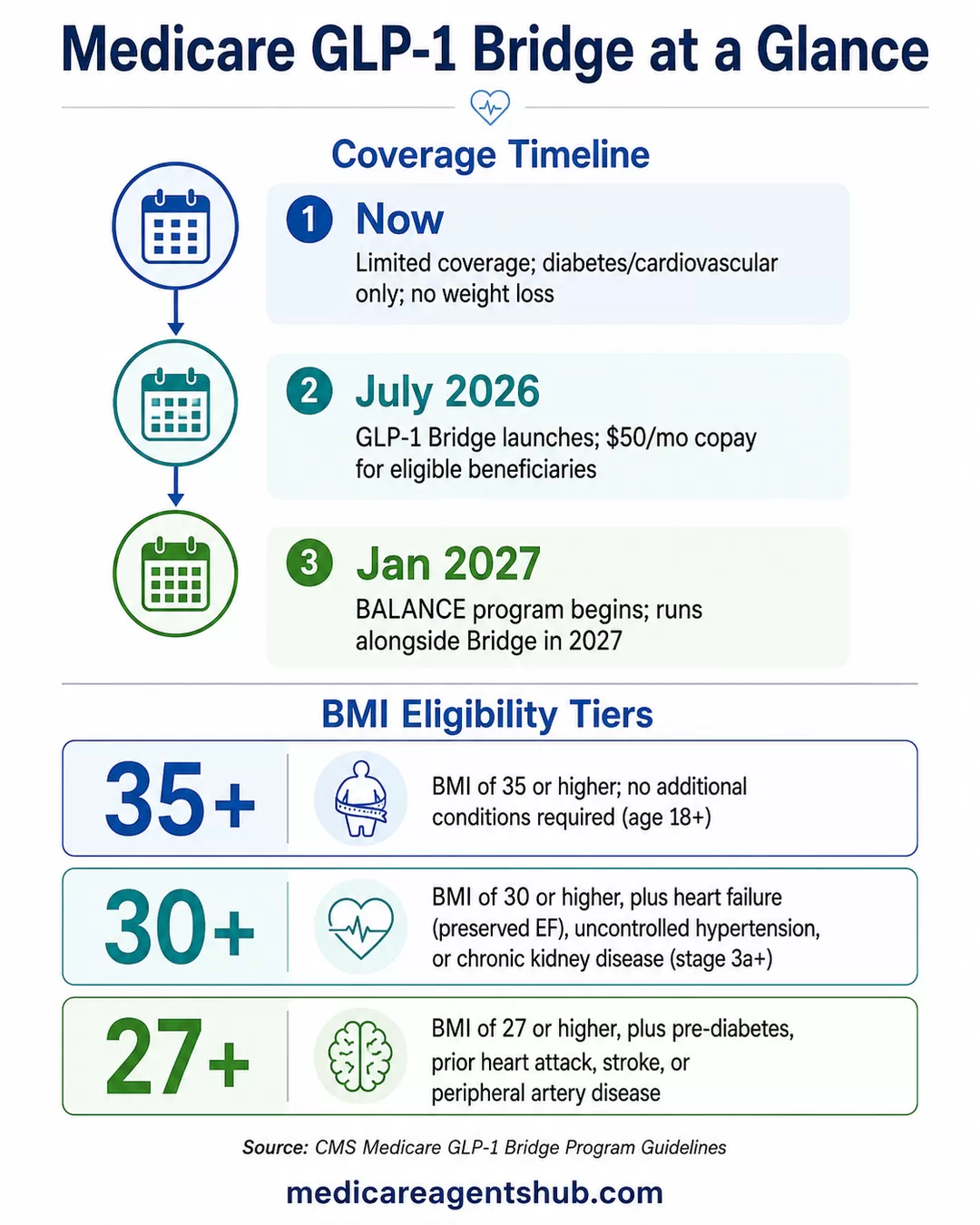
- Start date: July 1, 2026
- End date: December 31, 2027
- Transition: The BALANCE Model launches January 1, 2027 and will run alongside the Bridge through 2027
Which Drugs Are Covered?
The GLP-1 Bridge covers three medications for weight reduction and maintenance:
- Foundayo (all formulations)
- Wegovy (injection and tablets, all formulations)
- Zepbound KwikPen (KwikPen formulation only)
Note that Ozempic and Mounjaro are not included in the Bridge program, since those are the diabetes-indicated versions. If you have Type 2 diabetes, your Part D plan may already cover those drugs.
GLP-1 Bridge Eligibility: BMI and Health Requirements
To qualify for the GLP-1 Bridge, you must be enrolled in a standalone Part D plan (PDP) or a Medicare Advantage plan that includes prescription drug coverage. You must also meet one of these clinical criteria:
- BMI of 35 or higher (age 18+)
- BMI of 30 or higher with heart failure with preserved ejection fraction, uncontrolled hypertension, or chronic kidney disease (stage 3a or higher)
- BMI of 27 or higher with pre-diabetes, a prior heart attack, stroke, or peripheral artery disease
What Will It Cost?
Eligible beneficiaries will pay a flat copay of $50 per month, regardless of which benefit phase they're in. This is a dramatic reduction from the $1,000+ per month list price.
Novo Nordisk and Eli Lilly Pricing Agreements
The $50/month copay is possible because of pricing agreements between CMS and the two major GLP-1 manufacturers. Novo Nordisk (maker of Wegovy) and Eli Lilly (maker of Zepbound) have agreed to provide these medications at a net price of $245 per month to Medicare, well below their list prices of $1,000+. These negotiated rates are specific to the Bridge program and separate from the broader Medicare drug price negotiations taking effect in 2027.
One important note: the GLP-1 Bridge operates outside of your regular Part D benefit. That means costs under the Bridge don't count toward your Part D deductible or out-of-pocket maximum. Low-income subsidies also do not apply to Bridge prescriptions. If you currently receive financial assistance, learn more about Extra Help and other Medicare savings programs to understand how your benefits interact with Bridge coverage.
How to Enroll in the Medicare GLP-1 Bridge Program
If you're interested in the GLP-1 Bridge:
- Talk to your doctor about whether you meet the clinical eligibility criteria
- Your doctor will submit a prior authorization request (processed centrally by Humana)
- If approved, fill your prescription at a participating pharmacy
- Pay your $50 monthly copay
Humana's Role in the GLP-1 Bridge Program
CMS selected Humana as the single administrator for the entire Bridge program. Every prior authorization runs through Humana, regardless of which Part D plan you're actually enrolled in. If your Aetna, UnitedHealthcare, Wellcare, or any other PDP or MA-PD plan participates in the Bridge, your prescribing doctor still sends the paperwork to Humana for review against the BMI and clinical criteria.
This centralized setup keeps eligibility rules consistent across all plans. You do not need to switch to a Humana plan to qualify. You just need to be enrolled in any Part D plan or MA-PD that participates in the Bridge, and your doctor needs to submit the request through Humana's process.
What Happens After the Bridge? The BALANCE Model
What happens after the Bridge? The Bridge program runs through December 31, 2027, then hands off to the BALANCE Model (Better Approaches to Lifestyle and Nutrition for Comprehensive Health), which CMS plans to launch in Medicare Part D on January 1, 2027. The two overlap for a full year so beneficiaries don't lose coverage during the transition. BALANCE is the longer-term program that will allow Part D plans to cover GLP-1 medications for weight management beyond the Bridge.
If you start on a GLP-1 through the Bridge program, you'll have coverage through the end of 2027. Looking ahead, enrolling in a Part D plan that participates in BALANCE will be important for continued access beyond that. Your choice of Part D plan will matter more than ever.

How do I compare Part D plans to minimize costs for a mix of generic and specialty drugs?
If you take regular pills and a very expensive specialty drug, don’t just pick the plan with the lowest monthly premium. That cheap plan may often charge a large percentage of the specialty drug’s price every month — so you could pay thousands of dollars for it all year long. Instead, look for a plan that charges a low, flat copay (like $100) for your expensive drug, even if that plan’s monthly premium is higher. A flat copay is much easier on your wallet and helps you reach the stage where you pay very little much faster.The right plan will usually have no deductible on your expensive drug, so coverage starts right away. It will also typically offer low or $0 copays for your generic medicines. Use Medicare.gov and enter your exact drugs and pharmacy. Don’t sort by lowest premium — sort by “lowest yearly drug + premium cost.” This shows you the real yearly price based on your medications.
Finally, if a drug company offers help paying your copay, ask your agent if that help counts toward your Medicare out-of-pocket limit. And remember — review your plan every fall during Open Enrollment, because drug prices, copays, and covered medicines can change each year. A good agent can walk you through this so you get the most savings without surprises.
The Legislative Picture: Treat and Reduce Obesity Act
While the GLP-1 Bridge is a CMS demonstration program (not a permanent law), Congress has been working on a legislative solution: the Treat and Reduce Obesity Act (TROA). This bipartisan bill has been introduced multiple times since 2012 and was reintroduced in the 119th Congress in 2025.
If passed, TROA would:
- Permanently allow Medicare Part D to cover FDA-approved anti-obesity medications
- Expand Medicare Part B coverage of intensive behavioral therapy for obesity to include a wider range of providers (not just primary care physicians)
However, in April 2025, CMS announced it would not include Medicare Part D coverage of obesity drugs in its rule changes for 2026, stating the proposal was "not appropriate at this time." That decision pushed the issue back to Congress, where the TROA remains under consideration.
What Medicare Already Covers for Weight Management
Even without the GLP-1 Bridge (which doesn't start until July 2026), Medicare already covers several weight management services that many beneficiaries don't know about:
- Obesity Behavioral Counseling (Part B): If your BMI is 30 or higher, Medicare covers up to 22 intensive behavioral therapy sessions over 12 months with your primary care provider, at no cost to you
- Medical Nutrition Therapy (Part B): If you have diabetes or kidney disease, Medicare covers nutritional counseling sessions with a registered dietitian
- Diabetes Self-Management Training: Covers education on managing blood sugar, diet, and exercise
- Bariatric Surgery (Part A): Medicare covers certain weight loss surgeries if medically necessary
These preventive services are often overlooked, but they can be a solid starting point, especially while waiting for GLP-1 coverage to become available. For a broader look at what Medicare does and doesn't pay for, check out our guide to surprising Medicare coverage answers.
Out-of-Pocket Costs Without Coverage
If you don't qualify for the GLP-1 Bridge or prefer not to wait until July 2026, here's what you can expect to pay out of pocket in 2026:
- Ozempic: ~$199-$499/month through manufacturer savings programs (list price ~$998)
- Wegovy: ~$149-$199/month through savings programs (list price ~$1,350)
- Zepbound: ~$349/month through LillyDirect (list price ~$1,060)
- Mounjaro: ~$349/month through LillyDirect (list price ~$1,060)

How will the new 2025 Medicare Part D out-of-pocket cap impact seniors and prescription drug costs?
Excellent question! Thank you for the opportunity to answer this very important question. Medicare Part D has changed so much since 2024. For one the Donut Hole has been eliminated. Second, the True Out Of Pocket maximum was reduced from $8,000 to $2,000. In 2026, that maximum will go up to $2,100. So, plan accordingly.The impact of this is that the formularies cost sharing has shifted and many Part D providers have changed plans and/or left unsustainable service areas altogether. These impacts should begin to end in 2026 as the new Big Beautiful Bill takes effect.
One huge change is the Most Favored Nation pricing for medications in the United States. Previous to this year, foreign countries got Most Favored Nation pricing but Americans did not. So, Medicare Beneficiaries were paying the freight for countries around the world. That will not be the case in 2026.
The impact on seniors who take many medications or Tier 3,4 and 5 meds should reduce costs greatly. I look forward to see our country and those in their 'Golden Years' receive the best that America has to offer next year and beyond.
Thanks again and God bless!
Manufacturer savings programs and discount platforms can significantly reduce costs, though discount cards like GoodRx don't always save you money on Medicare. Medicare-negotiated prices for Ozempic, Wegovy, and related drugs are set to take effect in 2027, which should bring costs down further.
How Medicare Advantage Plans May Differ
Medicare Advantage (Part C) plans are required to cover everything Original Medicare covers, but many go further by offering additional benefits. When it comes to weight management and GLP-1 coverage:
- Some MA plans may offer fitness benefits like gym memberships (SilverSneakers, Renew Active) that support weight management goals
- Formulary differences matter: Each MA plan with drug coverage has its own formulary, so GLP-1 coverage for approved conditions (diabetes, cardiovascular risk) can vary significantly from plan to plan
- GLP-1 Bridge access: MA plans that include prescription drug coverage (MA-PD plans) are included in the GLP-1 Bridge program, so members of those plans can participate starting July 2026
- Supplemental benefits: Some MA plans offer nutritional counseling, meal delivery, or wellness programs that can complement weight management efforts
If weight management is a priority for you, it's worth comparing how different plans handle these benefits. For a look at what's changing across the board, see our breakdown of Medicare Advantage trends and changes for 2026. You might also be surprised at what's already available; many people don't take advantage of benefits their MA plan already offers.
What to Ask Your Medicare Agent
This is a fast-moving area of Medicare policy. If you're interested in GLP-1 medications for weight management or diabetes, here are specific questions to ask your agent:
- Does my current Part D plan cover Ozempic or Mounjaro for my diabetes? If you have Type 2 diabetes, you may already have coverage.
- Will my plan participate in the Medicare GLP-1 Bridge starting July 2026? Not all plans may participate on day one.
- Do I meet the clinical eligibility criteria for the Bridge program? Your agent can help you understand the BMI and health condition requirements.
- How will the BALANCE Model affect my plan choices for 2027? Plan selection during the next Annual Enrollment Period will be critical if you want continued GLP-1 access.
- Are there Medicare Advantage plans in my area with better weight management benefits? Some plans offer more comprehensive support than others.
- What are my options for managing prescription drug costs in the meantime?
GLP-1 Coverage Is Coming: Here's How to Prepare
For years, Medicare beneficiaries who wanted GLP-1 drugs for weight loss had to pay full price out of pocket. That's finally changing. The Medicare GLP-1 Bridge program launching in July 2026 will provide access to Wegovy, Zepbound, and Foundayo at just $50 per month for eligible beneficiaries through the end of 2027, with the BALANCE Model providing a long-term path for continued Part D coverage beyond that.
If you think you might benefit from these medications, start talking to your doctor now about your eligibility. And reach out to a knowledgeable Medicare agent who can help you choose the right plan to take advantage of these new benefits as they become available.