Is Medicare Primary or Secondary? Who Pays First When You Have Other Coverage

-
October 21, 2026

Reviewed by Brody Crawford
Medicare Agent Licensed in PA, AL, AR & 42 other states
If you have Medicare plus other health coverage — job insurance, a spouse's plan, VA, TRICARE, retiree benefits, Medicaid — one of them pays your medical bills first, and the other picks up whatever's left. That order matters. Get it wrong and claims can be delayed, denied, or billed incorrectly.
The rules aren't optional and they're not up to you. Federal law decides who's primary and who's secondary based on your situation. Here's the plain version.
A note on scope: This article covers coordination of benefits under Original Medicare (Part A and Part B). If you're enrolled in a Medicare Advantage plan, your plan may have its own rules for how it coordinates with employer or other group coverage. Check with your plan directly.
Quick answer: For people 65 and older, Medicare is secondary when you (or a spouse) are still actively working for an employer with 20 or more employees, when you have workers' comp or no-fault auto coverage for the injury being treated, or when a group health plan covers you as a working spouse. Medicare is primary once you retire, if your employer has fewer than 20 employees, and in most VA/TRICARE/Medicaid combinations. Different thresholds apply for disability-based Medicare and end-stage renal disease. The primary plan pays first; the secondary plan reviews what's left.
| Your situation | Who generally pays first? |
|---|---|
| Age 65+, current employer has 20+ employees | Employer plan |
| Age 65+, current employer has fewer than 20 | Medicare |
| Under 65 (disability), employer has 100+ employees | Employer plan |
| Under 65 (disability), employer has fewer than 100 | Medicare |
| End-stage renal disease (first 30 months) | Group health plan |
| Retiree health coverage | Medicare |
| COBRA at age 65+ | Medicare |
| Medicaid and Medicare | Medicare |
| TRICARE For Life (in the U.S., services covered by both) | Medicare |
| VA care at a VA facility | VA |
| Workers' comp / no-fault / liability insurance | That insurer |
General rules. Exceptions include multi-employer plans and specific coverage circumstances. See Medicare's coordination-of-benefits page for the full rules.
What "primary" and "secondary" actually mean
When you have two forms of health coverage, the doctor's office bills one first. That one is the primary payer. It processes the claim under its own rules, pays its portion, and sends the balance to the second one. The secondary payer then decides how much of that leftover it covers.
Between the two, you might owe very little. Or a lot. Depends on how the plans coordinate.
A few things to keep in mind:
- The secondary payer doesn't always cover the full remainder. It applies its own deductibles, copays, and network rules first.
- Some services covered by one plan aren't covered by the other. If the secondary doesn't cover it either, you pay.
- You can't pick the order. Medicare's coordination-of-benefits rules decide it.
Now the specifics.
When you're still working (and your employer has 20+ employees)
This is the big one people get wrong.
If you're 65+, enrolled in Medicare, and still working for a company with 20 or more employees, your employer group plan is primary. Medicare is secondary. The federal Medicare Secondary Payer rules require large employers to offer active employees the same coverage they offer younger workers — and that coverage pays first.
Same rule applies if you're covered under a working spouse's group plan and their employer has 20+ employees.
Because the employer plan is primary, some people in this situation evaluate whether it's worth paying the Part B premium ($202.90/month in 2026) for coverage that may provide limited additional benefit. You can delay Part B without penalty as long as you have credible coverage through active employment, then enroll during a Special Enrollment Period when the job coverage ends. Whether that's the right call depends on your employer plan's cost sharing, whether you have an HSA, and your overall health situation. Talk it through with your benefits administrator and a licensed Medicare agent before deciding.

If I have both Medicare and employer health insurance, which one pays first?
If you have both Medicare and employer health insurance, which plan pays first depends primarily on the size of your employer. If your employer has 20 or more employees, your employer health plan generally pays first, and Medicare pays second. If your employer has fewer than 20 employees, Medicare usually pays first, and your employer plan pays second.Because coordination of benefits can vary based on your specific situation, it's important to review your coverage before delaying Medicare enrollment or relying solely on employer insurance.
When you're still working but your employer has fewer than 20 employees
Different story. If the employer has under 20 workers, Medicare is primary and the small-group plan is secondary. And here's the part that stings: if you haven't enrolled in Part B, the group plan doesn't have to pay anything Medicare would have paid.
Meaning if you're on a 12-person company's plan at 66 and you didn't take Part B, the plan can process claims as if Medicare had paid its share — even though it didn't — and stick you with everything else.
Small-employer coverage is not a reason to delay Part B. You need Part B.
If you're in this bucket and haven't enrolled yet, fix it before your next appointment. HR should know the size rule, but plenty don't — the burden falls on you.
Exceptions to the 20-employee rule: disability and kidney failure
The 20-employee threshold applies to people who qualify for Medicare based on age (65+). Two other situations use different rules.
Disability-based Medicare (under 65): If you're under 65 and on Medicare due to a disability, and you also have group health coverage through your own or a family member's current employer, the employer-size threshold is 100 employees, not 20. Employers with 100+ workers must offer the same coverage to disabled employees that they offer to others, and that group plan pays first. If the employer has fewer than 100 employees, Medicare is primary.
End-stage renal disease (ESRD): If you became eligible for Medicare because of kidney failure requiring dialysis or a transplant, your group health plan generally pays first during a 30-month coordination period. After those 30 months, Medicare becomes primary regardless of employer size. This applies no matter how many employees the company has.
Multi-employer plans (like those from unions or trade groups) can also change how the employee threshold is calculated. If you're covered through one, check with your plan administrator about which rules apply.
When you retire or your employer coverage ends
When active employment ends, the payer order changes. Medicare becomes primary. Anything you keep — retiree health, COBRA, a spouse's retiree plan — becomes secondary. The timing depends on when your employment ends and when your group coverage actually terminates, which aren't always the same date.
Two things trip people up here:
- COBRA does not extend your Part B Special Enrollment Period. If you're 65+ and drop off active employer coverage to COBRA, your 8-month Part B SEP clock starts when active employment or employer coverage ended — not when COBRA ends. Miss that window and you're looking at a lifetime Part B late enrollment penalty. (Note: "creditable coverage" has a separate meaning for Part D purposes. COBRA can be creditable for Part D but still won't protect your Part B enrollment timeline.)
- Retiree plans expect you to enroll in Medicare. Most retiree plans are designed to sit behind Medicare and won't pay a dime for something Medicare would have covered. If you skip Part B, the retiree plan doesn't backfill.
Both traps are avoidable. Both catch people every year. If you're leaving job-based coverage, get the timing right — switching from employer health insurance to Medicare takes some planning, and the Special Enrollment Period rules are where most people slip.

Can you explain how Medicare works with other types of insurance like Veterans Affairs benefits or employer plans?
VA health care and Medicare are separate systems. The VA generally covers care authorized through the VA, while Original Medicare covers eligible services from Medicare-participating providers.Employer plans - the number of employees and whether the coverage is based on current employment can determine which insurance pays.
Age 65 or older — employer has 20 or more employees
The employer's group health plan generally pays first; Medicare pays second. 20 or less, Medicare generally pays first.
Medicare and VA benefits
VA and Medicare don't coordinate in the traditional primary/secondary sense. They run in parallel.
Care at a VA facility gets billed to the VA. Care at a non-VA doctor or hospital gets billed to Medicare. You generally use one system or the other for a given visit. VA-authorized community care (when the VA sends you to a non-VA provider) is typically covered by the VA, not billed to Medicare.
That's why so many veterans still enroll in Part B even with full VA benefits: it gives them options outside the VA network. But whether Part B is worth it for veterans depends on where you live, VA facility access, and what kind of specialists you need.
Medicare and TRICARE For Life
Once you're Medicare-eligible, TRICARE For Life acts as your secondary payer for services covered by both programs in the U.S. — but only if you're enrolled in both Part A and Part B. TFL fills in most of what Medicare doesn't cover, including deductibles and coinsurance. For care received overseas, TRICARE is the primary payer.
In most cases, you must maintain Part B to remain eligible for TRICARE For Life. Dropping it means losing TFL coverage, which is a steep trade-off given how much TFL picks up.
Medicare and Medicaid (dual eligibles)
If you qualify for both — usually called being "dual eligible" — Medicare pays first, Medicaid pays last. Medicaid is the payer of last resort, meaning it kicks in after every other coverage source (including Medicare) has done its part.
Many dual eligibles pay very little for care, but the exact cost-sharing protections vary. Full-benefit dual eligibles and people in Medicare Savings Programs (QMB, SLMB, QI) have different levels of protection. QMB beneficiaries, for example, should owe nothing for Medicare-covered services. Others may still have limited copays. Special dual-eligible Medicare Advantage plans (D-SNPs) are built specifically for this population.
Medicare and workers' comp, no-fault, or liability insurance
For an injury or illness covered by workers' compensation, no-fault auto insurance, or liability insurance, those pay first — not Medicare. Medicare might pay conditionally while a claim is being sorted out, but it expects reimbursement once the other insurer settles up.
If you're in a car accident and Medicare pays your ER bill, and your auto insurer later pays for the same treatment, Medicare will come collect. Don't spend that settlement money without setting some aside.
Medicare and a Medigap policy
Slightly different animal. Medigap isn't really "secondary insurance" in the coordination-of-benefits sense — it's a supplement designed to plug Original Medicare's cost gaps (Part A deductible, Part B coinsurance, etc.). Medicare processes the claim first, then Medigap picks up its share automatically based on the specific plan you chose. Plan benefits vary — Plan G covers different things than Plan N, for example — and Medigap doesn't cover everything Original Medicare leaves behind (like prescription drugs or long-term care).
You can't have Medigap alongside a Medicare Advantage plan. It's Original Medicare + Medigap, or Medicare Advantage — pick one.

Will Medicare cover everything my current employer plan does?
Not necessarily. Medicare is excellent coverage, but it doesn’t work exactly like an employer plan. Your employer plan may bundle medical, drug coverage, dental, vision, and sometimes even extras under one umbrella, while Medicare separates these into different parts and may require you to add a supplement or Medicare Advantage plan to match what you currently have. Many people find Medicare to be more cost-effective overall, but it usually isn’t a one-to-one replacement for every benefit offered by an employer plan.The situation nobody plans for: a working spouse dies
You had Medicare, your spouse had a group plan through work that covered both of you, and their plan was primary. Then they pass away.
The employer coverage typically ends within 30-60 days. COBRA is usually offered but is limited (36 months for the surviving spouse under federal law). Medicare stays put — but now it's primary, and whatever secondary coverage you had is gone or shrinking fast.
If you delayed Part B because your spouse's employer coverage qualified, you generally have an 8-month Part B Special Enrollment Period starting when the employment or coverage ends (whichever comes first). Don't confuse this with Medigap enrollment rights, which work on a separate timeline. Your initial 6-month Medigap Open Enrollment Period begins when you're both 65 or older and enrolled in Part B. A separate 63-day guaranteed-issue window for Medigap applies in specific situations (like losing employer group coverage), but it isn't automatic in every scenario. Getting these timelines mixed up is one of the most expensive Medicare mistakes. A licensed agent can map out exactly which windows apply to your situation.

My husband passed away, and we had Medicare and health insurance through his employer. Medicare was primary. What happens to my coverage now?
If a spouse who had Medicare and group health insurance through their employer passes away, and the surviving beneficiary was a dependent on that group health insurance, the surviving beneficiary's Medicare stays active because Medicare is individual; however, the dependent coverage under the employer group health insurance would typically end due to the employee's death. This would be considered a Qualifying Life Event and would then trigger a Special Enrollment Period for the surviving Medicare beneficiary.Because this is a significant life event and such a difficult time, he/she would want to contact their Medicare Agent for help and guidance to find out if they could and/or should switch plans or make a change in supplemental insurance.
How to actually figure out your situation
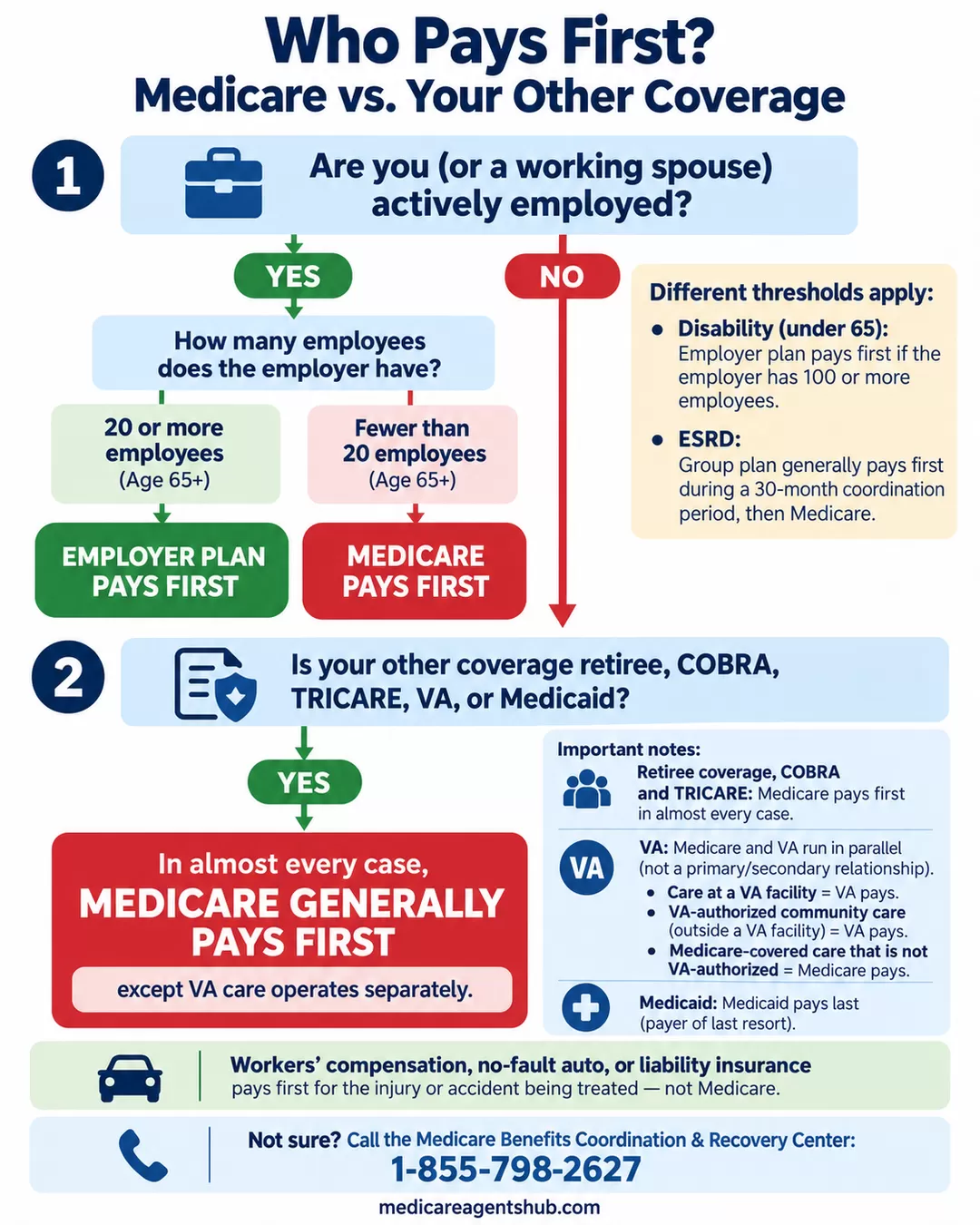
The rules are less complicated than they sound. Two questions do most of the work:
- Are you (or a working spouse) actively employed? If yes, the employer size matters. 20+ = employer primary. Under 20 = Medicare primary. (Different thresholds for disability and ESRD — see the exceptions section above.)
- Is the coverage retiree, COBRA, TRICARE, VA, or Medicaid? In almost every case, Medicare pays first (VA runs parallel; Medicaid pays last).
If you're not sure, call the Medicare Benefits Coordination & Recovery Center at 1-855-798-2627 — they'll pull up your record and tell you exactly what Medicare thinks the order is. Whatever they say is what your doctor's office will see when they bill.
What to do next
If your coverage situation is changing — retiring, losing a spouse, switching jobs, or coming off COBRA — the primary/secondary order changes with it, and enrollment deadlines usually come attached. A licensed Medicare agent in your area can walk through the specifics and flag which windows apply to you. Find one who works in your state before you make a move — most agents don't charge for consultations, and getting the sequence right saves real money.