Medical vs Cosmetic Dermatology: What Medicare Will and Won’t Cover

-
February 21, 2026

Reviewed by Connor Vizethann
Medicare Agent Licensed in MD, AL, AR & 41 other states
As we get older, our skin changes right along with us. Brown spots show up after years in the sun. Dryness becomes more common. Moles look different than they used to. Sometimes those changes are harmless. Other times, they require medical attention.
If you are approaching Medicare eligibility, newly enrolled, or have had coverage for years, it is completely normal to wonder what is actually covered when it comes to dermatology. The key distinction comes down to one word: medical necessity.
Understanding the difference between medical and cosmetic dermatology can help you avoid surprise bills and make more confident decisions about your care.
What Counts as Medical Dermatology Under Medicare?
Under Medicare, dermatology services are generally covered when they are considered medically necessary. This typically means the service is needed to diagnose, evaluate, or treat a medical condition.
If you are enrolled in Original Medicare, outpatient dermatology services are usually covered under Part B. That includes doctor visits, diagnostic testing, and certain procedures performed in a medical office setting.
Common examples of medical dermatology that Medicare may cover include:
-
Evaluation of suspicious moles or lesions
-
Skin biopsies
-
Treatment of skin cancer
-
Care for chronic conditions like psoriasis or eczema
-
Treatment of infections, rashes, or severe inflammation
-
Medically necessary removal of lesions that are painful, bleeding, or changing
For example, if your primary care doctor refers you to a dermatologist because a mole has changed in color or size, that visit is typically considered medically necessary. If the dermatologist performs a biopsy to rule out skin cancer, that procedure is also generally covered.
Treatments for conditions like actinic keratosis, which can develop into skin cancer, are often covered as well. Likewise, procedures such as cryotherapy or even specialized surgical treatments like Mohs surgery are usually covered when treating confirmed skin cancer.
In these situations, Medicare is not paying to improve appearance. It is paying to diagnose or treat a legitimate health concern.
One point worth clarifying: Medicare does not cover routine, full-body skin cancer screenings on their own. A dermatology visit is generally covered when you or your doctor notice a suspicious spot, symptom, or change that warrants a medically necessary evaluation.

What does Medicare Part B cover? Is it enough?
Medicare Part B covers outpatient and medically necessary services — essentially anything needed to diagnose or treat a medical condition outside of a hospital stay. This includes doctor visits, preventive care (like screenings and vaccines), lab tests, X-rays, outpatient surgeries, durable medical equipment (such as walkers or wheelchairs), and certain home health services. It also helps cover some mental health services and emergency room care that doesn’t require hospital admission. Beneficiaries pay a monthly premium, an annual deductible, and typically 20% coinsurance for most covered services.However, Part B alone usually isn’t enough for most retirees. It doesn’t cover prescription drugs, dental, vision, hearing, or long-term care, and it has no annual out-of-pocket maximum, meaning there’s no cap on what you could spend in a bad health year. Without additional coverage — such as a Medigap plan or a Medicare Advantage plan — you could face substantial and unpredictable medical expenses. Most beneficiaries choose to pair Part B with supplemental coverage to protect themselves financially and ensure more comprehensive care.
What Is Considered Cosmetic Dermatology?
Cosmetic dermatology focuses on improving appearance rather than treating illness or disease. This is where coverage usually stops.
Medicare does not cover services that are performed solely for cosmetic reasons. That includes procedures meant to enhance appearance, reduce signs of aging, or remove harmless imperfections.
Examples of services that Medicare typically does not cover include:
-
Botox for wrinkles
-
Dermal fillers
-
Laser treatments for age spots or sun damage
-
Removal of benign skin tags for appearance only
-
Chemical peels for cosmetic purposes
-
Treatment for hair loss that is not medically related
If a procedure is done strictly to improve how you look and not to treat a medical condition, you should expect to pay out of pocket.
This is where confusion often happens. For instance, removing a mole for cosmetic reasons is not covered. But removing that same mole because it is irregular, painful, or potentially cancerous may be covered. The medical documentation and diagnosis matter.
The Gray Area Between Medical and Cosmetic
Not every situation is black and white. Some procedures fall into a gray area where coverage depends on the specific circumstances.
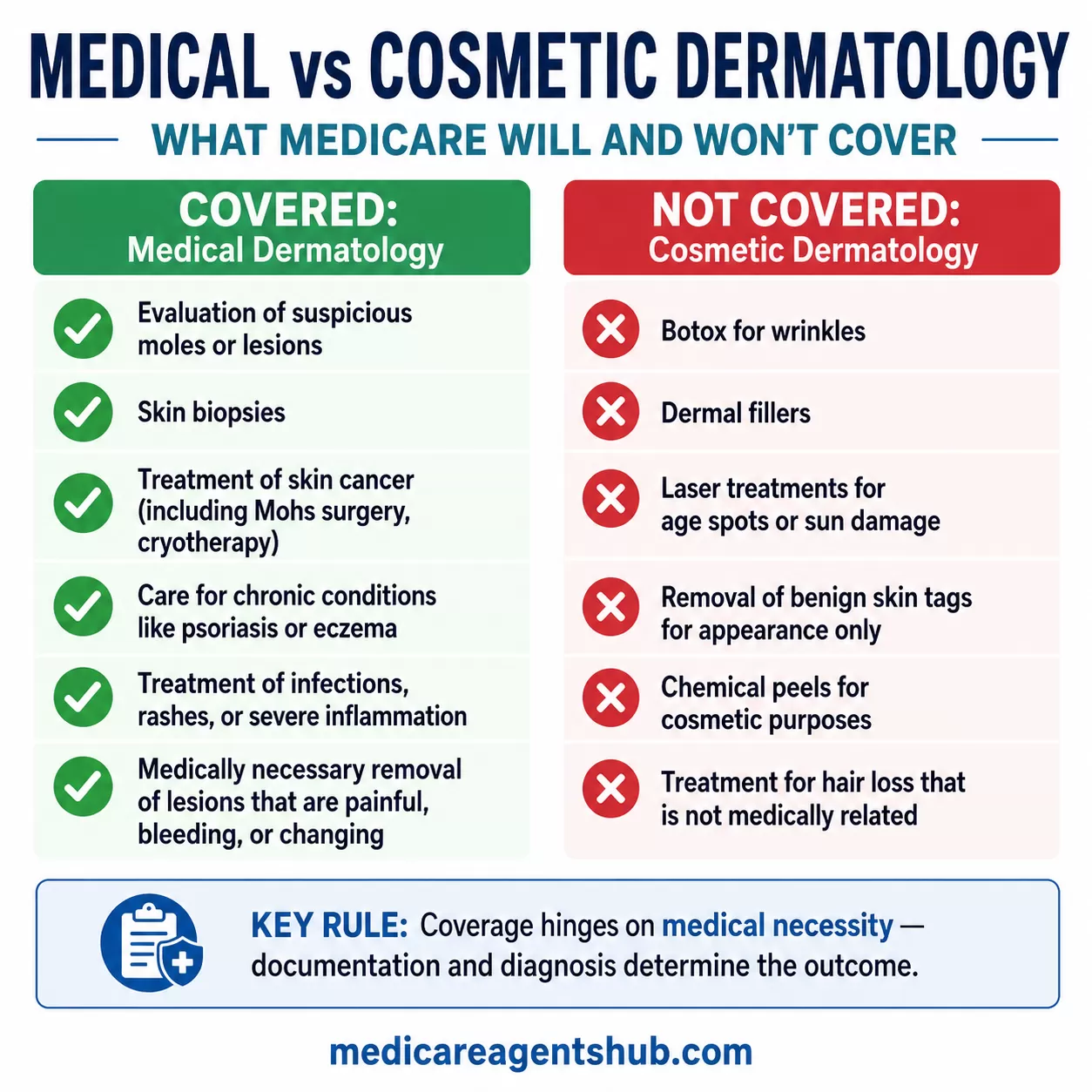
The same procedure can go either way depending on why it is being done. Here is a quick side-by-side to make the distinction clearer:
| Typically Covered (Medically Necessary) | Typically Not Covered (Cosmetic) |
|---|---|
| Mole removal due to changes, bleeding, or cancer risk | Mole removal for appearance only |
| Eyelid surgery when drooping interferes with vision | Eyelid surgery to look younger or more rested |
| Scar revision after injury or surgery when it causes symptoms | Scar revision solely to improve appearance |
| Skin tag removal when painful, irritated, or infected | Skin tag removal for cosmetic reasons |
| Treatment of severe acne, rosacea, or eczema | Chemical peels or laser treatments for sun damage |
| Removal of lesions suspected to be cancerous | Botox or fillers for wrinkles |
Take eyelid surgery as an example. If it is done to improve appearance, it is considered cosmetic and not covered. But if drooping eyelids are interfering with vision and documented as medically necessary, Medicare may cover it.

I've got a Medicare Advantage plan, and I'm curious if my upcoming eye surgery is fully covered or if I'll owe extra out of pocket.
With a Medicare Advantage (MA) plan, coverage for eye surgery depends on the type of surgery and your plan’s network rules. Here’s a breakdown:1. Type of surgery matters
Medically necessary eye surgery (like cataract surgery or retinal procedures) is generally covered under your MA plan, because it falls under Part B services.
Elective or cosmetic procedures (like LASIK or some vision-correction surgeries) are usually not covered.
2. Costs you may owe
Even if the surgery is covered:
You may have a copay, coinsurance, or deductible depending on your plan.
MA plans often have in-network requirements, so using an out-of-network surgeon could increase your out-of-pocket cost.
Prior authorization may be required — your plan may not pay if approval isn’t obtained first.
3. Extra benefits
Some MA plans offer routine vision benefits, but these usually cover exams, lenses, or frames, not surgery.
If your surgery involves a device like a lens implant, some costs may fall under Part B, not the vision benefit.
✅ What to do next
Call your MA plan to confirm:
Is the procedure covered?
Will it be considered in-network?
What will your out-of-pocket cost likely be?
Ask the surgeon’s office to submit a pre-authorization request to your plan.
Review your plan documents — look for “Prior Authorization” and “Surgery Coverage” sections.
The same can apply to scar revisions, treatment for certain growths, or removal of lesions. If your dermatologist documents symptoms such as bleeding, itching, pain, rapid growth, or suspicion of malignancy, the procedure is more likely to be classified as medically necessary.
This is why it is important to ask questions before scheduling treatment. You can ask the provider’s office whether the procedure is expected to be billed as medically necessary and whether they accept Medicare assignment.
What About Medicare Advantage Plans?
If you are enrolled in a Medicare Advantage plan instead of Original Medicare, your coverage still must include everything that Original Medicare covers. However, costs and rules may look different.
With a Medicare Advantage plan, you may:
-
Need a referral to see a dermatologist
-
Be required to use in-network providers
-
Have different copayments or coinsurance amounts
Some Medicare Advantage plans may offer limited supplemental benefits related to wellness or preventive services, but cosmetic dermatology is still generally excluded.
Because plan networks and costs vary widely, this is one area where working with a Medicare agent or broker can be helpful. A knowledgeable agent can review your plan’s provider network, referral requirements, and out of pocket structure to make sure you are set up with coverage that aligns with your healthcare needs, including access to specialists like dermatologists.

My Advantage plan says I need a referral just to see a dermatologist. I thought PPOs didn't require that - was I wrong?
Some Medicare Advantage plans still have referral requirements. It is always a good idea to carefully review the plan documents to see if referrals are required.What Will You Pay for Covered Dermatology?
Even when a dermatology service is covered, you are still responsible for your share of the cost.
Under Original Medicare Part B, after you meet the annual deductible, you typically pay 20 percent of the Medicare approved amount for covered services. If you have a Medigap policy, it may help cover some or all of that 20 percent, depending on your plan.
With Medicare Advantage, you may pay a flat copay for specialist visits or a percentage of the cost for procedures.
Prescription creams, oral medications, or specialty treatments may fall under Part D prescription drug coverage if they are self administered. It is important to check your drug plan formulary to confirm that your medication is covered.
Again, reviewing your coverage annually with a Medicare agent or broker can help you avoid surprises. Plans change each year, and something that was affordable last year may not look the same during the next enrollment period.
How to Protect Yourself From Surprise Bills
Before seeing a dermatologist, especially for a procedure, consider taking a few proactive steps:
-
Confirm that the provider accepts Medicare or is in network for your plan.
-
Ask whether the service is considered medically necessary.
-
Request an estimate of your expected out of pocket cost.
-
If the service may not be covered, ask whether you will be asked to sign an Advance Beneficiary Notice.

I've got a Medicare Advantage plan, and I'm curious if my upcoming eye surgery is fully covered or if I'll owe extra out of pocket.
Depends on type of surgery and Medicare Advantage Plan one is enrolled in. Other factors that impact are in and out of network, whether one got prior authorization, place of service, whether it is in and out patience procedure. It is important to talk to the hospital/doctor who is performing the service as well one's insurance company to understand any out-of-pocket cost prior to surgery.An Advance Beneficiary Notice lets you know that Medicare may deny the claim and that you agree to pay if that happens. Reading this carefully can prevent misunderstandings later.

What's the best way to avoid surprise bills for lab tests under Medicare Advantage?
To avoid any surprise lab bills you need to know what your plan covers which you can get that information through your plan’s Summary of Benefits. If you do not have that you should contact your plan to get a copy of it so you always have it on hand. Also, if after you have gone through the summary of benefits and you are not sure if a test is covered, then contact your plan for verification. In addition, talk to your doctor to make sure the tests being ordered are in-network.If possible, get a good faith estimate of the costs before the tests are performed.
If you should receive a surprise bill, check for its accuracy, and if the bill seems incorrect or includes an out-of-network charge, you can dispute the bill by calling your plan and filing a grievance…they will explain the process.
There is a “No Surprise Act’ in effect which does provide additional safeguards, particularly for certain out-of-network care in emergency situations and at in-network facilities.
This Act requires providers and facilities to give you certain information about balance billing protection and out-of-network care costs.
Medicare Dermatology Coverage: Key Takeaways
The difference between medical and cosmetic dermatology comes down to medical necessity. If a service is needed to diagnose or treat a health condition, Medicare will often cover it. If it is done solely to improve appearance, it likely will not.
For future beneficiaries, it is helpful to understand this distinction before you enroll. For new enrollees, it can prevent frustration during your first year on Medicare. And for current beneficiaries, reviewing your coverage annually ensures you are still aligned with your healthcare needs.
Skin health becomes increasingly important as we age. Regular evaluations, especially for skin cancer, can be essential. Knowing what Medicare will and will not cover allows you to prioritize your health while planning for potential costs.
If you are ever unsure how your specific plan handles specialist visits, procedures, or prescription treatments, reviewing your options with a licensed Medicare agent or broker can provide clarity. The right guidance can help ensure you are not only covered, but covered in a way that makes sense for your situation.