What Agents Are Actually Telling Clients About AI in Medicare: The Faster-Approvals-Faster-Denials Split Before AEP

-
July 24, 2026
Your clients are going to ask about AI this AEP. Some already have.
Maybe it's the 68-year-old who saw a news segment about algorithms denying claims. Maybe it's the spouse who read something about Medicare Advantage plans using software to auto-reject prior authorizations. Either way, the question lands in your lap: "Is a computer going to decide whether I get my surgery?"
We pulled 895 answers from agents on Medicare Agents Hub who've already fielded versions of this question. The responses split into three distinct camps, and each one points to a different enrollment script. Where you land probably depends on how you position MA vs. Original Medicare in your practice. But regardless of your camp, you need a compliant, honest answer ready before October 15.
Key takeaways for AEP:
- Agents split three ways on AI in claims processing: optimist, pessimist, pragmatist. All three camps include producers with decades in the business.
- Frame the client answer around process. Every plan type uses automated review of some kind, including Original Medicare.
- CMS marketing rules still apply. You can explain how prior authorization and appeal rights work. You can't disparage a specific plan or carrier.
- Cover denials and appeals during discovery, before enrollment. That is where your post-sale value gets concrete.
The three camps
Across 15 questions touching AI, claims processing, prior authorization, and denials, agents cluster into three groups. None of these positions is fringe. All three show up repeatedly, often from producers with decades of experience.
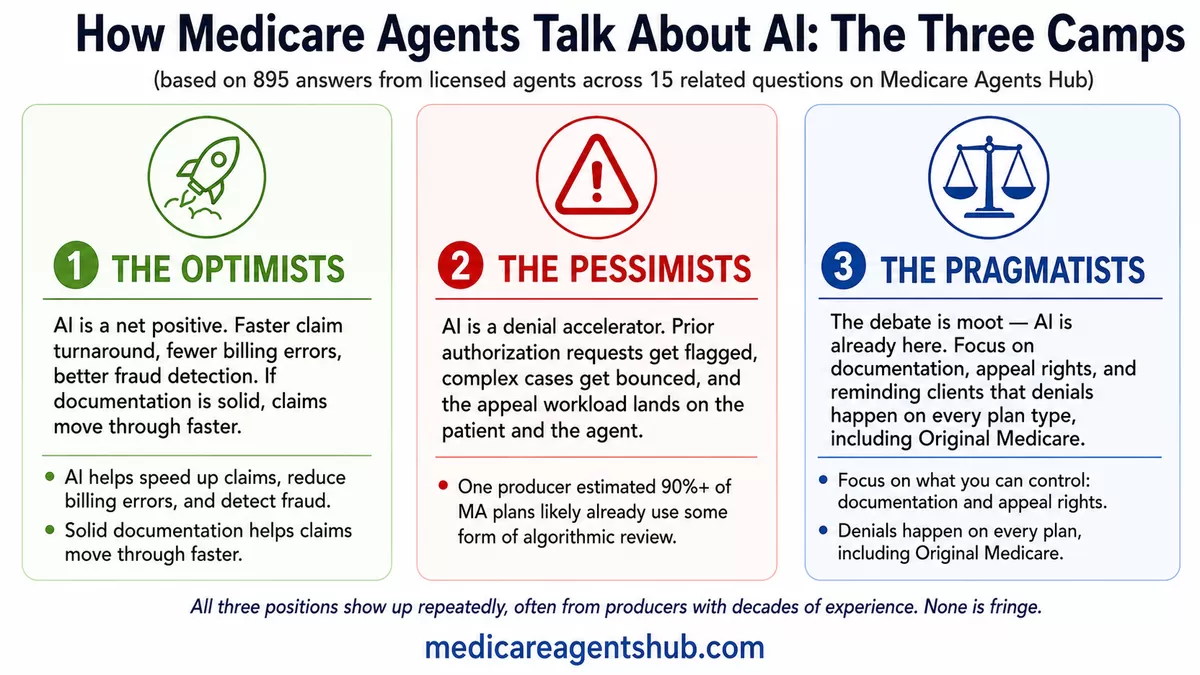
Camp 1: The optimists
These agents see AI as a net positive for claims processing. Faster turnaround. Fewer billing errors. Better fraud detection. The logic: if routine claims get auto-approved based on clean documentation, everyone wins. Providers get paid faster, beneficiaries see less lag between service and resolution, and the system spends less money chasing paperwork mistakes.

How might artificial intelligence change how Medicare approves claims in the future?
Artificial intelligence is likely to make Medicare claims processing faster and more automated, especially for routine services that meet clear coverage rules. AI can help flag errors, fraud, or missing documentation more quickly, which may reduce improper payments. It may also be used for prior authorization and medical necessity reviews, potentially speeding up approvals but also increasing scrutiny.However, Medicare (through the Centers for Medicare & Medicaid Services) will still require human oversight to ensure decisions are fair and compliant. The goal is greater efficiency, but providers and beneficiaries may need to be more precise with documentation.
The optimist position isn't naive. Most agents in this camp acknowledge that AI will also increase scrutiny. But they frame that as a feature, not a bug. If the documentation is solid, the claim moves through faster. If it's not, the system catches it earlier instead of letting it snowball into a denial three months later.
Where this gets tricky: optimists tend to be less vocal about what happens when the AI gets it wrong. The assumption is that human oversight catches errors. Whether that assumption holds at scale is the question the next camp is asking.
Camp 2: The pessimists
This is the group that worries you. And they're not small.
These agents see AI in Medicare Advantage claims processing as a denial accelerator. The concern: algorithms that are optimized for cost containment will default to "no" on anything that doesn't fit a narrow pattern. Prior authorization requests get flagged. Complex cases get bounced. And the appeal workload lands on the patient and their agent, not the carrier.

Who will make medical decisions as to what is necessary to me: my Doctor or the insurance company?
With Original Medicare and a Medigap or Medicare supplement policy, your doctor makes the decision.With a Medicare Advantage plan, it is said that AI calls the shots for your medical decisions. This could lead to not getting authorization. See a doctors. This is why the most prestigious hospitals do not accept Medicare Advantage.
That framing is blunt, and it's opinion, not established fact. CMS has not confirmed that any MA plan uses AI to make coverage determinations without human oversight. But the concern is real enough that agents are already building it into how they position plans at enrollment.
One more line in that camp deserves a caution flag before you borrow it: the claim that top hospital systems won't take Medicare Advantage. Network participation varies by system, by carrier, and by plan year. Some large systems have dropped specific MA contracts. Plenty of others still contract with MA plans. Repeating it as a blanket fact during an enrollment conversation is both inaccurate and the kind of statement a compliance reviewer will read as disparaging a plan type. Check the actual network for the actual plan, then tell the client what you found.
Several agents in the corpus specifically flag the prior authorization process on MA plans as the pressure point. One producer put it plainly: AI could speed up claims or cause more automatic declines that would have to be appealed. Another put it at over 90% of Medicare Advantage plans already using some form of algorithmic review, though that is an agent's estimate and not a published figure. The worry isn't that AI exists in the system. The worry is that it tips the balance toward denials without a proportional investment in making appeals easier.
Camp 3: The pragmatists
The third camp skips the debate entirely. Their position: AI is already here, the question is moot, and what matters is whether your clients know what to do when a claim gets denied, regardless of whether a human or an algorithm made the call.

How might artificial intelligence change how Medicare approves claims in the future?
AI will definitely change the way Medicare claims are handled by speeding up prior authorization, identifying potential fraud, waste, and abuse, and improving efficiency. There are still concerns that AI will increase denials and have an artificial bias by taking out the human element of underwriting or handling claims.Pragmatists are the ones most likely to fold the AI conversation into their existing enrollment workflow. They don't argue about whether AI is good or bad. They focus on documentation, appeal rights, and making sure clients understand that denials happen on every plan type (yes, including Original Medicare) and that the process for fighting them is well-defined.
This is probably the safest camp for compliance purposes. It doesn't make unsubstantiated claims about any specific plan or carrier. It doesn't scare clients away from MA. And it gives you a natural bridge into the value you provide post-enrollment, which is exactly where the agent's role in appeals becomes concrete.
The client script: handling "will an algorithm deny my care?"
This is the question. It's coming from news coverage, social media, and increasingly from adult children who are researching Medicare for their parents. You need a compliant answer that does three things:
- Acknowledges the concern without inflating it. Clients deserve honesty. "Yes, insurance companies use technology to process claims" is accurate. "AI is denying all your claims" is not.
- Separates the medical decision from the payment decision. Your doctor decides what care you need. The plan decides what it pays for. Those are two different decisions, and the patient has appeal rights when they disagree.
- Stays within CMS marketing rules. You cannot disparage a specific plan or carrier. You cannot make unsubstantiated claims about how a plan processes claims. You can explain how prior authorization works across plan types and what appeal rights exist.
A script that threads these needles:
"Technology is changing how claims get reviewed on every type of plan, not just Medicare Advantage. What I focus on with my clients is making sure you understand what your plan covers, what requires prior authorization, and exactly what to do if a claim gets denied. That's where I come in after enrollment. If something gets denied, we work through the appeal together."
That script works because it doesn't pick a camp. It doesn't promise AI will make things better or worse. It positions you as the person who knows the process and will be there when it matters.
What not to say
Avoid: "Medicare Advantage uses AI to deny your claims." Even if you believe it, you can't substantiate it for a specific plan, and CMS marketing rules prohibit disparaging plans during enrollment conversations. The line between educating a client and steering them away from a plan type is thin, and compliance reviewers know where it is.
Avoid: "Original Medicare doesn't use algorithms." Original Medicare uses its own automated systems for claims processing (the Medicare Administrative Contractors run sophisticated review software). Framing it as "human-only" is inaccurate.
Avoid: "AI will make everything faster and better." Clients who hear that and then get a denial will remember exactly what you promised.
And watch the word itself. Most of what runs inside claims processing today is rules-based automation: if the code doesn't match the diagnosis, the claim kicks out. That software has been running for decades and it doesn't learn anything. True machine learning, the kind that adjusts its own patterns, is newer, narrower, and still under active regulatory review. Calling every automated edit "AI" makes the conversation sound scarier than it is and makes you sound like you're guessing.
The pre-enrollment prep talk
Regardless of which camp you're in, the AI conversation creates a natural opening for something producers should be doing anyway: setting expectations about denials and appeals before enrollment, not after.
The agents who do this well in the corpus share a common pattern. They bring up denials proactively during the discovery conversation. Not as a scare tactic, but as part of explaining what their ongoing relationship looks like. The pitch: "I'm going to be here when something goes wrong. Here's what 'going wrong' can look like, and here's what we do about it."
What to cover in the prep talk
Prior authorization exists on MA plans, and sometimes on Original Medicare too. The prior authorization landscape is one of the most common sources of client frustration. Set the expectation early: some services require advance approval, and your office will help coordinate that with the provider.
Denials happen. They're not the end of the story. Walk clients through the basic appeal structure: organization determination, reconsideration by an independent review entity, Administrative Law Judge hearing, Medicare Appeals Council, federal court. Most cases resolve at level one or two. The appeal timeline and process are defined by CMS rules, not carrier discretion.
Peer-to-peer review is often a tool your doctor has. When a prior authorization gets denied, the treating physician can usually request a peer-to-peer review with the plan's medical director. Not every carrier offers it and no rule requires it, so confirm availability with the plan rather than promising it. Where it exists, agents across the corpus flag it as one of the most effective steps in reversing a denial, and one of the least known among beneficiaries.
Give them the sequence in plain order, so they aren't inventing a plan while a deadline runs:
- Read the denial letter and find the deadline. It is printed on the letter, and Medicare's official appeal instructions spell out what each level requires.
- Call the prescribing or treating provider's office. Most reversals start with better documentation from the doctor, not a better letter from the patient.
- Call your agent. Same day if possible.
- Pull together the records: the letter, the visit notes, the order, anything the plan says is missing.
Your role has limits. You can help a client understand the denial letter, identify the appeal deadline, and connect them with their provider's billing office. You cannot file medical documentation, argue medical necessity, or practice law. Being clear about this upfront builds trust and avoids the "why didn't you fix this?" call in February.

What role do you think technology will play in the future of Medicare?
As a Medicare expert, I believe technology will simplify processes like enrollment and plan selection, but I’m genuinely concerned that AI could soon replicate the expertise I offer clients. My biggest fear is that within a decade, it might crunch numbers and match plans better than I can, cutting into the personal guidance I provide. I just hope there’s still room for the human judgment and connection I bring to the table.What producers should be watching in 2026
A few things are moving in the regulatory space that touch this conversation directly. None of these are predictions. They're items on CMS and OIG radar that could change the terrain by the time AEP kicks off.
CMS scrutiny of algorithmic prior authorization. CMS has signaled interest in how MA plans use automated systems in coverage determinations. The agency's focus has been on ensuring that algorithmic decisions comply with the same clinical criteria and timeline requirements that apply to human reviewers. If new guidance drops before AEP, it could change the way you talk about prior authorization on MA plans.
OIG attention on MA denial rates. The Office of Inspector General has published multiple reports examining MA plan denial patterns, including denials that were later overturned on appeal. The consistent finding: a meaningful percentage of initial denials don't hold up under review. This data point is useful in client conversations about the value of appealing, but be careful about citing specific percentages without verifying the most recent report.
AI in diagnostics is a separate conversation. Medicare is already covering certain AI-powered diagnostic tools (cardiac imaging, retinal scans, some cancer detection applications). Agents in the corpus note this as an area where AI is clearly additive. Don't let the claims-processing debate bleed into the diagnostics conversation. They're different use cases with different regulatory frameworks.
The agent value proposition gets stronger, not weaker. If AI does increase claim scrutiny (whether through faster denials or more prior authorization requirements), the agent who understands the appeal process becomes more valuable to the client. Multiple producers in the corpus make this point explicitly. The technology changes. The need for someone who knows how to guide a client through complexity does not.
Bringing it back to the enrollment conversation
The AI question is really a trust question. Clients are asking: can I count on my plan to pay for the care my doctor says I need?
That question existed before AI entered the picture. Prior authorization, medical necessity reviews, and claim denials have been part of Medicare Advantage since the program started. What AI changes is the speed and scale at which those decisions get made, and maybe (agents disagree) the direction they tilt.
Your job isn't to resolve that debate. Your job is to make sure your client knows three things: what their plan covers, what happens if something gets denied, and that you'll be the one helping them through it. If you can do that clearly and honestly, the AI question answers itself.