New-to-Medicare vs. Already-on-Medicare: How Top Agents Split Their Playbook Between First-Timers and Plan-Shoppers

-
July 28, 2026
Two clients walk into your office the same week. One just got their Medicare card in the mail and has no idea what Parts A through D even mean. The other has been on a Medicare Advantage plan for 6 years and wants to know if something better came out this year. You're about to have two completely different conversations.
Most experienced agents already know this instinctively. But the split between these two intake flows, and how you adjust your timing, your questions, and your close for each one, is something worth spelling out. Especially for agents who cut their teeth in group or individual health and are now building a Medicare book.
The intake fork: what you offer first depends on where they’re starting
A first-timer walks in with a blank slate. They usually don't know the difference between Original Medicare and Medicare Advantage. Many have never heard of a Medigap plan. Some don't realize Part B has a monthly premium.
Your job with this person is foundational. You're building their entire mental model of how Medicare works. That means covering Parts A and B, explaining the 80/20 gap, walking through the fork between Supplement + Part D and Medicare Advantage, and helping them understand enrollment windows and penalty timelines. You're doing all of this before you ever pull up a quoting tool.
A plan-shopper is a different animal. They already have a mental model (whether it's accurate or not). They've been living with a plan. They know what copays feel like. They've probably gotten an Annual Notice of Change (ANOC) letter. They come in with opinions. Your job here is figuring out what changed: their health, their drugs, their doctors, or the plan itself.

How do you approach educating clients who are new to Medicare versus those who are considering switching plans?
People who are new to Medicare typically do not have any idea how it works so I try to offer the generic overview of how it all comes together first so they have a better understanding of what product they might want to look at. When someone is coming to the table with a clear cut agenda (plan change) then I am going to perform an analysis of what is making them want to make that change? If they are unhappy with the current plan, why? What features are they looking for in the new plan? It is kind of two different customers.The intake for a switcher starts with uncovering what's actually driving the change. Sometimes it's a real problem. Sometimes it's a TV commercial that made them nervous. You need to find out which one before you start running comparisons.
The pacing rule: why 90 minutes and 20 minutes are both correct
Agents who work with new-to-Medicare clients consistently describe appointments lasting 60 to 90 minutes. Some use a two-meeting process: one to educate, one to decide. The first meeting covers how Medicare works. The second meeting is where the enrollment happens.

How do you approach educating clients who are new to Medicare versus those who are considering switching plans?
Typically i use a two interview process for those who are new to Medicare. The majority of the initial meeting is to help my future client understand core principles. How original Medicare works. How Part D works. How Medigap plans work with Medicare versus replacing Medicare with a Medicare Advantage plan. The second meeting is our decision meeting.For those wishing to switch plans. We do a quick review as i fill in the gaps based upon their understanding. Once i am comfortable they understand the pros and cons of their decision; then we take action to "switch".
Plan-shoppers don't need (or want) the full course. A 20- to 30-minute review is often enough. You pull their current plan, check what changed in their ANOC, verify their doctors and drugs are still covered, and run a comparison against 2 or 3 alternatives. If nothing meaningful changed, you tell them that. Some of the best retention conversations end with "your current plan is still the right one."
The trap here is over-educating a switcher. If someone has been on Medicare for 5 years, they don't want a 45-minute lecture on Parts A through D. They'll check out, and you've just burned goodwill. Meet them where they are. Listen first, then educate only on the gaps in their understanding.
For agents preparing for AEP season (the Annual Enrollment Period, October 15 through December 7), this pacing difference has real scheduling implications. You can fit 2 to 3 switcher appointments into the same block of time a single T65 appointment takes, meaning a client turning 65. Planning your calendar around this makes the difference between a productive October and a chaotic one.
The three questions that surface what's really going on with a switcher
Experienced agents who work AEP renewals year after year tend to converge on the same starting questions for plan-shoppers. The pattern shows up across hundreds of answers:
1. What changed with your drugs? New prescriptions, dropped medications, or a drug that moved tiers can completely shift which plan makes sense. This is the single most common reason a plan that worked last year stops working.
2. What changed with your doctors? Did a specialist leave the network? Did they add a new provider they want covered? Are they planning a procedure? Doctor access is the issue most clients feel emotionally, even when the dollars don't change much.
3. What frustrated you this year? This is the question that separates a data-driven plan switch from an emotional one. Maybe they had a prior authorization denied. Maybe they got a surprise bill at the lab. Maybe they're just annoyed by customer service hold times. You need to know whether the frustration points to a fixable plan mismatch or a one-time incident that won't repeat.

How do you approach educating clients who are new to Medicare versus those who are considering switching plans?
If someone is new to Medicare I spend time explaining how Traditional Medicare works. Then, I explain the choices available to fill the gaps. Then, I ask questions to find out what the client needs the most and what they feel is most important. Finally we talk about next steps.For someone already on Medicare, I ask them how their plan has been working for them. I find out if there have been any major changes in their health or if other needs have changed. If they are happy and everything is working fine, we stay the same. If they need or want to look at other options, we do that.
That third question matters because it tells you whether to recommend a switch or talk them off the ledge. If the issue was a single denial that's already been resolved, moving them to a new plan creates churn without solving anything. If it's a pattern (multiple prior auth headaches, a narrowing network, a formulary that keeps shifting), then you have real grounds for a change.
How the close differs: reassurance vs. explaining the difference between the old and new plan
Here's where the two conversations end differently.
A first-timer needs permission. They've just absorbed a ton of new information. They're worried about picking wrong. Many have a son or daughter weighing in from the sidelines. Your close with this person is reassurance: "Based on everything we've talked about, your doctors, your prescriptions, your budget, this is the plan that fits. You're making a good choice."
A switcher needs a specific delta. They already have a plan. They already made a decision once. To move them, you need to show them exactly what changes and by how much. "You'll save $34 a month, your cardiologist is still in network, and your Eliquis goes from Tier 3 to Tier 2." That's a close. Vague improvements ("this plan has better benefits") don't move someone who's already enrolled somewhere.
Spelling out that difference is also part of the compliance job. When an enrollee is moving to a new plan, it’s the agent’s responsibility to explain how the new plan differs from the one they’re leaving: the premium, the copays, the drug formulary, the provider network, and any extra benefits that go away. Enrolling in a new Medicare Advantage or Part D plan automatically disenrolls them from the old one. Clients who never had that explained are the ones calling you in January because their dental benefit vanished or their pharmacy is no longer preferred.
Document the comparison. A short note of what you compared and what the client is giving up protects both of you if the switch gets questioned later.
The ANOC review is your best tool for building that delta. When you can point to specific line items that changed (a new copay tier, a dropped benefit, a pharmacy that left the network), the comparison sells itself.
The dissenting view: some agents say the split is overrated
Not every experienced agent buys into a hard line between these two conversations. A meaningful number argue that the approach should be basically the same regardless of where the client starts.

How do you approach educating clients who are new to Medicare versus those who are considering switching plans?
In both cases we are reviewing Medicare 101 because even someone currently on a plan doesn't speak Medicare everyday. We make sure to cover the ABC's again and Medicare Supplement vs. Medicare Advantage and do a full needs assessment. We then are making a formal recommendation based on their new to Medicare needs or their current coverage needs. There's no reason to assume a current Medicare beneficiary won't benefit from the re-education - they may have been mis-educated in the first place!There's a real point here. Agents who've been doing AEP reviews for a decade will tell you they regularly meet clients who've been on Medicare for years and still don't understand the basics. They chose a plan 6 years ago based on a seminar, never reviewed it, and have no idea what they're actually paying for. With those clients, a "quick switcher review" would miss the problem entirely.
The counterargument is about efficiency. When you have 200 clients to review in 8 weeks, you can't give every one of them the full T65 treatment. The agents who push back on shorter switcher meetings aren't wrong about the knowledge gap. They're just working with a different volume assumption.
The practical middle ground most top producers land on: start with their doctors and their drugs regardless of whether they're new or renewing. That gives you a read on how much education they actually need. Some switchers need 15 minutes. Some need the full hour. Let the conversation tell you.
Putting the playbook together
If you're building (or refining) your intake process, here's what the pattern across 230+ agent answers suggests:
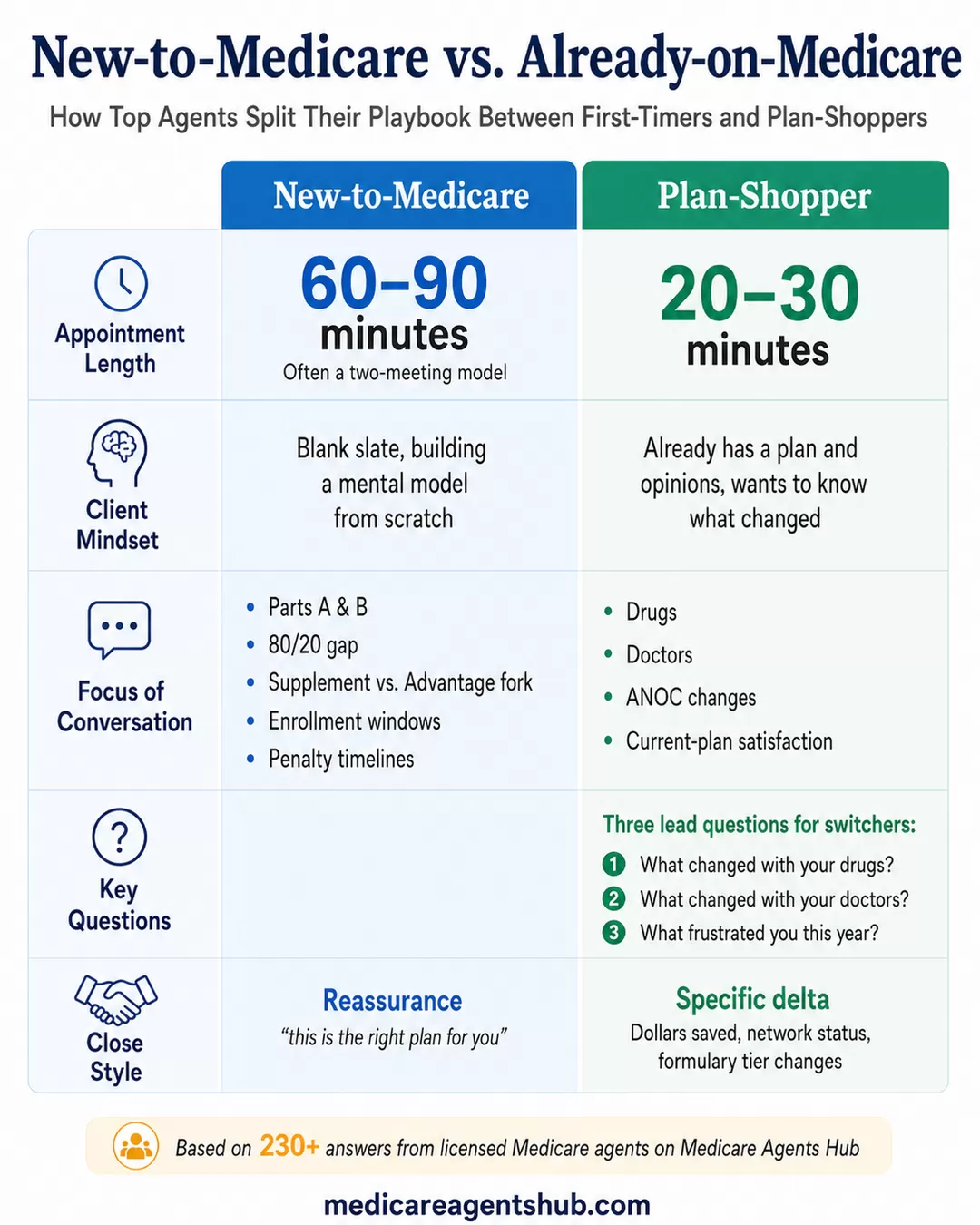
For new-to-Medicare clients:
- Block 60 to 90 minutes. Consider a two-meeting model if your schedule allows it.
- Cover the fundamentals before you quote anything: Parts A and B, the 80/20 gap, the Supplement vs. Advantage fork, enrollment windows, penalty risks.
- Collect doctors, prescriptions, and pharmacy before the second meeting (or the second half of a long first meeting).
- Close with reassurance. They need to hear "this is the right plan for you."
- Expect family involvement, especially adult children. Being listed where families search helps you get in the door early.
For plan-shoppers:
- Block 20 to 30 minutes. Be prepared to extend if you discover knowledge gaps.
- Lead with what changed: drugs, doctors, and satisfaction with the current plan.
- Review their ANOC. Point to specific changes, not general plan features.
- Close with a concrete comparison. Show the dollar amount, the network difference, the formulary change. Make the delta specific.
- Be willing to say "your current plan is still the best fit." Retention builds trust. It also builds referrals.
One thing that doesn't change between the two: the paperwork. Both conversations need a documented Scope of Appointment on file before you sit down to talk about a Medicare Advantage or Part D plan. Switchers are where agents get sloppy, because a renewal review feels like a quick check-in rather than a sales appointment. It's still a sales appointment.
The best agents don't pick one playbook and run it for everyone. They read the client in the first 3 minutes and adjust. The new client who did a month of research online might only need 30 minutes. The "switcher" who picked a random plan at a seminar 4 years ago might need the full T65 conversation. Start with doctors and drugs. Listen first. Then teach what they need to know, and skip what they don't.