How to Retain Medicare Clients After AEP: A Post-Enrollment Follow-Up Strategy

-
February 25, 2026
AEP is over. You survived the 54-day sprint, enrolled new clients, and maybe even picked up a few who switched from another agent. But here's the part most agents overlook: keeping those clients next year.
Client retention doesn't get the same attention as lead generation, but the math is straightforward. Acquiring a new Medicare client costs significantly more in time, ad spend, and effort than keeping an existing one. And every client who leaves is a renewal commission you'll never see again.
At Medicare Agents Hub, we see every day how the strongest Medicare agents separate themselves after enrollment. The agents who keep clients long term don't rely on one big annual review. They build small, consistent touchpoints into the client relationship all year. What follows is the Medicare client retention strategy that the best agents in the business use to protect their book of business.
Key takeaways:
- Call every new client 30 to 60 days after enrollment to reinforce the relationship and catch problems early.
- Track birthdays, Medicare anniversary dates, and plan renewal dates in a CRM so nothing slips.
- Send two or three helpful, non-sales touches per year so you're the agent clients hear from between AEPs.
- Own the ANOC review before someone else does — it's the single biggest retention moment of the year.
Start With a Post-Enrollment Check-In
The single highest-impact retention move is a post-AEP client follow-up call 30 to 60 days after enrollment. Most agents disappear after the sale. The ones who don't stand out immediately.
Your check-in doesn't need to be complicated. Ask three things:
- Have you used your new plan yet?
- Were there any surprises with your coverage or costs?
- Do you have any questions about how your benefits work?
That's it. You're not selling anything. You're reinforcing that you're their person for Medicare questions, and you're catching problems early before they turn into resentment or a switch during the Medicare Advantage Open Enrollment Period (OEP), which runs January 1 through March 31.
If the client enrolled in a plan that's giving them trouble, this is also when you can step in and help them navigate plan failures before the frustration builds.
Track Key Dates for Every Client
Retention runs on timing. Miss a key date and you look inattentive. Hit it and you look indispensable.
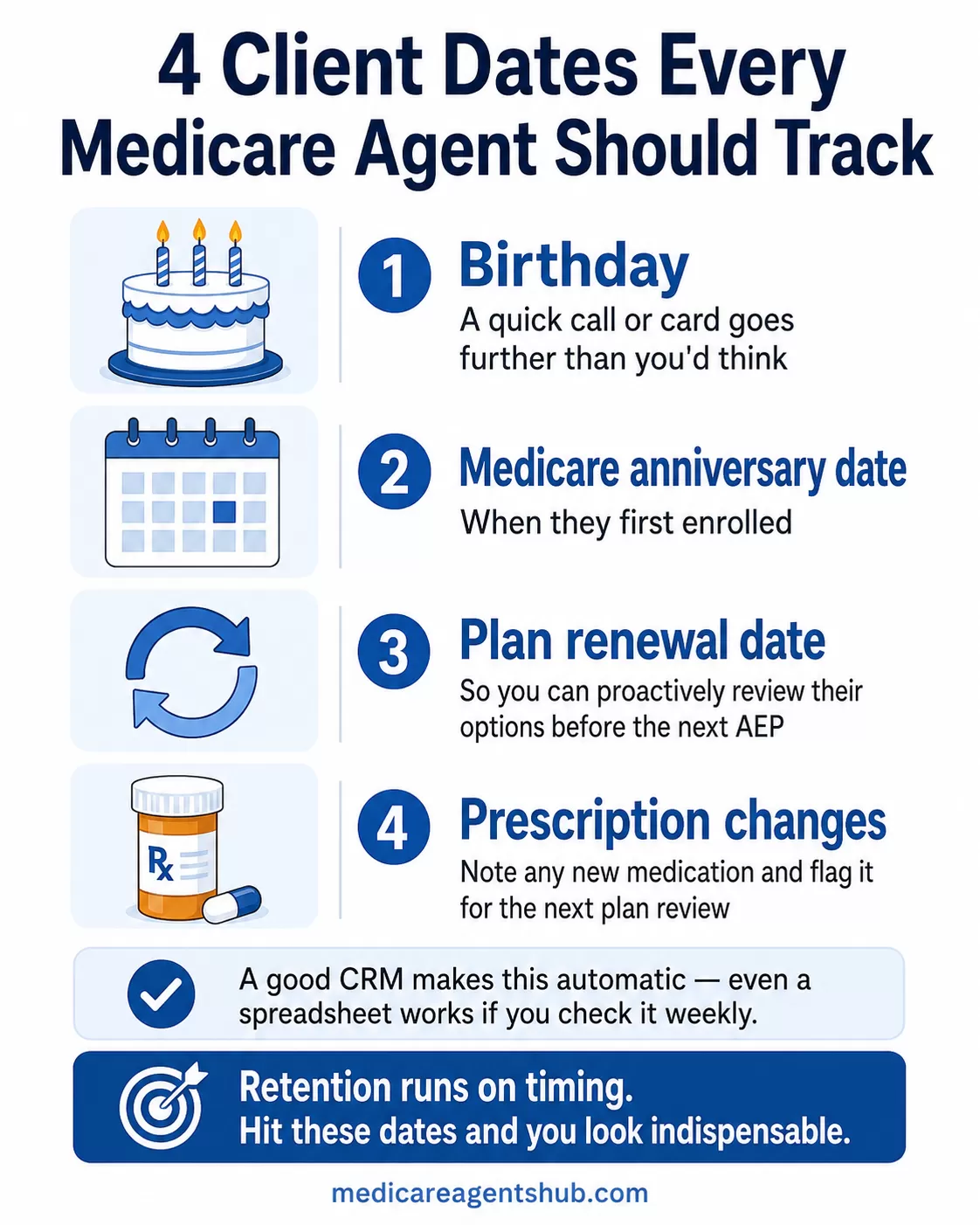
For every client, you should be tracking:
- Birthday - a quick call or card goes further than you'd think
- Medicare anniversary date - when they first enrolled
- Plan renewal date - so you can proactively review their options before the next AEP
- Prescription changes - if they mention a new medication, note it and flag it for their next plan review
A good Medicare agent CRM makes this automatic. Even a spreadsheet works if you're disciplined about checking it weekly. The point is to have a consistent follow-up system, not to rely on memory.
Send Value Between Enrollment Periods
The agents who only call during AEP are the ones who lose clients during AEP. If the only time a client hears from you is when there's something to sell, you're a salesperson. If they hear from you year-round, you're their advisor.
This doesn't mean blasting a monthly newsletter nobody reads. It means targeted, useful touches:
- A heads-up when CMS announces rate changes that might affect their plan
- A reminder about preventive benefits they might not be using (annual wellness visits, screenings, dental if they have MA)
- A quick note when something changes in their state's Medicaid or Medicare landscape
- An update when their Annual Notice of Change arrives (carriers are required to send these by September 30) with a plain-English summary of what changed
Two or three of these touches per year is enough. The bar is low because almost nobody does it. If you're looking for a broader game plan on what to do between enrollment periods, check out our guide on what smart agents do in the off-season.
Make Yourself Easy to Reach
One of the top reasons clients switch agents is that they couldn't get a hold of the last one. A client with a billing question in March who can't reach their agent will find a new agent by October.
This doesn't mean being available 24/7. It means:
- Returning calls within one business day
- Having a voicemail that sounds professional and current (not "I'm busy with AEP" in February)
- Offering at least two ways to reach you (phone plus email or text)
- Setting up an auto-reply during vacations that gives clients an alternate contact
If you're building a team, make sure your junior agents are trained on response time expectations. How you train your team directly affects whether clients feel taken care of.
Ask for Referrals at the Right Moment
The best time to ask for a referral isn't at enrollment. It's 60 to 90 days after, when the client has had a positive experience with their plan and remembers that you're the reason they found it.
Frame it simply: "Do you know anyone turning 65 soon, or anyone unhappy with their current Medicare coverage? I'd be happy to help them the same way I helped you."
Clients who refer others are also more likely to stay. The act of recommending you reinforces their own decision to work with you. It's a retention strategy disguised as a growth strategy.
Watch for Warning Signs
Not every client will tell you they're thinking about switching. But there are signals:
- They stop returning your calls. Follow up, but don't be aggressive. A simple "Just checking in, hope everything's going well with your plan" is enough.
- They mention talking to another agent. Don't panic. Ask what prompted the conversation. Sometimes they just got a cold call. Sometimes there's a real issue you can fix.
- They had a bad claims experience. This is the most common trigger. If a claim gets denied or a provider isn't in-network, the client blames the plan and, by extension, you. Get ahead of it by helping them resolve the issue.
- They had a life change. Retirement, a move, a new diagnosis. These all trigger plan reevaluation. If you're not helping them through life changes proactively, someone else will.
Use Your ANOC Review as a Retention Tool
Every September, when ANOCs go out, most agents treat plan review as a sales activity. Flip the frame: it's a retention activity.
Call your existing clients before they call you. Walk them through what's changing. If their current plan is still the best fit, tell them so. Nothing builds trust faster than an agent who says "your plan is still great, no changes needed" when they could have pushed a switch for a new commission.
If changes are needed, you're already in the conversation. You're not competing with whoever else might reach that client first. The agents who use ANOC reviews strategically hold onto the vast majority of their book year over year.
Keep Follow-Up Helpful and Compliant
Client retention does not mean pressuring clients to switch plans or turning every touchpoint into a sales conversation. The best follow-up is service-oriented: helping clients understand their benefits, reminding them about important plan documents, answering questions, and reviewing changes when appropriate.
Agents should also make sure their outreach practices follow current CMS marketing guidelines, carrier-specific rules, and any state-level regulations that apply. The line between a helpful check-in and a compliance issue can be thin, especially around enrollment periods. When in doubt, keep the conversation focused on service, not sales.
Retaining Medicare Advantage clients, Medigap policyholders, and Part D enrollees all require slightly different approaches, but the principle is the same: if the client feels served, not sold, they stay.
Build a Referral-Worthy Reputation Online
Clients Google their agent. If your online presence is thin or outdated, it doesn't inspire confidence, even in people who already work with you.
Keep your profiles current. Respond to reviews (especially negative ones). Make sure your Google Business Profile is optimized and reflects where you actually serve clients. When a client refers someone to you, the first thing that person does is look you up. What they find either confirms the referral or kills it. Your personal brand is a retention tool whether you realize it or not.
Medicare Client Retention Checklist After AEP
If you want a quick-reference framework for your post-enrollment follow-up system, here it is:
- Call new clients 30 to 60 days after enrollment
- Confirm they understand their benefits, costs, providers, and prescriptions
- Record key dates (birthday, anniversary, renewal) in a CRM or spreadsheet
- Schedule at least two useful, non-sales touches during the year
- Review ANOC changes before the client asks
- Ask for referrals after a positive client experience
- Keep online profiles current so referrals can verify you quickly
- Make sure all outreach stays compliant with CMS and carrier guidelines
The Retention Mindset
Most agents think about their business in terms of how many new clients they can bring in. The best agents think about how many clients they can keep. A 95% retention rate versus an 85% retention rate doesn't sound dramatic, but over five years the compounding difference in your book size is massive.
Every client you retain is a client you don't have to replace. Every Medicare renewal commission is revenue you earned once and collect repeatedly. And every satisfied long-term client is a walking referral source who does your marketing for free.
AEP gets the glory. Retention builds the business.
FAQs About Retaining Medicare Clients After AEP
How soon should Medicare agents follow up after AEP?
A good rule of thumb is 30 to 60 days after enrollment, once the client has had time to receive plan materials and possibly use their benefits. This gives you something real to discuss rather than just checking a box.
Can a Medicare agent contact past clients during OEP?
Yes, but with limits. CMS marketing rules prohibit agents from proactively marketing Medicare Advantage plan changes to enrollees during the Open Enrollment Period (January 1 through March 31). You can still contact your existing clients for service reasons — answering questions, resolving claims issues, helping with benefit questions, or responding to a client who reaches out first. What you cannot do is initiate outreach whose purpose is to encourage a plan switch during OEP. When in doubt, review the current CMS marketing guidelines and your carrier's specific rules before making the call.
What causes Medicare clients to switch agents?
Common reasons include poor communication, unresolved plan issues, bad claims experiences, life changes like a move or new diagnosis, or simply feeling forgotten after enrollment. Most of these are preventable with a basic follow-up system.
How often should Medicare agents contact existing clients?
Most clients don't need constant contact, but two or three helpful touches per year plus an ANOC review can keep the relationship active. The key is that every contact should provide value, not just be a reason to call.
Is an ANOC review a sales call?
It should be framed as a service call first. If the client's plan is still a good fit, saying so builds more trust than pushing a switch ever could. If changes are needed, the client will appreciate that you brought it to their attention proactively.
Ready to Build a Stronger Book of Business?
Want more Medicare clients to find and trust you before AEP? Claim or upgrade your Medicare Agents Hub profile so local seniors can verify your experience, read about your background, and contact you when they need help. The agents who invest in their visibility year-round are the same ones who retain clients year after year.