SSA-44 IRMAA Requests: A Medicare Agent Playbook

-
July 13, 2026
Most Medicare clients hear about IRMAA for the first time when a letter from Social Security shows up in the mailbox six months after they enrolled. By then the surcharge is already coming out of their check, and they're on the phone asking how the agent who sold them a Part D plan didn't warn them. The Income-Related Monthly Adjustment Amount is one of the highest-leverage conversations you can own with higher-earning clients, and knowing how to walk someone through an SSA-44 request turns a painful surprise into a client-for-life moment.
What IRMAA Actually Is (in Agent Terms)
IRMAA is an income-based surcharge that stacks on top of the standard Part B and Part D premiums. Social Security bases the calculation on the client's Modified Adjusted Gross Income from two tax years back. In 2026 that means Social Security is looking at 2024 returns. A client who sold a business, cashed out stock, converted a Traditional IRA to a Roth, or collected a one-time payout in 2024 can get hit with an IRMAA bill that looks nothing like their current retirement income.
The surcharge is real money. At the top 2026 bracket, IRMAA adds $487 per person per month on top of Part B alone, plus a separate Part D adjustment of $91. For a married couple both on Medicare with Part B and Part D, that's $13,872 annually in IRMAA alone, before standard premiums.
The 2-Year Lookback Is the Whole Problem
Every IRMAA conversation starts with the same math. If your client retires in 2025 and their income drops from $300,000 to $80,000, that lower income won't automatically show up in their premiums for a year or more. The 2025 tax returns won't be filed until 2026, and IRMAA works on the prior-prior-year MAGI. Without a qualifying SSA-44 request, a retiree may pay IRMAA for one or more premium years based on income that no longer resembles their current retirement income.
The Eight Qualifying Life-Changing Events
Form SSA-44 is used to request a new IRMAA determination after a qualifying life-changing event. Social Security recognizes eight events that let a client ask for IRMAA to be recalculated based on current or projected income instead of the two-year-old return:
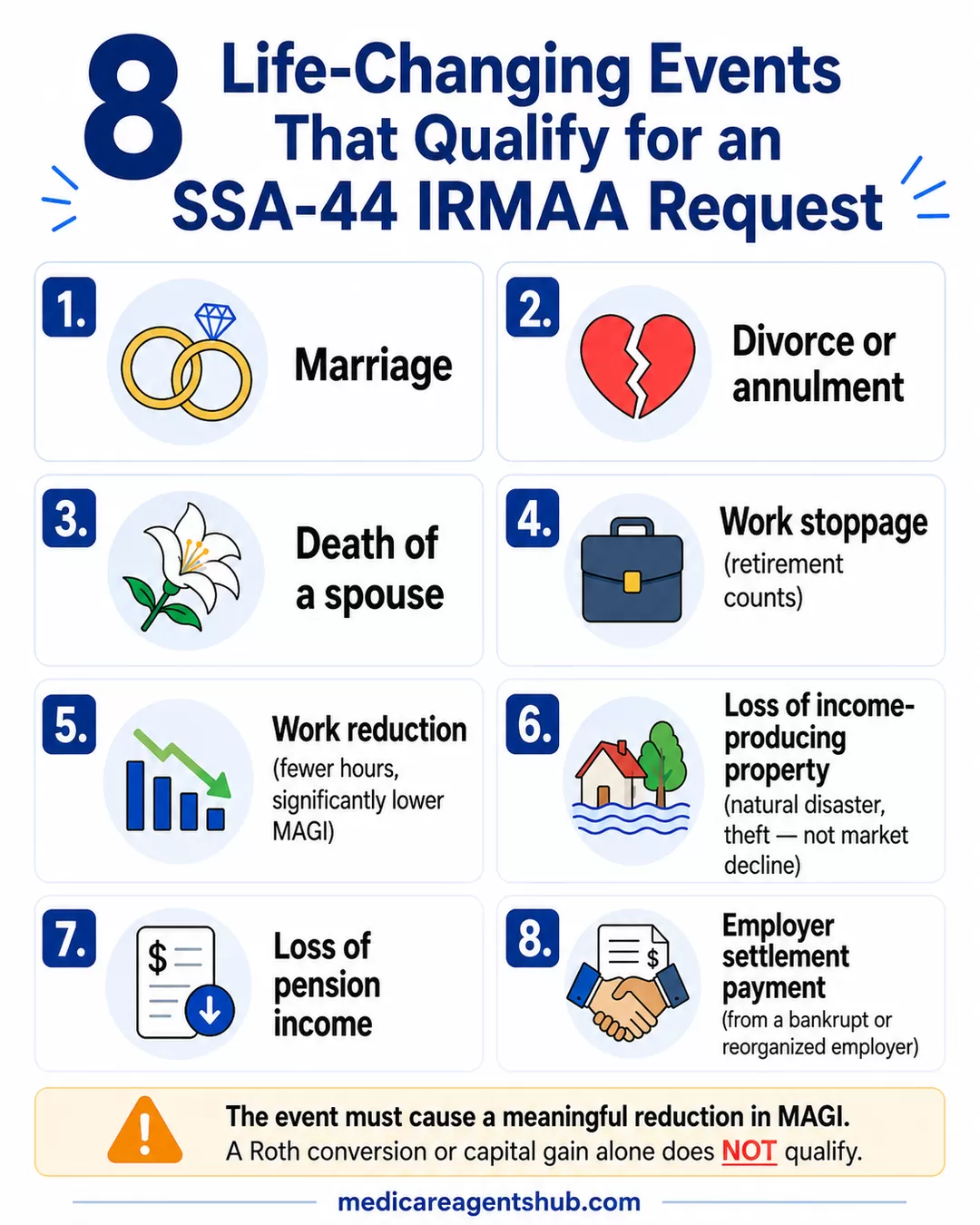
- Marriage
- Divorce or annulment
- Death of a spouse
- Work stoppage (retirement counts)
- Work reduction (the beneficiary or spouse reduced their working hours, resulting in significantly lower MAGI)
- Loss of income-producing property (natural disaster, theft, and similar events, not a market decline)
- Loss of pension income
- Employer settlement payment from a bankrupt or reorganized employer
The life-changing event must cause a meaningful reduction in MAGI; experiencing one of the listed events does not automatically reduce IRMAA.
Anything outside this list is not a valid SSA-44 event. A one-time Roth conversion by itself doesn't qualify. A capital gain from selling stock doesn't qualify. Retirement combined with the loss of that income stream does. This is the single most common place agents get confused, and it's where the request fails if the paperwork doesn't accurately reflect what occurred.

How can I lower my Medicare Part B premium if my income drops after retirement?
Income-Related Monthly Adjustment Amount: Life-Changing Event (Form SSA-44) can be used to reduce or eliminate the additional premium adjustments charged to those with higher income. There are 8 Life-Changing Events: Marriage, Divorce/Annulment, Death of Your Spouse, Work Stoppage, Work Reduction, Loss of Income-Producing Property, Loss of Pension Income, and Employer Settlement Payment. If you have one of these events that results in a reduction of income, this form will reduce or eliminate the IRMAA immediately rather than waiting for it to happen automatically 2 years later.Is Form SSA-44 an Appeal?
Agents and clients commonly call this process an "IRMAA appeal," and you'll see that language across the industry. Technically, SSA treats a qualifying SSA-44 submission as a request for a new initial determination, not a formal reconsideration or appeal. When someone qualifies, the new determination replaces the previous one without requiring a separate appeals process.
The distinction matters mostly when you're explaining the process to financially sophisticated clients or working alongside attorneys and CPAs. Use whichever term your client understands, but know that the SSA-44 is its own track, separate from the formal Medicare appeals process.
Where the SSA-44 Actually Fits Into Your Workflow
Most agents treat IRMAA as a tax problem and refer it out. That leaves value on the table. Agents can educate clients about the SSA-44 process, help them identify the appropriate official resources, and organize the enrollment timeline. Clients should calculate or confirm MAGI with their CPA, enrolled agent, attorney, or other qualified tax professional, particularly when business sales, investments, Roth conversions, or complex filing situations are involved. This is exactly the kind of coordination that separates a transactional agent from a trusted advisor during major life changes like retirement, relocation, and diagnosis.
Timing: Identify IRMAA Exposure Early
Identify possible IRMAA exposure during enrollment and prepare the supporting information early. When SSA issues a predetermination or IRMAA notice, help the client respond promptly. A timely favorable determination may prevent withholding from beginning or result in a retroactive refund of excess IRMAA already paid.
Building this into your enrollment workflow for higher-income clients means the surcharge gets addressed as quickly as the process allows, rather than months after the client starts paying it.

Does IRMAA go away automatically if my income drops, or do I need to report it to Social Security?
IRMAA (Income Related Monthly Adjustment Amount) is based on income from the previous 2 years and it's determined by SSA from IRS data. So if your income decreases, IRMAA will automatically adjust with your updated tax information from the IRS, but it could take that 2 year window to show up. If you've had a significant decrease in income due to a life event, you should file an SSA -44 with Social Security to reduce it sooner.The Documents Clients Should Prepare
- Current Form SSA-44, completed and signed
- Evidence of the qualifying life-changing event (retirement letter, death certificate, divorce decree, employer separation notice, or other documentation SSA accepts)
- A signed federal tax return for the more recent year, if available, or a good-faith MAGI estimate
- Any additional documentation SSA requests
For in-person appointments, clients should also bring a photo ID. SSA now allows the SSA-44 request to be completed or uploaded online, as well as submitted by mail, fax, or in person at a field office.
The Client Conversation Script
You do not need to give tax advice to have this conversation. What you need is a five-minute intake that flags at-risk clients before enrollment closes. Something like:
"Before we finalize your Part B and Part D enrollment, I want to ask about your 2024 income. For 2026 Medicare premiums, Social Security generally looks at 2024 tax information. If your 2024 MAGI was more than $109,000 as an individual filer or more than $218,000 if married filing jointly, you may owe an additional amount for Part B and Part D. Is there any chance your 2024 income was in that range, and does it look different from what you'll actually earn this year?"
"If yes, and there was a life event like retiring, losing a spouse, or getting divorced, there's a form we can file that tells Social Security to use your current income instead. It's called the SSA-44, and I can walk you through the process."
This is a one-question qualifier that most agents skip. The clients who qualify are also the ones who refer their friends, because nothing generates goodwill like saving somebody thousands of dollars a year they didn't know they were about to lose.
The Referral Angle You're Sitting On
IRMAA conversations are the natural bridge to structured referral relationships with CPAs, financial advisors, and elder law attorneys. A CPA who watches a client get hit with an unexpected IRMAA surcharge remembers exactly which Medicare agent didn't warn them, and which one did. Bring an IRMAA one-pager to your next CPA meeting. Offer to co-review high-income clients approaching 65 or retiring. That's a referral pipeline built on real value, not a business card exchange.
Financial Planners Care About This More Than You Think
Roth conversion strategies, retirement date planning, and asset location decisions all interact with IRMAA. A planner who wants to convert a client's IRA in a specific year cares deeply about staying under the next bracket. If you can speak fluently about the thresholds and the 2-year lookback, you become useful to that planner's practice. For context on what your clients are hearing on the consumer side, this breakdown of IRMAA strategies for retirees covers the same territory from the client's perspective.

My income fluctuates significantly year to year from investment distributions. How can I avoid IRMAA surcharges when I have an unusually high-income year?
If your income fluctuates year to year due to investment distributions, and you have a spike that causes IRMAA (Income-Related Monthly Adjustment Amount) surcharges on your Medicare Part B and Part D premiums, there is a way to potentially reduce or eliminate those extra charges. Medicare bases IRMAA on your Modified Adjusted Gross Income (MAGI) from two years prior, but if your current income is significantly lower due to a qualifying life event, you can file a “Request for Reconsideration” using Form SSA-44.While investment income itself isn’t a qualifying event, you can strategically plan around it. One approach is income smoothing, where you work with a financial advisor or tax planner to spread out large distributions over multiple years, use Roth conversions carefully, or consider Qualified Charitable Distributions (QCDs) if you're over 70½ to reduce taxable income. Another tactic is to plan large capital gains or trust payouts in years when you don’t need to renew IRMAA calculations—like after age 63 if you're claiming Medicare at 65.
IRMAA planning takes some foresight, but with proper tax and financial coordination, it is possible to minimize or avoid surcharges even with variable income. Working with a tax professional and a Medicare expert together can help you build a strategy that protects your benefits and your budget.
Common Agent Mistakes That Cost Clients Money
1. Waiting for Social Security to Send the Letter
By the time the IRMAA determination arrives, the client may have already paid surcharges for months. Identifying exposure early and preparing documentation means the request can go in as soon as the event is documented.
2. Treating a Roth Conversion Like a Life-Changing Event
It isn't. A tax strategy that creates high MAGI in a given year has no SSA-44 remedy. The client should either spread conversions across years or plan for the temporary IRMAA hit.

I start Medicare in 2026 and a one-time 401(k) withdrawal in 2024 placed me in the second IRMAA tier for part of that year. When should I file Form SSA-44 so my 2027 premium returns to the lowest tier?
You don't need to file Form SSA-44 because an event like a 401(k) withdrawal or a home sale do not qualify you for a premium reduction. The premium will automatically drop down in 2027 because it's based on the income shown on your 2025 tax return, as long as it's below the IRMAA thresholds.The bottom line is that you don't have to do anything for the 2027 premium reduction.
3. Failing to Update an Earlier MAGI Estimate
SSA may initially rely on the client's estimated MAGI when processing an SSA-44 request. If that estimate changes materially, the beneficiary can update it. After the tax return is filed, SSA may also request or verify the final tax information. Agents should remind clients to keep SSA informed rather than treating the original estimate as final. If your clients are asking whether IRMAA surcharges are permanent, that's a sign the annual recalculation hasn't been explained clearly enough.
4. Not Coordinating With the Spouse's Filing
Both spouses have to contact SSA or submit their own SSA-44 if both are on Medicare. One spouse's request does not automatically apply to the other.
The IRMAA Brackets Refresh Every Year
Thresholds are indexed to inflation, so the numbers shift annually. Rather than memorizing brackets, agents should keep a bookmarked link to the current CMS IRMAA table and check it before every client conversation. Pushing outdated brackets in a client meeting undermines your credibility with a financially sophisticated household.
Building IRMAA Into Your Pre-Enrollment Checklist
The agents winning the high-income Medicare market treat IRMAA as a standard enrollment step, not an edge case. Add a single line to your intake: "2024 MAGI: under/over threshold, SSA-44 candidate Y/N." That question, asked at enrollment, is what separates the agents who keep a book of business that compounds year over year from those who chase new leads forever.
Higher-earning clients don't want a discount hunter. They want somebody who understands the tax and Medicare interaction well enough to protect them from surprises. The SSA-44 conversation is one of the cleanest ways to prove you are that agent, and it costs you nothing but ten minutes of preparation before the client ever walks in the door.
Frequently Asked Questions
Can SSA-44 be filed before an IRMAA bill arrives?
Yes. The form can be submitted as soon as the qualifying life-changing event has occurred. However, SSA may issue a predetermination notice first, and the timeline depends on when SSA processes the request.
Does retirement automatically qualify?
Retirement qualifies as a work stoppage, but the key is that MAGI must actually decrease as a result. Retiring while maintaining the same income level from other sources may not produce a favorable determination.
Can a Roth conversion be appealed?
No. A Roth conversion is a voluntary tax strategy, not a life-changing event. There is no SSA-44 remedy for IRMAA caused by a Roth conversion, even if it was a one-time event.
Does each spouse need a separate SSA-44?
Yes. Each affected spouse must contact SSA or submit their own request. One spouse's favorable determination does not automatically apply to the other.
What documents should accompany SSA-44?
Evidence of the qualifying life-changing event, plus either the most recent tax return reflecting the income change or a good-faith MAGI estimate. SSA may request additional documentation during processing.
Can the form be submitted online?
Yes. SSA now allows the SSA-44 request to be submitted online, as well as by mail, fax, or in person at a local Social Security office.