Referral Partnerships for Medicare Agents - Working With CPAs, Financial Advisors, and Elder Law Attorneys

-
May 13, 2026
The agents with the steadiest year-round pipeline almost never get there with paid leads alone. They get there by becoming the Medicare person that a handful of trusted local professionals call without thinking. A CPA finishing a retiree's tax return. A financial advisor mapping out a 65-year-old's drawdown plan. An elder law attorney closing on a Medicaid spend-down. Each of those moments produces a Medicare question, and the agent on the other end of that phone call wins business that never had to be paid for.
This is a slower channel than buying clicks, but it compounds. One solid CPA relationship can quietly produce a steady stream of referrals year after year. Below is the playbook for building it.
Why Professional Referrals Are Worth the Work
Paid leads have a ceiling. You spend more, you get more, you stop spending, the pipeline stops. Referrals from CPAs, advisors, and attorneys behave differently. The cost is your time, the trust is borrowed from someone the prospect already pays for advice, and the close rate is dramatically higher than any cold internet lead.
A few things make this channel uniquely strong for Medicare:
- Timing. CPAs and financial planners see clients around the exact life events that drive Medicare decisions: turning 65, retirement, IRMAA surprises, a spouse's death, a major asset sale.
- Pre-qualified intent. If a CPA tells a client "call my Medicare person," the call you get is a warm one. There is no skepticism to overcome.
- Compliance fit. Referrals from licensed professionals can be cleaner when the beneficiary initiates contact through their own advisor, but agents still need to follow CMS, carrier, and permission-to-contact rules.
If you want a fuller picture of how this fits into a sustainable pipeline, our piece on building a year-round Medicare lead engine walks through stacking referral, organic, and paid channels together.
Who You Actually Want as a Partner
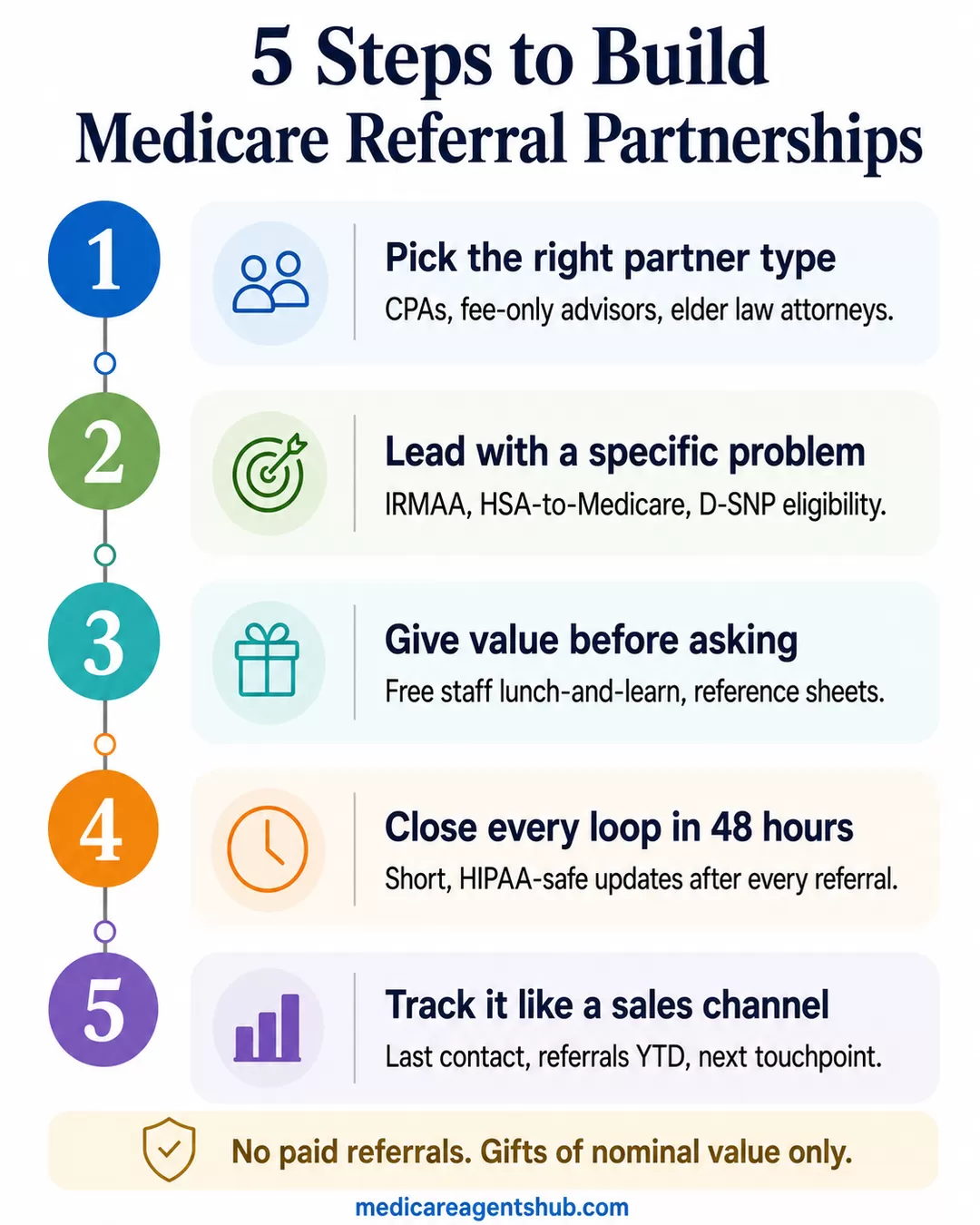
Not every professional is worth your time. The good partners share three traits: they serve clients in or approaching the Medicare age range, they're already used to giving referrals, and they don't sell Medicare themselves. Here is the short list, ranked by what tends to produce volume.
1. Certified Public Accountants (CPAs) and Enrolled Agents
CPAs are the highest-value partner most agents underuse. They see retirement income changes before anyone, they get the IRMAA letter questions every spring, and clients trust them on financial moves the way they trust their doctor on health moves. A typical small-firm CPA serves 200 to 600 individual clients. Even a tiny fraction of those crossing into Medicare each year is real volume.
2. Independent Financial Advisors and RIAs
Fee-only and fiduciary advisors are usually the best fit. They cannot sell Medicare products themselves (and many of them genuinely don't want to learn the space), so they need someone to hand the question off to. Wirehouse and bank-branch advisors are harder to crack because of compliance layers, but the independent RIA next door is often a one-meeting yes.
3. Elder Law and Estate Planning Attorneys
Elder law is a specialized partner with lower volume but higher complexity per case. The clients you'll see from this channel often involve long-term care planning, Medicaid eligibility, and dual-eligible situations. If you're comfortable with D-SNPs and serving clients with chronic conditions, this is worth pursuing. Our guide on ethical marketing to seniors with chronic conditions covers the tone these conversations require.
4. Senior-Focused Service Providers
Senior move managers, geriatric care managers, in-home care agencies, hearing aid clinics, and even local optometrists who see a lot of Medicare patients all sit on top of a referral stream. These won't deliver the same per-contact value as a CPA, but they're easier doors to open and they round out a local network.
5. State Health Insurance Assistance Programs (SHIPs)
SHIP counselors are unpaid volunteers who can't sell. They generally cannot endorse a specific agent, but being known as a helpful local resource can still build community credibility. Show up, do education, be useful. Over time you become a known quantity in that community.
The Outreach: How to Actually Get the First Meeting
Cold-emailing 200 CPAs in March is a terrible idea. They're underwater. The mechanics that work are smaller, more personal, and seasonal.
Timing matters. Reach out to CPAs in May through August, after tax season but before extension crunch in early October. Reach financial advisors any time except the last two weeks of December and the first two of January. Attorneys are mostly time-agnostic.
Lead with a specific reason. "I'd love to grab coffee and learn about your practice" is a no. "I had three of your tax clients call me about IRMAA appeals this spring and I wanted to introduce myself so we can coordinate" is a yes. Make the first contact about a real problem they already know they have.
Common openers that get responses:
- For CPAs: IRMAA appeals, the Form SSA-44 process, and how Roth conversions interact with Medicare premiums two years later.
- For financial advisors: HSA-to-Medicare transition rules at 65, employer coverage coordination, COBRA-versus-Medicare timing, the 8-month Part B special enrollment window after employer coverage ends.
- For elder law attorneys: D-SNP eligibility, Medicare Savings Programs, the interaction between Medicaid and Medicare Advantage, and ANOC season triggering plan reviews for clients with shifting income.
Showing up to that first meeting with one printed handout (clear, branded, useful, not a sales sheet) does more than a polished slide deck ever will.
The First Meeting: Be the Resource, Not the Pitch
The single biggest mistake agents make in these meetings is talking too much about themselves.
The professional across the table doesn't care about your years in the business or your carrier appointments. They want to know two things: can I trust you not to embarrass me, and will you make my job easier or harder.
Spend the first ten minutes asking about their practice. What does the typical client look like? When in their workflow does a Medicare question come up? Who do they currently refer to, if anyone? Why hasn't that worked perfectly?
Then offer something useful before you ever ask for anything. Real examples:
- A one-page IRMAA appeals reference they can put in their tax-prep packet.
- An offer to do a free 30-minute lunch-and-learn for their staff on Medicare basics so the front desk stops giving wrong answers.
- A standing offer to take any of their clients' Medicare questions, even ones that won't lead to enrollment, with no expectation of a referral.
That last one is the killer move. Most agents won't do it because it feels like giving away free work. The agents who do it become the only person that CPA ever calls.
Compliance Without Killing the Relationship
CMS rules on third-party marketing organizations and referral arrangements are strict, and they got stricter in the 2024 and 2025 cycles. Two things you need to be clear-eyed about:
You cannot pay for referrals. Not directly, not indirectly, not in gift cards, not in steakhouse dinners tied to volume. The federal anti-kickback statute and CMS marketing rules both prohibit this for Medicare Advantage and Part D referrals. Professional partnerships have to be built on value and trust, not compensation.
Be careful with gifts and gestures. Small, occasional, non-cash gestures may be acceptable when they are not tied to referrals, enrollments, or production, but agents should tread carefully here. Do not offer anything of value in exchange for Medicare referrals. Check your carrier, FMO, CMS marketing rules, state DOI, and legal/compliance guidance before creating any formal referral arrangement. A working lunch during a CE session is a different conversation than a gift after a closed enrollment.
Documentation matters. If a partnership ever gets formal (say, a CPA wants to include a one-pager from you in client tax packets), keep written records of what was exchanged and when. Most agents won't need this, but if you ever face a CMS or state DOI inquiry, paper protects you. Compliance-curious agents will find our broader piece on collecting all necessary client details useful as a parallel discipline.
How to Make the Partnership Sticky
Getting the first referral is hard. Getting the tenth is what separates a real partnership from a one-off favor. The agents who build durable referral books all do some version of the same things.
Close the Loop, Every Time
When a CPA refers a client, send the CPA a short note within 48 hours: "Thanks for sending Mrs. Henderson my way, we're scheduled for next Tuesday." After the appointment, another note: "Got her enrolled in a plan that keeps her cardiologist. She was relieved." No HIPAA-protected detail. Just enough that the CPA knows the referral landed somewhere real.
Most agents never do this. The ones who do it become unreplaceable.
Make Them Look Good
Send the partner anything you find that helps their practice: a new IRS ruling on HSA contributions in the year of Medicare enrollment, a state legislative update on long-term care insurance, a clean explainer on the Inflation Reduction Act's Part D changes. You're playing a long game where your partner sees you as a source of useful information, not just a destination for handoffs.
Show Up in the Off-Season
Most agents disappear from January through September. The ones building a referral book are visiting partners in May, doing lunch-and-learns in July, sending August check-ins about ANOC season. Our breakdown of what smart Medicare agents do in the off-season covers this rhythm in more detail.
Be Findable
When a CPA decides to recommend you to a client, they often check your online presence first. A claimed listing on a major directory, a clean Google Business Profile, and a real website all matter at that moment. Agents who already understand Google Business Profile strategy have the easier sell.
What to Track
Most agents who try this fail because they treat it as networking instead of a sales channel. Track it like one. At minimum, keep a simple sheet with:
| Column | Why it matters |
|---|---|
| Partner name & firm | Anchors the relationship. |
| Last meaningful contact | Anyone past 90 days is going cold. |
| Referrals YTD | Reveals who is producing and who is polite. |
| Enrollments closed | The honest measure. |
| Next planned touchpoint | Forces a forward action. |
Review this quarterly. A partner who's gone 12 months without producing despite repeated value isn't a partner. Drop them and reinvest the time. A partner producing three or more closed cases a year deserves your best work and your fastest response time, always.
A Realistic Timeline
A partnership rarely produces referrals in month one. A reasonable expectation:
- Months 1 to 3: Initial meeting, deliver something useful, no referrals yet.
- Months 4 to 9: First one or two referrals as test cases. Your job is to handle them flawlessly.
- Months 10 to 18: The relationship deepens or dies based on how you handled the test cases. Strong partners start sending three to ten referrals per year.
- Year 2 and beyond: A handful of strong partnerships become a real chunk of your annual production.
This isn't a fast channel. But two or three good CPA partnerships can quietly carry an agent through OEP and into a profitable off-season every year. That's the prize.
Where to Start This Week
If you've never built a referral partnership before, don't try to launch ten at once. Pick one CPA, one independent financial advisor, and one elder law attorney within driving distance of your office. Send each a short, specific outreach email this week. Offer a 20-minute coffee and one real piece of value. See who responds.
The agents reading this article in two years and saying "that's where my best clients come from" are the ones who send those three emails today.