From Cold to Closed: The Medicare Agent's Complete Guide to Better Conversions

-
Last Updated October 6, 2026
You can have the best lead sources in the industry and still struggle to grow your book if you can't convert. The agents who consistently close are working their leads better. They have a system, they follow it, and they refine it over time.
This guide breaks down a complete conversion framework: from the moment a cold lead hits your pipeline to the moment they sign. Whether you're generating leads through directories, referrals, or digital marketing, what happens after you get the lead is what separates agents who survive from agents who thrive.
In This Guide, You'll Learn
- Why a 25% close rate on 60 leads beats a 10% rate on 100
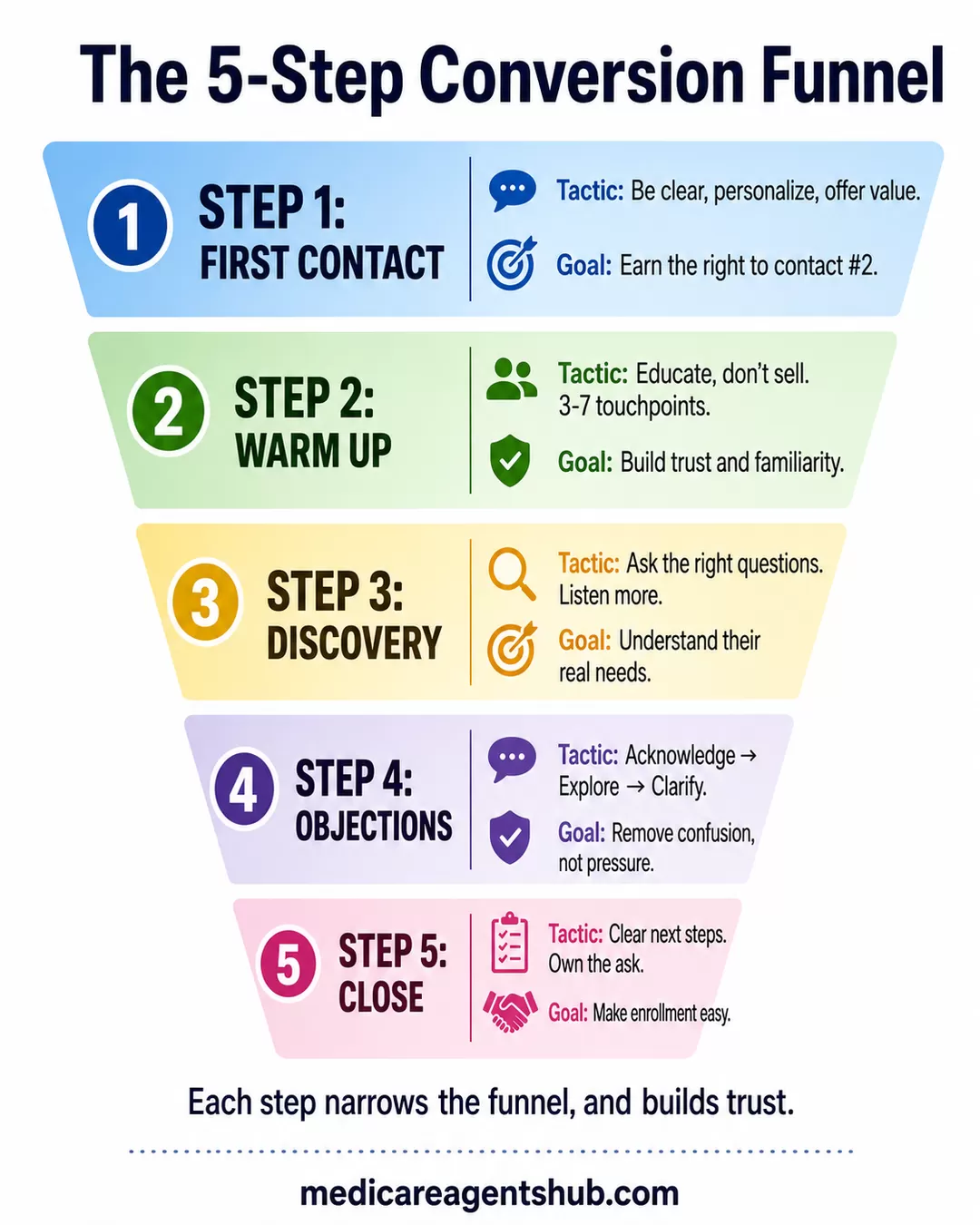
- The 5-step framework: first contact, warm-up, discovery, objections, close
- A 5-touch follow-up cadence, and why the enrollments usually land in the later touches
- The 6 conversion killers that quietly wreck an agent's numbers
- The metrics to track monthly so you can improve what's actually broken
Why Your Conversion Rate Matters More Than Your Lead Count
Most agents obsess over lead volume. More leads, more chances, more closings. That's the thinking. But the math tells a different story.
Consider two agents:
Agent B is working far fewer leads and closing more. They're spending less time chasing, less money on lead sources, and delivering a better experience to every prospect they touch. That's the power of focusing on conversion over volume.
When you improve your conversion rate, everything compounds. Your cost per acquisition drops. Your time per client decreases. Your confidence on calls goes up because you're not desperately trying to make each one count. You know your process works. Agents who prioritize lead quality over raw quantity consistently outperform those throwing money at volume.
The 5-Step Conversion Framework
Every successful conversion follows a pattern. The specifics vary (phone, in-person, email), but the underlying framework stays the same. Here's the process the best agents use, broken down step by step.
Step 1: Make First Contact Count
The first time someone hears from you sets the tone for the entire relationship. Cold leads don't respond well to pressure or a hard pitch right out of the gate. Your only job on first contact is to open the door, not push through it.
- Be clear and concise. Let them know who you are, how you can help, and why you're reaching out. No rambling intros or corporate-sounding scripts.
- Personalize the message. Reference where you got their info, their location, or the specific problem you solve. Generic outreach gets ignored.
- Offer value immediately. A quick Medicare tip, a deadline reminder, or a short guide gives them a reason to keep listening. Lead magnets work especially well here. They position you as helpful before you've asked for anything.
- Keep it short. Whether it's a voicemail, email, or text, respect their time. You're introducing yourself, not delivering a presentation.
The mindset shift: contact one earns you the right to contact two.
Step 2: Warm Them Up With Value
Cold leads need trust before they'll talk about coverage. That trust doesn't come from one great pitch. It comes from consistent, low-pressure value over multiple touchpoints.
Warming strategies that work:
- A short email series that educates on a specific Medicare topic (enrollment deadlines, plan types, common mistakes)
- A mailed info sheet or postcard with your name, face, and a helpful tip
- Helpful posts in a Facebook group or local community page they follow
- A brief follow-up call or text checking in, not pitching
The goal is to show you're a reliable, knowledgeable resource, not just another salesperson. Agents who invest in educational content find that prospects come to them when they're ready, rather than needing to be chased.

I’ve talked to a few Medicare agents near me already, and everyone seems to push something different. How do I know you’re genuinely looking out for me and not just trying to make a sale?
If an agent is pushing something it is likely all they have to offer. Everyone will have thier own opinions, but you are looking for someone who can actually educate you without pressure so you can decide for yourself what is the right fit for YOU. Try to find a broker in your area who has several companies they contract with and ask them if they sell both Medigap & Advantage plans. Medicare is very individualizd, what is right for one person might not be right for another.A good benchmark: most cold leads need 3-7 touchpoints before they're ready to have a real conversation. Don't give up after one or two attempts.
Step 3: Ask the Right Discovery Questions
Once a lead engages, your job shifts from warming to guiding. And the best way to guide someone is by asking better questions, not delivering a monologue about plan features.
Strong discovery questions sound like:
- "What are you currently using for coverage, and how's it working for you?"
- "What's been the most confusing part of Medicare so far?"
- "What would your ideal plan look like, what matters most to you?"
- "Are there specific doctors or prescriptions we need to make sure are covered?"
- "Has anything changed in your health or living situation recently?"
Every one of these is a trust-builder. Each question tells the prospect that you care about their situation, not just closing a deal. The more you understand about their actual needs, the better your recommendation will be, and the more confident they'll feel following it.
The agents who are best at this treat discovery like detective work. They're uncovering hidden needs the prospect might not even realize they have, things like upcoming surgeries, specialist relationships, or prescription changes that could affect plan fit.
Step 4: Handle Objections Before They Become Roadblocks
Most objections come from confusion or fear, not actual disagreement. When you hear pushback like "I need to think about it" or "I'm not sure this is right for me," the worst thing you can do is argue or pressure.
Instead, use this framework:
- Acknowledge. "That's completely understandable."
- Explore. "What's the part you're still unsure about?"
- Clarify. Address their specific concern with facts, not pressure.
- Confirm. "Does that help clear things up, or is there something else on your mind?"
The most common objections you'll face, and what they usually really mean:

Why do so many seniors wait until the last minute to enroll in Medicare, and how can agents help prevent bad decisions?
Why do so many seniors wait until the last minute to enroll in Medicare — and how can agents help? It often comes down to procrastination and information overload. That’s where a broker can make all the difference. Educate early using workshops, simple mailers, and clear Medicare timelines. Use visual tools to show key deadlines — and position yourself as the personal guide who makes the process easier.The goal with every objection is clarity, not pressure. If they walk away understanding the facts and still want to wait, that's fine. They'll remember how you handled it, and many will come back.
Step 5: Close Clearly and Confidently
When the prospect is informed, their questions are answered, and they're leaning in, make the next step obvious. Don't mumble through the close. Own it.
- "Based on everything we've discussed and your specific needs, [Plan X] looks like the strongest fit. Let's get your application started so you're covered before the deadline."
- "I'll send over a summary of what we talked about and schedule our sign-up call for Thursday. Sound good?"
- "I want to make sure you're set before the enrollment window closes, since premiums and coverage can change year to year. Let's get this wrapped up today."
Leads appreciate clarity and direction. If they trust you and understand the plan, most will follow through. A confident close is the natural conclusion to a well-run process.
The Follow-Up System That Separates Closers From Chasers
Most agents give up too early. The widely repeated line in sales training is that most deals close after the 5th contact, and while nobody has a clean study on Medicare specifically, agents who track their own numbers tend to find the same shape: the enrollments cluster in the later touches, not the first one. Yet most agents stop after one or two attempts.
A repeatable follow-up system looks like this:
- Day 1: Initial outreach: phone call or personalized email
- Day 3: Value-add follow-up: a helpful article, tip, or deadline reminder
- Day 7: Check-in call: "Just wanted to see if you had any questions"
- Day 14: Different channel: if you've been calling, try email or mail
- Day 21: Final personal touch: brief, respectful, leave the door open
- Ongoing: Add to a monthly nurture list (email newsletter, seasonal check-ins)
The key is consistency without desperation. Every touchpoint should offer something: a piece of information, a reminder, a resource. Never follow up just to "check in" with nothing to offer. Agents who avoid common follow-up mistakes close significantly more business from the same lead pool.
Use a CRM or even a simple spreadsheet to track where each lead sits in your follow-up cadence. If you're relying on memory, you're losing leads.
Common Conversion Killers (And How to Fix Them)
Even agents with good instincts sabotage their own conversion rates with habits they don't realize they have. Watch for these:

Can my daughter work with a Medicare agent or broker on my behalf?
Your daughter can sit in on discussions with the agent and can help you compare plans. She may ask questions and help you provide information. However in order to enroll in a plan for you she will need a Power of Attorney or be listed as your Authorized Representative with Medicare and the plan.Tracking What Matters: Conversion Metrics Every Agent Should Monitor
You can't improve what you don't measure. At minimum, track these numbers monthly:
Even tracking these loosely in a spreadsheet will reveal patterns you'd never see otherwise. You might discover that referral leads close at 3x the rate of paid leads, or that your Tuesday morning calls convert twice as often as Friday afternoons.
Building a Repeatable Conversion Process
The difference between agents who convert consistently and those who have hot-and-cold months usually comes down to one thing: a repeatable process.
That means:
- Scripted (but natural) first contacts. Not robotic word-for-word scripts, but a consistent framework for how you introduce yourself and what you say in the first 30 seconds.
- A defined follow-up cadence. Know exactly when and how you'll follow up, and stick to it.
- Standard discovery questions. Have your go-to questions ready so you never wing it during a needs assessment.
- An objection playbook. Write down the 5-10 objections you hear most and your best response to each. Review and refine quarterly.
- A clear close. Know your closing language and practice it until it feels natural.
Building this kind of system is also what makes it possible to build a book of business that compounds year over year. When your process is dialed in, every lead that enters your pipeline has a predictable path to becoming a client, and you can start fixing each stage instead of guessing.
Bottom Line
The agents who convert the most leads are the clearest communicators with the most disciplined processes. From first contact to final enrollment, your job is to build trust, offer value, and make every next step obvious.
Better conversions beat more leads, every time. And that starts with showing up like the expert you are, every single time.
Put the process to work. A dialed-in conversion process only pays off if leads reach you in the first place. Update your Medicare Agents Hub listing so the next person searching for an agent in your area finds you.