Lead Generation for Medicare Agents: Proven Strategies That Work

-
Last Updated November 18, 2026
Regardless of if you're a new agent or a seasoned pro, one truth holds firm: lead generation for Medicare agents and brokers is the whole game. You can be the most knowledgeable, licensed, and well-intentioned agent around, but without a steady stream of prospects, there's no business to be had.
Fortunately, generating Medicare leads isn't a mystery. It's a matter of using the right tools, relationships, and habits to keep your pipeline full. Here's a practical guide to how to get Medicare leads — including Medicare Supplement and Medicare Advantage leads — and keep that flow consistent instead of feast-or-famine.
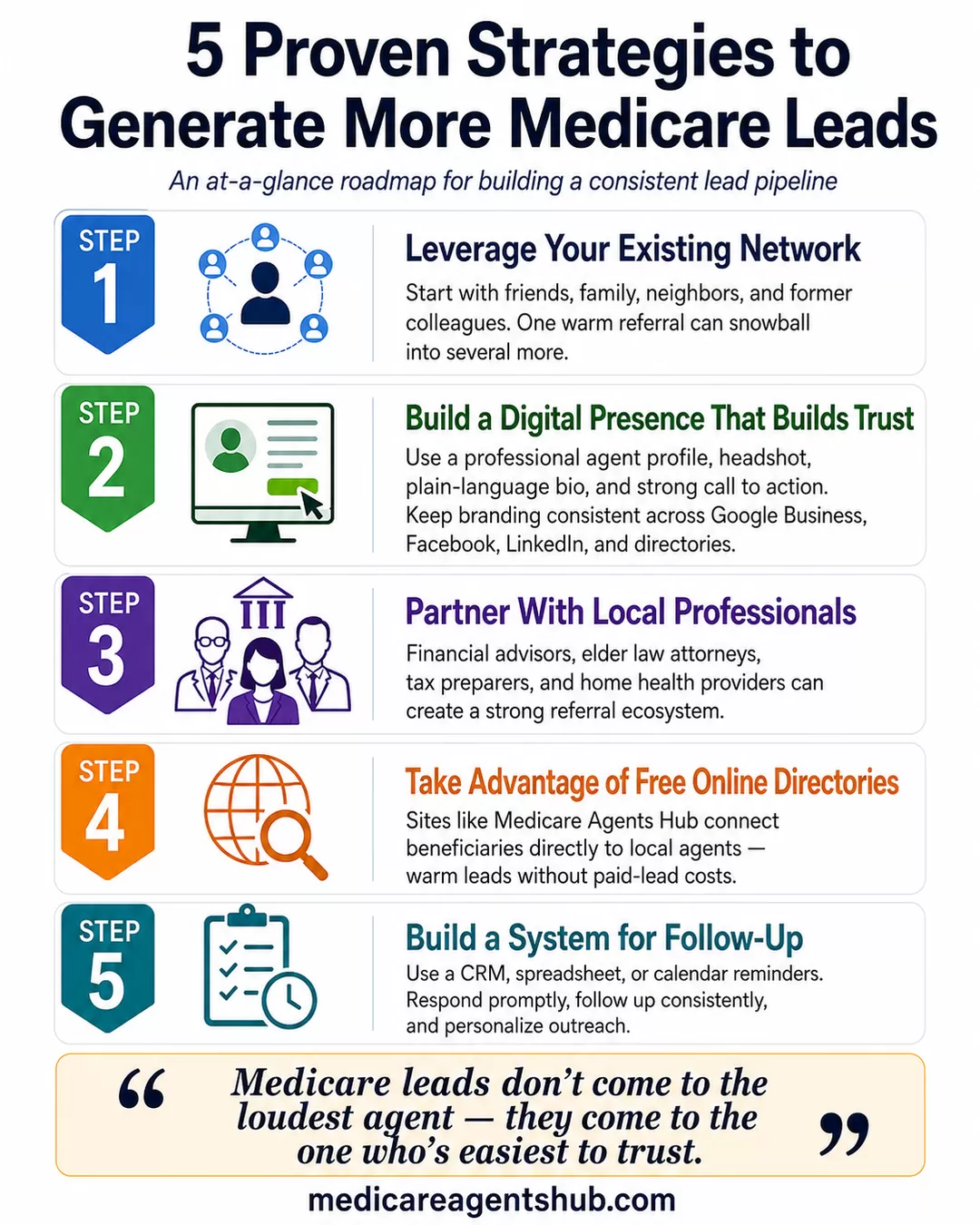
Leverage Your Existing Network
Your current network, such as friends, family, neighbors, former colleagues, is often overlooked, but it can be one of your most effective lead sources.
These people may not need Medicare advice themselves, but they likely know someone who does. Position yourself as the go-to Medicare expert in their circle. Be clear about who you help and how. One warm referral can easily snowball into several more.
Give them one sentence they can repeat without butchering it. "I help people turning 65 sort out their Medicare options, and it doesn't cost them anything." Vague asks get vague results.
Even if you've already tapped your network, stay top of mind with occasional check-ins or educational updates. Familiarity builds trust, and trust drives referrals.
Build a Digital Presence That Builds Trust
Your online presence is often your first impression, whether a lead comes from a referral, a Google search, or a social post. Make sure that impression builds confidence, not confusion.
Creating a professional agent profile landing page on Medicare Agents Hub is a great start. A strong profile should include:
- A professional headshot
- A brief bio in plain language (who you help and how)
- Up-to-date contact info in your listing
- A clear call to action
Once your profile is live, ensure your contact info and branding are consistent across platforms like Google Business, Facebook, LinkedIn, and any directories you're listed on. This consistency reinforces your credibility and helps people find you easily.
Social media is an extension of your online presence, not a replacement. Choose one platform (Facebook is often ideal for Medicare) and use it to share helpful, relevant content. Tips, FAQs, enrollment reminders, and real-life examples of how you help clients all demonstrate your expertise without feeling like a sales pitch.
You don't need to post every day or go viral. Just show up regularly with value and authenticity. When someone needs Medicare help, they’ll remember the agent who's been showing up with clarity and care.
Partner with Local Professionals
Forming relationships with professionals who serve the same demographic can create a powerful referral ecosystem. Great starting points include:
- Financial advisors
- Elder law attorneys
- Tax preparers (CPAs)
- Home health providers
Offer to be a trusted Medicare resource for their clients. You're not pitching them, you're helping them provide more value. Strong professional partnerships often yield steady, high-quality referrals over time.
Take Advantage of Free Online Directories
You don't have to rely on paid leads to grow your book. Free directories are a smart, low-effort way to increase visibility with people actively searching for Medicare help.
Sites like Medicare Agents Hub connect beneficiaries directly with local agents. A complete profile with a headshot, short description, and clear contact info can get you in front of warm, motivated leads. All without the competition or high cost of traditional lead services.
Should You Use a Medicare Lead Generation Company?
Purchased leads are a different animal from a directory listing. A directory puts your profile in front of someone who is already looking for an agent, and they pick you. A Medicare lead generation company hands you a name and a number, often sold to three or four other agents the same afternoon, and the consent trail behind it is only as good as the vendor's intake form.
That doesn't make vendors useless. Outsourced lead generation can fill a calendar quickly, especially heading into the Annual Enrollment Period (AEP), and plenty of agents build real volume on it. It just has to be bought with your eyes open. Before you send anyone a deposit, get straight answers on:
- Who collected the lead, and how. A co-registration pop-up on an unrelated site and a dedicated Medicare landing page produce very different first phone calls.
- What the beneficiary actually agreed to. Ask to see the consent language word for word, not a summary of it. You're the one who has to answer for that contact.
- How many other agents got the same record. Shared leads are cheaper for a reason. Exclusive leads cost more up front and usually win on cost per closed sale.
- How old the lead is when it reaches you. A form fill from eleven days ago is a cold call wearing a costume.
- Whether the lead is local to you. National lead buys look efficient on a spreadsheet and fall apart on the phone. Local leads convert differently, and for county-level products like Medicare Advantage the difference is enormous.
- The replacement policy. Wrong numbers, under-65 prospects, and people who never filled out anything should not be on your invoice.
Then judge the vendor on cost per closed sale, not cost per lead. Track every source separately for a full quarter and some of them will quietly disappear from your budget. That accounting is also the only honest way to compare a paid vendor against free channels like referrals and directory listings, and what agents learned about lead quality last AEP is that the cheapest leads are rarely the cheapest clients.
How to Generate Medicare Supplement Leads
If Medicare Supplement is a core line of your business, tune each of the strategies above around that specific audience. Call out Med Supp expertise directly in your profile bio, share content that explains how Medigap plans work alongside Original Medicare, and ask your referral partners to send Medigap shoppers your way.
Timing matters more with Med Supp than almost anywhere else, because three specific moments create most of the leads: someone turning 65 inside their six-month Medigap open enrollment window, someone who just opened a rate increase letter from their current carrier, and someone with guaranteed issue rights after a Medicare Advantage plan exit or a trial-right switch. Build your content calendar and your outreach around those three triggers instead of a generic "Medigap quotes" pitch, and you stop competing on price with every other agent in the county.
Beneficiaries shopping for Medicare Supplement plans tend to be researchers. They compare, they ask questions, and they value agents who can explain plan letter differences clearly. Being the agent who publishes that kind of plain-language content is one of the more reliable ways to earn Med Supp leads over time.
Keep one rule front and center while you market to them: Medigap only works alongside Original Medicare. Nobody can hold a Medicare Advantage plan and a Medigap policy at the same time. So a Med Supp pitch to a current MA enrollee is really a conversation about dropping the MA plan first, medical underwriting and all. Agents who skip that step end up quoting premiums the client can't actually buy.
How to Generate Medicare Advantage Leads
Medicare Advantage shoppers don't behave like Med Supp shoppers, so the lead sources that work for them look different too. MA interest is seasonal and event-driven. It spikes when something changes on the plan the person already has.
That gives you a predictable calendar. Annual Notice of Change (ANOC) letters landing in September, a carrier pulling out of a county, a hospital system dropping out of a network mid-year, a doctor who's suddenly out of network — each of those is a moment when thousands of beneficiaries start searching for someone to explain what just happened. The agent who already has content answering that question and a visible local profile is the one they find.
MA is also the most local product you sell. Networks, extra benefits, and plan availability change county by county, so say which counties you actually serve in your Medicare Advantage profile and content. Generic statewide language loses to a competitor who names the town. The ongoing growth of Medicare Advantage enrollment means the volume is there; being findable at the county level is what converts it.
One tradeoff to plan for: MA is where the CMS marketing rules bite hardest. Scope of Appointment, disclaimers, and filing requirements all apply to MA and Part D in ways they don't to standalone Medigap, so budget time for the compliance side of any MA campaign before it goes live.
Build a System for Follow-Up
Even the best leads are worthless without proper follow-up. Missed calls, delayed responses, and forgotten inquiries are the fastest way to lose business.
Have a clear system in place. Whether it's a CRM, spreadsheet, or calendar reminders that track and manage your leads. Respond promptly, follow up consistently, and personalize your outreach when possible.
The agents who win are often just the ones who show up on time and stay in touch.
Stay Compliant While You Market
Whatever mix of strategies you use, make sure your outreach follows the current CMS Medicare Communications and Marketing Guidelines. Rules around permission to contact, disclaimers, and permitted marketing activities can shift year to year, so check the latest guidance before rolling out any new campaign.
A few of those rules land directly on the strategies above:
- Referrals still need permission to contact. A CPA or a neighbor handing you a phone number isn't consent. The beneficiary has to agree to be contacted, and you should be able to show how and when they did.
- Purchased leads bring federal calling rules with them. The Telephone Consumer Protection Act (TCPA) and the National Do Not Call Registry sit on top of the CMS rules. Calling a registered number without permission, or using an autodialer, prerecorded message, or text campaign without the prospect's prior express written consent, can run $500 to $1,500 per violation, and that exposure lands on the agent who dialed, not just the vendor who sold the lead. Scrub purchased lists against the National Do Not Call Registry and your own internal do-not-call list before anyone picks up the phone.
- Social posts count as marketing. Once a post mentions plan benefits, premiums, or cost sharing, it's marketing material and the filing and disclaimer rules apply. General education about how Medicare works usually doesn't cross that line.
- Your profile and bio are communications too. What disclaimer language you need depends on whether you're naming specific plans or carriers. If you list the carriers you're appointed with, check what has to go alongside it.
- Handle the Scope of Appointment before the meeting. For Medicare Advantage and Part D sales appointments, CMS wants the SOA documented before the personal marketing appointment, and in writing when you meet in person. The old 48-hour waiting period is gone for 2027 marketing, which began October 1, 2026, but phone and walk-in appointments still need an SOA. A directory lead that turns into a scheduled sales call is no different. Standalone Medigap sales sit outside the CMS marketing rules, so SOA isn't a federal requirement there, though plenty of carriers want it documented anyway.
Carriers stack their own rules on top of CMS, and theirs are often tighter. A handful of states run tighter still, especially on how you advertise and how Medigap gets marketed, so check your state DOI and your FMO's compliance guidance before a new campaign goes live. When the rules disagree, follow the strictest one.
Closing Remarks
Lead generation isn't a one-time campaign, it's an ongoing strategy. Whether you're looking to expand, improve your systems, or simply stay relevant in a competitive space, the key is consistency.
Focus on visibility, value, and trust. Keep showing up, keep building relationships, and keep making it easy for people to find you and to refer you.
If your profile isn't live yet, get listed on Medicare Agents Hub for free and put your name in front of the people already searching in your county. The directory sent agents 73,000 leads in 12 months.
Medicare leads don't just come to the loudest agent. They come to the one who's easiest to trust.