How to Advertise Yourself as a Medicare Agent

-
Last Updated October 1, 2026
You've passed your certifications, you've signed your contracts, and you're ready to help clients navigate their Medicare options. Now what?
You need to be seen.
Advertising yourself as a Medicare agent isn't about throwing money at ads and hoping for the best. It's about building trust, showing up where your audience is, and creating a presence that keeps you top of mind. Whether you're brand new or looking to sharpen your approach, these Medicare advertising ideas and marketing strategies will help you attract the right clients without wasting time or money.
Here's how to do it...
And don't forget your own disclaimers. If you don't represent every plan in your service area, CMS requires a disclaimer on your marketing materials telling people they can contact Medicare.gov, 1-800-MEDICARE, or their local State Health Insurance Assistance Program (SHIP) for the full list of their options. The exact wording changes from year to year, so get the current version from your FMO and put it everywhere — flyers, website, directory bio, social posts, not just your phone scripts.
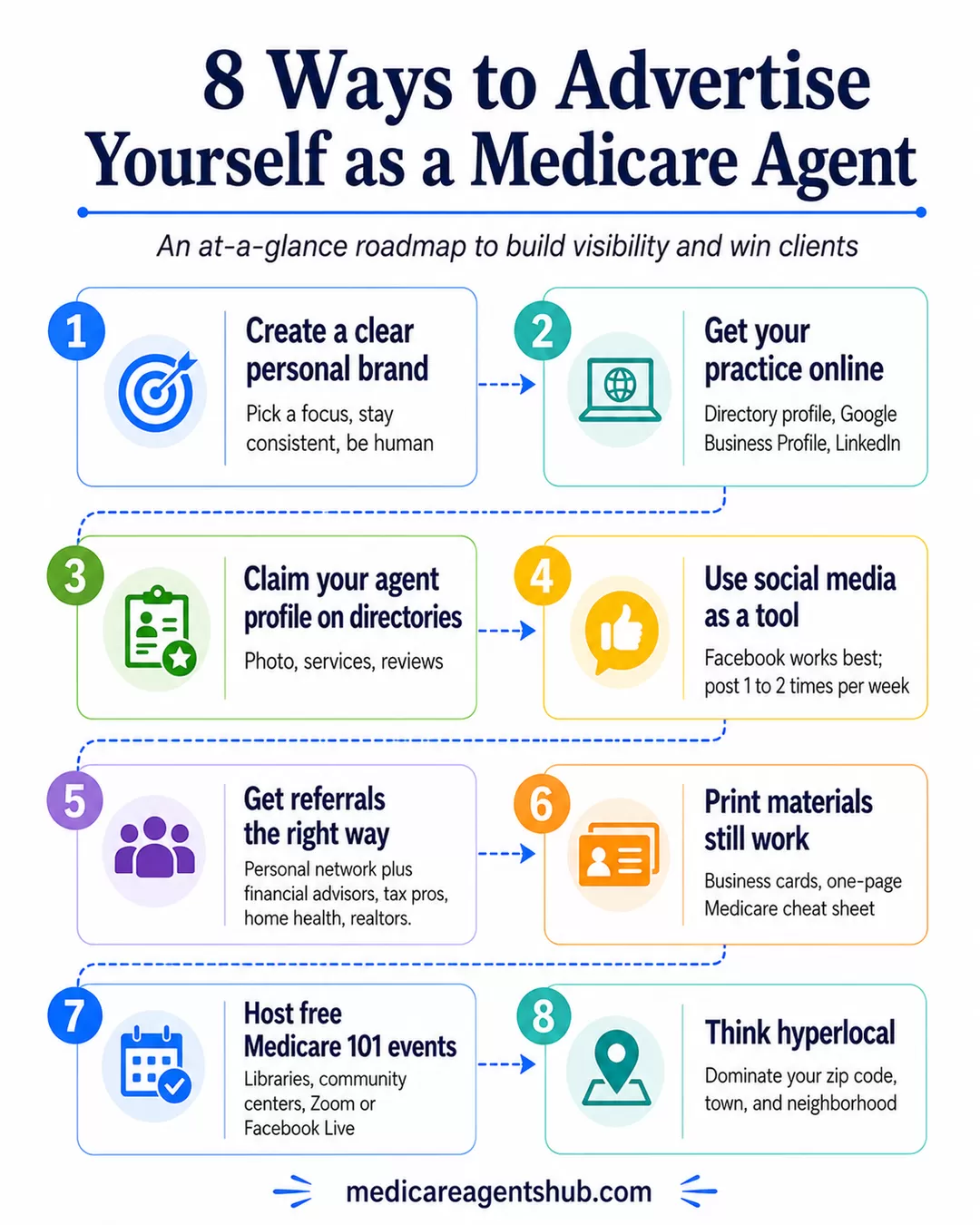
1. Create a Clear Personal Brand as an Agent
Before you advertise anywhere, know what you're advertising.
Your brand is what sets you apart from other agents. It's how people will remember you.
Pick a focus: Are you the local expert? The "plain English" explainer? The patient listener who walks clients through every detail? Lean into that.
Keep it consistent: Use the same name, photo, tagline, and tone across all your marketing. Whether it's your website, business cards, or Facebook page, consistency builds credibility.
Be human: People work with people they trust. Skip the corporate jargon and be yourself. A genuine, approachable presence will always outperform a polished but impersonal one.
2. Build Your Medicare Broker Online Presence
If you're not online, you're invisible. Clients, especially adults helping their parents, will often search your name before they ever pick up the phone. That means your digital presence matters, even if you're not running a full-blown website.
Start with what's already available to you. Agent directories like Medicare Agents Hub offer free profile pages that act as mini-websites. These landing pages can include your photo, bio, services, contact info, and more. They're simple, trusted, and easy to share. Best of all, they help you show up in Google when people search for Medicare help in your area.
You can also use your social media profiles, Google Business Profile, or even a well-set-up LinkedIn page to build visibility. The key is to control what people see when they look you up, and to make it easy for them to know who you are, what you do, and how to reach you.
If you do build an agency website, these are the pieces people actually look for:
- Your name, a current photo, and the states you're licensed in
- A plain-language list of what you help with (Medicare Advantage, Supplement, Part D)
- A phone number and a way to book a call, visible without scrolling
- Your CMS plan-availability disclaimer and your license number
- A few client reviews or testimonials
- Your city and service area written into the page text, not just dropped on a map
Most agents don't need more than that. A site that answers "who are you, what do you do, how do I reach you" beats a slick one that buries the phone number.
Why online presence matters for Medicare brokers:
-
People search before they call. If they can't find you online, they may assume you're not legit or not active.
-
Online visibility builds credibility. A professional-looking profile reassures clients that you're trustworthy and experienced.
-
It supports word-of-mouth. Even if someone refers you, most people will still Google your name to check you out.
-
You'll show up in local search results. Tools like Medicare Agents Hub help position you in front of people actively looking for help.
-
You stay top of mind. Regular updates or content (like posts or directory updates) help keep your name familiar when it's time to enroll.
Focus on being findable and credible online. You don't need to be everywhere, but you do need to be somewhere your audience is already looking.
3. Claim Your Agent Profile on Directories
Online directories are still very much alive and valuable, especially in the Medicare space. People often search these platforms when they're looking for a local agent they can trust.
Make sure you claim and complete your profile on directories like Medicare Agents Hub. Take the time to fill in all the details. Use a recent, professional photo and write a short, clear summary of the services you offer. Let people know where you work and how to reach you.
This small step goes a long way toward helping you show up in search results. It also gives you another place online where potential clients can get to know you. And don't overlook the power of client feedback — collecting reviews on your directory profiles adds a layer of social proof that can tip the scales in your favor.
4. Use Social Media as a Tool
Social media can be a powerful tool if you use it the right way. Pick one platform to start; Facebook is usually best for Medicare agents, since most of your audience is already there.
Post content like:
- Medicare reminders and tips
- Common client questions and answers
- Testimonials or stories (with permission)
- Short videos explaining confusing topics
You don't have to post daily. Once or twice a week with helpful, honest content is enough to build credibility. The goal isn't to go viral — it's to stay visible and build trust over time.
5. Get Referrals the Right Way
Referrals don't happen automatically — you have to put the word out.
Start with your personal network. Let friends, family, and former coworkers know that you're now working in Medicare. Be specific about who you help and how. The more clearly you explain your role, the easier it is for people to refer someone your way.
You should also consider building relationships with professionals who serve a similar client base. Financial advisors, tax preparers, home health workers, and even real estate agents working with downsizing seniors can all become great referral partners. Introduce yourself, explain how you can help their clients, and focus on building genuine connections, not just leads.
Local agent associations are worth your time too, including your NABIP chapter if there's one nearby. The room is mostly other agents, which sounds useless until you realize that's where you hear which carriers are actually paying, which FMOs people are leaving, and who's retiring and looking to hand off a book.
The wider Medicare agent community lives online too. Facebook groups, Reddit threads, and FMO Slack channels are where agents trade notes on carriers, commissions, and what's actually happening during AEP. Lurk for a few weeks before you post. That overlap turns into referrals more often than you'd expect, because agents who don't write a certain carrier, or who are pulling out of a county, hand those clients to someone they know.
One caveat: never pay for Medicare referrals without running the arrangement past your FMO or compliance attorney first. CMS anti-inducement rules can turn a casual finder's fee into a serious problem.
6. Print Marketing Ideas That Still Work
Even in a digital world, print marketing has its place. Having business cards and simple printed materials gives people something tangible to remember you by.
A clean, well-designed business card with your name, phone number, and a short tagline can go a long way. Flyers or brochures that explain what you do in plain language are also helpful, especially for older clients who may prefer paper over screens. A one-page Medicare cheat sheet can make a great handout — think of it as a lead magnet in physical form.
Distribute these materials in places where your target audience spends time, like community centers, senior living facilities, or doctors' offices (always ask first). A well-placed flyer can be surprisingly effective.
7. Host Free Medicare 101 Events
Education builds trust. Hosting a free event, even for a small group, is a great way to position yourself as a helpful, non-pushy expert.
You can offer in-person events at libraries, community centers, or churches, or virtual sessions via Zoom or Facebook Live.
Keep it simple: Cover the basics of Medicare, leave time for Q&A, and make it easy for people to book a follow-up with you. Even if only a handful of people show up, those attendees are highly engaged prospects who already see you as a trusted resource.
One CMS reminder: keep educational events truly educational. Don't collect enrollment forms, Scope of Appointment forms, or plan-specific information during the event itself — those belong in a separate follow-up meeting.
8. Think Hyperlocal
One of the most effective (and underused) Medicare agent marketing strategies is hyperlocal advertising. Instead of trying to reach everyone, focus on dominating your immediate area — your zip code, your neighborhood, your town.
When seniors or their families search for "Medicare agent near me" or "Medicare help in [city]," you want to be the name that shows up. This means optimizing your online profiles for your location, mentioning your service area in your bio and posts, and being active in the groups your neighbors already use: Nextdoor, the town Facebook group, the senior center's mailing list, your local Rotary or Elks lodge.
Hyperlocal beats broad every time when it comes to Medicare. Your clients want someone nearby who understands their local healthcare landscape.
What About Paid Advertising?
Nothing above costs much beyond your time. Paid ads are a different animal, and most new agents shouldn't touch them in year 1.
Medicare keywords are some of the most expensive in insurance, and you're bidding against national call centers with budgets you can't match. Burning $2,000 on clicks before you have a finished profile, a referral partner, or a single review is a fast way to talk yourself out of marketing entirely.
When you're ready, start small and local: geo-targeted Facebook or Google ads inside a 15-mile radius, pointed at a page you control. Know that CMS requires most Medicare Advantage and Part D marketing pieces to be reviewed by the carrier or filed with CMS before they run. Your FMO usually handles the paperwork, but it does mean "launch it tonight" isn't on the table. If you'd rather skip the ad auction, there are ways to get high-intent Medicare leads online without paying per click.
Agencies that specialize in Medicare and health insurance advertising do exist, and a few are genuinely good. Ask any of them how they handle compliance review before you sign. A vendor who's never heard of an HPMS filing will cost you more than they bring in.
Your First 30 Days: A Simple Action Plan
8 tactics is a lot to stare at when you're starting from zero. Here's one way to sequence them so you're not trying to do everything in week 1.
| Week | What to do |
|---|---|
| Week 1 | Pick your focus and lock in your name, photo, and tagline (section 1). Claim and fully complete your free directory profile (section 3). |
| Week 2 | Set up one social profile and post twice (section 4). Order business cards and print a one-page Medicare cheat sheet (section 6). |
| Week 3 | Tell your personal network what you do and who you help. Reach out to 1 referral partner — a tax preparer or financial advisor is an easy first call (section 5). |
| Week 4 | Claim your Google Business Profile and add your service area (sections 2 and 8). Book a room and a date for your first Medicare 101 event (section 7). |
Nothing on that list costs much beyond your time. Work it in order and by day 30 you have a brand, a findable profile, a referral conversation started, and an event on the calendar.
Final Thoughts: Which Medicare Advertising Ideas to Start With
Advertising yourself as a Medicare agent doesn't have to be complicated, but it does have to be intentional. Focus on clarity, consistency, and showing up where your audience is already looking.
Start with the basics: your brand, your online presence, and your local community. Then build from there.
You don't need to do everything at once, but you do need to start.