What the Growth of Medicare Advantage Means for Independent Agents and Brokers

-
Last Updated October 15, 2026
Medicare Advantage (MA) enrollment continues to climb year over year, driven by political momentum, carrier expansion, and growing consumer demand for bundled benefits. For independent agents and brokers, that growth creates both opportunity and responsibility.
As of 2026, more than half (55%) of eligible Medicare beneficiaries are enrolled in Medicare Advantage plans, a milestone that cements the ongoing shift away from Original Medicare. The growth rate has cooled, though. MA added about 1.1 million enrollees between 2025 and 2026, roughly 3%, continuing a slowdown that started the year before. The pool is still expanding, just not as fast as the number of agents chasing it. With more carriers entering the market and plan options becoming increasingly competitive, independent brokers are positioned to play a central role in helping beneficiaries navigate a crowded and confusing market.
What does this shift actually mean for your business? Let's break it down.
Key Takeaways for Agents in 2026
- MA is now the majority product at 55% penetration. Prospects walk in already asking about it.
- Net growth has slowed to about 3% a year, and most of it is landing in special needs plans.
- Competition among agents is rising alongside enrollment. Differentiation matters more each year.
- CMS marketing and compliance scrutiny is stricter than ever. Documentation is not optional.
- Local knowledge, provider networks, and formulary fluency are the real edge.
- Trust-based education beats hard selling for retention and referrals.
Medicare Agent vs. Medicare Broker: Does the Label Matter?
Agents and brokers use these titles interchangeably, and in the Medicare world the practical difference is small. Both hold a state health insurance license, both complete annual certification, and both get paid by the carrier rather than the client.
The distinction people reach for is captive versus independent. A captive agent is contracted with one carrier and sells that carrier's plans. An independent agent or broker is appointed with several carriers and can compare plans across them. That second model is what most of this article is about, and it is the one beneficiaries are usually looking for when they search for a "Medicare broker."
What matters more than the label is being clear about scope. No independent broker represents every plan in a service area, and beneficiaries who assume otherwise end up disappointed. Saying plainly which carriers you are appointed with does more for trust than any title on a business card.
Where the Opportunity Is for Medicare Advantage Agents
The most obvious impact of Medicare Advantage growth is the expanding market. More seniors are considering MA as their default option, especially as they become aware of the additional benefits these plans offer: dental, vision, hearing, and prescription drug coverage, often at little or no additional premium.
A caveat worth naming with clients: premiums and out-of-pocket costs vary by region and plan. Some MA plans have $0 premiums, but beneficiaries still pay their Part B premium and may face copays, coinsurance, and network restrictions. Setting that expectation up front prevents churn later.
This expansion means:
- More prospects entering the Medicare funnel each year
- Higher demand for licensed agents who understand MA plans
- Greater earning potential through commissions and renewals
Partnership Opportunities With MA Carriers
Carriers are also competing more aggressively for member acquisition, and they rely heavily on independent brokers to reach seniors at the local level. That reliance shows up in richer commission structures, dedicated broker portals, and stronger co-op marketing support for agents who consistently produce. Independent agents who cultivate direct relationships with a few carrier reps, rather than staying at arm's length through an FMO, tend to hear about plan changes and bonus programs first.
Many brokers find that they no longer need to "sell" the idea of Medicare Advantage. It's already in demand. Instead, the job is now to guide people through the complexity of choosing the right plan for their situation.
One honest note on the opportunity: as MA penetration grows, so does competition among agents and the volume of compliance documentation required to stay clean. New agents sometimes hear "the market is booming" and underestimate how crowded local territories have become. The opportunity is real, but it rewards agents who show up prepared.
What Medicare Advantage Agents Actually Get Paid
CMS caps what carriers can pay for Medicare Advantage enrollments, which is why commission figures look similar from one carrier to the next. For 2026, the maximum sits at roughly $611 for a new MA enrollment and about $306 per year in renewals for as long as the client stays on the plan. Part D is far smaller, around $100 initial and $50 renewal. The full breakdown, including Medigap and the like-to-like switch rules, is in our guide to how Medicare agent commissions work.
That structure explains a question beneficiaries ask out loud and agents hear constantly: why do brokers seem to push Medicare Advantage plans? MA pays more per enrollment than a Part D plan, renewals compound, and the enrollment process is faster. Those incentives are real, and pretending otherwise damages credibility. The honest answer is that a renewal only pays if the client stays, so an agent who puts someone on a plan that does not fit loses the income anyway. We dug into that tension in the commission conversation.
The practical takeaway for a growing book: initial commissions fund this year, renewals fund the business. With net MA growth down to about 3%, retention is where the compounding actually happens.
Plan Selection Challenges for Independent Brokers
While the MA boom opens new doors, it also raises the stakes. As the number of plans increases, so does the need for deep product knowledge, compliance awareness, and strong client education.
Each plan comes with its own network rules, drug formularies, benefit designs, and cost-sharing structures. Seniors rely on brokers to make sense of it all. That puts pressure on agents to stay current, not only with plan features, but with regulatory updates from CMS as well.
The plan selection challenge is real. In many counties, a single beneficiary might have 40+ MA plans available. Sorting through formularies, provider networks, and star ratings for each one takes real work. Brokers who build a repeatable intake process, doctors first, drugs second, then plan match, cut that time dramatically and give clients a much better experience.

What's your go-to strategy for helping someone decide between Medicare Advantage and Medigap?
My go-to strategy is a simple needs assessment in plain English.I start by looking at three things: their doctors, their medications, and their budget.
If a Medigap premium is realistic, we walk through how that would work versus Medicare Advantage options in their area.
If a Medigap premium really isn’t affordable, then it’s not a true ‘either/or’ decision, so we focus on finding the Medicare Advantage plan that best fits their providers and drugs.
In those cases, I spend extra time educating them on the real-world costs, rules, and networks so they’re not surprised later by copays, referrals, or prior authorizations.
Independent agents who succeed in this environment are the ones who invest in ongoing training, stay ahead of carrier changes, and adopt tools that help them operate efficiently. Platforms like Medicare Agents Hub give agents built-in visibility and lead flow without the overhead of running paid ads or managing a marketing funnel from scratch.
Platforms Growing Medicare Agencies Actually Use
A common question from agents scaling up: what platforms are the fastest-growing Medicare agencies actually running on? There's no single answer, but a few categories keep showing up in every successful stack.
- Quoting and enrollment: Sunfire, Connecture, and MedicareCENTER are the common picks for side-by-side plan comparisons and e-applications during AEP.
- CRM: AgencyBloc and Radius are built for insurance workflows. HubSpot works well for agents who lean into content marketing.
- Compliance and call recording: CMS requires sales call recording for MA and PDP. Convoso and similar dialers handle recording, retention, and pull-back requirements.
- Directory and lead flow: Medicare Agents Hub is where beneficiaries search for local agents, which is why paying agents see steady inbound leads from consumer traffic.
None of these tools are magic on their own. The agencies growing fastest tend to pick a small stack and use it well, rather than chasing every new platform that pops up.
How to Become an Independent Medicare Agent or Broker
With MA at majority share, a steady stream of new agents is entering the market every year. The requirements to sell Medicare Advantage are not complicated, but they are strictly enforced and they repeat annually.
- Get a state health insurance license. Most states issue a combined life and health license. Pre-licensing coursework plus a state exam, and you will need a separate non-resident license for every additional state you want to write in.
- Complete AHIP certification. CMS requires annual Medicare training for anyone selling MA or Part D. AHIP is the version nearly every carrier accepts, and it resets each summer ahead of AEP.
- Pass carrier product certifications. Each carrier layers its own product and compliance modules on top of AHIP. Getting appointed with four carriers means four sets of certifications before you can write a single application.
- Get appointed, directly or through an upline. Carrier contracts come either straight from the carrier or through an FMO. Either way, you cannot quote a plan you are not appointed to sell.
- Carry errors and omissions coverage. Most carrier contracts require active E&O before they will release your writing number.
- Certify on SNPs. This is the step new agents skip, and it is the costliest omission in the current market. About 85% of 2026 net MA growth landed in special needs plans. Without D-SNP and C-SNP certification you are locked out of most of the growth described above.
Expect the licensing and certification cycle to take a few weeks before AEP, and expect to repeat the certification half of it every single year. The barrier to entry is low, which is precisely why differentiating yourself in a crowded market matters more than the license itself.
Where Field Marketing Organizations (FMOs) Fit
Most independent Medicare agents contract through a field marketing organization rather than going direct to every carrier. An FMO consolidates carrier appointments, handles certification tracking and commission processing, and typically supplies compliance training, call recording, and CMS-aligned marketing material.
What an FMO does not do is hand you a business. Lead programs vary wildly in quality, and "free leads" usually means shared leads. Agents who grow fastest treat the FMO as back-office infrastructure and own their own demand generation, whether that is a local directory presence, referrals, or content. Agencies building out multiple producers can read how agencies and FMOs scale a digital presence across a team.
Education and Transparency Matter More Than Ever
Seniors today are not passive consumers. They research, compare, and often come to the table with specific concerns or questions. A successful Medicare Advantage broker doesn't just point clients to the most popular plan. They ask the right questions, dig into doctors, prescriptions, and lifestyle needs, and guide clients toward a plan that fits.
Brokers who prioritize education and transparency build long-term trust. That trust translates into better retention, referrals, and renewals, all critical to building a lasting book of business.

How do you approach educating clients who are new to Medicare versus those who are considering switching plans?
When you are new to Medicare, I use a flow chart directly from one of the official Medicare books to help people understand their options.For clients who are in Medicare and thinking of changing plans, the first step is to review their current benefits and network. After that, I ask questions to find out if changing plans actually fixes the problem they have. Most of the time, their current plan is just fine, and there are details they haven't been reminded of in a while.
Leaving someone in a plan where the enrollment was done by someone else doesn't earn me any commission, but it's the right thing to do quite often.
Local Knowledge Is a Competitive Edge
Despite national carriers dominating the Medicare Advantage space, success for brokers often comes down to local knowledge. Knowing which providers are in-network, what plans are strongest in your area, and which hospitals offer the best care. All of this matters to seniors, and it is the one thing a national call center cannot fake. It is also why beneficiaries increasingly start with a local search rather than a toll-free number, whether through a directory like "Find a Local Agent," a referral, or their SHIP office.
Independent agents who are embedded in their communities can provide value that online quote tools or call centers simply can't replicate. Thinking hyperlocally, dominating your ZIP code rather than casting a wide net, is one of the most effective ways to convert the MA growth wave into real business.
Medicare Advantage Enrollment by the Numbers
Here's a quick look at how MA's market share has grown over the past decade:
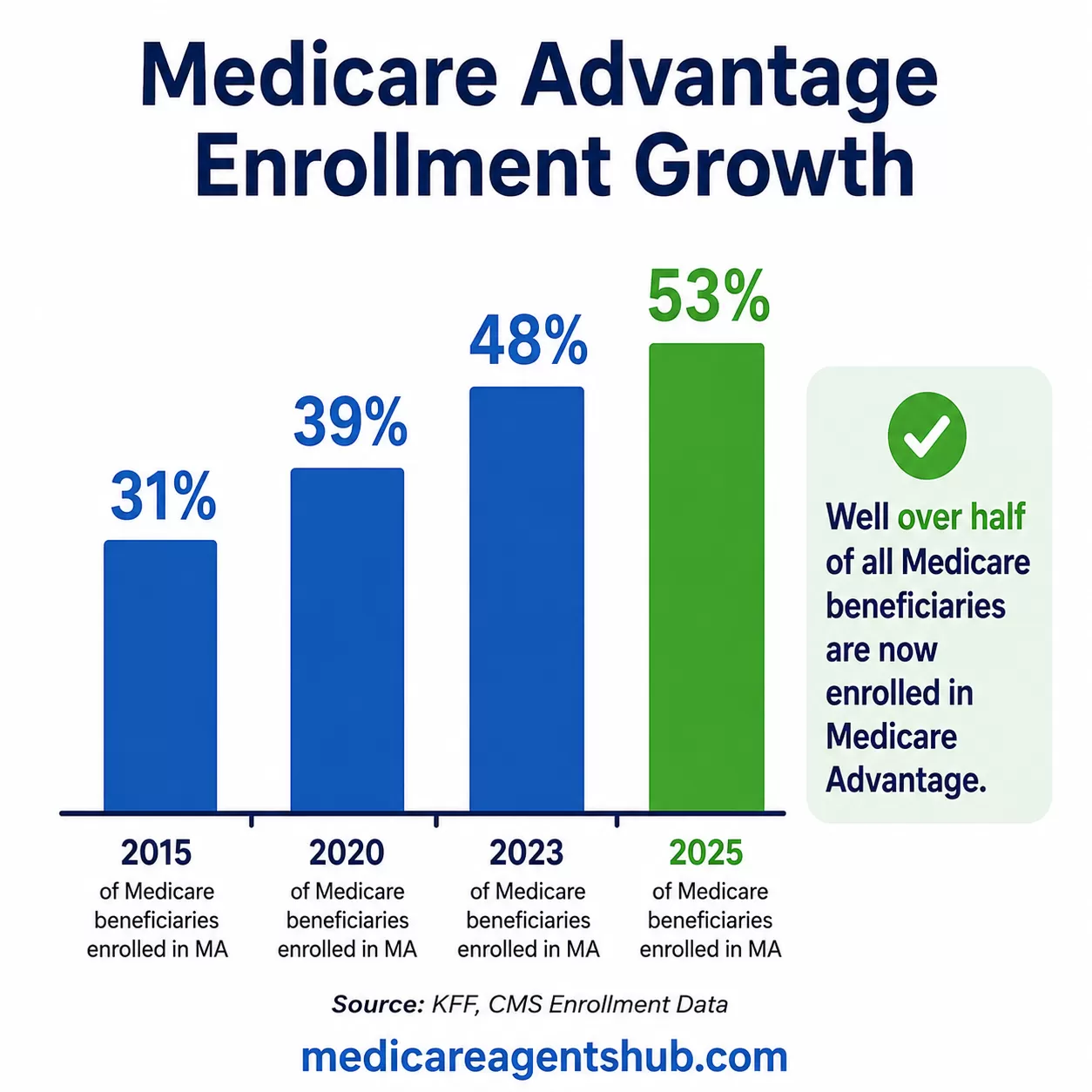
- 2015: 31% of eligible Medicare beneficiaries enrolled in MA
- 2020: 39% of eligible Medicare beneficiaries enrolled in MA
- 2023: 48% of eligible Medicare beneficiaries enrolled in MA
- 2026: 55% of eligible Medicare beneficiaries enrolled in MA, or 35.2 million of the 64.2 million people with Parts A and B
Two details behind the 2026 headline number matter more for your book than the percentage itself.
First, the pace. Net MA enrollment grew about 1.1 million (3%) from 2025 to 2026, down from 4% the year before. The easy tailwind of a fast-growing pool is thinning out.
Second, where that growth went. About 85% of the net increase landed in special needs plans (per March 2026 CMS enrollment data), up from 48% a year earlier, and chronic-condition SNPs grew 45% year over year. Nearly a quarter (23%) of all MA enrollees are now in an SNP. If you are not certified on D-SNPs and C-SNPs, you are sitting out most of the actual growth in the market.
Further out, CBO projects MA will reach 63% of all Medicare beneficiaries by 2034 and hold roughly flat through 2036.
Source: KFF, Medicare Advantage in 2026: Enrollment Update and Key Trends (updated July 2026, using March 2026 enrollment data), CMS Enrollment Data. Penetration figures are shares of beneficiaries enrolled in both Parts A and B.
MA's majority position means the role of brokers in this space will only increase. With net growth flattening, agents are increasingly competing against each other for the same prospects rather than riding a rising tide. Those who stay sharp during every enrollment period and use the off-season wisely are the ones who pull ahead.
Compliance and Marketing Rules: Staying on Track
With growth comes greater regulatory scrutiny. CMS continues to monitor how plans and agents market Medicare Advantage to ensure seniors are not misled. That means agents must stay within strict guidelines, especially during the Annual Enrollment Period (AEP). The governing rules live in CMS's Medicare Communications and Marketing Guidelines, which is worth reading at the source rather than relying on a carrier's summary slide.
One habit that keeps agents clean: be explicit, in writing and on the call, about which carriers and plans you actually represent. No independent agent offers every plan available in a service area, and saying so plainly up front costs nothing and heads off the most common complaint CMS sees.
For independent brokers, this makes it more important than ever to work with Field Marketing Organizations (FMOs) or platforms that provide compliance training, call recording tools, and CMS-aligned marketing resources. Agents who market ethically and lead with education rather than pressure will always have a longer runway than those cutting corners.

What's the most misleading Medicare Advantage ad you've seen, and how do you explain the reality to clients?
Commercials, letters, or postcards that mention $0 co-pays and grocery cards are the most common misleading type of advertising. They are usually limited to Dual Eligible Medicare and Medicaid enrollees. A traditional Medicare Advantage Plan with no associated government or other financial assistance will have co-pays for most chronic illnesses, hospital stays, specialized care, chemotherapy, etc.When I sign someone up for a plan, we review every page of the summary of benefits, which outlines ALL mandatory co-pays and network-related restrictions.
The Broker's Role Is Evolving
Independent agents are no longer just policy sellers. They are educators, compliance stewards, plan navigators, and advocates. Seniors rely on brokers to help them make informed decisions, and as MA becomes more dominant, that reliance will only deepen.
For brokers, this is a chance to build a resilient, high-impact business, one rooted in service, trust, and continuous learning. The agents who invest in building a strong personal brand alongside their product knowledge are the ones who will thrive as the market matures.
Adapting to Win
The growth of Medicare Advantage is rewriting the playbook for independent agents and brokers. It's creating more demand, more complexity, and more responsibility. For those willing to evolve and meet the moment, it's also creating more opportunity than ever before.
Where to Verify This Yourself
Enrollment numbers and marketing rules both move every year. These are the primary sources worth bookmarking rather than waiting for a secondhand recap:
- CMS MA/Part D contract and enrollment data — the raw monthly enrollment files, including SNP breakouts by contract and county.
- KFF, Medicare Advantage in 2026 — the annual analysis most of the figures in this article come from.
- CMS managed care marketing guidance — current-year communications and marketing requirements for agents and plans.
- NABIP — trade association continuing education, certifications, and legislative tracking for health and Medicare brokers.
If you're an independent Medicare broker looking to grow in this space, partnering with the right tools and support system (like those found at MedicareAgentsHub.com) can give you the edge you need in today's Medicare market.