2025 Medicare Open Enrollment Period: Key Dates and Changes to Know


-
Last Updated October 5, 2026
Written by Kevin Truebenbach
Medicare Agent Licensed in WI, AR, AZ & 26 other states
Note: This article covers the Medicare Open Enrollment Period for the 2025 plan year, which ran October 15 through December 7, 2024. The $2,000 Part D out-of-pocket cap described below is now in effect. For the current enrollment window and this year's plan changes, see our guide to the 2026-2027 Medicare Annual Enrollment Period.
Key Dates for the 2025 Medicare Open Enrollment Period
The Medicare Open Enrollment Period for 2025 ran from October 15, 2024, to December 7, 2024.
This is a critical time for Medicare beneficiaries to review their current coverage and make necessary adjustments for the upcoming year. Whether you are enrolled in Original Medicare, Medicare Advantage, or a Part D Prescription Drug Plan, this enrollment window is your opportunity to assess whether your current plan still meets your healthcare and budgetary needs.
Key Options During Open Enrollment
During the 2025 Medicare Open Enrollment Period, you can:
- Switch from Original Medicare (Part A and Part B) to a Medicare Advantage Plan (Part C) or vice versa.
- Change from one Medicare Advantage Plan to another (with or without drug coverage).
- Join, switch, or drop a Medicare Part D Prescription Drug Plan.
- Switch from one Medicare Part D Prescription Drug Plan to another to find better coverage for your prescriptions.
Important: Open Enrollment does not give you an automatic right to buy or switch a Medicare Supplement (Medigap) policy. Outside of your one-time Medigap Open Enrollment Period at 65 and a handful of state birthday and guaranteed-issue rules, insurers can require medical underwriting and turn you down for health reasons. Medicare.gov explains when you can buy Medigap. This is one of the most common and most expensive misunderstandings seniors run into during the fall enrollment window.
It's essential to carefully review your Annual Notice of Change (ANOC) document from your current plan provider. This document outlines changes to your coverage, including premiums, drug formularies, co-pays, and other important details for 2025.
The 2025 Part D Maximum Out-of-Pocket Cap
A major change that took effect in 2025 is the introduction of a $2,000 maximum out-of-pocket (MOOP) limit for Medicare Part D plans. This change is part of the Inflation Reduction Act, which aims to lower drug costs for Medicare beneficiaries. We made a short video to explain these changes, which you can view below.
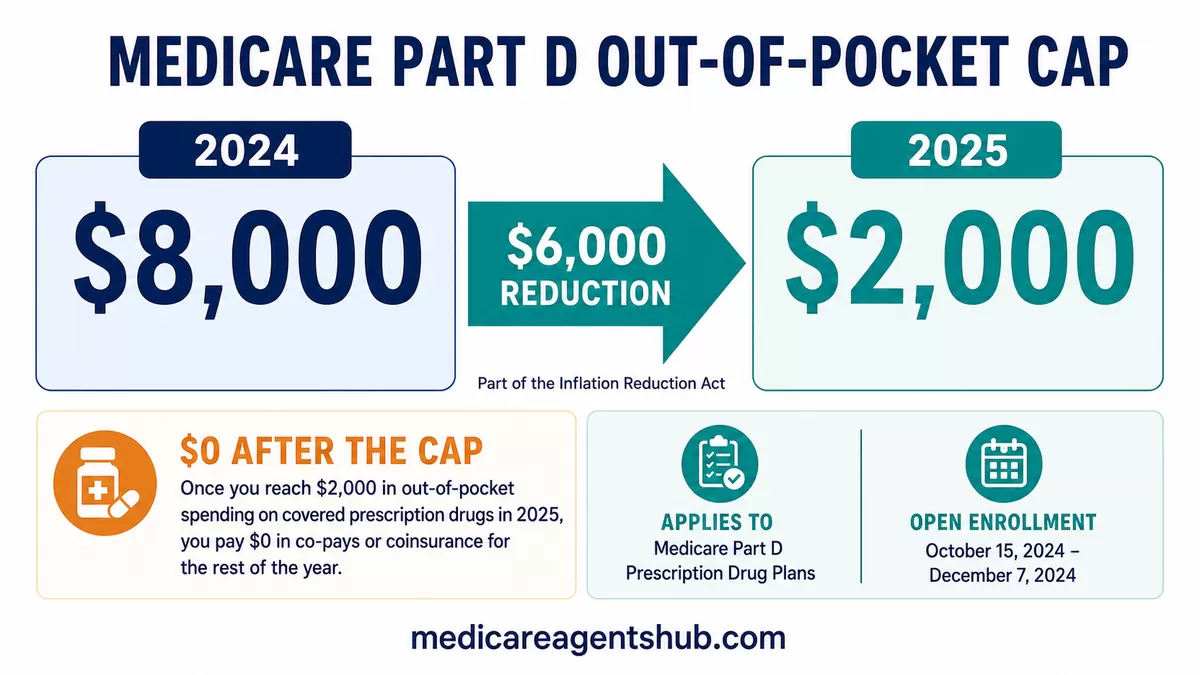
In 2024, the comparable figure was about $8,000 — but that number was the threshold for reaching the catastrophic coverage phase of Part D, not a true limit on what you paid. It counted total drug spending that included manufacturer discounts, so the amount that actually came out of a beneficiary's own pocket before hitting catastrophic coverage was a different, harder-to-predict number.
That distinction is what makes the 2025 change significant: $2,000 is a real annual ceiling on your own spending. Once you hit $2,000 in out-of-pocket spending for covered prescription drugs, you no longer pay co-pays or coinsurance for the remainder of the year (see the CMS overview of Medicare prescription drug affordability). This change provides significant financial relief to millions of Medicare beneficiaries who face high drug costs.
How will the new 2025 Medicare Part D out-of-pocket cap impact seniors and prescription drug costs?
A major change coming in 2025 is the introduction of a $2,000 maximum out-of-pocket (MOOP) limit for Medicare Part D plans. This change is part of the Inflation Reduction Act, which aims to lower drug costs for Medicare beneficiaries.Why the MOOP Is Important
The $2,000 out-of-pocket maximum is a significant improvement for those who rely on expensive medications. After reaching this threshold, all additional drug costs are fully covered by your Medicare Part D plan for the remainder of the year. This means that, for the first time, Medicare enrollees can predict and limit their annual prescription drug spending, offering peace of mind and financial predictability.
If you're someone who has been burdened by high medication costs in the past, this is a good time to review your current Medicare Part D plan and compare it with others to ensure you're getting the best value. Many plans vary in terms of premiums, drug formularies, and preferred pharmacy networks, so switching plans during Open Enrollment could save you money in both premiums and out-of-pocket costs.
What Medicare Agents Say
Why is the new $2,000 out-of-pocket maximum for drug costs important?
The $2,000 out-of-pocket maximum is a significant improvement for those who rely on expensive medications. After reaching this threshold, all additional drug costs will be fully covered by your Medicare Part D plan for the remainder of the year. This means that, for the first time, Medicare enrollees can predict and limit their annual prescription drug spending, offering peace of mind and financial predictability.How to Prepare for Medicare Open Enrollment
- Review Your Current Plan: Examine your ANOC to understand changes in premiums, deductibles, and prescription drug coverage for 2025. If your current plan is still a good fit, you don't need to take any action, as coverage will automatically be renewed.
- Compare Your Options: Use the Medicare Plan Finder tool on Medicare's official website to compare Medicare Advantage Plans and Part D Prescription Drug Plans in your area. Consider factors such as coverage for your specific medications, co-pays, premiums, and overall costs.
- Seek Local Guidance: Medicare can be complex, and plan options may change from year to year. Contact a licensed Medicare agent near you.
Final Thoughts
The 2025 Medicare Open Enrollment Period offered an excellent opportunity to review your healthcare and prescription drug coverage. With the introduction of the $2,000 out-of-pocket cap for Medicare Part D, many beneficiaries experienced significant savings on prescription drugs. Make sure to review all available options carefully and take advantage of this period to ensure your Medicare plan suits your medical needs and budget.
If you want unbiased help that isn't tied to any insurance company, every state runs a free State Health Insurance Assistance Program (SHIP) with trained counselors — find yours at shiphelp.org. If you'd rather work with a licensed professional who can compare plans with you, find a Medicare agent in your area or browse agents by state. Plan options, premiums, and drug formularies change every year, so it's worth a fresh look each fall.
Kevin Truebenbach of Transition Health Benefits is a Medicare Agent Licensed in AR, AZ, CO, DC, DE, FL, GA, IA, IL, IN, KS, KY, LA, MD, MI, MN, MO, MS, MT, NC, NE, NM, NV, OH, OK, PA, SC, SD, TN, TX, UT, VA, WI and WV. Licensed Medicare agent for over 20+ years and has 600+ positive Google Reviews.